How effective are religious and political billboards?

On a recent long drive, I noticed two additional types of billboards compared to the typical ones selling good and/or services: religious billboards and political billboards. These do not comprise a majority of billboards in my observations – or even a significant minority – but there were at least a few. Such efforts raise several questions for me:

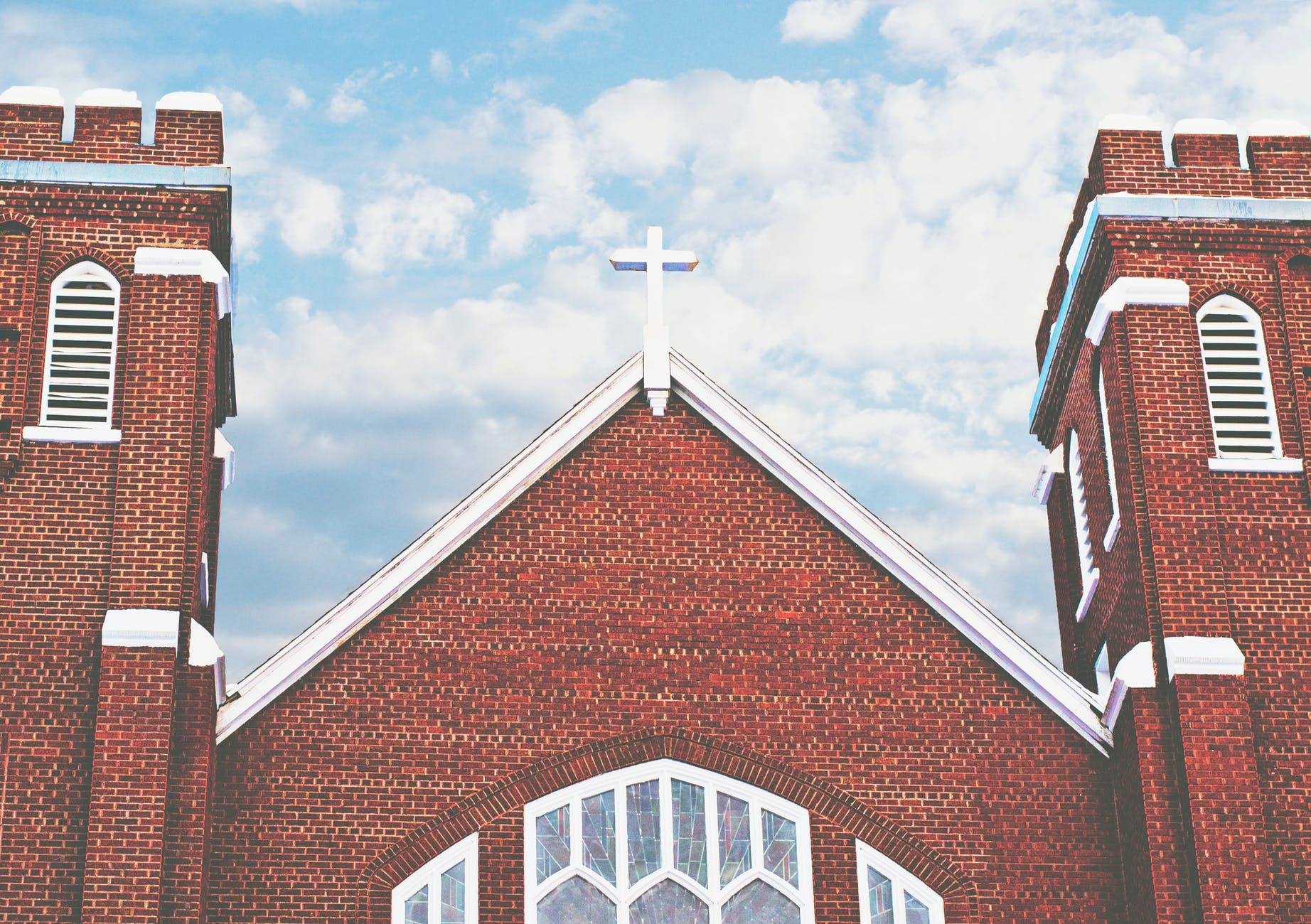
Photo by Taras Makarenko on Pexels.com
  1. Do religious and political billboards reach a large audience compared to other forms of media advertising? Compared to some other forms of advertising, the audience along the road might be more known: traffic counts are known and drivers who use a particular road or go through a particular location are a particular group. This may be more targeted advertising with a known number of daily viewers.
  2. Do people seeing religious or political billboards respond to them similarly or differently compared to commercial billboards? The medium of a billboard requires a fairly simple message as people go by them at a high speed. An image or two and limited text are possible. People are used to commercial appeals. So, does anything change if a Bible verse is on a sign? I know there is a religious marketplace in the United States but does a billboard encourage more religiosity? Or, does an image of a politician and a short statement catch people’s attention? Are these just like other billboards, or, because religion and politics can be personal and contentious, do they provoke more engagement or more turning away?
  3. My bigger question about billboards and all forms of advertising: how much does it influence behavior? I saw these billboards, they caused me to think a little and I am blogging about the concept here, and any other ongoing influence is hard to ascertain. In my lifetime, I have seen thousands of billboards, just as I have likely seen hundreds of thousands of advertisements in other forms. I know they influence people but it is hard to connect the dots between billboards and change.

I will keep looking for and reading more unusual billboards. At the least, they help break up a long drive.
The transmission of religious faith from parents to children and individual faith choices

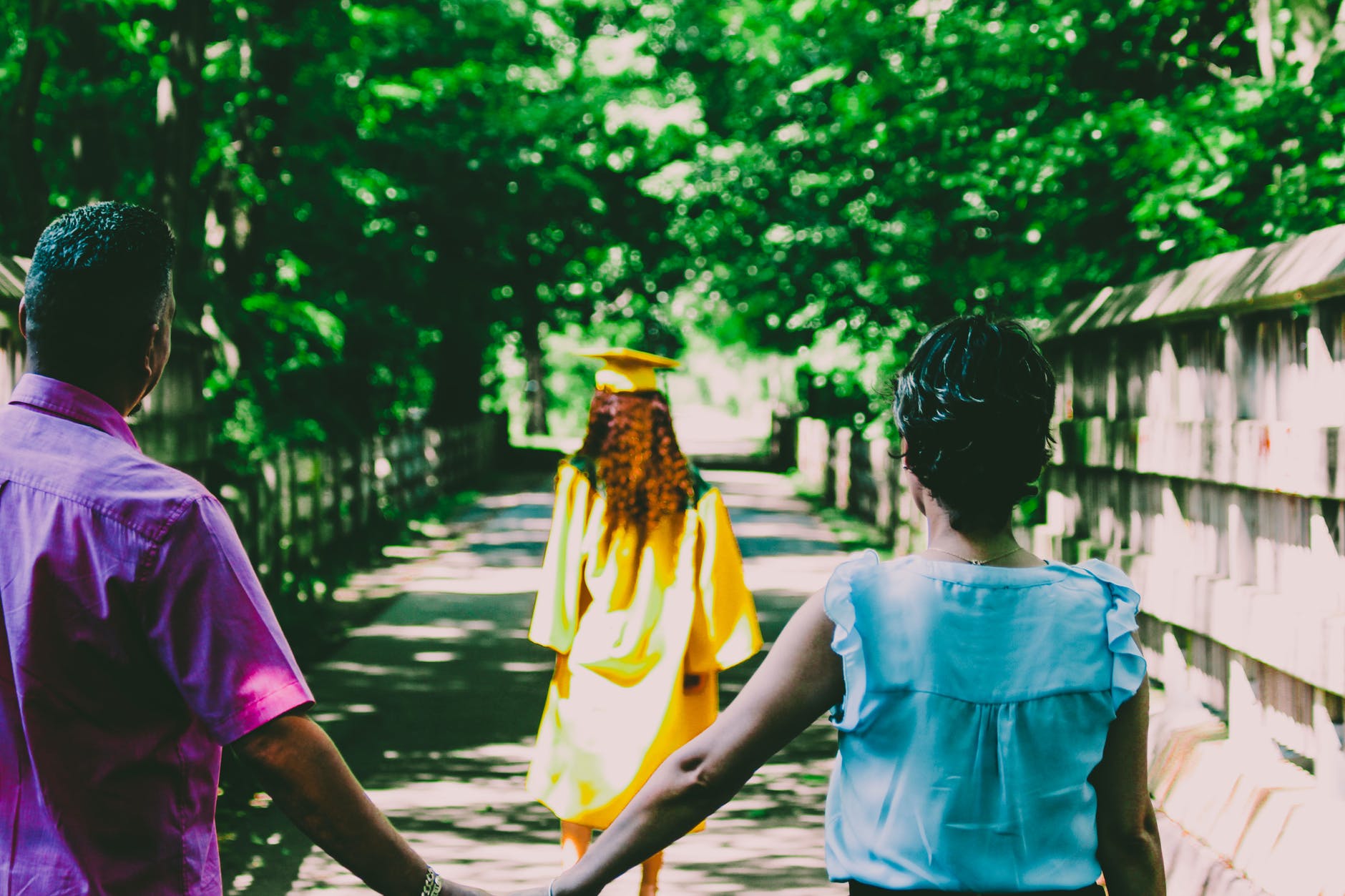
A sociology book published in 2021 emphasizes the role of parents in religiosity in the United States. From an excerpt:

Photo by Feedyourvision on Pexels.com

Parents define for their children the role that religious faith and practice ought to play in life, whether important or not, which most children roughly adopt. Parents set a “glass ceiling” of religious commitment above which their children rarely rise. Parental religious investment and involvement is in almost all cases the necessary and even sometimes sufficient condition for children’s religious investment and involvement.

This parental primacy in religious transmission is significant because, even though most parents do realize it when they think about it, their crucial role often runs in the background of their busy lives; it is not a conscious, daily, strategic matter. Furthermore, many children do not recognize the power that their parents have in shaping their religious lives but instead view themselves as autonomous information processors making independent, self-directing decisions. Widespread cultural scripts also consistently say that the influence of parents over their children recedes starting with the onset of puberty, while the influence of peers, music, and social media takes over.

Other common and influential cultural scripts operate to disempower parents by telling them that they are not qualified to care for their children in many ways, so they should turn their children over to experts. Further, the perceptions of at least some (frustrated) staff at religious congregations is that more than a few parents assume that others besides themselves (the staff) are responsible for forming their children religiously (in Sunday school, youth group, confirmation, catechism, etc.).

Yet all empirical data tell us that for intergenerational religious transmission today, the key agents are parents, not clergy or other religious professionals. The key location is the home, not religious congregations. And the key mechanisms of socialization are the formation of ordinary life practices and identities, not programs, preaching, or formal rites of passage.

There are multiple implications of these findings. I’ll briefly consider one hinted at above. In the United States, religion is often considered an individual matter. A believer is one who has consciously made a choice in their religious beliefs, behaviors, and belonging. In the American religious system, there is plenty of freedom to make such choices, whether one is identifying with a different religious tradition, putting together multiple pieces from different traditions, or citing no religiosity at all.

But, sociology as a discipline suggests no one is a complete free agent. This applies in all areas of life, including religion. We are pressured – a negative connotation often in the American context but social pressure can be positive or negative – by society and its parts.

If a religious tradition then emphasizes agency and authenticity regarding faith, it has the possibility of ignoring or downplaying social forces at work. Take evangelicals. According to the Bebbington Quadrilateral, one feature of this group is conversionism. This emphasis on a religious conversion often refers to an individual moment when a believer made a decision and/or had a definable conversion experience. This helps establish that this is a true and authentic faith, in comparison to being a cultural Christian or adopting the faith of one’s family or people.

The excerpt above does not suggest that the actions of a parent – or other social actors or institutions – always leads to a certain outcome but rather that how parents interact with religion increases or decreases the likelihood of religious faith of their kids. It is not deterministic but it is a demonstrable pattern where social forces – parents – influence individuals regarding religiosity.

If parents influence the faith of a teenager, is that teenager’s faith less real? Or, is this how human life works: we are influenced by social forces around us and we have the ability to exercise some agency?

The role of religious buildings in the decline in religiosity in the US during COVID-19

New data from Pew Research suggests religiosity declined during COVID-19:

Photo by Nikko Tan on Pexels.com

The percentage of Americans who identify as Christians now stands at 63%, down from 65% in 2019 and from 78% in 2007. Meanwhile, 29% of Americans now identify as having no religion, up from 26% in 2019 and 16% in 2007, when Pew began tracking religious identity.

Many places of worship closed during the pandemic—some voluntarily, others as a result of state and local social-distancing rules—and in-person church attendance is roughly 30% to 50% lower than it was before the pandemic, estimates Barna Group, a research firm that studies faith in the U.S. Millions of Americans moved to worshiping online, and questions linger about how many will come back in person.

A previous Pew survey, in January, found that a third of Americans said their faith had grown stronger during the pandemic—the highest share of any developed country. But overall, religious engagement trended downward at roughly the same rate as before the pandemic, according to the new Pew survey.

These findings are likely part of a longer trend away from religion that was already underway before COVID-19 hit. Sociologists and others have noted the rise of “religious nones,” particularly among younger Americans. Religion in the United States can often be individualistic and anchored less in religious traditions or denominations.

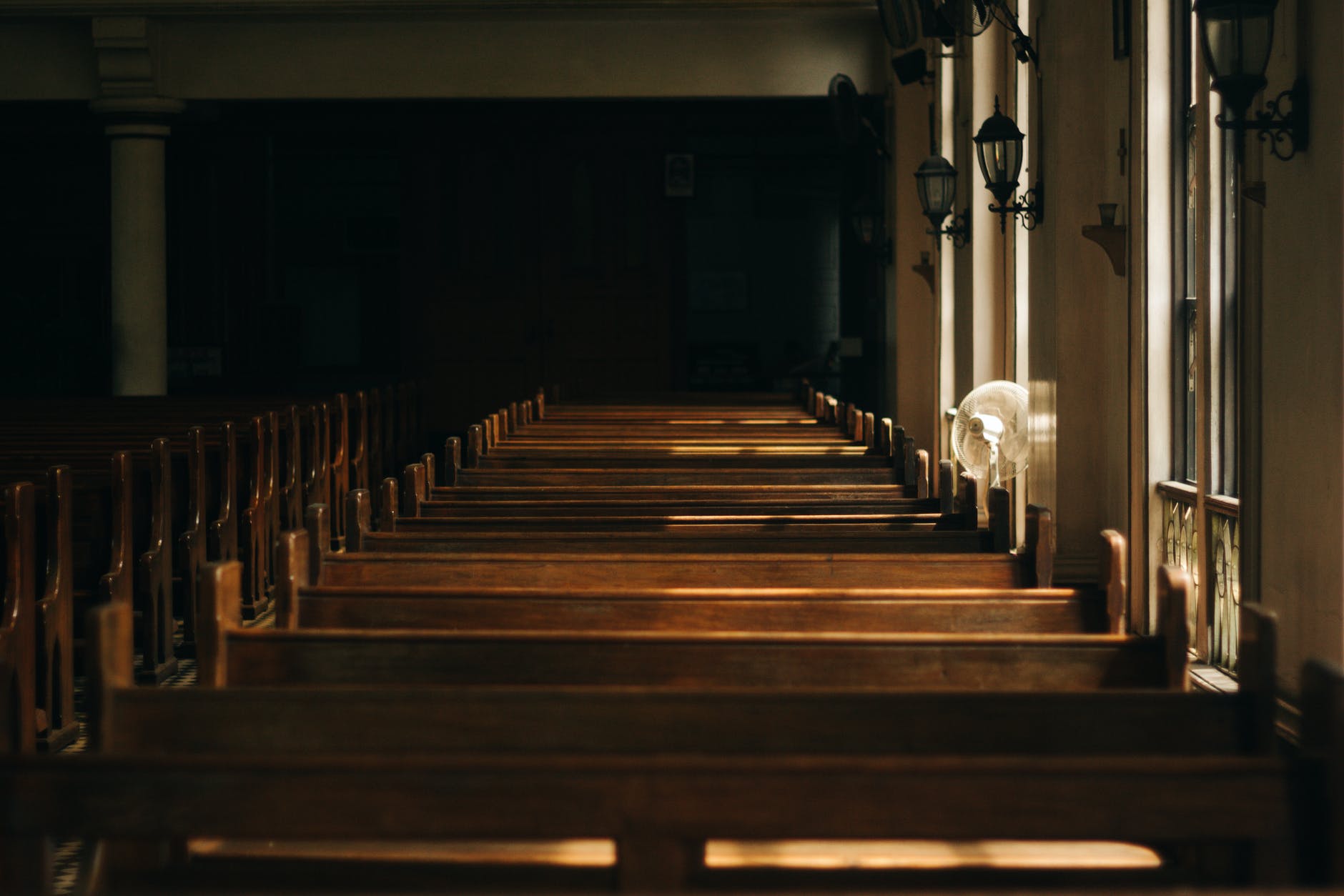
Yet, I wonder if COVID-19 presented a unique disruption to religiosity as it limited interaction with religious buildings. Sociologist Robert Brenneman and I discuss the impact of religious buildings on worship and community in Building Faith. We argue that the religious building and the ways that exterior and interior features are designed influence people who interact with them. The buildings do not just reflect religious values or doctrine; they help shape religious experiences.

When COVID-19 stopped people from being in buildings that influenced their faith, did this register as a loss and/or lead to a decline in religious engagement? With today’s technology and the ways that many congregations pivoted to online options, people can still engage with faith communities. Yet, that experience through Zoom or other video options is not the same as being in a physical structure that reinforces faith experiences. Even in congregations that tend to downplay the role of space, they still try to shape the religious building space in ways that encourages particular emotions and experiences.

Can religious faith in the United States survive as an enterprise free from the confines of a religious building? I have my doubts. While buildings themselves are unlikely to reverse the decline in religiosity in the last decade or so, they have a role in shaping communal and individual faith.

Suburban lawns and religious alternatives

With religious motivation, the suburban lawn can be transformed into an area of biodiversity:

Photo by Anna Shvets on Pexels.com

Mr. Jacobs is an ecologist and a Catholic who believes that humans can fight climate change and help repair the world right where they live. While a number of urban dwellers and suburbanites also sow native plants to that end, Mr. Jacobs says people need something more: To Reconnect with nature and experience the sort of spiritual transcendence he feels in a forest, or on a mountain, or amid the bounty of his own yard. It’s a feeling that, for him, is akin to feeling close to God…

Mr. Jacobs, for his part, looks around at all the pristine lawns (“the lawn is an obsession, like a cult,” he says) and sees ecological deserts that feed neither wildlife nor the human soul. “This is a poverty that most of us are not even aware of,” he said.

And he has started a movement to promote better ecology:

About 20 years ago, he began compiling quotes from the Bible, saints and popes that expound on the sanctity of Earth and its creatures, and posting them online. He considered naming the project after St. Francis of Assisi, the go-to saint for animals and the environment. But, not wanting to impose another European saint on American land, he instead named it after Kateri Tekakwitha, a 17th Century Algonquin-Mohawk woman who converted to Catholicism as a teenager and, in 2012, became the first Native American to be canonized…

Three years ago, Mr. Jacobs took a step further, teaming up with a fellow Catholic ecologist, Kathleen Hoenke, to launch the St. Kateri Habitats initiative, which encourages the creation of wildlife-friendly gardens that feature native plants and offer a place to reflect and meditate (they also teamed up to write a book, “Our Homes on Earth: A Catholic Faith and Ecology Field Guide for Children,” due out in 2023). They enlisted other ecology-minded Catholics, and have since added an Indigenous peoples program and two Indigenous women to their board.

What exactly is the connection between religious faith in America and the suburban lawn? Two hints above:

  1. First, Jacobs suggests the lawn is “like a cult.” Americans put a lot of effort into keeping the lawn looking good. The lawn signals status and is part of necessary upkeep for the sacred single-family suburban home. The lawn may provide insight into someone’s soul. The devotion to the lawn has its own practices, beliefs, and organizations.
  2. Religious traditions have something about how to approach the earth and land. Jacobs draws on Catholic theology, tradition, and practice to develop both his personal personal practices and an organization that now has members around the world. In a country where a majority of residents are Christians of one tradition or another, how many suburbanites draw on religion to help them interact with their yard and nearby nature?

As more people reconsider whether to have a lawn or consider modifying their lawn, bringing religion into the conversation could help clarify what the lawn is all about. Is the lawn itself worthy of religious devotion or does it help point to larger and transcendent realities?

A religious destination in the Chicago suburbs: Shrine of our Lady of Guadalupe in Des Plaines

The suburbs might not be the place where people would expect to find a significant religious shrine. Yet, thousands gathered over this past weekend in Des Plaines, Illinois:

Screenshot of solg.org December 5, 2021

That was the first sighting of at least 1,000 equestrians who rode through a Cook County Forest Preserve in Wheeling to pay homage to Our Lady of Guadalupe, or the Virgin Mary. Saturday marked the tenth kickoff of the tradition in which mostly Latino Catholics from across the tristate area and even the U.S. made the pilgrimage to Des Plaines to visit the Guadalupana’s shrine, the most visited monument of its kind in the United States.

Many make the annual journey to the shrine to mirror the pilgrimages done in Mexico to fulfill a promise — a manda ― or give thanks to the Virgin Mary for blessings and protection. Others do it as a sacrifice as they pray for a specific need or concern…

Equestrians and their families from all over the Midwest partake in the pilgrimage. There are young children and women who also ride their horses.

Though Maria Vargas has attended hourslong pilgrimages to honor Our Lady of Guadalupe, also known as the Patroness of the Americas, for several years, in 2016 she and her brother organized a caravan with their semi-trucks offering it as prayer for their family business.

The same suburb known as an early home to McDonald’s is also home to an important religious site. This latter fact highlights the potential for suburban space – often devoted to private, single-family homes – to be sacred space. I have seen and experienced both more permanent and transitory sacredness in such settings.

The history of the shrine at solg.org says it all began in the late 1980s:

In 1987, Mr. Joaquín Martínez acquired a statue of Our Lady of Guadalupe during a visit to the Basilica of Our Lady of Guadalupe in Mexico. When the statue arrived in Chicago, Mr. Martinez and a group of devotees called “Friends of Our Lady of Guadalupe” decided to begin a mission whereby the image began a pilgrimage to several parishes and family homes to encourage devotion to Our Lady of Guadalupe in Chicago.

At the beginning of this mission, which coincided with the Marian Year proclaimed by Pope St. John Paul II, Fr. Robert Harne blessed the statue during a Mass that was held outdoors at Lake Opeka Park (Des Plaines) on June 14, 1987.

In June 1988, in search of a permanent place for the veneration of the Pilgrim Statue of Our Lady of Guadalupe, Fr. John P. Smyth, President of Maryville Academy, welcomed the image and its faithful devotees. On July 4, 1988, the statue was brought to Maryville Academy with the blessing of Most Rev. Placido Rodríguez, O.C.M, Auxiliary Bishop of the Archdiocese of Chicago.

On December 12, 1995, Fr. John Smyth, Fr. David Ryan and Fr. Rafael Orozco inaugurated the construction of an outdoor shrine modeled after the hill of Tepeyac in Mexico City. The outdoor shrine, known as “El Cerrito”, became the main devotional area for the veneration of Our Lady of Guadalupe.

The number of Mexican Americans in the Chicago region, both in the city and throughout the suburbs, helps make this possible. The city does not mention the shrine on its history page but there are numerous Catholic parishes and Latino residents in and around the community.

Only megachurches and “minichurches” in the United States?

Recent data suggests there may be two very different sizes of churches in the United States:

Photo by Emily Hopper on Pexels.com

According to the recently released Faith Communities Today study, half of the congregations in the United States have 65 people or fewer, while two-thirds of congregations have fewer than 100…

“Shrinking attendance figures coupled with an increase in the number and percent of small congregations obviously indicates that a good many congregations are not growing,” the study’s authors found. “Indeed, the median rate of change between 2015 and 2020 was a negative 7%,” meaning half of all congregations declined in attendance by at least 7%.

While most congregations are small, however, most worshippers attend a larger congregation. Another prominent report, the National Congregations Study, found that while the average congregation is small — about 70 people — the majority of churchgoers are worshipping in a congregation of about 400 people.

The report reflects the reality that religious Americans are being sorted into two kinds of churches — megachurches, and minichurches like Cornerstone.

Are they being sorted or has this been going on for a while? On the larger end are megachurches, congregations with more 2,000 members. Megachurches have been a phenomena for at least a few decades. Megachurches get a lot of attention due to their size, their programs, and leaders. Since each one attracts many attendees, they could equal dozens of smaller churches in terms of people there for services. Megachurches have been a phenomena for at least a few decades.

If the primary marker of a religious congregation is size and growth, then megachurches are more successful. The article goes on to talk about different reasons why people and leaders might choose smaller congregations. The megachurch experience is not for everyone. Whether there is much left for small congregations if much of the resources and attention is going to larger congregations is another story.

And the answer regarding this competition between megachurches and minichurches might be in between. The big megachurches are known, small congregations are everywhere, and a sizable set of Americans worship in congregations of several hundred. These medium sized congregations can offer some of the amenities of the biggest churches while staying at an approachable size.

The academic rabbit trails to watching a particular TV show for fun/analysis

In a recent trip to the campus library, I checked out the first season of a television show. I briefly interacted with the checkout clerk who remarked that I was in for a good viewing experience. My path to this show was not a straightforward one; rather, it involved reading, my own research, and a lot of time. Here is the path to this one TV show:

Photo by Jean van der Meulen on Pexels.com
  1. I develop an interest in the sociology of culture as an undergraduate studying both sociology and anthropology. The study of the “processes of meaning-making” becomes one of my primary graduate school interests and I continue to work within this subfield today. In my daily life, any cultural product or expression can then be both experienced and analyzed. This can be applied both to cultural activity as well as places, connected to my interest in suburbs and cities.
  2. Even as I continue with the sociology of culture, I also run into media studies, a field that combines insights from multiple fields and tackles all sorts of media. I teach a class titled “Culture, Media, and Society” where we consider multiple media and cultural forms including documentaries, films, television, comics, theater, music, art, news coverage, social media, and other phenomena. In conducting research on social media (several studies here, here, and here), I also encounter media studies research and journals.
  3. Several years later, I combine an interest in places and media by publishing two studies: one considers television shows set in suburbs and one examines the role of McMansion on The Sopranos. These works straddle the lines between sociology and media studies.
  4. In the summer of 2021, I read the book Divine Programming by television studies scholar Charlotte Howell. I watch one television shows Howell points out treats religion seriously (see posts here and here).
  5. With a little more flexibility in my schedule as we reach the holidays and approach the end of the semester, I decide to watch a second show featured in Howell’s book to continue to explore and enjoy how religion is depicted in television.

There are certainly other ways to come to a television show, including receiving recommendations from friends and family, reading a review, browsing or receiving a recommendation on a streaming service, and more. My path is probably not a typical one. But, I am also reminded of the ways that knowledge and studies develop as an academic: there is not necessarily a linear path toward a predetermined goal and a guaranteed outcome plus there can be a lot of time involved as ideas and projects wax and wane.

Acknowledging that a building proposal from a religious group can lead to a “painful” process

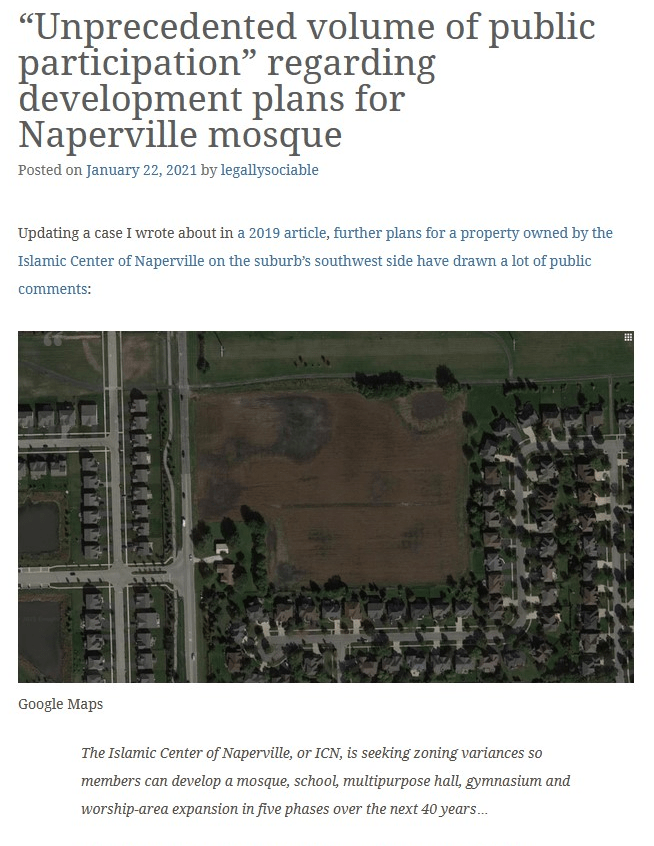
Religious groups regularly propose changes for land and buildings and I have studied this both in the western suburbs of Chicago and the New York City region. After a City Council vote to approve changes to land owned by the Islamic Center of Naperville (see earlier posts on the unusual amount of attention this drew and approval by the planning and zoning commission), the mayor of Naperville acknowledged that it had been a difficult process:

A large crowd in the city council chamber erupted in applause when the vote was completed. Each council member and Chirico expressed gratitude for the work put in by all parties throughout the process that played out over nine months in the city’s planning and zoning commission with 500 speakers in 15 meetings.

“We all know it was painful,” Chirico said. “There were times where I was entertained. There were times where I was angry. There were times where I was throwing my shoe at the TV. Every emotion it seemed like it went through.”

Even as life will now continue with the different actors involved, acknowledging the difficult process is noteworthy. In my study of such proposals, the religious groups do not always reach the outcome they desire nor do communities and residents always get what they want. Here, describing the process as “painful” could refer to a number of things – the time it took, figuring out the particulars, working with all of the interested parties, etc. – and very involved may have attained exactly what they wanted at the beginning.

It is also worth noting that the same group and site may be up for conversation again in the future. In order to help the proposal succeed, the Islamic Center of Naperville agreed to submit future changes for the building and property for review:

The final step pushing the proposal over the finishing line was a concession by the Islamic Center to submit its third, fourth and fifth phase to additional city council review when the time comes. A group representing the nearby subdivisions of Ashwood Pointe, Pencross Knoll and Tall Grass agreed to accept the proposal with those conditions.

Will the process at that point be less painful? The group has made two proposals and both times has encountered numerous questions from neighbors and community members. Some of the particular actors involved in those two discussions may be gone but the underlying questions may not.

Divine Programming and the last two seasons of a critically acclaimed TV show that takes religion seriously

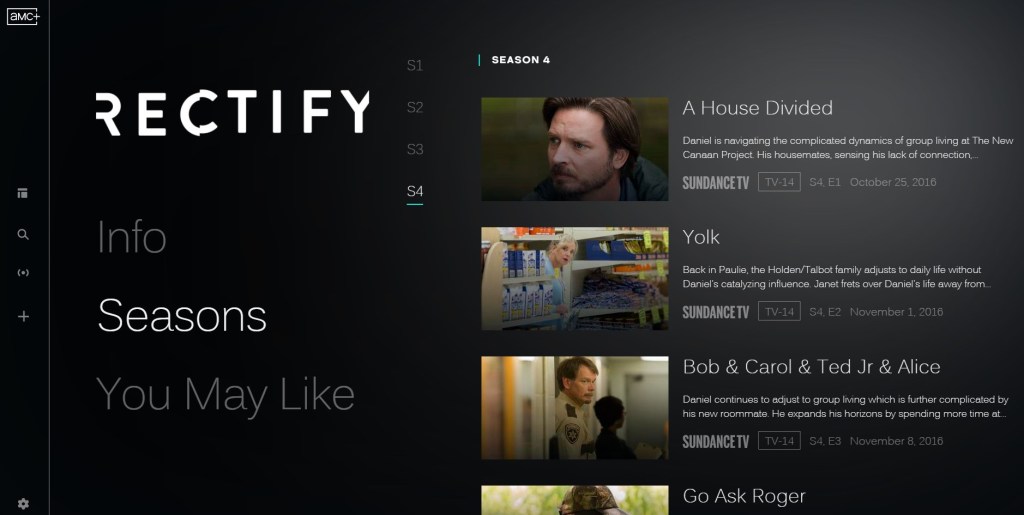
In September, I wrote about reading the academic study Divine Programming and watching seasons one and two of the TV show Rectify. I have now watched the final two seasons of the show, seasons three and four, and was interested to see the role religion played. Here are some thoughts.

  1. Religion is certainly not as important to the plot as it was in the first season. The number of times it is mentioned decreases. There is no presence of organized or institutional religion; it is all personal or individual.
  2. The primary religious character has a return to their faith in the final season. This does not mean everything turns out correctly for them or religion helps solve big issues. It appears that their privatized faith emerges again after going through some personal trials.
  3. The final episodes interact with the themes of hope and disappointment. Arguably, these themes run throughout the entire series; when Daniel is released from prison at the beginning, this does not necessarily lead to long-term consequences for the characters as they engage with what happened in the past and their current circumstances. These are themes that certainly fit with a religious theme. Why do bad things happen? Why are we disappointed? What gives us hope? In the end, the themes of hope and disappointment are left more to the individual characters and immediate family to address, not to religion.

Considering the full show, religion did matter in the narrative arc of the show but it was not a primary force, one that even a majority of the characters engaged with, and did not provide hope or disappointment in the end. Other forces and actors were more influential and the show, like many American narratives, puts a lot of hope in individuals and close relationships among family.

The consequences of losing the physical dimensions of religious and spiritual rituals

A psychologist encouraging people to adopt religious rituals – though not necessarily the religion associated with them – highlights the physical dimension of these rituals:

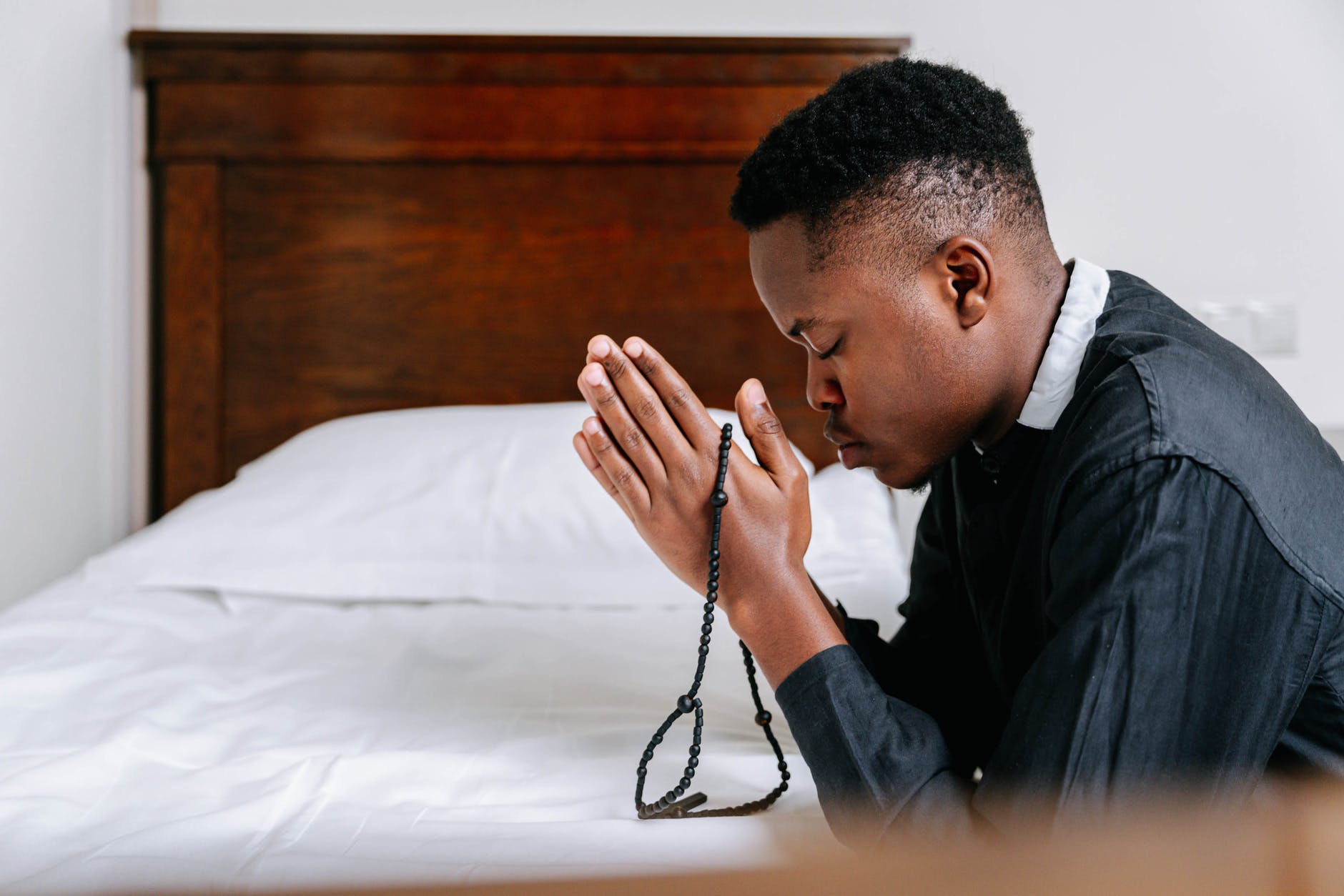
Photo by Ivan Samkov on Pexels.com

One thing that does worry me is a move toward doing these things online. We had to do it remotely because of covid-19. But these rituals are designed to happen and work best in the presence of other individuals. When we’re together, our heart rate synchronizes our breath. These mechanisms are leveraging our minds and bodies. Why do people kneel in church? There’s research showing that if you show people information on a screen above them, they place more emphasis and believe more on the higher screen because they’re looking up at it. Physiologically, we interpret something higher verticality as more authoritative. If you’re sitting on your computer or watching on your phone, I worry that we’re going to lose a lot of the power and majesty of certain rituals because we’re doing them remotely. That’s not how they were designed to work.

It is hard to overstate the communal factor of physical rituals. As sociologist Randall Collins describes in Interaction Ritual Chains, the bodily presence of others enhances the individual and collective experience.

This train of thought is also part of the reason sociologist Robert Brenneman and I wrote Building Faith. A recent trend is that people interested in religion or spirituality do it on their own and in secular settings. But, this is not what numerous religious traditions have highlighted for thousands of years. They have buildings that are intended to enhance the experience of the transcendent as well as enhance fellowship among believers. They may structure this space in different ways – whether to emphasize the preached Word, music, prayer, viewing other attendees, etc. – but they generally agree that buildings shape religious faith. Move those beliefs and practices to other spaces or to no spaces and it is something different.

Could people eventually have a faith or set of spiritual beliefs and practices and no common rituals whatsoever? Remove the physical structures and a group of people around them doing something similar and it is easier to imagine.