The number of vehicles required to maintain a suburban county’s roads

The suburbs are known for driving and therefore have a lot of roads. How many vehicles does it take to maintain the county’s share of roads? Here is the number from DuPage County, Illinois:

Photo by Tom Fisk on Pexels.com

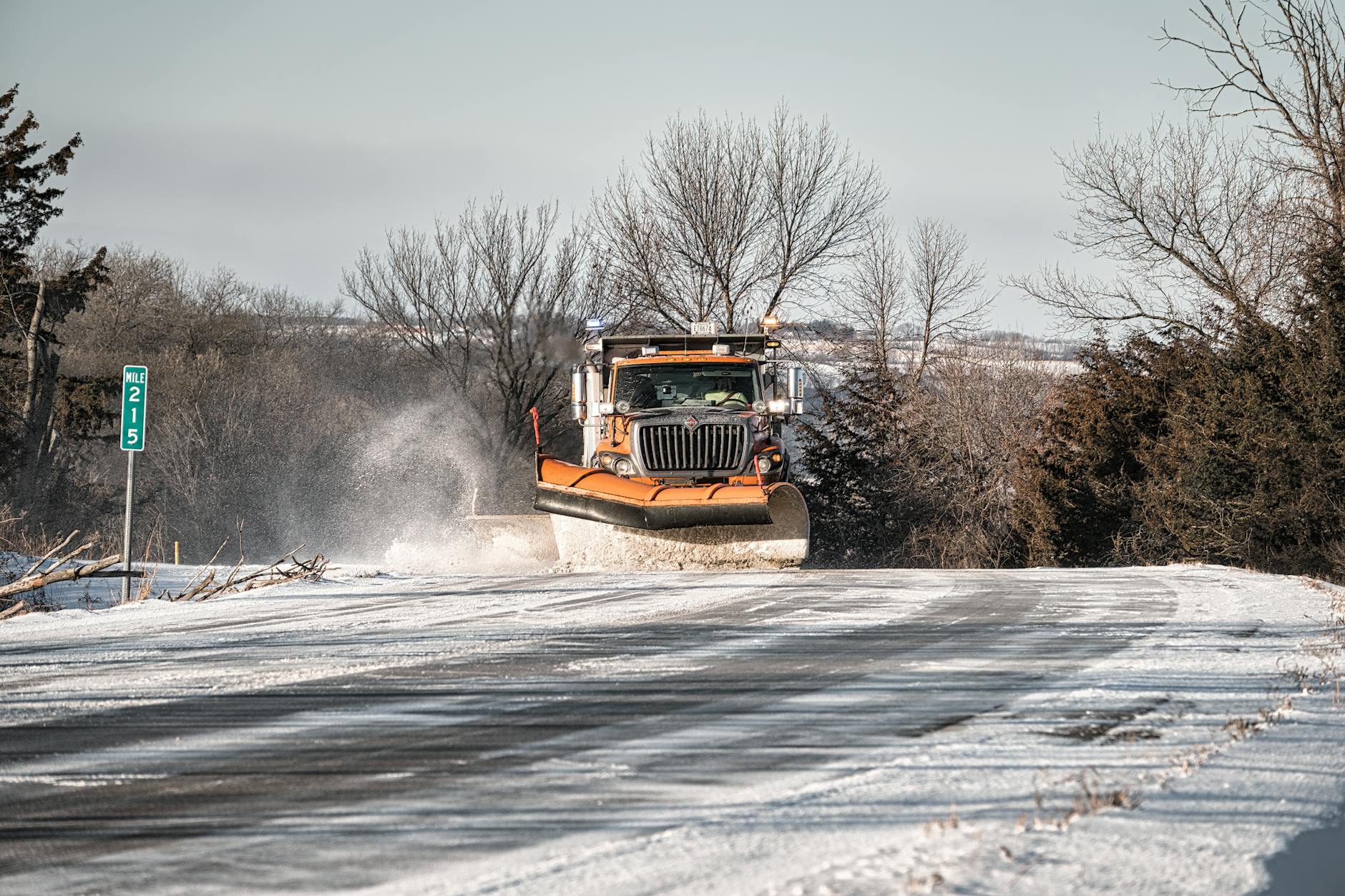
She noted the county’s division of transportation takes care of 220 miles of county highways and 92 miles of multiuse trails. It also maintains 650 vehicles in the countywide fleet and is responsible for snow removal on county roads.

This sounds like a lot of vehicles and I do not know if it is a lot or a little compared to similar-sized counties. At least in this story, the county is looking for a bigger transportation facility to meet all its need for space.

So in one suburban county, there are multiple actors responsible for the roads: the state for interstates and other highways, townships for some roads, municipalities for some roads, and the county for some roads. Is this the best way to approach things? Does each government body have similar vehicles? How close are each other’s roads to each other? If starting suburbia from scratch from this point on, would it be better to have one body address all the roads?

Roads are near sacred in the United States so I understand the attention paid to them. Yet the resources and energy required to maintain them, let alone expand them, is large.

The awesome ability to see Earth from above

I can only imagine what it feels like to see the Earth from truly far away. From the first person who walked on the moon:

It suddenly struck me that that tiny pea, pretty and blue, was the Earth. I put up my thumb and shut one eye, and my thumb blotted out the planet Earth. I didn’t feel like a giant. I felt very, very small

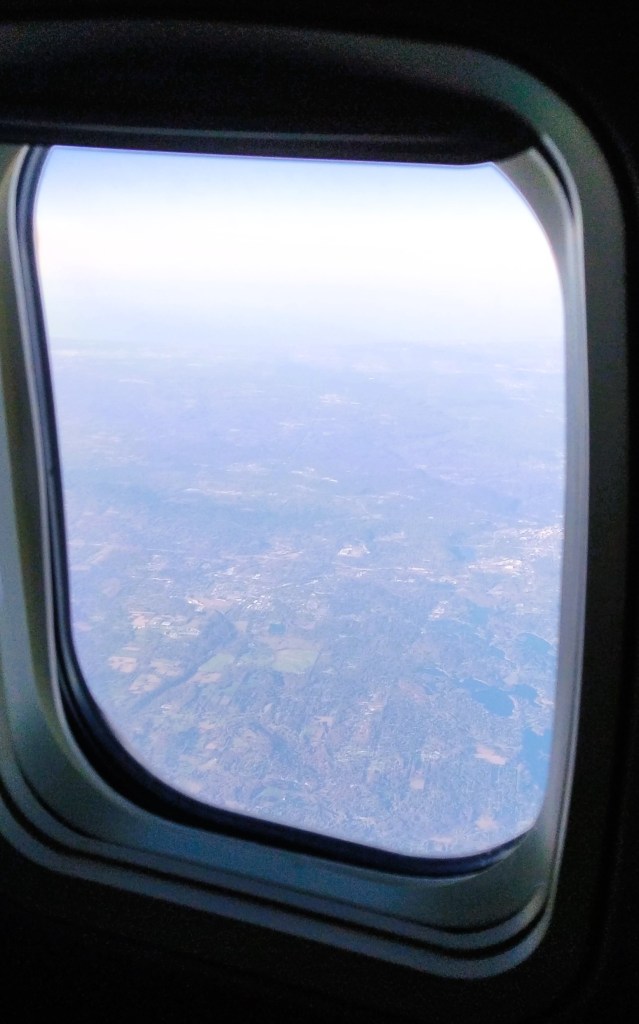
The closest I have come to that is a view like this:

This was my view from an airplane window on a recent trip. The landscape is not particularly special (no big mountains, no big cities, no big bodies of water, etc.) nor is the sky or atmosphere particularly noteworthy (it was cloudless and in the afternoon).

Yet, I enjoy looking out the window every time. To be able to fly thousands of feet above the ground and see it from this angle is exciting. A map can provide an overview from an above perspective but this is not the same as looking at the landscape as it moves below you.

From the ground, planes look very small flying through the air. But the view from the plane makes the landscape as a whole look big as it trails off to the horizon. I do not think I could get tired of this perspective from above and adding it to the very human experiences we all have rooted firmly to the ground.

Finding the end of the airport

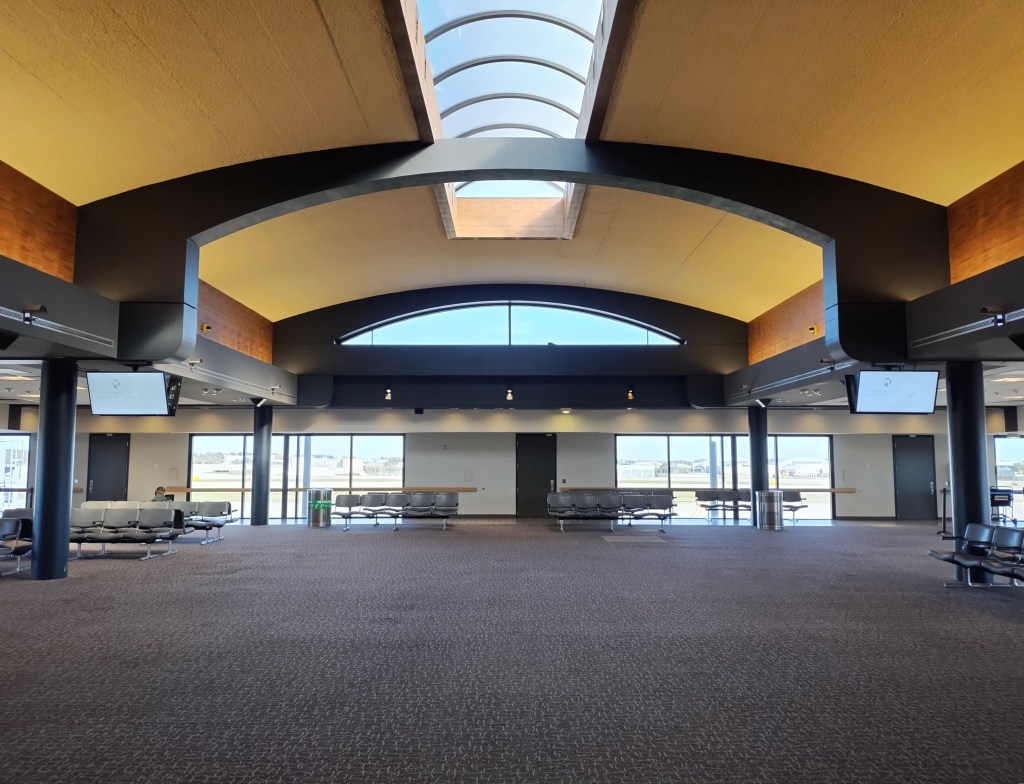
With time to spare on a recent trip, I walked all the way to the end of the airport:

This is both what I expected to find and not what I expected to find. On one hand, there are few spaces that look quite like an airport. The big open space surrounded by banks of chairs, a particular kind of carpet, and plenty of windows to see outside interspersed with a lot of doors no one can enter unless they are officially open.

On the other hand, there was no one at the end of the airport. Well, one person on the left taking advantage of the relative solitude. No planes waiting at this area and actually no used gates even near the end. This is not what I commonly see in the two Chicago airports where it seems the opposite issue is present: there are not enough gates for all the flights and airlines and some people have to wait on a tarmac.

Depending on your point of view, this might be an oasis or an opportunity or a waste of resources. Could this provide a refuge from the hustle of the airport near the center where all the concourses branch out? Could the airport do with fewer gates, thus leading to lower costs for maintenance and staff? Or might this lead to a future of more flights with room to grow? Is this space best experienced when filled with activity and travel?

The (American) city of bridges?

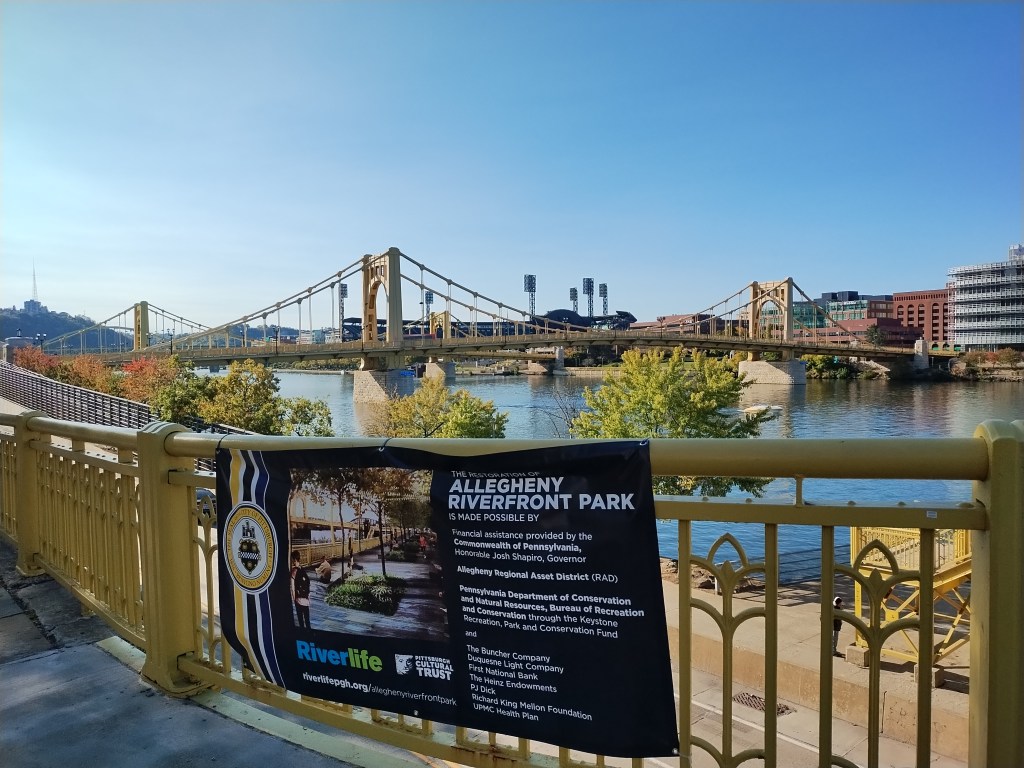
Pittsburgh has a lot of bridges:

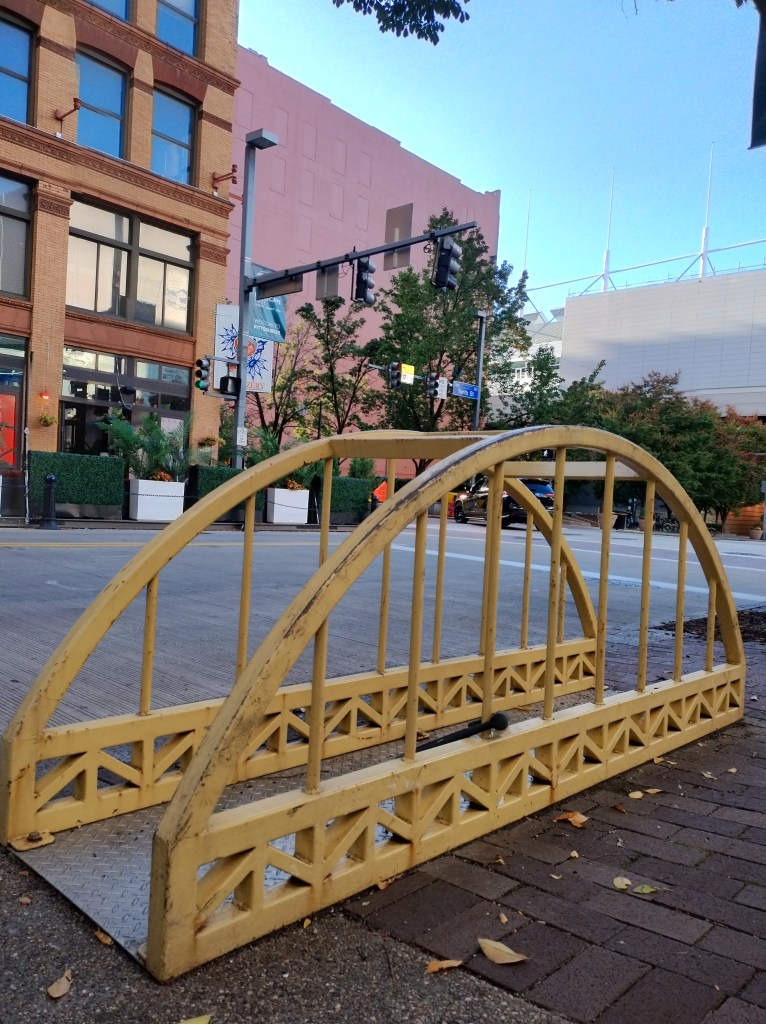
Smaller versions can even serve as bike racks:

According to a few sources (here and here), Pittsburgh might claim the most bridges in the United States. Other people disagree (such as here).

All communities have features that they regard as unique or noteworthy. Bridges are an interesting choice: beyond having a lot of them, they are easy to see and are necessary for transportation.

Like in many matters, it may depend on measurement for claiming this civic title: what counts as a bridge?

The diamond interchange advances in the Chicago region

A new diamond interchange, the fourth in Chicagoland, just opened in the southwest suburbs of Chicago:

Photo by ben neale on Pexels.com

Illinois Department of Transportation leaders unveiled a new diverging diamond design they predict will expedite travel for drivers on the interstate and local roads…

“The modern design is a proven solution to improve safety and traffic flow in a busy area like where we are today,” IDOT Secretary Omer Osman said…

The interchange dovetails with Rock Run Collection, a major Will County development that will include housing, retail, restaurants, offices, and the relocated Hollywood Casino Joliet…

A diverging diamond has a smaller footprint than conventional cloverleafs and is cheaper to build.

Innovation to keep all the vehicles moving smoothly between interstate and a local major road.

What other major roadway changes could help speed up traffic and increase safety? Adding lanes does not necessarily speed up traffic. The Chicago region has plenty of left-turn on green signal only lanes that help reduce certain crashes. Protected bike lanes are only found in a few denser places.

Is the answer in better vehicle technology? Vehicles that talk to each other and/or driverless cars? Smaller or lighter vehicles?

Another possible solution is to reduce the amount of driving. This could be hard in sprawling suburban areas, like where these diamond interchanges are located. Introducing more mass transit options in the region is possible but it is costly, is harder to implement in the suburbs, and it might not find favor among residents.

The drivers at this busy interchange may come to appreciate their new diamond among the asphalt. Others may want to wait for more innovation that improves travel through suburbia.

The numerous consequences of “car bloat”

Vehicles on American roads have gotten bigger over the years. This has various effects:

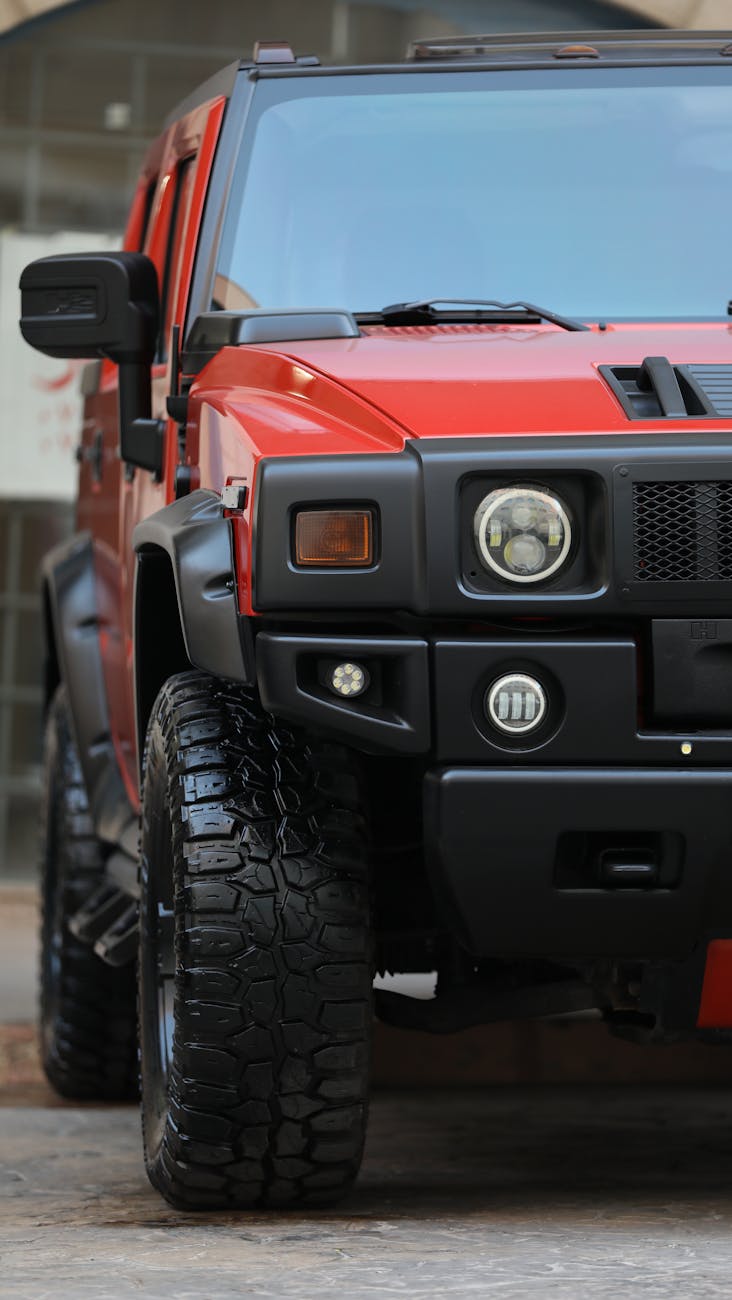
Photo by Ameer Aljdou on Pexels.com

I use the term car bloat to describe the ongoing expansion of vehicle models over the past 50 years. Although car bloat is a global trend, it is especially pronounced in the United States, where sedans and station wagons have been largely replaced by the SUVs and pickups that now account for about 4 in 5 new car purchases. At the same time, individual models have grown heftier. A 2024 Chevrolet Silverado pickup, for instance, is around 700 pounds heavier and 2 inches taller than the 1995 edition. According to federal data, the average new American car now weighs around 30 percent more than it did 40 years ago.

Car bloat creates numerous costs that are borne by society rather than the purchaser, or “negative externalities,” as economists call them. These include increased emissions, faster road wear, and reduced curbside parking capacity. But car bloat’s most obvious and urgent downside may be the danger it presents to anyone on the street who isn’t cocooned inside a gigantic vehicle.

Although occupants of big cars may be slightly safer in a crash, those in smaller ones are at much greater risk. A recent analysis by the Economist found that among the heaviest one percent of American cars, 12 people die inside smaller models for each person saved by the enormity of their vehicle. Pedestrians are still more exposed. A recent study by the Insurance Institute for Highway Safety found that vehicles with tall, flat front ends—common on SUVs and pickups—are more than 40 percent more likely to kill a pedestrian in the event of a crash than those with shorter, sloped ones. Worse, giant cars are more apt to hit a human in the first place because drivers sitting high off the ground have an obscured view of their surroundings. A 2022 IIHS study found that large vehicles’ A-pillars (the structure between a windshield and side window) frequently conceal pedestrians at intersections, and TV news stations have run segments demonstrating that an SUV driver cannot see as many as nine toddlers sitting in a row in front of her.

Having a bigger vehicle may help increase the safety of the driver and passengers but causes issues for others. If the American emphasis on driving and planning around cars was not enough, having even larger vehicles makes it more difficult for pedestrians, bicyclists, and users of smaller vehicles.

The article goes on to discuss options to limit the danger to pedestrians while still allowing vehicles to be big. It might be harder to think of realistic ways that American vehicles could shrink over the next few decades. Imagine an American landscape in 2050 where large vehicles are rare. Large SUVs and pickup trucks are small in number. More vehicles are smaller. How did it happen? Will Americans come to care more about the environment? Will there be a larger groundswell for alternative modes of transportation? Will there be influential financial incentives to move to smaller vehicles? Is there political will to set size and/or weight limitations?

I also imagine there might be some limits to how big vehicles could get. Do lane widths and parking spots all need to be redesigned? Is there a significant loss in drivability and/or fuel efficiency at some point?

The Chicago suburbs soon to be home to the country’s biggest truck stop

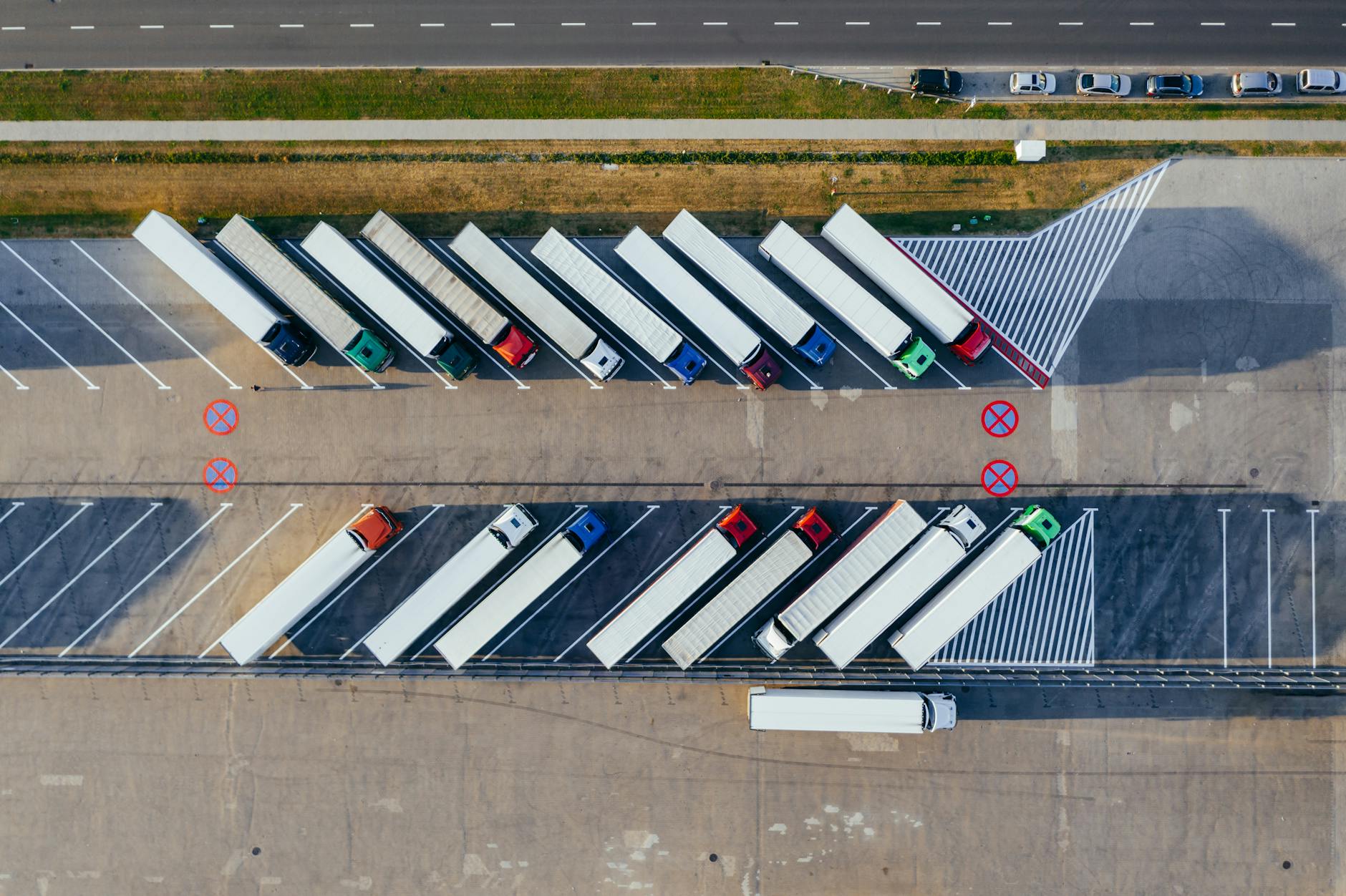
I would not expect the biggest truck stop in the United States to be in the Chicago suburbs. But it will soon open:

Photo by Marcin Jozwiak on Pexels.com

Outpost, an Austin, Texas-based company, is transforming 30 acres at 70 Airport Road into a location where 1,000 semi trucks can park in a safe, secure setting, said Trent Cameron, the company’s co-founder and CEO…

When it opens Oct. 1, the number of parking spaces will exceed the 900 available at the Iowa 80 Truckstop in Walcott, Iowa, which bills itself as the world’s largest truck stop, in part because of the restaurants, stores, truck dealership, movie theater, repair shop and other service businesses spread out over its 220 acres, according to its website.

As Cameron noted, there’s a need for more truck parking. A report done by the American Trucking Association found there is one parking space for every 11 trucks on the road and many drivers spend nearly an hour every day trying to find a place where they can stop, resulting in about 12% lost pay annually.

Beyond that, truck drivers waste a lot of fuel searching for parking and often are forced to park in unsafe and unauthorized locations, the association report said.

Suburbs are not often home to truck stops as these tend to be located further outside of big cities. Developers may see land as more profitable for other uses. Companies may want cheaper land and more of it. As noted later in the article, suburban residents often do not like lots of trucks on local streets and as neighbors.

However, local and long-term trucking is essential to everyday life. Suburbanites may not like trucks on their roads but they would not like it if their local grocery store or big box store did not have what they want. For people to receive their deliveries from Internet orders, the goods have to get to warehouses first and then have to make it to their addresses.

Additionally, Chicago is an important trucking and transportation hub, serving both the large metropolitan area and a lot of traffic passing through to other places. Many trucks make their way into and out of the region with many warehouses, retail facilities, and communities.

Will large suburban truck stops become more and more common? Will this push residents and communities to make certain choices about land and locations?

American minivan sales peaked in 2000

As the era of the McMansion and SUV emerged in the early 2000s, the minivan went into decline:

Photo by jacky xing on Pexels.com

Even so, minivan sales have been falling steadily since their peak in 2000, when about 1.3 million were sold in the United States. As of last year, that figure is down by about 80 percent.

What caused this decline? The same article suggests this:

However it evolves, the minivan will still be trammeled by its fundamental purpose. It is useful because it offers benefits for families, and it is uncool because family life is thought to be imprisoning. That logic cannot be overcome by mere design. In the end, the minivan dilemma has more to do with how Americans think than what we drive. Families, or at least vehicles expressly designed for them, turned out to be lamentable. We’d prefer to daydream about fording Yukon streams instead.

I am interested in some of the bigger connections that might be made around this same time (early 2000s). So family life in the suburbs – embodied by the minivan – became uncool? The 2000 Census was the first time 50% of Americans lived in suburbia. By this point, several generations of Americans had experienced or grew up in suburban settings. Is a choice of vehicles really pushing back against family life in the suburbs (even as plenty of Americans continue in these settings)?

Or another way to take the argument above is that individualism wins out over any symbols of family life. The iPhone and SUV somehow broadcast a consistent message of a cool or unique individual – regardless of how many people own the same model – while the minivan is saddled with family life. Did the long-term American yearning to be an individual doom the minivan (despite its peak in 2000)?

A third consideration: is this just a branding question? If so, other products have been revived so why not the minivan? Imagine a famous celebrity endorses the minivan and drives one around. Or a new brand emerges. Or problems arise with SUVs and the minivan is dependable. Or families become cool again. There may be limited interest in trying to revive the minivan but this could provide someone a marketing challenge.

The Wild West of parking lots with no traffic signs

Parking lots may appear to be safe and controlled traffic environments. Drivers are usually not traveling very fast. Drivers need to be attentive to carts, curbs, and people walking around. New drivers go to parking lots to build their skills.

Photo by Wendy Wei on Pexels.com

Yet parking lots can be the Wild West of driving situations. This is particularly true of lots where there are few or no traffic signs and markings. You have rows and arteries through the parking lot that have no stop signs or signs of where to go.

Last year, we had an incident in such a lot. Driving around the outside of the lot on a roadway separated by curbs from the parking rows, someone pulled out and into the side of the front of our vehicle. There was no stop sign at the end of the row or marking on a pavement. Anyone could be turning in and out of the rows. Presumably they should look to see if vehicles are coming toward them? Presumably everyone is supposed to yield (though there are no yield signs)?

I feel this in parking garages as well where there may be signs and markings but they can be hard to see in the lighting and a cramped environment. Vehicles come quickly around turns. Drivers are looking to back out and pull in.

Since parking is essential in American places due to the heavy reliance on driving, are there better solutions to lots with few signs? Is the primary goal of a parking lot to move vehicles quickly through the space? Is it to help customers or residents or visitors to safely make it to their destination? Is it to fit as many vehicles as possible in/

Trying to cut through a street grid on a diagonal to save time and distance

Street grids have benefits, including offering multiple routes should congestion arise at one intersection or certain routes are off-limits. But what if a driver or pedestrian wants to move quickly through the grid at a diagonal?

Photo by Pixabay on Pexels.com

Different communities may offer options for this. Perhaps there are alleys one can cut through. These back ways offer even more alternatives through the grid if the main streets are congested. Or there might be an occasional diagonal roadway that crosses at an angle to other roads. Depending on the way one is traveling, the diagonal route might be more direct.

Chicago is a good example of having both options in numerous neighborhoods. The flat Midwestern city primarily has a road grid that stretches for miles. East-west and north-south streets can go a long way from one end of the city to the other (and beyond). At the same time, alleys and diagonal streets provide other travel options. The diagonal roadways can create some interesting intersections – these present travelers with different visuals and traffic patterns than they might be used to – but offer more direct routes at an angle to the grid. Numerous alleys take some pressure off the roads for garages, garbage, and other uses.

I imagine other places might offer different options. Any city offer an underground grid at a 45 degree angle to the ground-level grid? Or pedestrian skyways or tunnels that offer paths that cross the grid in different ways?