More road traffic due to a recovering economy

The Texas A&M Transportation Institute suggests traffic has increased due to an improved economy:

America’s traffic congestion recession is over. Just as the U.S. economy has regained nearly all of the 9 million jobs lost during the downturn, a new report produced by INRIX and the Texas A&M Transportation Institute (TTI) shows that traffic congestion has returned to pre-recession levels.

According to the 2015 Urban Mobility Scorecard, travel delays due to traffic congestion caused drivers to waste more than 3 billion gallons of fuel and kept travelers stuck in their cars for nearly 7 billion extra hours – 42 hours per rush-hour commuter. The total nationwide price tag: $160 billion, or $960 per commuter…

Recent data from the U.S. Department of Transportation shows that Americans have driven more than 3 trillion miles in the last 12 months. That’s a new record, surpassing the 2007 peak just before the global financial crisis. Report authors say the U.S. needs more roadway and transit investment to meet the demands of population growth and economic expansion, but added capacity alone can’t solve congestion problems. Solutions must involve a mix of strategies, combining new construction, better operations, and more transportation options as well as flexible work schedules.

I’d love to know whether the average driver would prefer a depressed economy or more traffic. This could be an example of competing interests: a depressed economy could have ramifications for jobs and retirement savings but many people may not have to think about it if they have a job. Yet, if you have a job, an increasingly lengthy commute makes few happy. This might lead to people wanting the economy to be better but not wanting those people to drive. (If only all the new jobs could be telecommuting workers!)

Is the real story about the economy or is it about (a) an increasing population (though the population growth rate may be quite low, the US still added over 2 million people in 2013) and (b) cheaper gas over the last year?

Four options for road diets

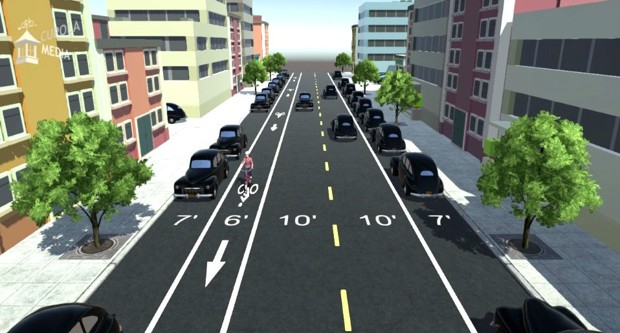
Watch planner Jeff Speck explain how four different road diet strategies might work. Here is an example of one approach:

40-footer lane insertion

(Jeff Speck / Spencer Boomhower)

This time we focus on a 40-foot street with two 12-foot lanes of opposing traffic and two parking lanes at the curb. Many cities have adopted 12-foot lanes with the assumption that they move more traffic; in fact, as Speck has argued at CityLab before, they present a major safety hazard for cities by encouraging faster driving. He recommends slimming them down to 10 feet—a design configuration that leaves room for a bike lane and makes the street safer, even as it more or less preserves traffic flows.

This is a reminder of some of the paradoxes of road design. Provide bigger lanes and more lanes and cars tend to drive faster and traffic increases. Narrow the lanes and drivers have to slow down and pay more attention, leading to improved safety. And all of this might actually free up space for other uses – like bike lanes or more pedestrian space.

If you want more on such techniques, read Speck’s Walkable City.

The case for connecting Chicago’s airports with a rail line

The Active Transportation Alliance argues for a rail line connecting O’Hare Airport and Midway Airport:

Imagine if you could get from Midway to O’Hare in less than 40 minutes on public transit.

Currently, that trip takes well over an hour and involves transferring from the Orange to the Blue Line in the Loop before coming all the way back west towards O’Hare. Building the Airport Connector Express, one of 10 expansion projects in our Transit Future vision, could cut the travel time between Chicago’s two airports in half…

The benefit to business travelers and tourists looking to transfer flights is the most obvious benefit of the project, but definitely not the only one. Even more importantly, the line would connect communities across western Cook County to the two major job centers, greatly boosting job access and opportunities for many working class families. It could also reduce traffic congestion on highways and major arterial streets as more people choose to ride transit as it becomes a more convenient option…

These communities and many others like them are not well served by the current hub-and-spoke model of the region’s transit system. Some are connected to downtown by suburban Metra service but we know not all jobs are located downtown.

This should have happened years ago as these are two of the busiest airports in the United States. I can imagine three reasons why it has not happened:

1. Money. Who is going to pay for it? What would the revenues be from passengers using it? However, I don’t think this is the primary reason. Given the projections of economic growth that are sometimes trotted out for other projects, I bet this could be justified (particularly if you account for reduced traffic).

2. For various reasons, the Chicago area has been slow to build mass transit lines to connect the spokes of the hub-and-spoke train model that arose first with railroads in the mid-1800s and then was reinforced with the CTA lines that converge in the Loop. The mass transit in the region suggests people primarily want to head downtown even as job centers have developed throughout the region including Oak Brook, Naperville, Schaumburg, and Northbrook. The highways are a little better; the Tri-State Tollway was one of the first highways to open and I-355 became the next ring out. However, I-355 doesn’t go all the way around (even its extension was limited and covers an area that was not yet very dense) and the proposed Fox Valley Expressway was never constructed.

3. Perhaps there are some issues to work out across these suburban communities. The majority of this proposed track would be outside Chicago city limits and cooperation from nearby suburbs is needed. But, suburbs don’t always agree on projects like these that could bring changes.

Fight NYC inequality with more expansive subway options

One writer suggests Mayor DeBlasio could address inequality in New York City by improving the subway:

To see how that works in practice, de Blasio should spend a week commuting on the subway from various points in the city: taking the No. 7 train from Flushing, the L train from Greenpoint, the F train from Fort Hamilton Parkway.

Such an exercise may remind de Blasio that while a few rich people can bail out of mass transit by taking ever-cheaper black cars, most New Yorkers are stuck on a subway system that is creaking under record ridership.

The mayor should do some weekend, night and borough-to-borough commutes, too, so he can see how hard it is for lower-paid, off-hours workers to get around when the MTA cuts its service.

Then, the mayor should agree to Gov. Andrew Cuomo’s request to put $3 billion into investments in subways and buses over the next five years, helping to pay for the next few stops on the Second Avenue Subway, plus better technology on existing subway lines.

The mayor should think seriously, too, about funding his own transit project. He mentioned a subway on Utica Avenue, and then never talked about it again. With China’s economy cratering, it’s a good time to build — steel and concrete are cheaper.

Former Mayor Michael Bloomberg’s extension of the 7 train to Manhattan’s Far West Side will open soon — and New Yorkers will remember that Bloomberg did it.

What will they remember about de Blasio?

Powerful politicians often like to enhance their legacy through the construction of massive buildings or public works projects. And mass transit can easily become an issue tied up with social class and race as mass transit in theory is supposed to be more democratic. But, how many would like their legacy to be underground subways in a city that already has an extensive system? Such projects often take billions of dollars, cause all sorts of disruptions, and can be lengthy. This might only work in New York City, a place so dependent on daily subway usage (particularly compared to other large American cities).

If pushed by the mayor, can a new line be called the de Blasio line? I can’t help but think of the “Rod Blagojevich, Governor” signs every time I pass through the open road tolling facilities on Chicago area tollways…

Suburban car dealer limited to 75% of sales must be over $75k

The suburb of Burr Ridge has some price restrictions for a used car dealership:

The proposal would place the pre-owned luxury car dealer under a two-year probation period to see how a $10,000 minimum sales price would work. Under terms of a 2013 special use permit granted for the dealership, cars may not be sold for less than $30,000, and 75 percent of the vehicle sold must have an average sale price of $75,000 or higher, said Mayor Mickey Straub. The average price of a car in the show room needs to be $87,500, he said…

The dealership has maintained a $79,000 average sale price on its vehicles, but it is losing sales when it cannot trade in vehicles under $30,000, said Mutie Sughayar, Global Luxury Imports owner.

Residents expressed their concerns with traffic around the car dealership and the perceived image of the village if the minimum vehicle sales price is decreased…

“It was one of the stipulations that would ensure that the business remain a luxury used car dealer with minimal foot traffic,” said Mary Bradley, another resident.

Some suburbs want car dealers because they can generate a lot of tax revenue. Others think they are eye sores and project a certain kind of image. Burr Ridge is not alone in this; the city of Wheaton also worked to avoid the numerous car dealers along Roosevelt Road in Glen Ellyn. But, I’ve never seen price restrictions for car dealers like these enacted in Burr Ridge. Raising concerns about traffic are common in NIMBY situations even as this car dealer is close to an I-55 exit where there are plenty of other businesses and County Line Road has to have moderate traffic to make these businesses worthwhile. The negative image of the car dealer is likely the more important culprit in this community with a median household income of $115k.

Perhaps the only worthwhile car dealers in wealthy suburbs are ones that solely sell expensive vehicles to a limited number of people. Talk about exclusive…

“Turning Suburban Tysons [Corner] Into a Walkable City Will Take Time”

Eric Jaffe discusses the slow transformation of Tysons Corner, Virgina from car-dominated edge city to walkable city:

Last week marked the Silver Line’s first birthday, and with so much riding on it, so to speak, attention naturally turned to the lower-than-expected ridership numbers. The Washington Post reported that the Silver Line is serving about 17,000 daily riders during the work week, well off the pace of 25,000 riders that planners had set by this time. The “bulk” of this ridership aren’t even new users, according to the Post, but rather people who used to take the Orange Line instead…

But while it’s far, far too soon to declare the great Tysons shift a failure, it’s not too early to point out some of the little failings that still need to be addressed.

Poor walkability is one. Citing an internal analysis, Martin Di Caro at WAMU reports that Metro officials believe a lack of “sidewalks, crosswalks, and bike lanes” is a key reason behind the low ridership numbers…

But the neuroscience of driving habits clearly shows that mode choice is most susceptible to change in the early stages of a major life event, such as moving homes or starting a new job. Insofar as Tysons developers have been slow out of the gate when it comes to encouraging transit, walking, and biking, they might be missing a critical opportunity to change commuter behavior…

A third setback might fall more on Metro itself. The Post’s Dr. Gridlock reports that the biggest problem facing Silver Line ridership isn’t the stations—it’s the service. A delay on new rail cars forced Metro to stretch the existing fleet thin. The proposed fix involves running fewer eight-car trains during rush-hour twice a week so the older cars can get maintenance; given the strong ties between transit service and transit ridership, that’s not an encouraging proposition.

Transforming an exemplar of suburban sprawl is not easy: the community has to respond with corresponding infrastructure (improving walkability), changed mindsets (getting people into new patterns and perhaps this requires newer residents), and adequate service to make it viable alternative.

However, we might ask how much time is needed before we could properly evaluate the impact of the Silver Line. Five years? Twenty years? A couple of generations? And it matters who is doing the evaluating and for what reasons. Is this about seeing a financial impact (paying for the construction of the new line plus measuring new development prompted by the new line)? Assessing the decisions of politicians? Trying to reach a magic number of daily users? It will be interesting to watch the ongoing analysis and who gets to take the credit or blame.

Highway rest stops intended to fight driver fatigue, be free of commercial pressure

Here is an explanation for the distances between highway rest stops as well as their purpose:

According to federal policy, about every half-hour of driving or so there should be a place to take a break. This includes state-run rest stops, commercial rest stops, and regular city exits—in other words, the placement of official rest stops is calculated against the existence of other, non-state-run opportunities to pull over.

The official purpose of a rest area is for safety and convenience, as stipulated in the Federal-Aid Highway Act of 1956, which created the national interstate system. The act recognized that in some rural parts of the interstate opportunities to exit the highway would be few and far between. Since shoulders were meant only for emergencies and vehicle breakdowns, occasional rest areas were necessary. The half-hour rule of thumb was set out in a 1958 policy by the American Association of State Highway Officials that laid out detailed standards for the design and placement of rest areas in the national interstate system. The vast majority of rest sites were developed concurrently with the highway system itself in the two decades following the 1956 act.

Although the 1958 policy did not designate minimum or average distances between sites—that would be too complicated given the many variable factors on a highway like traffic volume, topography, and climate—it broadly stated that there should be enough rest areas to “reasonably accommodate the safety rest needs of Interstate highway travelers” and “encourage drivers to use them as a safety measure to break long periods of travel.”…

Before the federal intervention in 1956, drivers couldn’t count on a place to stop at all. The character of early rest areas (then called roadside parks) ranged widely and most had sprung up organically. The first unofficial rest stop is believed to have appeared in Michigan in 1929, where a road engineer noticed people who had pulled over to picnic on a tree stump, albeit with difficulty. The engineer was inspired to create some roadside picnic tables at the spot, and the idea spread. Early roadside parks were usually found by long stretches of road, particularly near scenic vistas or historic landmarks, and were often very rustic, with no running water or flushing toilets.

Additionally, some states combined rest areas with commercial properties (gas stations, restaurants) to have a stop that could meet all needs (exercise, rest, bathrooms, gas, food). Yet, the initial goal was to provide commercial free stops according to Federal Highway Administration:

Can I set up a business in safety rest areas or welcome centers selling food or other products to motorists?

No. Section 111 of Title 23 (“Highways”), United States Code, prohibits the States from commercializing the right-of-way along the Interstate System. The commercial prohibition in Section 111 dates to 1956 when Congress was considering the legislation that launched the Interstate Highway Program. The Members considered following the model of the toll turnpikes that provided commercial facilities in service areas for motorists who would otherwise have to leave the facility and pay a toll to continue their journey. Congress rejected this model by enacting the Section 111 prohibition on commercialization. The intent was to avoid State approved or supported monopolies for traveler services, such as those provided on toll roads. During the debate, Representative Charles A. Vanik (D-OH) explained what Congress had in mind: “Let the highway traveler turn off the Interstate system if he requires food, motor-vehicle service, lodging or Stuckey’s pecans.”

The Surface Transportation Assistance Act of 1982 modified the commercial restriction by permitting vending machines in rest and recreation areas constructed or located on the Interstate right-of-way.

Safety rest areas are intended to serve motorists by allowing them to take a short break, use the rest rooms, shake off drowsiness, and then move on. The absence of commercial services (except for vending machines) means motorists can stop without any pressure to make purchases. For food, gasoline, lodging, and other commercial services, motorists can leave the highway and return to it without a toll charge.

Interesting to see an interest in protecting drivers from commercialism along the road. This was also aided by the Highway Beautification Act.

Since rest areas are intended to break up long travel, I wonder if the average highway driver goes too long without stopping. For example, here is the recommendation from one AAA club:

Stop every 100 miles or every two hours to get out of the car and walk around; exercise helps to combat fatigue. (p.5)

Perhaps rest areas should be even more crowded. But, stopping more often means interfering with the American obsession with time.

We don’t want automated cars driving the current speed limits

Should automated vehicles follow all the current traffic laws or will they need to be changed?

When Delphi took its prototype Audi robocar from San Francisco to New York in April, the car obeyed every traffic law, hewing to the speed limit even if that meant impeding the flow of traffic.

“You can imagine the reaction of the drivers around us,” Michael Pozsar, director of electronic controls at Delphi, said at a conference in Michigan last week, according to Automotive News.  “Oh, boy. It’s a good thing engineers have thick skin. All kinds of indecent hand gestures were made to our drivers.”

And that indicates that a problem is brewing, argues Prof Alain Kornhauser, who directs the transportation program at Princeton University. “The shame of the driving laws is that they all sort of have a ‘wink’ associated with them,” he says. “It says 55 miles per hour, but everyone knows that you can do 9 over. If that’s the situation, why isn’t it written that way—with a speed limit at 64?”…

In fact, if all cars were autonomous and connected to each other wirelessly, they wouldn’t need stop signs even at the intersections of multilane highways…

I imagine following the speed limit in the Chicago area would lead to some very unhappy drivers. Theoretically, we might not even need speed limits with driverless vehicles as it would all be dependent on the conditions. This might mean that vehicles would go slower at times than drivers might like (perhaps in inclement conditions) but could go a lot faster and more safely even with a good number of drivers nearby.

But, if traffic laws need to be changed, when exactly would this happen? Presumably, it will take some time to introduce these vehicles onto the road and some time for them to grab a large part of the market. Of course, the government could push all new cars in this direction – particularly since they could be so much safer – but older models would still be on the road for some time. To change the laws, all the cars need to switch over at once, an unlikely event. Until all cars are driverless, traffic laws would have to be more conservative to account for drivers but that probably wouldn’t make the new owners happy.

Overall, I haven’t seen much discussion of how automated cars and cars with drivers will mix even as we creep closer and closer to this eventuality.

Planning bicycle-only highways in Munich

Officials are looking into constructing 400+ miles of highways for bicycles:

The ambitious plan calls for a network of 14 two-way bike paths, each 13 feet wide and fully segregated from automobile traffic, that would spread out over an area of about 400 square miles. No crossroads, no traffic lights. It’s an autobahn for cyclists, or, as the Germans obviously call it, a Radschnellverbindungen

The Radschnellverbindungen is designed to do for bikes what highways do for cars: make traveling long distances more efficient and pleasant. Cyclists will be able to ride at about 12 mph, Kastrop says, without the need the need to slow down then get back up to speed at intersections. There are no nearby cars to worry about, and with wider lanes, you don’t risk getting stuck riding single file behind some slowpoke…

This idea of networks made for bike commuting has been catching on lately. As usual with this kind of thing, the Netherlands is out in front, with 28 long-distance, cyclist-only paths, according to City Lab. London’s planning a network of “direct, high capacity, joined-up cycle tracks.” Copenhagen’s got a “bike skyway.” Paris’ $160 million plan to boost cycling includes five proposed “highways” that will be almost entirely protected from car traffic, on some of the city’s biggest corridors, including the Champs-Elysées.

Building the Radschnellverbindungen’s not a done deal yet. Local authorities must approve the project before construction starts, and it won’t be cheap. The German newspaper Süddeutsche Zeitung pegs the estimate at $1.75 million per mile.

Three quick thoughts:

1. It would be interesting to see what it takes to plan such paths around existing infrastructure like roads, rail lines, power lines, and other obstacles. To not have any interruptions on the paths could require some ingenuity.

2. Would bicycle highways require their own rules of the road or traffic laws? You don’t want riders in the middle of the paths or riding three abreast. What happens when needing to make an exit from the path?

3. If you are curious about the cost per mile of construction, one group estimates it costs $8-10 million per mile of highway construction in urban areas.

Argument: solve Interstate issues by handing them back to the states

One writer suggests it is time for the federal government to get out of the business of funding interstate highways:

Assuming time travel is off the table, let’s learn from our mistakes. First, let’s get the federal government completely out of the business of maintaining the interstate highways crisscrossing our big metropolitan areas. Hand these roads over to state governments as soon as possible, and free state governments to finance these roads in any way they see fit, from higher state gas taxes to variable tolls they could use to reduce traffic congestion. Second, for interstate highways that connect cities across deserts and cornfields, let’s replace the federal gasoline tax with per-mile tolls. One of the many problems with the gas tax is that as gas mileage improves, and as a small but growing number of drivers turn to electric vehicles, gas tax revenue is not keeping up with the needs of the highway system. Per-mile tolls can solve that problem by charging drivers according to how much they actually use the highway system, regardless of the kind of vehicle they’re driving. And as Robert W. Poole Jr. explains, they can be pegged to the cost of each road and bridge, which will help ensure that roads and bridges are adequately financed.

After adopting this approach, we will see states investing in the infrastructure projects that best meet their needs, with some states, like California and New York, choosing to invest more heavily in urban mass transit while others, like Texas and Utah, build bigger and better highways. What remains of the federal highway system, meanwhile, will evolve over time, as the routes that attract the most traffic will grow in line with their per-mile toll revenue while those that attract the least will stay the same size, or perhaps even shrink. We’ll have an infrastructure worthy of a bigger, denser, more decentralized America—the kind of infrastructure that Ike, in his infinite wisdom, would be proud of.

An interesting argument that might have appeal for both liberals and conservatives. For conservatives, having more local control is generally good and states could innovate in a way that a larger bureaucracy might not. (At the same time, corporate interests cross state and national lines and they might not like a decentralized highway network.) For liberals, highways have often been used in redevelopment projects harming poorer neighborhoods and state control would theoretically give neighborhoods and communities more say over the fate of highways. Additionally, interstates encourage sprawl and liberals might want to reign in highway building and maintenance in many places.

I could also imagine several objections to this argument:

1. How many states would be willing to take this on right now given budget issues? This would have to be phased in over time. Which government officials want to take responsibility for raising tolls for driving?

2. Uniformity in the system could be a good thing ranging from common road signs to expectations regarding levels of maintenance and service across states.