One of the features of the books I examined is their focus on everyday Christian/evangelical life. On the whole, these texts are part of a larger category of books where evangelicals wrestle with current social issues and consider Christian approaches. Across the books, the goal is help readers build their faith and draw on evangelical and biblical resources.
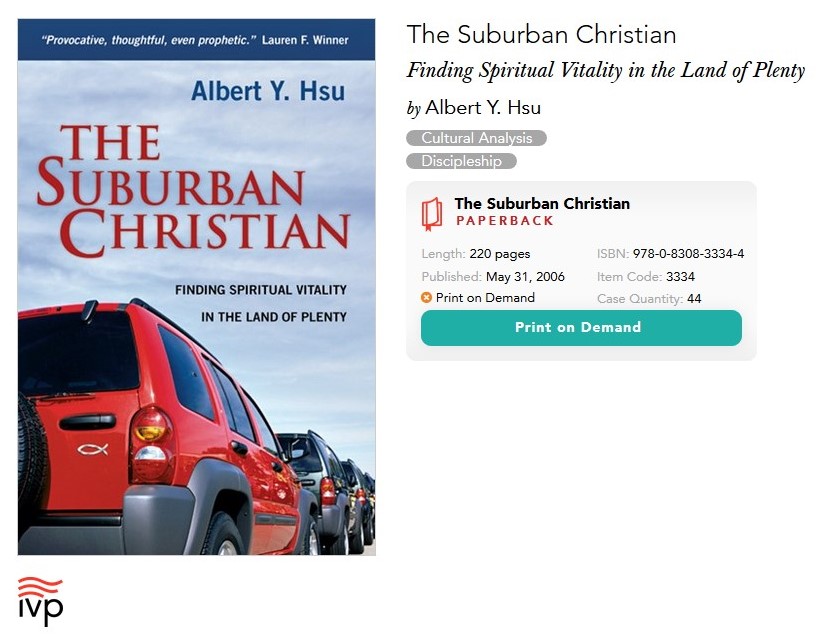
Al Hsu’s 2006 book The Suburban Christian: Finding Spiritual Vitality in the Land of Plenty is the best on drawing on existing historical, theological, and other scholarly research on suburbs and places. There is a full chapter on suburban development that draws on a number of well-cited texts about how the American suburbs came to be. While some books I studied cited no scholarly works, Hsu cites numerous works and the discussion and footnotes could provide a good starting point for a reader who wants to engage the decades-long scholarly discussion.
ivpress.com
The engagement with a wider academic conversation may be connected to other unique features of Hsu’s text. He considers how Christians could engage race and social class in the suburbs. In the final chapter when discussing solutions, Hsu connects religious activity and structural activity:
While we must never neglect the significant of evangelizing individuals, equally important is transforming societal, organizational and municipal structures. (188)
Hsu also helps individual Christians think about their beliefs and practices in the suburbs. For example:
Behind the readers’ comments is a tacit assumption that the Christian life simply can’t be lived in certain environments…But for Christians, nothing is beyond redemption. (13)
For individuals, church groups, and religious organizations looking for an evangelical book addressing suburban life with a more scholarly angle, this would be a good starting point.
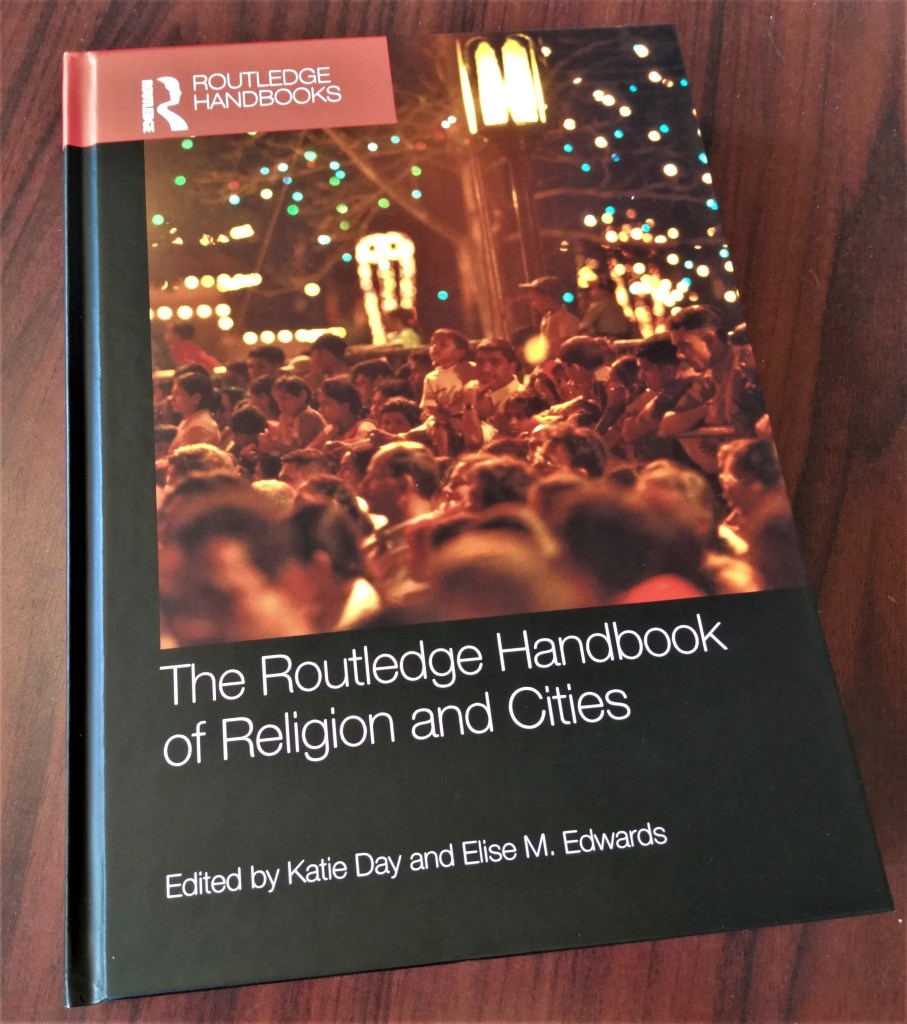
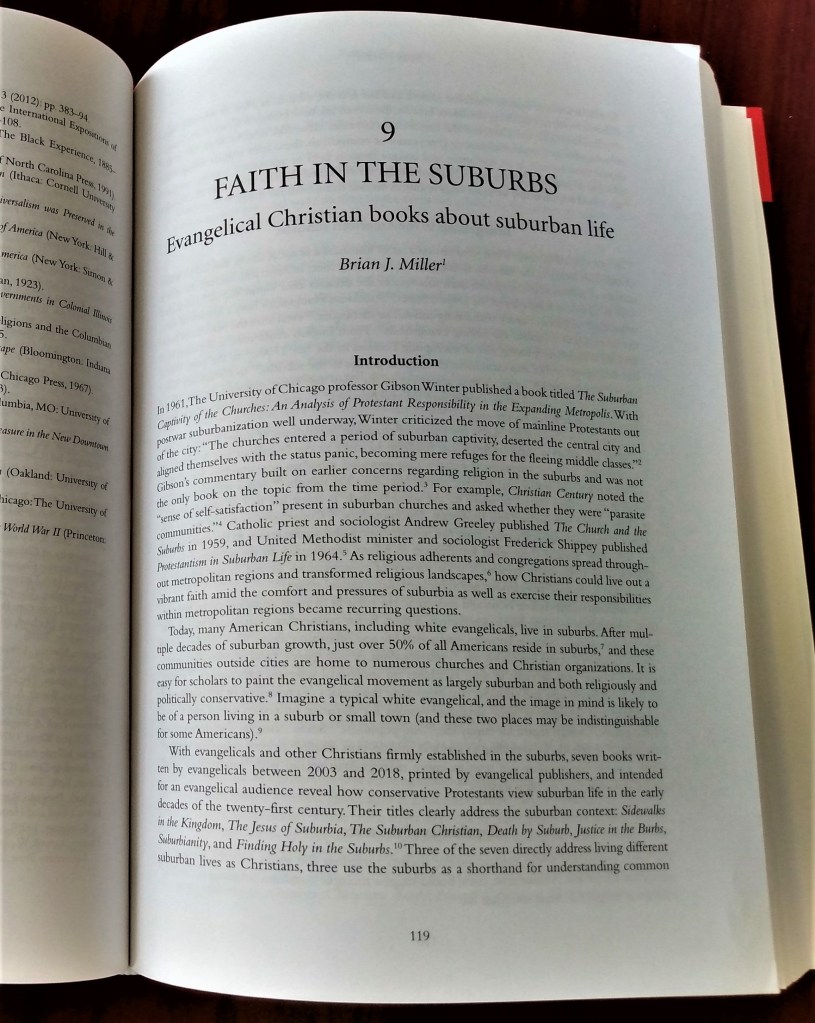
This chapter began in reading several books written over the last two decades where evangelicals considered how to live as a Christian in the suburbs. I slowly collected these books, purchasing some myself and even having one gifted to me by our college’s president. With Americans firmly established in the suburbs at the beginning of the twenty-first century (over 50% of Americans living in suburbs), from different angles the books ask some common questions: do the suburbs present particular opportunities or challenges regarding religious faith? Should Christians live in the suburbs or elsewhere? The chapter I wrote considers common patterns in these books as well as several areas they do not consider.
This chapter is not only about these books; I think these texts also hint at a larger sociological question. How do different spatial environments affect religious faith? Evangelicals do not always consider this; faith is often considered portable, truths are consistent across a variety of contexts, and churches are more about the collections of people rather than buildings and places. Other religious traditions take places more seriously. In the American suburban context with voluntaristic religion, congregations meeting in all kinds of structures, an emphasis on individualism and private property, and geographic mobility, how could a suburban environment not affect religious faith?
With the announcement that Arlington Park will be for sale, ideas are swirling about how the land could be used. I have heard a few times already the possibility of the Chicago Bears constructing a new stadium there. Here is one example:
The Loop from the North End of Soldier Field
Now it is urgently incumbent upon regional politicians and civic planners to begin a campaign to get a global-class Chicago Bears stadium built as a profitable symbol of the rebirth of the 326-acre site.
Fulfillment of such a bold and visioned plan would bring about a marriage of an NFL team and a suburb that was first discussed between “Papa Bear” George Halas and then-AP empress Marje Everett in 1968…
The question of “How?” can only be answered if there is an enormously creative and concerted joint effort put forth by such potential game changers as Bears chairman George McCaskey, Arlington Heights Mayor Tom Hayes and Gov. J.B. Pritzker…
Said Mayor Butts: “From my experience — and I’m talking about my suburb, which is 52 percent Hispanic, 47 percent Black and 1 percent ‘other’ — if you have an inspired plan, proper financing that does not put the host municipality at risk and a resolute ‘will-get-done’ attitude, toss in hard work and you can make a great thing happen.”
On one hand, this is a unique opportunity. It is rare for parcels of land this large to open up in suburbs developed decades ago. Filling a large parcel can be difficult; what can add to the existing community without threatening the current character? This particular location provides easy access to highways, easing travel for thousands of fans. The surrounding area is already used to sporting events on the sites. A suburb could become home to a major sports stadium.
How to balance these competing perspectives? Many suburbs would jump at the opportunity as growth is good, having a pro sports teams is an important status symbol, and hearing the Bears are playing in Arlington Heights could be part of a branding strategy. But, I would recommend leaving the taxpayers out of this: they will likely not benefit economically from a new stadium.
Pro tip: One of the more fun ways to hunt for real estate is to go to your favorite site and search the keyword “architect.” You’ll end up with a lot of zany McMansions, but among the chaff are some well-pedigreed gems.
While this sounds like an interesting exercise, it brings up an important question. Who exactly is designing the McMansions that critics revile?
One of the biggest critiques of McMansions is that they are poorly designed and their architectural quality is suspect. This might come in the form of odd proportions or a mish-mash of styles or a blending of features. Instead of a pleasing aesthetic, the McMansion presents a mass produced version of something that tries to nod to established homes but only succeeds in aping such residences.
Typically left unsaid in these critiques is who exactly put together these unpleasing designs. Often the designs for homes come from builders or developers. What they have in mind when designing a home may not be the same as architects.
I would guess that architects would prefer that more single-family homes are designed by architects. Not only would this supply more work, it would have likely lead to more architecturally coherent homes. The emphasis might be less on providing space, an impressive front, and the most bang-for-your-buck, and instead focus on beauty plus functionality. Of course, some homes could l look great in the eyes of some and not be very desirable (see some modernist structures).
Perhaps more of the focus should come back to builders and developers: what could they do to provide the features American buyers want while also designing more architecturally pleasing homes? The same McMansions might not be so bad for many if they had a better design or fit the neighborhood better. Some would still object to the size of the home – is it really necessary to have 3,000-10,000 square feet? – but at least it would not be in danger of easy attacks. The architectural coherence could affect the price point but might also help the long-term reputation of the neighborhood and builder.
The 2011 earthquake that hit Christchurch, New Zealand offered an opportunity for a new approach to city life. What ended up changing? One writer suggests not much.
The Feb. 22, 2011, earthquake killed 185 people and had an unprecedented impact on the built environment of Christchurch, a city built by white settlers on drained swampland. More than 1,200 buildings inside the central four avenues were destroyed by the quake or by demolition crews in the years after. In the suburbs, a process called liquefaction was just as devastating. As the ground shook, water and sand squeezed up through the soil to the surface, leaving the soil to subside into the space the water had vacated. Houses slumped, and roads folded inward like the icing on a failing chocolate cake. In the hardest-hit eastern suburbs, the government eventually bought out and demolished about 6,500 houses, upending countless families.
One of the champions for this area of the city, which is demographically poorer and browner than the rest of Christchurch, was then-opposition MP Lianne Dalziel. She left Parliament in 2013 to contest the mayoralty, won, and is now in her third term. When I asked her about lessons to come from the rebuild, she immediately mentioned “Share an Idea,” an inclusive project run by the City Council in the months following the quake. “It was an opportunity for people to submit ideas about how they might reimagine their city,” she said. More than 10,000 people contributed over 100,000 ideas, which the council used to influence its draft central city plan. Share an Idea empowered the community, produced concrete recommendations for the future, and won international accolades.
In late 2011, the national government rejected that community-generated plan. Sidelining local politicians, the government came up with its own version, formulated behind closed doors in about 100 days. With much fanfare, the government announced a “Blueprint” for Christchurch that promised a brand-new city peppered with big-ticket items: a stadium, a library, a convention center, a giant indoor sports facility. The CEO of the government agency set up to oversee the rebuild said that “this new city will absolutely set an international benchmark for urban design, innovation, and livability.” The minister in charge, Gerry Brownlee, noted that “the plan and its implementation are being watched by the rest of the world.”…
A 2019 survey of 30,000 Christchurch residents found that just 29 percent of them thought that the city was better than it was before the quake. I lived in central Christchurch for about a decade, both before and after the quake, and I have to agree with the majority. Rebuilding this city was an opportunity to make something great; instead, 10 years on, we’re still talking about Christchurch’s potential. What lessons can other cities, rebuilding from disaster or redesigning in anticipation of change, learn from Christchurch?
Given how major cities operate today, this might not be a big surprise. Do city and civic leaders tend to listen to the people or do they go with decisions that enrich the interests of elites?
Sociologists have written about this. More broadly, the growth regimes/machines literature suggests that city decisions are made by a pro-growth coalition that can make money off development. The broader public has limited influence in big decisions.
More narrowly, studies like Crisis Citiesshow how communities react to large-scale crises. In the case of New York City after 9/11, much of the money and redevelopment effort went back into expensive property. In New Orleans, relatively little was done to help poorer residents and neighborhoods while more effort went into rebuilding the tourism industry.
This does not mean such change could not happen. But, it would be unusual. Without sustained effort from the larger community or unusual efforts from leaders to incorporate the community, redevelopment and cleanup will be aimed in a particular direction.
For white Americans, “Atlantic City, like all mass resorts, manufactured and sold an easily consumed and widely shared fantasy,” Bryant Simon, a history professor at Temple University and the author of Boardwalk of Dreams: Atlantic City and the Fate of Urban America, told me. “Southernness is used to sell that fantasy in the North,” he explained, pointing to marketing that focused on the stereotypically white, southern luxury of hiring Black laborers to shuttle visitors around in rolling chairs, wait on their tables, or otherwise serve them. Jim Crow, Simon said, existed everywhere. Around the time that Monopoly was taking hold in Atlantic City, ballots there were marked “W” for white voters and “C” for “colored” voters, Simon said. It would take countless demonstrations and protests and a long struggle by the city’s Black residents to secure their civil rights, but the Monopoly board records a world of ubiquitous racism.
Although Black residents and tourists could work at hotels such as the Claridge, between Park Place and Indiana Avenue, they were not permitted to dine or lodge there. Some hotels even offered white guests the option of having only white workers wait on them. Black employment was largely limited to the tourist industry, as political and municipal jobs were reserved for white residents.
Atlantic City’s Boardwalk staged minstrel shows, but Black people were largely barred from attending any form of entertainment on the famed Steel Pier. Schools in the area were segregated, clerks at many hotels did not check in Black tourists, and what antidiscrimination laws were on the books were not enforced, Simon said. If Black residents were found to be on a beach that wasn’t designated for Black patrons only, “it wasn’t just like they were run off,” Simon said. “They would be arrested. The police enforced segregation in the city.”…
The impact of the decisions made during Monopoly’s heyday is still felt today. Atlantic City is a “redlined epicenter” of the state, according to the New Jersey Institute for Social Justice, and it leads the state in foreclosures. The rate of white homeownership in New Jersey stands at 77 percent, but Black homeownership is scarcely half of that, at 41 percent. A typical Black family in New Jersey has less than two cents for every dollar of wealth held by a typical white family.
Monopoly is meant to be fun. Until it is not quite the same when we know more about the city behind the game. The game ignores the racial and housing discrimination elements of real life while the winner is a good capitalist who rode real estate luck and development to the top. Few, if any, games deal with this dimension of social life even as the patterns are long-established.
Creating the antidote to Monopoly may only be able to go so far to remedy the historical record and improve conditions in New Jersey. Yet, at least knowing that there is more behind the story of Atlantic City and those who were not intended to be included in the game can help us remember which narratives carry the day – and which others could.
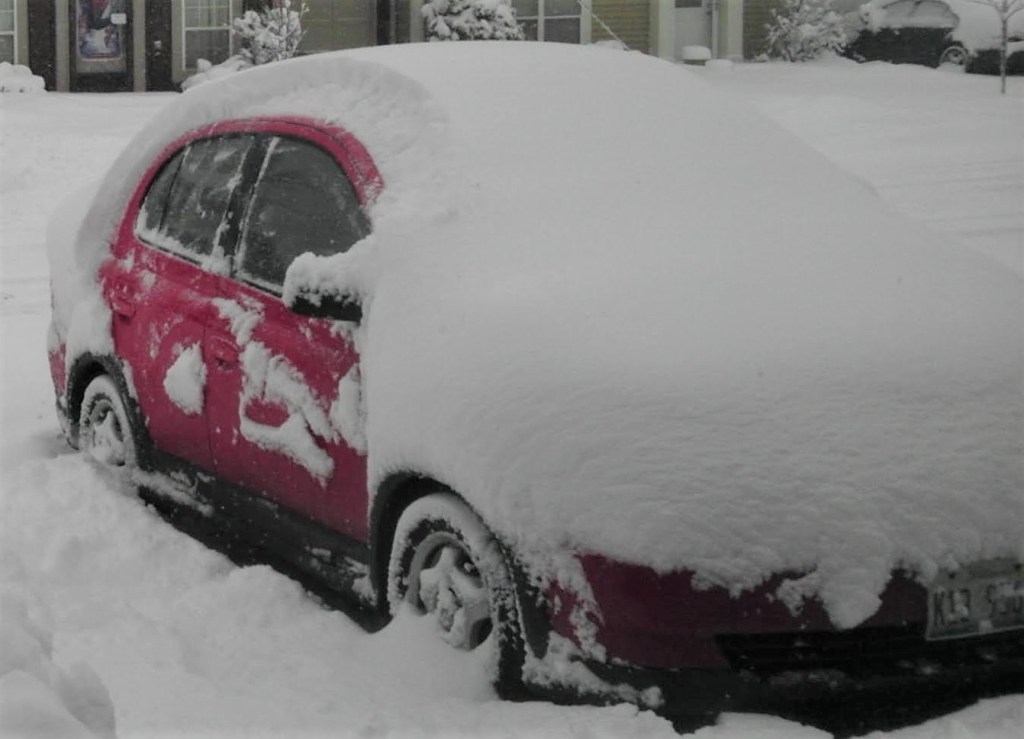
With cold and snow in much of the United States, a car dependent society runs into more difficulties driving. What it does it take to learn how to drive in the snow? Practice and caution. Let me explain.
As a newer driver, I had opportunities to gain valuable practice in driving in snow and bad conditions. I remember one time driving home from work on a school night at about 8 PM after several hours of snowfall. The road was completely covered but the path of the road was discernible amid trees and other markers. Hardly anyone else was out. I made it home by driving slowly.
Around the same time and working at the same place, I found myself leaving for work at 6:30 AM one winter morning. I did not give the car much time to heat up so when I pulled out of our subdivision on to the main road, the rising sun hit my not-clear windshield and made it impossible to see out the front. I stopped, rolled down my window, and slowly drove forward a short distance until I could pull over, let the car warm up, and have a completely clear windshield.
These were potentially risky situations. They were also learning experiences. Pair these experiences – and numerous others – with a few clear rules for driving in snow and icy conditions. First, do not follow anyone closely. Give yourself more space between vehicles. Second, brake slowly in case you start slipping. This means you need to start slowing down earlier. Third, adjust your speed for conditions. Watch how other vehicles are doing and how clear the roadway is.
Wintry conditions are not always possible to handle but are often manageable with practice and caution. These guidelines are less helpful if drivers have fewer opportunities to drive in such conditions. And even following these guidelines is no guarantee; a driver cannot control the actions of other drivers and surprises can arise (such as unseen ice). Even as we ask new drivers to practice certain maneuvers and skills, perhaps we should add snow and ice experience to that mix. Or, maybe it should be a bonus certification required for some parts of the country and recommended elsewhere.
The death of Rush Limbaugh yesterday provides a reminder of the power of mass media. Limbaugh was popular and he had a devoted set of listeners. My own experience in radio plus ongoing listening makes me wonder why radio has a special ability to connect with an audience compared to other mediums. Here are some of pieces that might be involved:
-Daily mass media can connect more than more episodic mass media. Many radio shows take place at the same time each weekday. People know where it is and when to listen. Some television shows have this but many other regular cultural products occur less frequently (think television shows that used to be weekly for part of the year or now released a season at a time on streaming platforms). Daily newspapers and columnists can also do some of this.
-The radio involves a voice but no images. It is a different interaction than with television or the Internet and social media. Listening only can require a certain amount of attention to focus and at the same time allows for the possibility of doing many other things while listening.
-Talk radio in particular provides an opportunity for broadcasters to share a persona or their personality. And they often get to do this over an extended amount of time. The show might have particular content – sports talk, political talk, religious talk, etc. – but the people behind the mic might be more important than the actual topics. Today, podcasts offer some of this as does social media.
-Radios are relatively cheap, portable, and available. At least for some decades, you could take a radio almost everywhere. No Internet connection needed (though there are some features of listening to the radio via Internet). And do not underestimate the ability to listen to the radio while driving; many other forms of mass media cannot be consumed in vehicles and Americans like driving.
Of course, the era of giants in talk radio may only be a thing of the past with fewer listeners and so many other options for consumers of media. Yet, these different platforms may appeal to different people in different ways. Radio was effective for decades – and it is worth noting how much of its early development including networks, sitcoms, and detective shows became part of television – and will likely continue in some form for quite a while.
The separation of the Texas grid from the rest of the country has its origins in the evolution of electric utilities early last century. In the decades after Thomas Edison turned on the country’s first power plant in Manhattan in 1882, small generating plants sprouted across Texas, bringing electric light to cities. Later, particularly during the first world war, utilities began to link themselves together. These ties, and the accompanying transmission network, grew further during the second world war, when several Texas utilities joined together to form the Texas Interconnected System, which allowed them to link to the big dams along Texas rivers and also send extra electricity to support the ramped-up factories aiding the war effort.
The Texas Interconnected System — which for a long time was actually operated by two discrete entities, one for northern Texas and one for southern Texas — had another priority: staying out of the reach of federal regulators. In 1935, President Franklin D. Roosevelt signed the Federal Power Act, which charged the Federal Power Commission with overseeing interstate electricity sales. By not crossing state lines, Texas utilities avoided being subjected to federal rules. “Freedom from federal regulation was a cherished goal — more so because Texas had no regulation until the 1970s,” writes Richard D. Cudahy in a 1995 article, “The Second Battle of the Alamo: The Midnight Connection.” (Self-reliance was also made easier in Texas, especially in the early days, because the state has substantial coal, natural gas and oil resources of its own to fuel power plants.)
ERCOT was formed in 1970, in the wake of a major blackout in the Northeast in November 1965, and it was tasked with managing grid reliability in accordance with national standards. The agency assumed additional responsibilities following electric deregulation in Texas a decade ago. The ERCOT grid remains beyond the jurisdiction of the Federal Energy Regulatory Commission, which succeeded the Federal Power Commission and regulates interstate electric transmission.
Historically, the Texas grid’s independence has been violated a few times. Once was during World War II, when special provisions were made to link Texas to other grids, according to Cudahy. Another episode occurred in 1976 after a Texas utility, for reasons relating to its own regulatory needs, deliberately flipped a switch and sent power to Oklahoma for a few hours. This event, known as the “Midnight Connection,” set off a major legal battle that could have brought Texas under the jurisdiction of federal regulators, but it was ultimately resolved in favor of continued Texan independence.
I have contended before that few people pay much attention to infrastructure until something goes wrong. When electricity, natural gas, water, roads, mass transit, and more operate normally, we do not think about them much. They just work. Until they don’t.
A short event last summer reminded me of this. Our family was about to leave our house for a trip and right as we were closing everything up, the power went out. In such a situation, what do you do? Stay and make sure all essential systems are back on – refrigerator, sump pump, air conditioning – before leaving? Just go and hope for the best? We stuck around for a little bit, power was restored, and we were on our way. And this happened in a location where we rarely lose electricity and most of the power lines are underground.
Our situation was a drop in the bucket compared to a severe storm or change in weather like Texas is experiencing. It all works until it is knocked out and millions of people are affected. Then, everyone wants to know what is going wrong. What is taking so long? Is there a way to quickly reestablish service or are people at the mercy of the cold? Certainly, the return of power and services will be accompanied by serious conversations about what to do to ensure something similar does not happen again.
And then there are the peculiarities of local infrastructure. How was it built? How is it managed? Who makes the decisions and what are the priorities for the systems? Is it prepared for a crisis? Some places take great pride in the infrastructure. As an example, the Chicago story of reversing the Chicago River to help improve public health is told over and over as a notable achievement. The construction of Deep Tunnel is a sizable project.
But, these are the big projects. Power, gas, and water are just supposed to be there. While some property owners, often in more rural areas, might have to deal with this more on their own (wells, propane tanks, septic fields, etc.), this is part of the urban and suburban bargain: you live there and the services work (and might even be relatively cheap – see the example of water).
Perhaps this will lead to more consideration of infrastructure. Build a strong infrastructure and it will help keep different and important parts of society running. When it fails, everyone struggles.
In some of MacGillis’s stories, the connection to Amazon is so tenuous as to be almost indiscernible; the characters’ problems seem to arise more from larger forces, such as globalization, gentrification, and the opioid crisis, than from any one corporation’s influence. A young man from small-town Ohio—alienated by his experience in D.C., where he starts college—returns home and enters Democratic politics. After scoring a local success, he runs for Congress, determined that the party not write off his opioid-ravaged, Trump-supporting region, but he fails to drum up more than a couple of union endorsements. A gospel singer who became a cultural force in Seattle during the ’80s watches as her neighbors are pushed out of the city’s historically Black Central District one by one.
Local energies may have been sapped for many reasons, yet in the coastal cities that MacGillis visits, Amazon’s disproportionate ability to further enrich and empower already thriving places and workers is glaring. Familiar though they are, evocations of the six-figure salaries and amenities available to young Amazon programmers—a café catering to their dogs, meeting space in a giant replica of a bird’s nest—acquire new salience set against Torrez’s experience. And the sense of entitlement on display in the company’s search for a second headquarters site is breathtaking. Local officials across hard-knock America prostrate themselves for a chance to host it. In the end, Amazon chooses the suburbs of the nation’s capital—already one of the wealthiest areas in the country—and walks away having amassed a great deal of useful regional data provided by eager bidders who probably never stood a chance.
In the less glamorous pockets of the country—the rural areas and small cities where MacGillis has spent so much time as a reporter—Amazon’s role in making economic hardship more entrenched is no less stark. In El Paso, Texas, Amazon has aggressively marketed itself to the city government as a go-to source for office supplies—which has pushed local purveyors to open up online storefronts on Amazon; a large cut of their sales goes to the corporation. In York, Pennsylvania, the headquarters of the once-fashionable Bon-Ton department store has been made extinct by Amazon and the broader retail consolidation it represents. The crisis of unemployment that has ensued is one that Amazon exploits, finding able bodies for its warehouses in nearby towns.
On his home turf of Baltimore, MacGillis explores most intimately the ebbing of human fulfillment that has accompanied Amazon’s promise of high-speed customer service. He profiles Bill Bodani Jr., who spent most of his working life at Bethlehem Steel’s Sparrows Point complex, outside the city. In the early 2000s, a serious injury forced him to retire in his mid-50s, around the time that foreign competition and other factors pushed the company into bankruptcy. Eventually, the Sparrows Point plant shut down and Bodani’s monthly pension payment was cut from $3,000 to $1,600. Now 69 years old and back at work as a forklift driver in a 22-acre Amazon warehouse, he returns every day to the exact same piece of land. The peninsula has been rebranded—it’s called Tradepoint Atlantic now—and has become what MacGillis calls an “all-purpose logistics hub” that houses, among other facilities, an Amazon fulfillment center.
While Amazon is not the only major corporation that could claim to have a a large impact on so many places in the United States (think Walmart, McDonald’s, and a few others), it’s particular reach and impact might just be unique. With an ability to reach millions of customers in their homes, tech workers in a lot of locations, and fulfillment centers spread across the country, Amazon reaches across multiple sectors and job segments.
Each of these Amazon locations, high-tech or not, has the potential to shape the character of communities. Consider the fate of places like Elwood, Illinois that rely on warehouses and distribution centers. Is an Amazon fulfillment center a good trade-off in the long run? Does the chase for a new headquarters or some higher-quality jobs in corporate offices encourage communities to offer tax breaks and more? What kind of local citizen is Amazon – does it participate in and contribute to local activities, do its buildings and its footprint positively contribute to civic life?
Amazon my be global but it is local for many communities. How it interacts with these numerous local contexts may help decide its long-term fate.







 Legally Sociable