Record office vacancy rate in Chicago’s Loop

Over a quarter of the office space in Chicago’s Loop is empty:

Photo by Yusuf Mahammed on Pexels.com

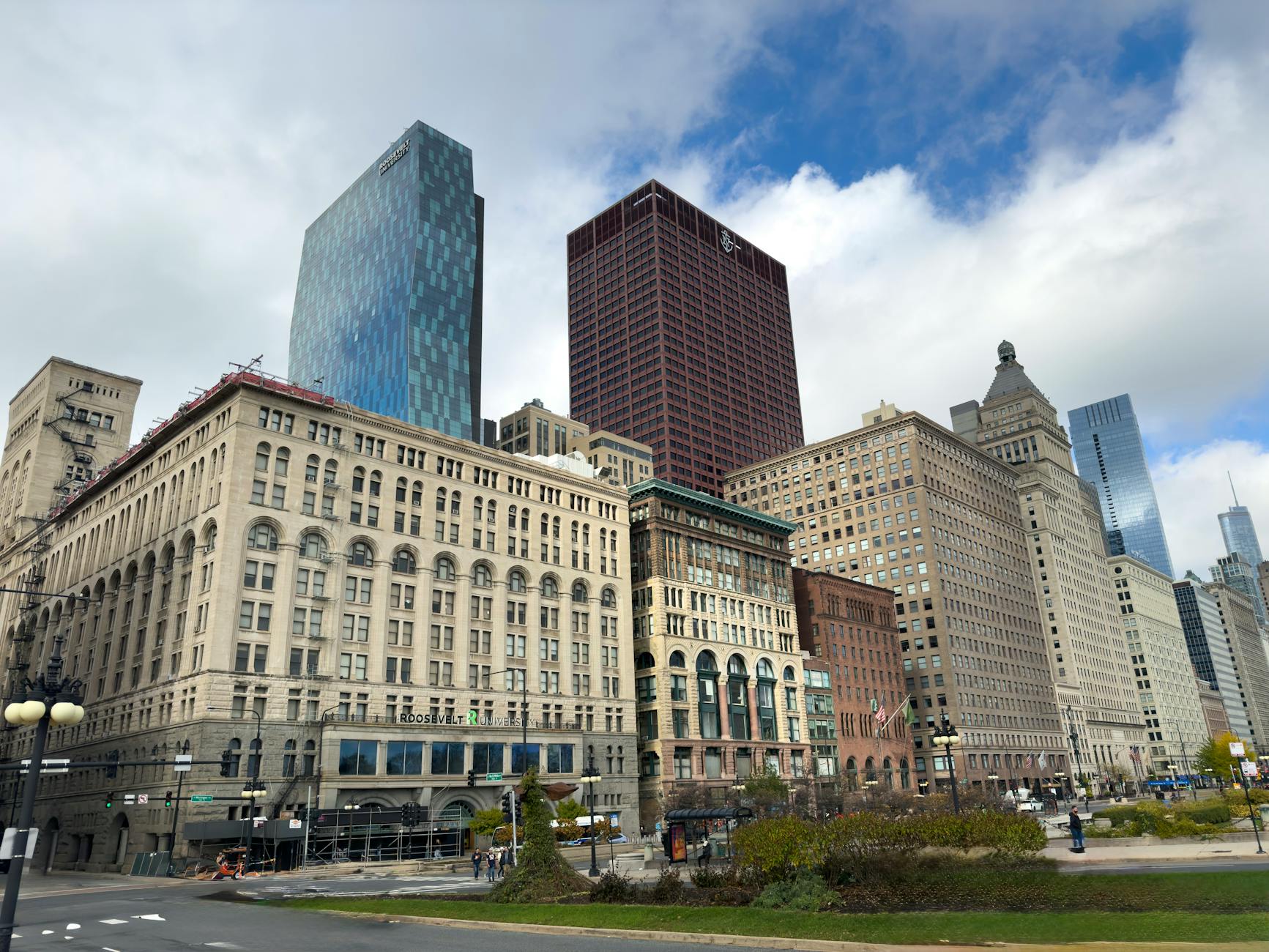
The vacancy rate in the Loop was 24.7% in the second quarter of 2025 — a record high, according to research from commercial real estate firm Bradford Allen. That’s up 1.3% from the first quarter, and a 2.7% increase compared to the second quarter of 2024.

The firm said the second quarter was also one of the weakest periods for overall office demand since the beginning of 2024. Direct net absorption, a measure of space that’s been leased versus vacated over a period of time, hit negative 1.5 million square feet. That means more companies vacated than leased office space in the second quarter…

But it’s reassuring to see more foot traffic in the Loop, and he said more companies are requesting office tours for larger spaces, signaling strong interest in the Loop. He also said his firm is doing more office and retail deals downtown.

Leasing activity is starting to return after companies pulled back on signing larger leases during the pandemic. There’s a lot of larger tenants in the office market right now, and it feels promising, DeMoss said.

Each time I teach Urban Sociology, we consider the famous concentric circles map of Chicago produced by the Chicago School. At the middle of the map is the Loop, the central business district. For decades, it has been an economic center for the city. With its placement at the center, it represents the importance of economic activity in the big cities of today.

But what if the Loop became something else? The vacancy rate cited above suggests about one-quarter of the office space is empty. In a setting where there is a lot of office space overall, this adds up to a lot of space. What if this space was used differently?

This could be a shift toward more residential units in the Loop. Mixed-use development is popular in many places as it can help create a 24-hour vibrancy that can be lacking in places primarily consisting of office space used during workday hours.

But it could also mean a shift toward other land uses. More food and retail spaces? More recreational and cultural spaces? More community and municipal spaces? Less need for parking spaces?

While the record vacancy rate gets the headlines, it would be interesting to hear more about people and institutions that could help shape the future. What will the Loop be in 10 or 25 years and does this hint at shifts across many American cities?

Criticizing cities and ICE activity in complex suburbia

President Donald Trump often criticizes American big cities, particularly Chicago as he has mentioned the city multiple times in his first and second term. Just yesterday in the Arizona service for Charlie Kirk, Trump highlighted Chicago:

Photo by cottonbro studio on Pexels.com

Trump told mourners that one of the last things the slain conservative activist and Illinois native said to him was, “Please, sir. Save Chicago.” Trump then launched into a familiar refrain, saying, “We’re going to save Chicago from horrible crime.”

One of the Trump administration’s actions regarding Chicago includes recent ICE activity. While all the details are hard to come by, it appears however that this activity has not just affected people living in Chicago; there has been ICE activity in numerous suburbs. An ICE facility in Broadview. ICE agents approaching people in numerous suburbs, as far as 40 miles out from the city.

These actions hint at the complexity of the Chicago region and suburbs across the United States. Even as some Americans have long associated cities with racial and ethnic diversity, this diversity has increased in suburbs in recent decades. The American suburbs are full of people of different racial and ethnic groups as well as large numbers of recent immigrants to the United States.

So when Trump says Chicago has problems, does he mean just the city or is the whole region in question?Again, from the Kirk service:

Trump later took aim at Gov. JB Pritzker, declaring, “You have an incompetent governor who thinks it’s OK when 11 people get murdered over the weekend. … He says he’s got crime [under control]. No, they don’t have it under control, but we’ll have it under control very quickly.”

Both the city of Chicago and its suburbs have the same governor. Only one of the Chicago collar counties in Illinois voted for Trump in 2024: McHenry County. (There are portions of the greater Chicago area in southeastern Wisconsin and northwestern Indiana but they may not be part of the same conversation.) Are the problems some see in Chicago also ones they see present in suburbs?

The rise in LLC property owners in Chicago

A new analysis shows that LLCs now own more properties in Chicago compared to two decades ago:

Photo by Photo By: Kaboompics.com on Pexels.com

In the last two decades, LLCs have become an increasingly common way to own real estate in Chicago, according to a first-of-its-kind analysis of 26 million property records by WBEZ, Injustice Watch and the Mansueto Institute for Urban Innovation at the University of Chicago.

The share of multifamily rentals owned by LLCs increased from 3% in 2006 to 16% in 2022, the analysis shows. Their share of ownership among larger apartment buildings with seven or more units, like the one where Carter resides, increased from 9% in 2006 to 34% in 2022.

Why the increase?

But LLCs gained traction with real estate investors in the 1990s when they realized LLCs had very minimal disclosure requirements, Hamill said. In Illinois, for example, only the manager and agent of an LLC — neither of whom are necessarily owners — are required to be publicly disclosed…

“There’s two big advantages with LLCs. One is the tax advantage that you’re not taxed as a corporation. The other big one is the ability to isolate liability and isolate financial assets,” Immergluck said…

But experts say the issue with LLCs isn’t their protection against legal liability. They say the problem with LLCs is the lack of transparency.

This could be told as a story of how a change in bureaucratic structures – the ways a corporation could incorporate – led to unintended outcomes. A new option from the 1970s eventually proved useful for property owners. But that could prove problematic for renters who cannot easily find people who can address important property issues.

This is a similar but different concern that those expressed in recent years about institutional investors buying up housing. What is similar is that some hard to find or hidden or presumed-to-be self-motivated actor is buying up housing and not acting in the best interests of residents or the broader good. What is different is that the concerns in the article above are primarily about the lack of having a person to contact and hold responsible, not about the numbers of units that are less affordable or less accessible because an LLC or corporation is acting rather than an individual owner. So this may not be a question of whether corporations can buy residential properties; it is about whether residents can know who these corporations are and whether they can be counted on to fulfill the landlord’s duties.

It would be interesting to hear from landlords what they would think of changes that would reveal their ownership. Would landlords who want to do the right thing object to this? Would some still want to not have their ownership public but would respond to residents well through property managers?

The lingering reminders of the railroads that once marked Chicago’s lakefront

In its early history, Chicago’s shoreline with Lake Michigan was marked by railroad lines and activities. Trains pulled right up to the Chicago River, moving goods to the center of the city and its thriving port. You can see a late nineteenth century images of the lines of the Illinois Central right along the water here and here.

Today, it is harder to see evidence of the bustling railroad activity. The city still has sizable railyards and a large amount of railroad traffic. But it is now largely outside of the Loop and more railroad activity has been pushed to the edges of the metropolitan region.

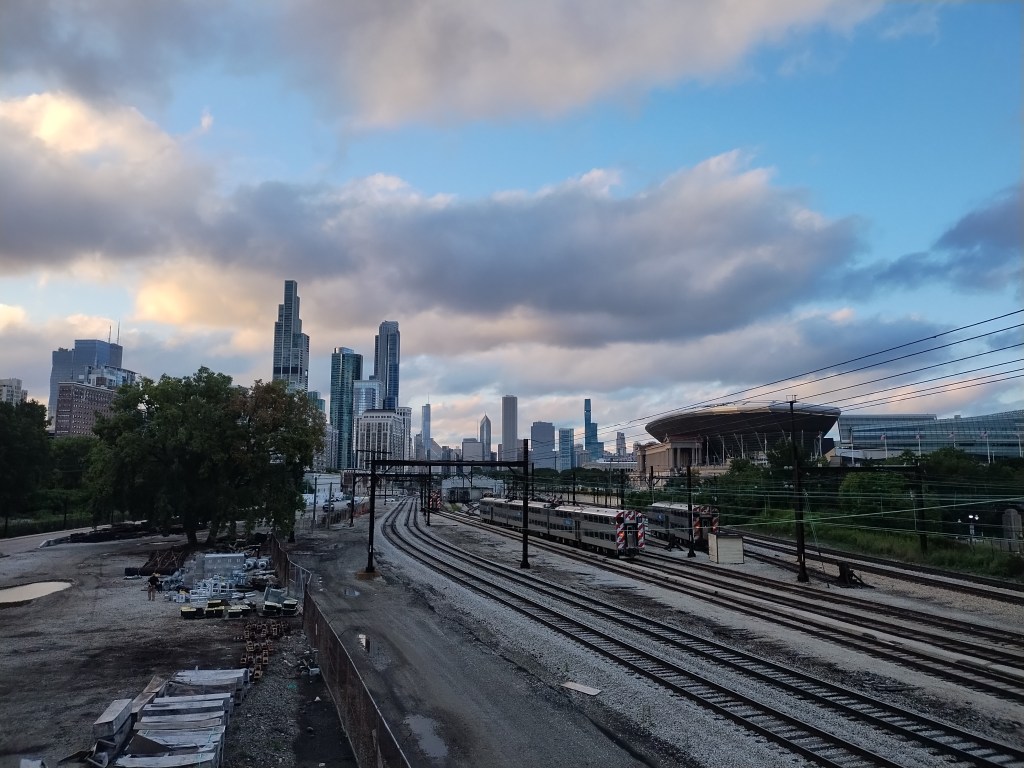
I recently found a spot where an observer can still get a hint of the important railroad activity that marked the lakefront:

This passenger line comes into the central part of the city from the south and its station is underground. This angle gives a broader view of the tracks and the infrastructure needed to move trains and people.

The major cities of the United States, including Chicago, are still dependent on railroad lines. The average resident of a region may only travel via car and visitors from further away may primarily arrive via airplane but the railroad lines continue to deliver large amounts of goods and resources. Their presence may be less visible but keeping the trains running on time in and around cities still matters.

“End of Beginning” and Chicago

One song popular in the last few years, “End of Beginning,” references Chicago in its chorus:

Photo by Alena Darmel on Pexels.com

And when I’m back in Chicago, I feel it
Another version of me, I was in it
I wave goodbye to the end of beginning

This song is “End of Beginning” by Djo, an artist name for Joe Keery who went to college in Chicago and then later left for New York City:

In a recent interview, the Newburyport, Massachusetts, native said he’s “excited” to get back to Chicago, where he studied theater at DePaul University.

Besides performing at Lollapalooza, he said he has plans to catch up with old friends and may even hit up Allende Restaurant, just steps away from the Lincoln Park campus. And at the top of his mind is a dip into Lake Michigan at Montrose Beach…

The last time the Sun-Times spoke with Keery, “End of Beginning” was one of the most popular sounds on TikTok. Though the song was released in 2022, fans made edits using the popular verse: “And when I’m back in Chicago, I feel it.”

It’s a song about closing the chapter on his life in Chicago before moving to New York City.

On one hand, the song seems to speak of good experiences in Chicago. The artist says he is looking forward to being in Chicago.

On the other hand, Chicago is the place before going to the real place of success: New York City. The singer may like Chicago but he finds fame elsewhere. One of Chicago’s nicknames is “The Second City” and this may have originated in its status behind New York. But now, those in acting or entertainment may need to go to New York or Hollywood/Los Angeles to make it big. Chicago might be a place to be when you are young but these larger coastal cities have a ability to launch you into the stratosphere.

For a number of American places, you could put together interesting playlists that speak to the character and music of a community. Add this song to the list of songs about Chicago and I am always interested in songs that namecheck specific places.

When “icons of urban decay” are demolished

One well-known site on Chicago’s southwest side will soon be no more:

Photo by Jan van der Wolf on Pexels.com

For some in the city’s cultural community, the demolition of the historic grain silos represents a visual gut-punch. The structures — icons of urban decay as they sat empty for nearly five decades — have been a popular backdrop for filmmakers, musicians and skyline photographers and served as a canvas for many graffiti artists who ignored the “No Trespassing” signs. The silos even appeared in the 2014 movie Transformers: Age of Extinction

Whether you think of them as eyesores or historically significant structures, the Damen Silos will soon vanish from the Southwest Side’s skyline. By the end of last week, a squat building along Damen Avenue had been reduced to rubble. Heneghan Wrecking’s crews were working next to the tall silos, where the noise of a jackhammer rang out. Workers sprayed water to prevent clouds of dust from filling the air.

“We are extremely disappointed about the demolition,” said Kate Eakin, managing director of the McKinley Park Development Council. “It represents a gross lack of imagination about what the site could be, as well as failures of government at several levels to communicate with each other.” Eakin’s local neighborhood group hoped to see the site transformed into a music venue and park that could host festivals. Other grain silos have been repurposed in similar ways: An art museum fills a former silo in South Africa, while Minneapolis left a silo standing in the middle of a popular tourism district…

“The Damen Silos are among the last remaining reminders of the agricultural trade that literally built the city,” said Tom Leslie, an architecture professor at the University of Illinois at Urbana-Champaign. “Losing the Damen Silos means yet another lost opportunity to celebrate the city’s history as the center of agricultural trade.”

This single case hints at multiple interesting questions communities consider. At what point does an abandoned building or property become worth preserving? Which buildings can or should be repurposed for cultural or recreational use? Who should make these decisions and who can or should fund decisions?

But this case also involves ruins, industrial ones at that. This is a different kind of case than a once opulent theater or a once thriving neighborhood. How many industrial sites in the United States are preserved? There would be no shortage of such sites across American cities, particularly in the Midwest and Northeast.

Chicago has at least 250 traffic circles

Chicago’s road grid is interrupted at least 250 times for traffic circles:

Photo by Tuesday Temptation on Pexels.com

The Chicago Department of Transportation reports it’s aware of 250 that appear on landscaping lists. The department is currently not clear on the likely sizable number of circles that require no landscaping.

One of the best features of traffic circles is that they force drivers to slow down and pay attention. They cannot blow through a stop sign or traffic light or unmarked intersection. If they can successfully yield and do not need to stop, they can keep their momentum going at a more reasonable speed.

This is an interesting way to count road features: those that need landscaping need to be on some list so that maintenance can be done. Those without the landscaping need would have to be on some other list to be counted. Is this the sort of task AI could do in the future with access to websites with satellite imagery?

Racial change in the suburbs and the first American pope

Pope Leo XIV grew up in Dolton, Illinois, a suburb just south of the city of Chicago. Is this a story not just of the first American pope but a pope who grew up in the changing American suburbs? Over the years, what happened in his suburban community that had its first white settlers in the 1830s? First from the Encyclopedia of Chicago:

Photo by Abdul7amid Al Fadhly on Pexels.com

The mixture of railroads and the Little Calumet River proved to be a good site for industry. Dolton grew as a center for truck farming and manufacturing. It has produced bakery equipment, brass castings, shipping containers, cement, furniture, agricultural equipment, steel tanks, and chemicals. This diverse activity attracted an ethnically varied workforce. In the 1960s the Calumet Expressway (now the Bishop Ford Freeway) improved automobile and truck access to Chicago by two interchanges serving Dolton. In recent years large numbers of African Americans have moved to Dolton. The 2000 census reported a population of 25,614 with 14 percent white, 82 percent black, and 3 percent Hispanic.

According to a table on this page, Dolton was 99.9% white in 1960, 58.1% white in 1990, and 14.3% white in 2000. According to the Census Bureau, Dolton is now 4.9% white.

Second, WBEZ in 2018 reported on the change that had taken place in Dolton:

This is the story of how one small town became trapped in a downward spiral that poverty experts say follows a well-worn pattern of deindustrialization that leads to a disenfranchised economic class. Communities of color inherit a legacy of decline and then lack the resources, both financial and political, needed to turn things around.

The focus is Dolton, but it just as easily could be Riverdale, Harvey, Dixmoor, Posen, Calumet City or other nearby suburbs that once were powered by steel and other industry but over time slowly coalesced into a broad swath of economic distress. In other parts of Illinois, such as North Chicago to the north or Maywood to the west, the details change but the problems are often much the same.

It was no one single thing, but a cascade of events that changed the fortunes of Dolton and its neighbors. The decline of manufacturing led to a loss of job and pay opportunities, which in turn fed a wave of white flight as longtime residents left and were replaced by African-American city dwellers lured by better, yet not too expensive, housing.

But luring new investment to now majority black communities proved a challenge and housing values began to fall, taking down with them the tax revenues needed to keep up public services. Next came widespread foreclosures and an invasion of real estate scavengers who bought houses on the cheap, transforming a community of homeowners with a deep financial stake in their town into one of renters with looser bonds.

All the while, the political fabric vital to turning things around continued to fray. Government stumbled amid patronage and gridlock, rendering even more challenging the task of drawing needed new investment.

This sounds like a number of American suburbs that provided opportunities for white residents after World War Two but did not provide the same opportunities for later residents.

After World War Two, Prevost’s parents owned a small suburban home and were educators with master’s degrees:

His parents had been living in a 1,200-square-foot brick house on East 141st Place in Dolton. They bought it new in 1949, paying a $42 monthly mortgage.

His father Louis Prevost was superintendent of the south suburban schools in District 169. News clippings from 1945 show he served as a Navy lieutenant in the Mediterranean in WWII. He had graduated from the old Central Y.M.C.A. College in 1943 while living in Hyde Park.

The new pope’s mother, Mildred Martinez Prevost, studied library science at DePaul University. Her death notice, in 1990, said she and her husband started the St. Mary’s library in the basement of the old school building and mentions jobs she had in the libraries at Holy Name Cathedral, Von Steuben High School on the North Side and at Mendel from 1969 to 1975.

This home was apparently recently fixed up after being purchased for under $70,000 in 2024.

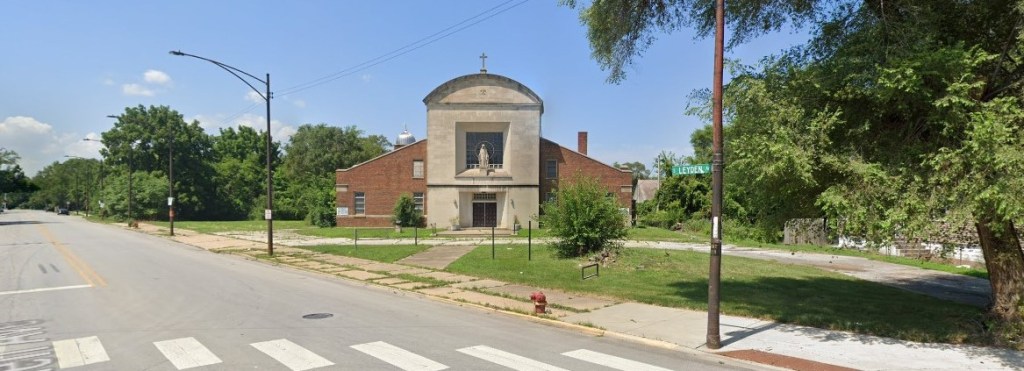
The Prevosts attended a Catholic parish – St. Mary of the Assumption – just inside the southern borders of Chicago and next to the suburbs of Dolton and Riverdale. Here is what the property looked like as of July 2024:

This parish closed in 2011 and is part of a larger set of Catholic institutions the Prevost family was involved with and that have closed:

Like St. Mary’s, other Catholic institutions that helped shape the future cardinal are long gone, closed over the past several decades as the Catholic population around where he grew up and elsewhere plummeted. Among those bygone institutions:

• Mendel College Prep High School, where Prevost and his mother worked.

• St. Augustine Seminary High School in Michigan.

• Tolentine College in Olympia Fields, the suburb where he briefly lived.

• Mount Carmel Elementary School in Chicago Heights, where his father was principal.

Several of these communities mentioned – Olympia Fields, Chicago Heights – experienced racial change similar to that of Dolton.

If white Catholic residents indeed left Dolton and other communities on the South Side of Chicago and its southern suburbs and American suburbia became more complex, where did they move to? How did this shape the ministry of Pope Leo XIV?

How flat Chicago is

In some American cities, you can see mountains. Los Angeles, Seattle, Denver. What you see (and experience) in Chicago is flat land. How flat? Here is one way to approach it:

Photo by Chait Goli on Pexels.com

According to “A History of Beverly Hills, Chicago,” a 1926 University of Chicago thesis by Cora DeGrass Heinemann, that Far South Side neighborhood, which now goes by Beverly, “is the highest land in Cook County.” That’s because the Blue Island Ridge, a glacial moraine, winds through it.

In the Dan Ryan Woods, a forest preserve that adjoins Beverly to the north, a historical marker for Lookout Point says the spot was “used as a signal station on [the] main highway of Indian travel.” Lookout Point offers a fine view of downtown Chicago, but at 660 feet above sea level, it’s not quite the highest spot in the city. That’s a little farther south, at 91st Street between Claremont and Western, where the land rises to 670 feet.

By contrast, the city’s lowest point, the lakefront, is at 577 feet. The lesson here: With less than 100 feet between its highest and lowest elevations, Chicago is one flat city.

This is some variation in elevation, almost 100 feet. I wonder if there are additional factors that help hide changes in elevation:

  1. An urban landscape. Lots of buildings and activity might distract from elevation changes.
  2. Chicago is not just any urban landscape; there are plenty of tall buildings. A ten-story building is roughly 100 feet tall and there are plenty of these across Chicago. Such buildings could help a 100-foot difference seem small in comparison.
  3. Gradual elevation changes. This could be from the natural landscape and/or the smoothing effects of development over decades.
  4. The location of the highest point is away from the center of the city. How many people pass by this location regularly compared to other parts of the city with less variation in elevation?

So Chicago is relatively flat – and other factors could contribute to the sense of flatness.

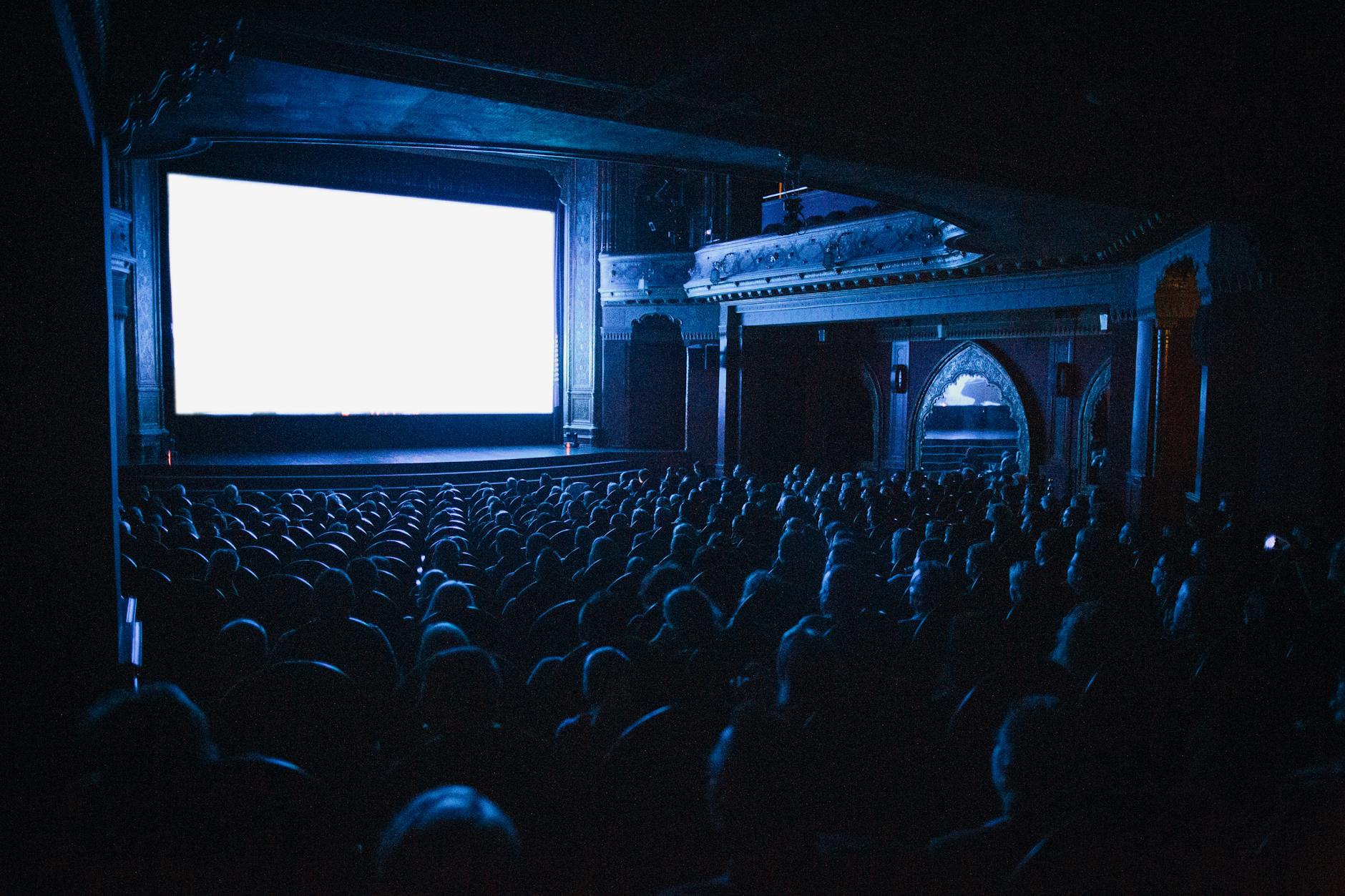
Chicago and the beginning of the soap opera

The American soap opera started in Chicago:

Soap operas have long been trivialized as low-brow women’s entertainment. Even the term “soap” is pejorative when describing television. But there’s a deeper story to tell about the genre that changed storytelling on the small screen. Irna Phillips doesn’t get enough credit for her creation. She’s the Chicago woman who birthed the daytime serial for radio in the 1930s and ushered it onto television in the 1950s. Phillips established staples in the genre like the cliff-hanger; she was a prolific writer who knew the daytime audience wanted to see their own problems in stories. As she summed it up in 1947: “[T]heir own conflicts, their own heartache, their hopes and their own dreams. Everything isn’t happiness, is it? No.” Beyond the melodrama and romantic escapism, soaps took bold risks, embracing social consciousness with groundbreaking women-centered storylines.

According to this timeline, here is the early history:

1930: Painted Dreams, the first ever daytime serial, airs five days a week on Chicago radio station WGN. It’s written by an innovative woman named Irna Phillips, who plays the lead character: a sweet-hearted mother who talks out issues with characters in long expository scenes.

1930s: Soap maker Procter & Gamble (P&G) begins sponsoring daytime serials, birthing the name “soap opera.”

1932: When WGN refuses to take Painted Dreams national, Irna Phillips moves to competitor WMAQ radio and creates Today’s Children. This show goes national.

1937: Irna Phillips creates The Guiding Light, which is set in a fictional Chicago neighborhood. It follows Rev. John Ruthledge, who provides help to those around him. It is among the longest-running broadcast shows in history, airing on radio for 15 years and on television for 57.

1938: Chicago is firmly the mecca for the daytime serial. Fifty are on the radio, and most originate in Chicago.

How does a city recognize this cultural contribution? Chicago is known for a number of important cultural products but I was not aware of this deep connection to the soap opera. What could put this in the public eye; a historical marker or museum of the soap opera or public art or school curriculum?

And how much is this limited recognition connected to the ways soap operas intersect with gender, race, and social class? Thinking about Chicago, soap operas might not be considered by many to be high-brow cultural works compared to the Chicago Symphony Orchestra or the Art Institute or architectural movements. But Chicago also has a long history of mass entertainment.