Identifying the pockets of carless Chicagoans

With more Americans living alone and significant transportation costs for middle-class Americans, where do the carless Chicagoans tend to cluster?

So where do those carless Chicagoans live, and how many of them are there? A lot, it turns out. If you break down Chicago by cars and household size using 2012 census numbers, these are the only groups of more than 100,000:

One person, one vehicle 193,174
One person, no vehicle 168,004
Two people, one vehicle 135,143

Along the northern lakefront, around half the households don’t have a car; there are pockets in the Near North Side and Lake View over 60 percent. In one Edgewater tract, it’s over 70 percent. It’s not the highest percentage, though—there are two tracts in one of the poorest stretches of the South Side, between U.S. Cellular Field and 47th Street along the Dan Ryan, above 80 percent.

As you move north and west and the city gets less dense, the percentage of carless households drops off. There’s an exception, though: one tract in Logan Square, adjacent to the California Blue Line stop, where 41 percent of households don’t own a car. The “twin towers” transit-oriented development that’s going up at 2293 N. Milwaukee, and causing controversy as it goes, will live right next to that tract.

If I had to guess, this is related to income, age, more expensive parking options (for example, having to pay for a garage spot as opposed to plenty of street parking), and housing types (single-family homes which are more attractive to families versus apartments, condos, etc.). How well would these clusters line up with where the Creative Class lives?

The headline suggests that this is has led developers to respond with what they are proposing and building. Yet, the article doesn’t say much regarding these changes. For example, how about more shared streets like have been proposed for a few spots in Chicago? How about more bike lanes in these areas? How about more high-rise housing? If these population clusters hold and developers are indeed responding, these could be very unique places in a few decades.
Branding battle: “Chiraq” vs. “Chicago Epic”

Spike Lee and the city of Chicago have opposing views of how the city should be viewed. First, from Lee:

No sooner did the Wrap report that notable director Spike Lee has been tapped by Amazon Studios to make a movie titled Chiraq did the controversy and backlash begin to grow online because of the movie’s title. It wasn’t Lee who coined “Chiraq,” however. Chicago residents who have experienced the deadly shootings in “The Chi” gave it the moniker of Chiraq. The term combines Chicago with Iraq to compare the violence of the two places, as witnessed in the below documentary video previously released about “Chiraq,” but unrelated to Spike’s forthcoming movie…

Alderman Anthony Beale says Chiraq should have a new title, reports CBS Local. Beale adds that he doesn’t care what other name Lee uses for his new movie, but that it shouldn’t be Chiraq due to the violent images it brings forth. The alderman from the 9th ward didn’t make mention of the nickname coming from other sources than Lee.

Another politician was more forgiving of the Chiraq title. Senator Dick Durbin said he’d first like to give Spike a chance to explain what the Chiraq movie is all about before passing judgment. Although he says the Chiraq title is worrisome, he admitted he doesn’t know much more about the movie than the title.

Other politicians weighed in on Spike’s Chiraq, reported the Chicago Sun-Times?. Although Alderman Beale continued to point out criticisms, claiming Lee was stigmatizing Chicago with the Chiraq nickname, Mayor Rahm Emanuel refused to go that far. The mayor would only say that he’s focusing on the safety of the city.

Second, this news comes as the city is launching a national ad campaign to bring more tourists to Chicago:

The campaign, dubbed “Chicago Epic,” features a visually diverse 30-second TV commercial and far-flung ambitions. Target markets include San Francisco and Denver, but viewers throughout the country will likely see the spot over the next six weeks. Whether it changes minds about Chicago, or travel plans, remains to be seen…

Choose Chicago is funding the summer campaign with $2.2 million, up slightly from last year. About half of that budget will go to TV and online video. The rest will go to digital advertising, social media and paid search, hoping to sway online travel bookers as they plan their getaways…

Created by ad agency FCB Chicago, an 80-second long-form video was whittled down to a 30-second spot for the TV campaign. The spot features a distinctively Chicago voice urging visitors to be “part of something epic,” incorporating scenes of Divvy bikes, Lollapalooza, North Avenue Beach, Wicker Park and Alinea, recently named the best restaurant in the world by Elite Traveler. The forearms of renowned mixologist Charles Joly, which feature a tattoo of the Chicago flag, also have a starring role. Michael Jordan, the Chicago Theatre marquee and even the Chicago skyline ended up on the cutting-room floor for the edited TV spot…

“I think we’ll make ‘Chicago Epic’ as famous as ‘I Love New York,'” Fassnacht said. “That’s one of our goals — we have to make this iconic.”

There are several ways to view these competing narratives that could go a long way to influence the branding of the city:

1. Both contain elements of truth. Both don’t tell the full story. Chicago has experienced a lot of violence, even with murder rates that are significantly lower than in the past. Chicago has numerous interesting sites, even if many of its neighborhoods don’t match the glittering tourist locations.

2. The city of Chicago has said they want to boost tourism. This would help bring in more money and boost the city’s profile. Tourism is the sort of industry that can take advantage of existing locations and infrastructure (like the world’s busiest passenger airport) without requiring many big changes.

3. Chicago is clearly a global city and yet there is ongoing anxiety about whether Chicago can hold to its spot or whether it can truly compete with the cities at the top of the list.

4. It is unclear which narrative will win out.

More global cities working independently from their country

An upcoming conference in Chicago will look at how global cities operate across and independent of national boundaries:

“By pursuing their own business ties, trade missions, cultural exchanges and agreements with each other, global cities may even have the ability to disrupt the foreign policy agendas of their nations,” said Sassen. “Cities are more nimble and often less weighed down by national politics than central governments are, and that means they can push the envelope further and faster by working with other cities that share a similar set of social and economic issues and interests.”

Already, cities around the world have formed associations and networks to work together and share information on such issues as the environment, transportation, energy efficiency and economic development. These include the C40, comprising some 70 global cities working together on climate change; Cities for Mobility, with its 650 members in 85 countries focusing on transportation; and Metropolis, in which more than 100 cities network on environmental issues.

“With countries struggling to reach basic agreements, city-to-city communication and coordination is not just innovative, it has the potential to change the nature of the conversation about international commitments,” said Sam Scott, chairman of Chicago Sister Cities International, a knowledge partner of the Chicago Forum on Global Cities…

“We’re going to see cities like London, Paris, Chicago and Sao Paulo frame their own civic foreign policies, with their own offices and representatives – sort of embassies and ambassadors – in the great cities of the world,” said Richard Longworth, a senior fellow at The Chicago Council whose report, On Global Cities, will be issued in advance of the forum. “This won’t usurp the prerogative of national governments. But cities, like nations, have their own interests that they need to promote and defend. If their nations can’t do it, cities can and will.”

Given the size of their economies (on the scale with many countries) plus their international connections, this isn’t too surprising. But, it would be fascinating to see when major cities and governments clash. Perhaps something like an international trade policy signed by a country that a city willingly violates. Or a national security arrangement that a city goes against for economic gain. Could cities actually pull off a major change in policy or would nations react strongly?

Over the years, I’ve seen a number of proposals for how nations might become less important on the global scene. The rise of global governance and agreements (on the national level). The increasing scope of multinational corporations. Perhaps the fragmentation of powerful countries into competing racial, ethnic, and cultural groups. But, the independence of major cities might hint at the return of nation-states. When can we expect one to secede?

How much might the NFL draft cost Chicago?

Given how new stadium deals tend to work out for cities, will the NFL draft lead to a similar outcome in Chicago?

Choose Chicago, the nonprofit, quasi-governmental tourism board that brokered the deal, has not released details on proposed spending, nor does it have to. The outfit does claim that no tax dollars will be spent and says sponsorships and donations will cover the costs. Plus, they say the event will provide another opportunity to show Chicago off to the world.

Allen Sanderson, a University of Chicago economist who studies sports, is doubtful of the purported benefits, and so are we. “We’re going to be paying for the right to have this party in our own backyard,” he told the Tribune…

The NFL is a linebacker that has sacked cities (and doctors who speak out about player concussions). We would hate to see Chicago get its bell rung, too. Despite broad assurances from Choose Chicago, we deserve to know how much this shindig might cost before the league turns the city into a temporary backdrop for its TV extravaganza.

Perhaps the real details will be released years down the road when people don’t care as much. Additionally, even if the NFL Draft doesn’t require any tax dollars, will there be conclusive proof that it was a net economic gain as opposed to a drain (compared to other possible events that could have been held, the drawbacks of closing down streets and parks for the event, etc.)?

Using Chicago as a new big data laboratory

University of Chicago sociologist Robert Park once said that the city was a laboratory. A new venture seeks to use Chicago as just that:

On the heels of the University of Chicago’s $1 million Innovation Challenge for urban policy solutions, today’s announcement that UI Labs (“universities and industries”) will open CityWorks, a private R&D partnership that will be based on Goose Island, sets up the city to be a center for urban studies, technology and innovations. Founding partners Microsoft, Accenture, ComEd and Siemens will operate a bit like angel investors, according to Jason Harris, a spokesman for UI Labs. This project will seek to “level up Chicago as a center for the built environment.” The city’s mix of university and industry partners, government leadership and legacy of architecture and design innovation place it in a perfect position for this kind of incubator, according to Harris.

CityWorks wants to seed 6-8 ideas this year, focused on energy, physical infrastructure, transportation and water and sanitation, Harris says (funding amounts aren’t being released). “Our vision is that we have projects that can use the city as a testbed and try out ideas not being tested in other cities,” he says.

CityWorks will award grants to university and private researchers, with a focus on digital planning and the Internet of Things. Chicago is vying to be an important center for this potentially lucrative field. With the recent introduction of the Array of Things, a cutting-edge system of sensors that researchers and computer scientists are hoping will prove the value of real-time, open-source city data, and the recent opening of Uptake, a Brad Keywell-backed startup looking to bring custom data analytics solutions to businesses, the city is well-positioned to become a leader in the field.

I’ll be interested to see what comes out of this. It sounds like the goal the goal is to use big data collected at the city scale to find solutions to urban business issues. I do wonder if this is primarily about making profits or more about addressing urban social problems.

Some might be surprised to see such a project going forward in Chicago. After all, isn’t it a Rust Belt city struggling with big financial problems and violence? At the same time, this project highlights Chicago as a center of innovation (which requires a particular social context), a place where businesses want to locate, and home to a good amount of human capital (in both research interests and educated workers).

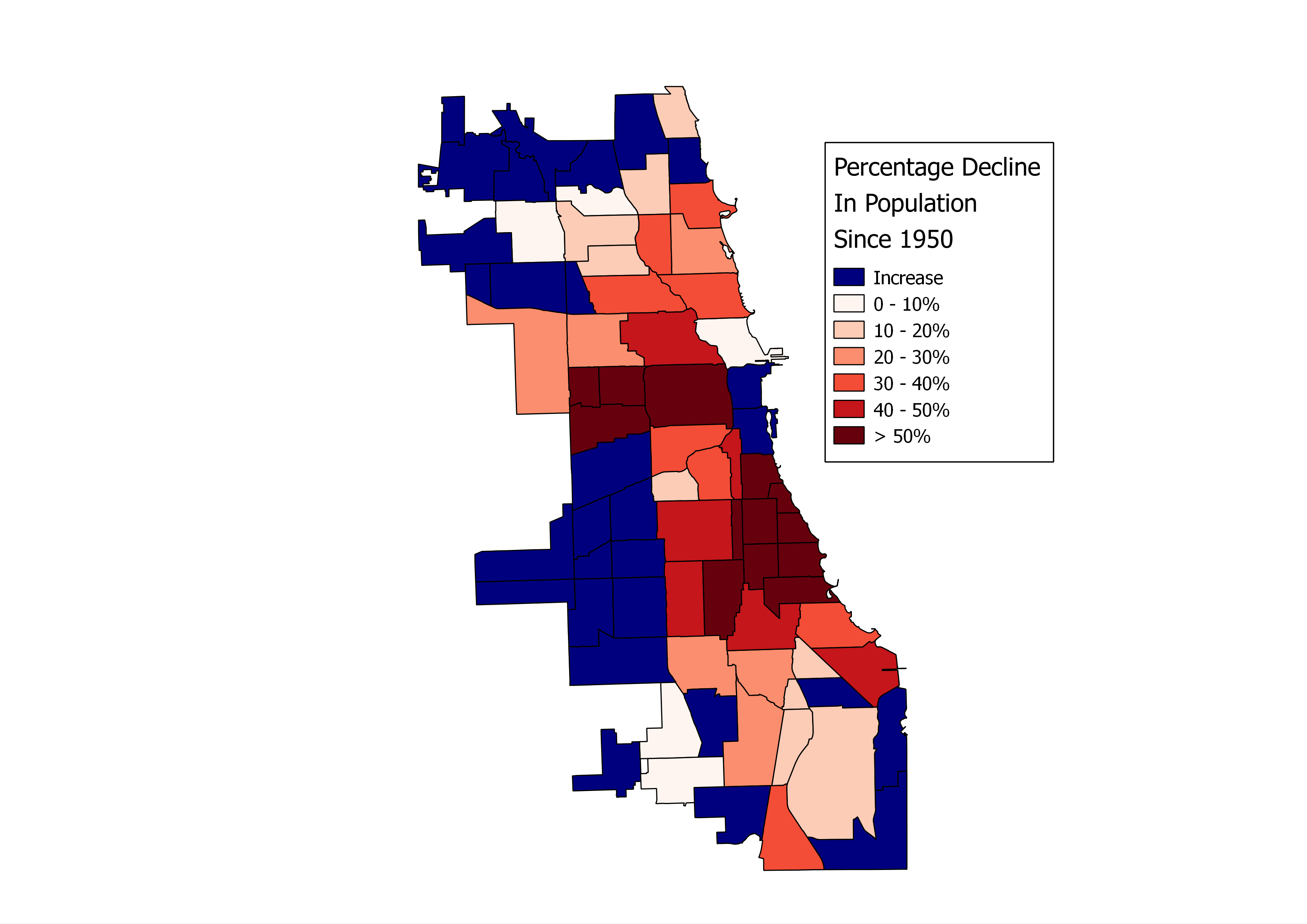
Even affluent Chicago neighborhoods, like Lincoln Park, have lost significant numbers of residents

Rust Belt cities like Chicago have declined in population since the mid-1900s and the population loss is not just limited to poorer neighborhoods:

For a long time, most accounts of Chicago’s lagging population have focused on parts of the South and West Sides where many residents, largely African-American, have decided to decamp for the suburbs or the South in search of better schools, less crime, and more jobs.But the under-appreciated flip side of population loss in those parts of the city is that places that ought to be growing like gangbusters are stagnant, often sitting 25% to 50% below their peak populations. Lakeview, for example, was once home to 124,000 people; its population is now 94,000. North Center is down from nearly 49,000 to under 32,000. West Town, which includes Wicker Park and Bucktown, has fallen from 187,000 to 81,000.

Decline5010

What explains the population loss in even popular neighborhoods? Here is one possible answer:

Since replacing a couple two-flats with a courtyard building is now illegal, developers make money by tearing down an old two-flat and building a luxury two-flat in its place. Or they build a mansion, and the neighborhood actually loses a housing unit. As a result, as a neighborhood becomes more attractive, the city encourages fewer people to live there.

Zoning (theoretically based on improving the neighborhood) plus chasing profits may just lead to population loss. This could be balanced out by approving more high-density housing in a particular area (like the Loop are in specific portions of popular neighborhoods as to limit their effect) but that leads to major changes in two places.

It is still worth noting that the areas that seen an increase in population are either (1) the Loop with a reemphasis on residential construction and (2) community areas on the edges of the city which other lower densities as well as potentially more open land since 1950.

How should the 1995 Chicago heat wave deaths be commemorated?

An arts critics think about how Chicago might remember the deaths of hundreds in the 1995 heat wave:

After all, events that caused far fewer deaths have been the subject of remembrances, designed to honor those who died. July 1995 has yet to make into that civic category, but it deserves a spot. Perchance someone may convene a discussion between those who were involved in that crisis and ponder what was learned (I should note that Klinenberg also charges the media, including the management of this newspaper, with some culpability in the tardiness of the connecting of the dots, while acknowledging some formidable reportage).

More useful, though, might be an artistic response.

A commissioned symphonic piece, perhaps played outdoors. A concert honoring those who died. A dance work. Some stirring poetic words. Some deep collective thoughts from city leaders as to if, or how, the city has changed since then and where there still is work to be done. Some consideration of whether we now do a better job of taking care of each other, whatever the weather outside. It is worth the attention of the city’s artists. And politicians.

“Marking it as a historic event is important,” Egdorf said. “If only to remind people to look after their neighbors.”

Three quick thoughts:

1. Given the demographics of those who died, such a commemoration could also go a long ways toward addressing social divisions such as those involving age, class, and race. Important figures are often commemorated but what about a mass number of average residents?

2. For the social forces that contributed to who died in this particular heat wave, I recommend Heat Wave by sociologist Eric Klinenberg.

3. The idea of having an artistic response to this disaster is an interesting one. We often have solemn commemorations but this presents an opportunity to create something new of tragedy.

Essay on Chicago’s alleys

You aren’t going to find too many erudite essays like this one on the subject of Chicago’s alleys:

Thus, alleys in Chicago, as in most other cities, evolved organically: as a general product of function and construction, but with modulations in dimension, materiality, position, and construction, readily changed to suit the needs of its neighbors and occupants. Fluxing along their entire lengths, they cut a byzantine pattern in the city’s figure ground, contributing to its unmistakable appearance in plan without serving as the primary warp and weft of the fabric…

The results are not always beautiful or orthodox, but they are usually interesting; alleys seen in this light could be conceived as both museums and laboratories for material combinations and adjacencies, methods of assembly and detailing. But in another light, alleys are urban canyons—broken glass, vegetation clinging to the fragile mortar joints, with a single swath of sky above: more products of time and erosion, with human intervention to architectonic formations what glaciers are to geology. Again: raw super-nature registered through a Kantian impression of the sublime…

And consider this: glamour in its modern manifestations is generally assigned to objects and places that are alluring, attractive, and special. Its secondary connotation is less positive; a permutation of Norse and Scottish words that tie it to illusion and obfuscation, spells of the eye meant to conceal true natures. In that vein, is it so difficult to see ordinary as glamour, and alleys as extraordinary? We would do well to keep ourselves open; there may be something truly remarkable lying in plain sight within the gravel and brick.

For those who know cities well, I suspect many of them could tell of places where they found something sublime in the non-glamorous places. Much of the attention paid to major cities focuses on major works (like skylines) while residents and others who take a longer and deeper look see a different side.

I was reminded of Chicago’s alleys recently when showing my class part of Mitchell Duneier’s video supplement to his ethnography Sidewalk. In the film, we see images of the subjects of his research – homeless street vendors – wandering through New York City’s garbage in order to find books, magazines, and other things to sell at their sidewalk tables. There was so much garbage simply piled at the curb, not exactly a glamorous sight. In contrast, alleys allow some of these basic functions to be moved behind buildings and open up sidewalks for more pedestrian and social uses.

Chicago named top metro area for business location

For the second straight year, Site Selection picked the Chicago metropolitan area as its top metro of the year:

In fact, 385 companies either expanded or located in Chicago in 2014, resulting in the city being named Site Selection’s Top Metro in the US for the second straight year. The consecutive wins are a pleasant endorsement, says Jeff Malehorn, president and CEO of World Business Chicago…

Chicago’s appeal is hardly surprising. The city’s boasts outstanding transportation and logistical assets, including two international airports, a rail hub and seaport, and stands at the crossroads of major Interstates. Chicago and the region are home to a wealth of talent educated at some of the nation’s premier colleges and universities. Foreign companies looking for a US home are drawn to the city’s diverse ethnic population. “Any company outside the US can look to Chicago and see a home,” says Malehorn.

Project highlights for Chicago in 2014 include:

  • Valence Health — a health services company based in Chicago adding 500 jobs over the next five years;
  • Yelp — the online review and advertising site based in San Francisco, Calif., is opening an office in Chicago and plans to hire 300 employees;
  • Braintree — the global payments platform expanded into a 65,000-sq.-ft. (6,000-sq.-m.) headquarters on the eighth floor of the Merchandise Mart. The company is adding 360 new jobs by 2017.
  • ADM — the food services company opened its new global headquarters in downtown Chicago in August 2014…

In figures released in January, Chicago posted its lowest unemployment rate since April 2008, 6.2 percent. The number of city residents employed in December 2014 increased by more than 38,000. The jobs were mostly attributed to professional and business services, education and health service and transportation and warehousing. Malehorn says diversity is a theme in Chicago’s growth, but so is innovation and disruption.

I wonder how the city’s critics would respond. Even with a perilous budget, state issues, Chicago corruption, and cold weather, Chicago continues to be a desirable site for business. They might say that this all happens in spite of the problems..but how would we know? Regardless, this is another piece of evidence that Chicago deserves its lofty ranking among the top global cities in the world.

Just how much is the Willis Tower worth?

News is that the Willis Tower in Chicago is up for sale and one insider suggests it could go for $1.5 billion:

The owners of the Willis Tower have hired Eastdil Secured to seek a sale, according to an offering book already given to potential buyers. The property’s owners are being advised in the deal by Chicago-based Stephen Livaditis and New York-based Douglas Harmon, senior managing directors at Eastdil, according to the materials…

Chicago is coming off the strongest year of office building sales downtown in seven years. Boosted by low interest rates, a strong real estate appetite for U.S. real estate by domestic and international investors and comparatively higher pricing in coastal cities such as New York and San Francisco, Chicago in 2014 experienced some of its biggest office deals…

Industry newsletter Real Estate Alert, which first reported Willis Tower was being shopped, estimated it could sell for about $1.5 billion. That would be almost $400 for each of the tower’s nearly 3.8 million square feet of office space.

But because of its huge size and unusually broad sources of revenue, experts say Willis Tower’s value is more difficult to pinpoint than a traditional office property.

Sounds like a thriving market right now. Building occupancy is up in recent years and several other large office buildings have sold for high prices in the last year or so.

It would be fascinating to see what happens if the name changes again. How would Chicagoans react? The Willis Tower switchover never completely happened – hard to believe that was over 10 years ago now – so would a new name work? We are not there yet but could be headed toward a world where major buildings consistently change names as they change owners or even develop sponsorship deals to have particular names?