Chicago named top metro area for business location

For the second straight year, Site Selection picked the Chicago metropolitan area as its top metro of the year:

In fact, 385 companies either expanded or located in Chicago in 2014, resulting in the city being named Site Selection’s Top Metro in the US for the second straight year. The consecutive wins are a pleasant endorsement, says Jeff Malehorn, president and CEO of World Business Chicago…

Chicago’s appeal is hardly surprising. The city’s boasts outstanding transportation and logistical assets, including two international airports, a rail hub and seaport, and stands at the crossroads of major Interstates. Chicago and the region are home to a wealth of talent educated at some of the nation’s premier colleges and universities. Foreign companies looking for a US home are drawn to the city’s diverse ethnic population. “Any company outside the US can look to Chicago and see a home,” says Malehorn.

Project highlights for Chicago in 2014 include:

  • Valence Health — a health services company based in Chicago adding 500 jobs over the next five years;
  • Yelp — the online review and advertising site based in San Francisco, Calif., is opening an office in Chicago and plans to hire 300 employees;
  • Braintree — the global payments platform expanded into a 65,000-sq.-ft. (6,000-sq.-m.) headquarters on the eighth floor of the Merchandise Mart. The company is adding 360 new jobs by 2017.
  • ADM — the food services company opened its new global headquarters in downtown Chicago in August 2014…

In figures released in January, Chicago posted its lowest unemployment rate since April 2008, 6.2 percent. The number of city residents employed in December 2014 increased by more than 38,000. The jobs were mostly attributed to professional and business services, education and health service and transportation and warehousing. Malehorn says diversity is a theme in Chicago’s growth, but so is innovation and disruption.

I wonder how the city’s critics would respond. Even with a perilous budget, state issues, Chicago corruption, and cold weather, Chicago continues to be a desirable site for business. They might say that this all happens in spite of the problems..but how would we know? Regardless, this is another piece of evidence that Chicago deserves its lofty ranking among the top global cities in the world.

Just how much is the Willis Tower worth?

News is that the Willis Tower in Chicago is up for sale and one insider suggests it could go for $1.5 billion:

The owners of the Willis Tower have hired Eastdil Secured to seek a sale, according to an offering book already given to potential buyers. The property’s owners are being advised in the deal by Chicago-based Stephen Livaditis and New York-based Douglas Harmon, senior managing directors at Eastdil, according to the materials…

Chicago is coming off the strongest year of office building sales downtown in seven years. Boosted by low interest rates, a strong real estate appetite for U.S. real estate by domestic and international investors and comparatively higher pricing in coastal cities such as New York and San Francisco, Chicago in 2014 experienced some of its biggest office deals…

Industry newsletter Real Estate Alert, which first reported Willis Tower was being shopped, estimated it could sell for about $1.5 billion. That would be almost $400 for each of the tower’s nearly 3.8 million square feet of office space.

But because of its huge size and unusually broad sources of revenue, experts say Willis Tower’s value is more difficult to pinpoint than a traditional office property.

Sounds like a thriving market right now. Building occupancy is up in recent years and several other large office buildings have sold for high prices in the last year or so.

It would be fascinating to see what happens if the name changes again. How would Chicagoans react? The Willis Tower switchover never completely happened – hard to believe that was over 10 years ago now – so would a new name work? We are not there yet but could be headed toward a world where major buildings consistently change names as they change owners or even develop sponsorship deals to have particular names?

Quick roundup of notable Chicago by drone

Many have seen famous Chicago sights in person or via photography but here are links to some impressive videos of Chicago by drone. The best thing the drone adds to seeing Chicago? Changing the level of sight so as to not just be on the ground or above everything. Now, where is the ultra-impressive promotional video or commercial for Chicago utilizing this technology?

Gentrification limited in Chicago; should worry more about neighborhoods in severe decline

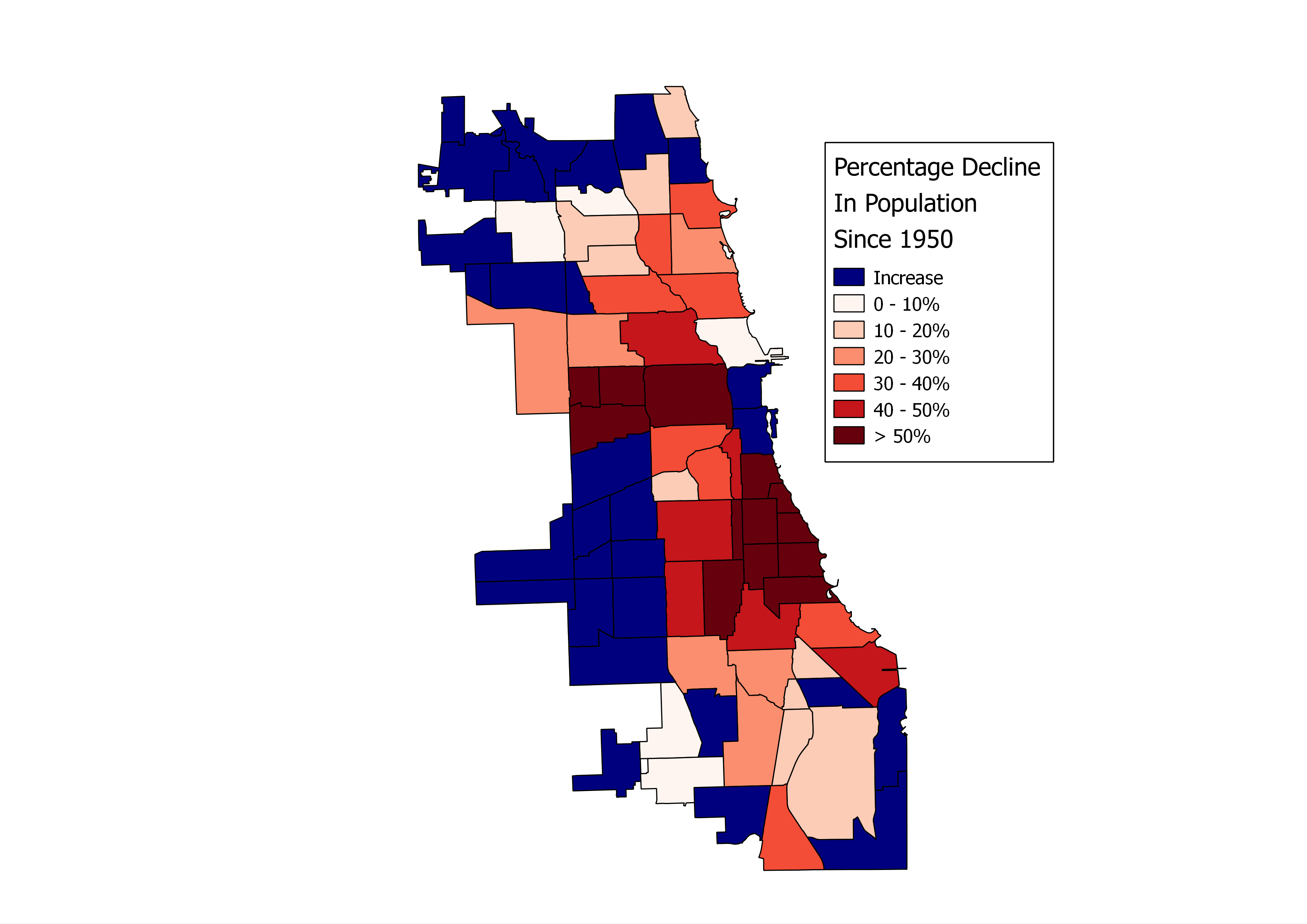
Gentrification may get a lot of attention in big cities but one journalist suggests the more influential issue in Chicago is the number of neighborhoods that have undergone severe declines.

At WBEZ, a Chicago public radio station, our neighborhood bureau reporters produced a package of stories, “There Goes the Neighborhood” (found here) in December, about the changing conditions of neighborhoods in racially segregated Chicago. We partnered with the University of Illinois at Chicago, which created a gentrification index for understanding how to measure neighborhood change in the city, for better or worse. The index measures 13 indicators of neighborhood conditions, including race, income, house values, education, and even the percentage of kids attending private schools. The findings confirmed and challenged some of our own notions, but the main takeaway is that gentrification is not as pervasive throughout Chicago as conventional wisdom might suggest.

Scoring neighborhoods based on the index, Chicago’s 77 neighborhoods were grouped into nine categories ranging from “stable upper/middle class,” meaning index scores remained high since the 1970s, to “severe declines,” meaning those scores dropped significantly since the ’70s. The “gentrification” category captured neighborhoods that had low index scores in the 1970s, but grew significantly higher by 2010. There were only nine neighborhoods that fit that “gentrifying” classification, almost all of them in downtown Chicago (“The Loop”) or just north of it, areas that have been historically white. These places were basically immune to the housing crash, but meanwhile a glut of luxury high rises cast shadows over Lake Michigan.

The category you want to pay attention to, though is “severe decline” — 14 neighborhoods found mostly in South and West Chicago have populations that are, on average, two-thirds African American. Add those to the 12 neighborhoods that have remained in extreme poverty since the ’70s, of which 94.5 percent of residents are African American…

Policymakers, hence, must address the concerns of inequitable development across neighborhoods and income inequality, which are both also national issues. According to a City Observatory report examining urban poverty released last year, the problem over the past four decades is not wealthy whites infiltrating black and Latino neighborhoods with designer Pulaski hatchets and vegan cupcake shops. Governing magazine came to similar conclusions, showing low percentages of gentrified Census tracts in Chicago since 1990.

Gentrification might be the sexy topic but addressing the pressing issues in persistently disadvantaged neighborhoods would likely help more people in the long run. Of course, addressing the issues in poor neighborhoods is complex and not change may not come as quickly as it does through gentrification. Given Chicago’s long history of residential segregation, many of these poor neighborhoods – which are often heavily non-white – are not in any danger of gentrification anytime soon because they are far removed from the edges of wealthier white neighborhoods where good real estate deals or trendy spaces appealing to young, white, creative types might be found.


Chicago to get its first national monument: Pullman Park district

George Pullman’s factory town on Chicago’s south side is to be named a national monument next week:

President Obama will designate Chicago’s Pullman Park district, an iconic site in African American and labor history, as a national monument next week, according to White House officials.

The area, which includes nearly 90?percent of the original buildings that rail car magnate George Pullman built a century ago for his factory town, was the birthplace of the nation’s first African American labor union. The president will travel to Chicago Feb. 19 to make the designation in person, said White House spokesman Frank Benenati in an e-mail…

“The people who are part of the Pullman legacy helped to shape America as we know it today,” Lynn McClure, Midwest senior director for the National Parks Conservation Association, said in a statement. “Pullman workers fought for fair labor conditions in the late 19th century and the Pullman porters helped advance America’s civil rights movement… Thanks to the president, Pullman’s story will soon be remembered and recounted for the millions of people that visit America’s national parks each year.”…

Chicago is one of the only major cities in the U.S. that does not have a national park.

Status-anxious Chicago now gets a national park and at least one symbol that its history is important. Some of the earlier discussion about this possible monument had to do with development opportunities; now that there may be a steady stream of visitors to the site, how can it help promote economic development? I’m not sure what I would imagine growing up around such a site; souvenir shops? Restaurants to help feed visitors?

From Chicago grain elevators to art/film space to potential spot for redevelopment

Urban properties can go through a series of changes and one set of grain elevators on Chicago’s Southwest Side have seen their share of uses:

Grain elevators’ histories are often marred with explosions (something about the dust mixed with oxygen), and one such spontaneous combustion on these 24 acres led to the current John Metcalf-designed “Damen Silos” property, formerly the Santa Fe Railroad Grain Elevator, built in 1906 at 2900 S Damen off the South Branch of the Chicago River. Keep in mind the staggering presence of 35 80-foot silos in the pre-skyscraper era. They churned out 400,000 bushels thanks to machines running on 1,500 horsepower (from steam and electricity). Unfortunately while users changed (Stratton Grain Co was up next), explosions continued…

The property’s been a fertile stomping ground for the street art and photography set for years. Brent Bandemer’s 2012 short film “Gone” documents the life of David “Gone” Brault, a 23-year-old suspended college student squatting at the Damen Silos to teach others how to survive when the apocalypse comes. (Understandable, given the silos’ arty End of Days vibe, and where Chicago apartment rents are headed.) As David’s favorite graffiti on the property says, “One day the whole city will be this beautiful.” In 2013 it was a filming location for Michael Bay’s Transformers: Age of Extinction, whose special effects hit eerily close to home…

The state’s only remaining vacant land in Chicago, the property’s location (with Chicago River frontage and access to interstate travel) should be its biggest selling point, says the CMS spokeswoman, along with lots of land to play with for industrial redevelopment. Looking at other grain elevators around the world, you’ll find creative adaptive reuse strategies ranging from residential to office to data centers to artsy (they work well as both canvases and projection screens). A distributor who needs water and highway access would be more practical, though probably not as pretty.

Perhaps this exemplifies the shifts in the American economy in the last century or so: Chicago as an agricultural center taking in grain from all over the Midwest but then losing agricultural and manufacturing jobs as the country moved to a knowledge economy. The empty space then finds a second use as space for artists who can work with the postindustrial vibe. Now, the property offers some advantages for redevelopment with easy access to transportation (one of Chicago’s continued strengths).

At the least, this property offers some unique potential in a city known for its industrial and agricultural past.

Using Chicago skyscrapers as inspirations for spaceships

“Jupiter Ascending” may not be very good but some of the spaceships are based on Chicago architecture:

When Hull came to Chicago, the Wachowskis began peppering him with reference photographs of Chicago buildings, facades, landmarks, ornamental detail and infrastructure. “Of all the directors I have worked with, they are by far the most architecture-minded,” he said. “They wanted a very decorative vision for the ships, almost Louis XIV-like in places, existing alongside this other aesthetic, far more gothic and less feminine.”

Indeed, the Wachowskis, who started a small construction company and worked as carpenters before becoming filmmakers, wanted the two warring ships at the center of “Jupiter Ascending” to somewhat reflect Chicago itself. “I like how the great curling femininity of the Frank Gehry (Pritzker Pavilion) is juxtaposed against the weight of those harsh, more severe buildings on Michigan Avenue,” Lana said. “I liked that tension in Chicago, that something as elegant as a big river can curl through so many grandiose statements. When we were looking at the design of the ships, we kept exploring this, placing almost baroque, exuberant levels of detail on one end, while on the other, contrasting a rigorous, rational logic.”…

“But also I really love the top of the Carbide & Carbon Building (on Michigan Avenue),” Lana said. So its lighthouse peak informs the back of Titus’ ship, while the front is, well, a play on the flying buttresses that shape the top of the Tribune Tower. “But I often wasn’t flamboyant enough for the Wachowskis,” Hull said. So the gold-green design along the facade of the Carbide building is mirrored on the outside of the ship. And inside: The ceiling of the ship’s loading dock is reminiscent of the dense mosaics in the Chicago Cultural Center ceilings; the long, vaulted chapel is vaguely similar to the reading room of the Newberry Library. “Which was a sanctuary for me as a kid,” Lana said, “where I went when I cut school.”

Balem, played by Eddie Redmayne, is the imperialist, the severe, ominous bully. His ship, therefore, is gothic, less curvaceous than Titus’ ride. The front end, its T-shaped bow, has some inspiration in the terra-cotta faces that watch from the facade of the old Tree Studios building on Ontario Street. And there are hints of the former Midway Gardens entertainment venue in Hyde Park, designed by Frank Lloyd Wright (torn down in 1929). “His ship is more of a towering, hard-looking, Albert Speer-ish brutalism,” Hull said, “but it would be too on the nose for his designs to just reflect that, to not suggest Balem wouldn’t want some ornamental embellishment to his world.” So, his boardroom has touches of the latticework beneath the Loop “L” tracks.

An interesting source of inspiration for objects – spaceships – that we might typically think are otherwordly or something completely different. Additionally, buildings are pretty static, even if they are involved in dynamic social settings, while spaceships have incredible mobility. But, as noted in this earlier post about The Hunger Games, it is difficult to make something completely new. Human creativity rarely involves completely innovative ideas that have never been expressed before but rather often involves taking existing forms and objects and doing new things with the mix. So, in trying to imagine the future, why not draw some on the past while also adding potential changes?

This is also a reminder that Chicago architecture is influential. If we do get to an age of large spacecraft, would Chicago still be a major inspiration? Could we have competing fleets based on different global cities?

“Using a Real Life SimCity to Design a Massive Development”

As a massive SimCity fan, I find this use of predictive urban models intriguing:

596 acres, 50,000 residents, $4 billion dollars and even a 1,500-boat marina: Everything about the proposed Chicago Lakeside Development, developer Dan McCaffery’s massive micro-city being built at the former site of the U.S. Steel Southworks Plant, is on a different scale. It follows that the design process for this mixed-use project requires a different set of tools, in this case, LakeSim, an advanced computer modeling program. Developed as part of a collaboration between the University of Chicago, Argonne National Laboratory, Skidmore, Owings & Merrill and McCaffery Interests, this program functions like a customized SimCity, analyzing and simulating weather, traffic patterns and energy usage to help architects and designers plan for a site that may eventually contain more than 500 buildings.

“A lot of the Big Data approaches tend to be statistical in nature, looking at past data,” says Argonne scientist Jonathan Ozik. “We’re modeling a complex system of interactive components, running the data forward, so what we end up having is your SimCity analogy, energy systems interacting, vehicles and people moving. What we’re doing here is using a complex systems approach to tackle the problem.”…

The challenge for planners is predicting how so many different systems and variables will interact. LakeSim gives them a framework to analyze these systems over long timelines and run millions of scenarios much quicker than past models — hours as opposed to days — asking “hundreds of questions at once,” according to Ozik. The program is a step forward from similar modeling software, especially valuable at a site that in most respects is being built from scratch.

This seems quite useful at this point but it will be necessary to look at this down the road once the site is developed. How much time did the model save? How accurate was the model? Did relying on such a model lead to negative outcomes? If this is a predictive model, it may be only as good as the outcome.

Interesting to note that the commenters at the bottom are wondering where all the people to live in this development are going to come from. I assume that demand is appropriately accounted for in the model?

NPR photojournal looks at “The end of Chicago’s public housing”

NPR has put together an interesting site with photos and text that explores the demolition of Chicago’s public housing. Some of the more interesting lines:

Ironically, the [Robert Taylor Homes] were named for a Chicago Housing Authority board member who resigned in 1950 — in opposition to the city’s plans to concentrate public housing in historically poor, black neighborhoods…

The buildings became hulking symbols of urban dysfunction to the suburbanites who saw them from the expressway on their daily commute…

While some have described public housing as a tangle of failed policies and urban planning, to the people who lived there, it was home. But at the end of the 1990s, like the tenement residents before them, they were told that their world would be “transformed.” Many would not be able to live there anymore…

[After the demolitions:] People lost track of each other; the housing authority lost track of them.

A lot of lives were affected even as there really hasn’t been much public conversation about the fate of the public housing residents. Ironically, removing the high-rises may just have made the problems of housing in the Chicago region – and there is a lot of need for good affordable housing, evidenced by recent sign-ups for the public housing waiting lists – even more difficult to see.

See earlier posts about the demolitions of the last high-rises at Cabrini-Green here, here, and here.

Seeing 1940s Chicago in a lost promotional film

Chicago, the #7 global city today, looked quite different in the 1940s in long-lost promotional footage:

In contrast to typical city promotional films, this video offers glimpses of downtown spots like Buckingham Fountain along with the city’s manufacturing plants and meat-packing facilities. The footage also comes with all sorts of statistics and facts. For example, Michigan Boulevard (now Michigan Avenue) carried more than 55,000 automobiles on an average day.

Based on the credits, it appears the video was produced by the Chicago Board of Education, with an assist from United Airlines (for the aerial shots). The release date of the film has also been pinned to between 1945 and 1946. John Howatt, credited as the Business Manager of the Board in the video, was elected on January 8, 1945, and Johnnie Neblett, the narrator, died on September 15, 1946.

Altman writes that he thinks the video was meant to attract people or companies to Chicago, or perhaps as a resource in the classroom. But according to DNAInfo, a spokesman from the Chicago Board of Education said that staff haven’t been able to find any reference to the film in its archives.

A few quick thoughts on seeing this film:

1. The tall buildings are quite different. One, there aren’t as many. Yes, Chicago was dense but it was more due to low-rises. Two, they don’t have the shine that we have come to associate with skyscrapers and instead tend to be covered in stone or masonry and are marked by pollution. (Blame the International Style, which bloomed in Chicago.)

2. The focus on industry is interesting. Manufacturing would have made up more of the economy at the time (Chicago, like many Rust Belt cities, lost hundreds of thousands of manufacturing jobs in the late 20th century) while the emphasis today is more on finance and services.

3. Some of the footage of Lake Shore Drive seems quaint as it appears to sometimes have two lanes each direction without many barriers between each side or the paths and sidewalks nearby. This was the era before major highways as we know them which were not completed in the Chicago region until the mid 1950s.

4. What is missing and can be found in pretty much any major city? Like any growth machine which wants to promote high-quality growth, this film omits the lower-class areas of the city. Chicago at the time had numerous poor neighborhoods including the Black Belt on the South Side which was the only place where blacks could live. These areas somehow didn’t make it in…

5. I wonder at times how much the less-than-high-def footage influences our interpretations of the past. Chicago looks fairly inviting in this film – bustling, beautiful lakefront, lots of nice buildings – yet it all looks so grainy. We’ve reduced this look to a filter on our Instagram accounts but it is hard to find the HD images that might help us make an apples-to-apples comparison of scenes.