What society defines as “sinful” and ranking the most sinful cities

A recent Wallethub list of the “most sinful cities in America” is built on this definition of sin:

Photo by Pavel Danilyuk on Pexels.com

“Regardless of any particular religious tenets, certain activities are considered ‘sinful’ by society as a whole. Sometimes, these activities are always bad, like violent crimes or identity theft. In other cases, they may be relatively harmless in moderation but incredibly destructive when not kept under control, such as alcohol use or gambling. The most sinful cities are those where illicit activities and vices alike are the most widespread.” – Chip Lupo, WalletHub Analyst…

To determine the most sinful cities in America, WalletHub compared 182 cities — including the 150 most populated U.S. cities, plus at least two of the most populated cities in each state — across seven key dimensions: 1) Anger & Hatred, 2) Jealousy, 3) Excesses & Vices, 4) Greed, 5) Lust, 6) Vanity and 7) Laziness.

We examined those dimensions using 37 relevant metrics listed below with their corresponding weights. Each metric was graded on a 100-point scale, with a score of 100 representing the highest level of sinfulness.

I find intriguing the idea that sins as defined by American society are less about religious traditions and more about social constructions of sin. Where do these ideas about sin come from and who defines them? The seven categories seem like they could match up with the traditional seven deadly sins.

If Americans see a list about sins, how many connect that to a religious meaning rather than a social meaning? If Americans grow up loosely connected to religion or are not connected at all, how do they learn about sin? Perhaps sin is more like modern capitalism which sociologist Max Weber argued lost it religious motivations and meanings decades ago. Are these measures good proxies for secularized sins?

Looking at the list of cities, some would not be a surprise. Others might be. For example, a number of cities in what would be considered the Bible Belt make the top 10. There are also some cities that some Americans might assume are higher than they are (Washington, D.C., at #35 and San Francisco at #42, for two examples).

Finances, ideal lifestyles, and the push and pull away from cities experienced by young adults

Looking back at residential patterns after the late 2000s economic crisis and the COVID-19 pandemic, what motivated younger adults to leave cities and move to suburban or rural communities?

Photo by Kelly on Pexels.com

Later waves that arrived just after the Great Recession, however, had a different type of migrant identity. As luxury housing continued to be built in New York City and affordable areas disappeared, some residents found the big city “inhospitable to their desired urban lifestyle and identity”: “Many of today’s newcomers to Newburgh use the term ‘priced out’…though few actually left in direct response to their rents rising or their landlord pressuring them to move out,” Ocejo writes. “But cost still played an important role in their decision to relocate…. They felt displaced from their own potential and opportunities to thrive as middle-class urbanites living a specific city lifestyle in the metropolis.”

Herein lies the tension between getting “pushed” from a city versus “pulled.” Some contemporary migrants are pushed from a particular lifestyle and pulled by a promise that it can be built elsewhere. Unlike midcentury white flight—which was highly dependent on the construction of suburban housing, racism, and statecraft—middle-class millennials (especially those facing mounting city prices and remote work) find that smaller cities and towns cater to a broader vision for life, one that provides opportunities to buy a house, build a business, or comfortably raise a family…

“When people move from one community to another…they leave behind their old job, connections, identity, and seek out new ones. They force themselves to go meet their neighbors, or to show up at a new church on Sunday, despite the awkwardness,” Appelbaum writes. What this might mean for rural or metro areas is yet to be seen. But for people moving out of large cities, it’s redefining what upward mobility might look like. Building wealth through housing may be unattainable, but it’s being replaced by a search for a new American dream: self-actualization.

What I read in this description is an intertwining of financial matters and what lifestyle people see themselves having. Costs and resources matter; housing is a sizable portion of many budgets. Housing has become more expensive in many American metropolitan areas. But cultural narratives and individual aspirations also matter; what life does someone want to live? What do they see as a good life?

On this first factor, it helps to have more financial resources. The stories told in this article seem to involve people who had enough resources that they had options of where to live. They could make a major move, perhaps by selling a residence in one place to go to another. Or they had careers and job skills that enabled them to live in multiple places.

On this second factor, Americans have developed a lot of narratives over time about desirable lives. They want a single-family home in the suburbs. They want to be individuals who pursue their own path (the self-actualization suggested above). They want to engage community life. And so on.

Perhaps then it would be helpful to think about a two-pole line that demonstrates how people make decisions about where to live and what to pursue. On one side of the line is finances and what is possible in terms of money and resources. On the other side of the line is an image of the life they want to live and what that entails on a day-to-day and long-term basis. Depending on the current situation personally and in society, they might slide a marker more toward one pole than the other.

(Does this describe how young adults make these decisions or is this limited to a certain subset with particular resources and goals?)

Chicago as the epicenter for the creation of American time zones

When Americans decided on time zones in the late 1800s, where did they gather to formalize the boundaries and clocks? Chicago, a railroad center:

Photo by Crono Viento on Pexels.com

Until 1883, a Chicagoan asked to tell what time it was could give more than one answer and still be correct.

There was local time, determined by the position of the sun at high noon at a centrally located spot in town, usually City Hall. There was also railroad time, which put Columbus, Ohio, six minutes faster than Cincinnati and 19 minutes faster than Chicago. Scattered across the country were 100 different local time zones, and the railroads had some 53 zones of their own.

To do away with the inevitable confusion, the railroads took the matter into their own hands, holding a General Time Convention in the fall of 1883 at the Grand Pacific Hotel at LaSalle Street and Jackson Boulevard. (Today, a plaque at the location — which is just north of the Chicago Board of Trade Building — notes its significance).

Its purpose: to develop a better and more uniform system of railroad scheduling. The Standard Time System — based on the mean solar time at the central meridian of each time zone — was formally inaugurated on Nov. 18, 1883, a day that came to be known as the “Day of Two Noons.”

Another summary of the same story ended this way:

But it was an astonishingly rapid and successful shift, syncing up almost the entire country in the space of a week, with all roads leading back to Chicago.

Three interrelated features of Chicago stand out to me as contributing to being the place where time zones were agreed upon:

  1. A railroad center with numerous major railways running in and through the city and region.
  2. Business leaders, specifically railroad leaders, pushing for standard time zones in order to help their commercial activity. Chicago was a center for commerce and industry.
  3. The ease of getting in and out of Chicago – lots of railroads, central location in the United States – helped facilitate a meeting there.

These features of Chicago still hold today. The city continues to be a railroad center with lots of traffic throughout the region. It is still a business center, a leading global city. And it still serves as a transportation hub. Just as the railroad executives found it a good place to gather, see the number of important meetings that take place near O’Hare Airport, in the city, and throughout the region.

Might such a meeting in 1883 taken place elsewhere? Perhaps. If something as consequential as time zones were to be decided in 2025, which American city might we expect to host the discussion: the political center of Washington, D.C.? The leading global city of New York? The tech capital in San Francisco?

Chicago, a city of (many suburban) neighborhoods

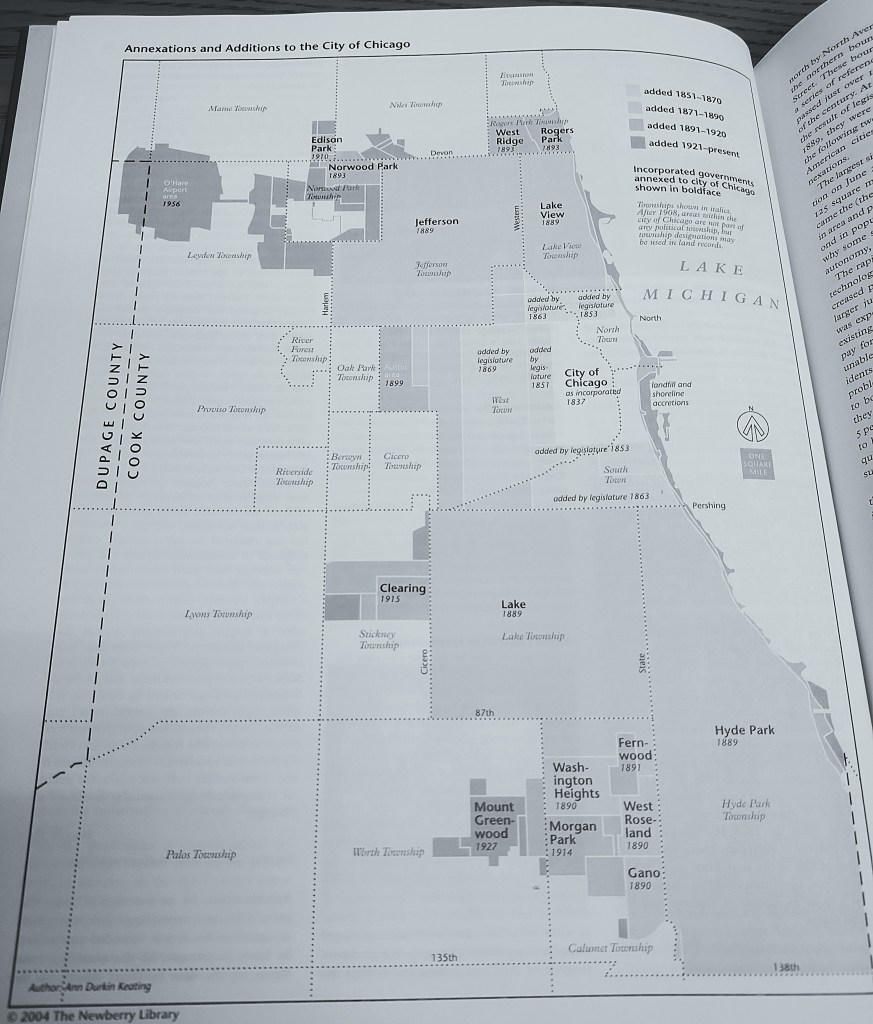
Chicago grew in a way that many American cities have grown: they annexed land and communities just outside their borders. Famously, New York City annexed Brooklyn in 1898 when the separate community across the East River was one of the most populous communities in the United States. But Chicago also had its share of large annexations that helped it add neighborhoods and expand to the borders it has today. The Encyclopedia of Chicago summarizes this process:

The Encyclopedia of Chicago (The University of Chicago Press, 2004), 22

For Chicago, the period of extensive annexations extended from 1851 to 1920. The largest annexation occurred in 1889, when four of five incorporated townships surrounding Chicago (as well as a part of the fifth) were annexed to the city. Most annexations to Chicago during these years came because Chicago offered superior services, from better water connections in the nineteenth century to better high schools in the early twentieth. Later, prior incorporations and suburban resistance to the power and urban complexity of Chicago halted the process.

Chicago is often known now as a city of neighborhoods and starting with efforts by University of Chicago sociologists in the 1920s to define Chicago neighborhoods, it has 77 community areas. But many of these areas were once suburban. Historian Elaine Lewinnek in The Working Man’s Reward discusses what happened in Lake Township, bordered by Pershing, State, 87th, and Cicero, as it developed as an industrial suburb with working-class residents. It was added to the city in 1889, an important year for the city’s boundaries as several other large suburban areas were incorporated into the city including Hyde Park just east of Lake Township and Jefferson Township and Lake View Township on the north side of the Loop.

As these suburban areas became part of the city, they received city services and became part of the larger city’s fabric. They added residents and structures. But they also have hints of suburban life. Row upon row of single-family homes. Strip malls and big box stores. Residents might drive more.

Such neighborhoods can be found in many American cities. Big cities are not just the dense downtowns with skyscrapers, major corporate offices, and certain cultural institutions. They include numerous residential, commercial, and industrial neighborhoods on their edges where the borders of municipal boundaries can blur.

Some American cities have seen no gain in housing values for decades, others with large gains

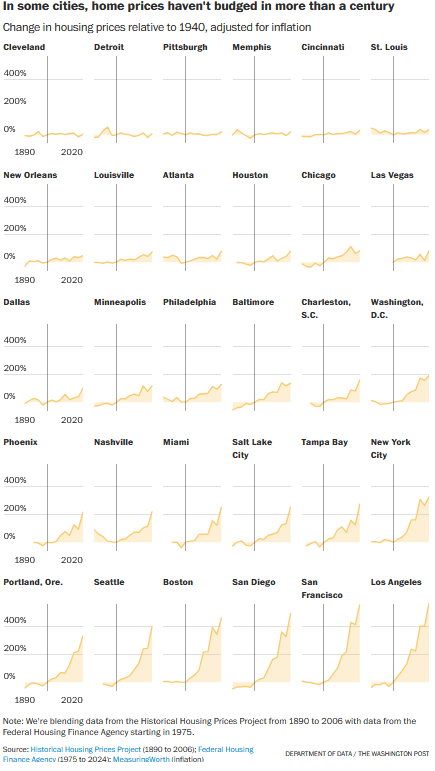
Looking at long-term data regarding housing values in different American cities shows large differences across places:

What drives these differences?

When we stopped to think about that, we couldn’t get it out of our heads. So many of us have internalized the lesson that homes are speculative, flippable investment vehicles, yet in much of the country — Cleveland, Memphis, Detroit, we could keep going — housing has been a truly quotidian commodity. There, home prices simply keep pace with inflation over the long run, no different from spaghetti or sprockets…

Consider that Dallas, Houston, Seattle and Portland, Oregon, all had what the researchers would classify as high demand for housing. But prices in Dallas and Houston have only roughly doubled in price since 1890, compared with a more than sixfold jump in Portland, or almost fivefold in Seattle…

“If prices go up,” Lyons asked us rhetorically, “does supply come on stream to follow? Do people look to build homes?”

Since 1970, the metros where housing stock grew the least relative to population growth — think Los Angeles, San Francisco, San Diego or Seattle — saw the some of the fastest home price growth. While metros that built enough housing — such as Atlanta, Phoenix and Charleston, South Carolina, saw home prices rise much less rapidly, even as their populations soared.

Does this suggest that Americans have come to view houses as investments when some places in the country have not experienced large increases in housing values over time?

For the cities with big increases over time, how do local leaders and residents see the jump in property values? It clearly leads to issues with affordable housing: rising housing values prices some people out of the market, particularly compared to what that market was and what residents had previously experienced. But rising housing costs can be viewed positively: people can sell their properties for more money and rising values can be associated with success.

This might be another reason why it is difficult to address housing issues at a national level. Housing is a very local issue and the cities in the top row of the graphic above have very different conditions compared to the cities in the bottom row.

Jobs as economic engines and prestige for big cities

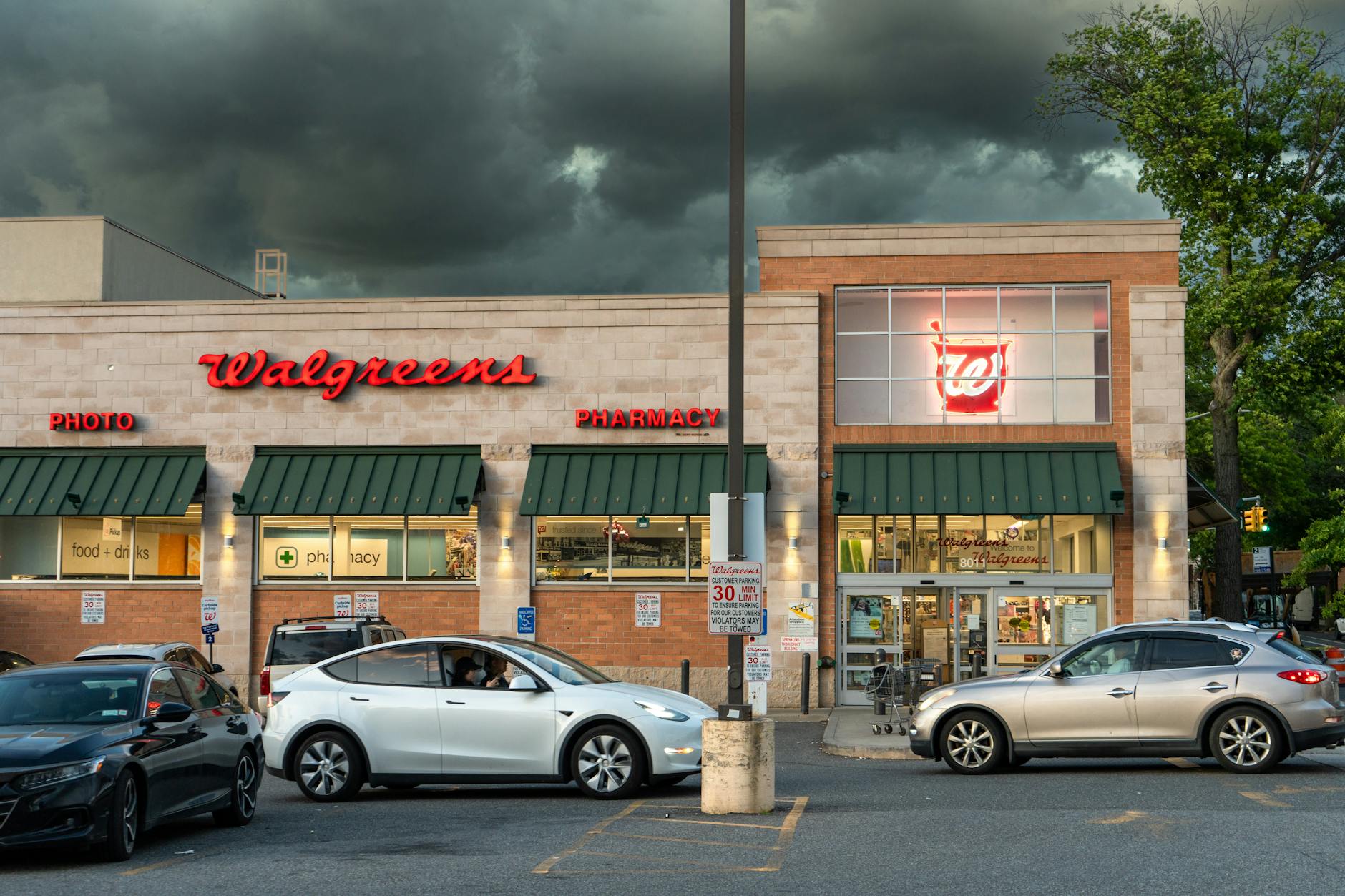
Walgreens recently announced it will move employees from Chicago’s Loop to its suburban headquarters. The Chicago Tribune discusses the consequences:

Photo by Yuugen Rai on Pexels.com

But let’s be honest: this news stings. The city loses many hundreds of workers who are downtown most days of the week. Grabbing lunch. Shopping. Going out after work.

And it loses just a little bit more prestige.

Jobs are often thought of in terms of their economic benefits. A company is hiring and paying people. Those employees then spend money in the community. Having lots of good-paying and/or stable jobs can be a sign of a strong local economy.

But jobs are also about prestige for cities. In this case, the jobs are attached to a large company founded in the city. Having jobs of prominent companies in a community suggests the community is a desirable place to be.

Politicians and leaders love to talk about gaining jobs. “We added this many jobs.” Or “major corporations added jobs here.” It is partly about economics but it is also about status; they can claim to be the one who brought the jobs to the community or they created the conditions that led to the jobs.

In other words, a region may have lots of jobs but if there are constantly stories – or even just perceptions – that companies are eliminating jobs in a city, this can be a blow to the place’s prestige. To lose jobs to another community hints that the place losing the jobs is not as desirable.

Finding the world’s “coolest neighborhoods” and considering their “nowness”

One publication just released a ranking of the coolest neighborhoods in the world:

Photo by Willian Justen de Vasconcellos on Pexels.com

If you’re daydreaming about the most exciting local spots in your next city-break destination, global listing guide, Time Out has you covered with its latest roundup of the “world’s coolest” neighborhoods.

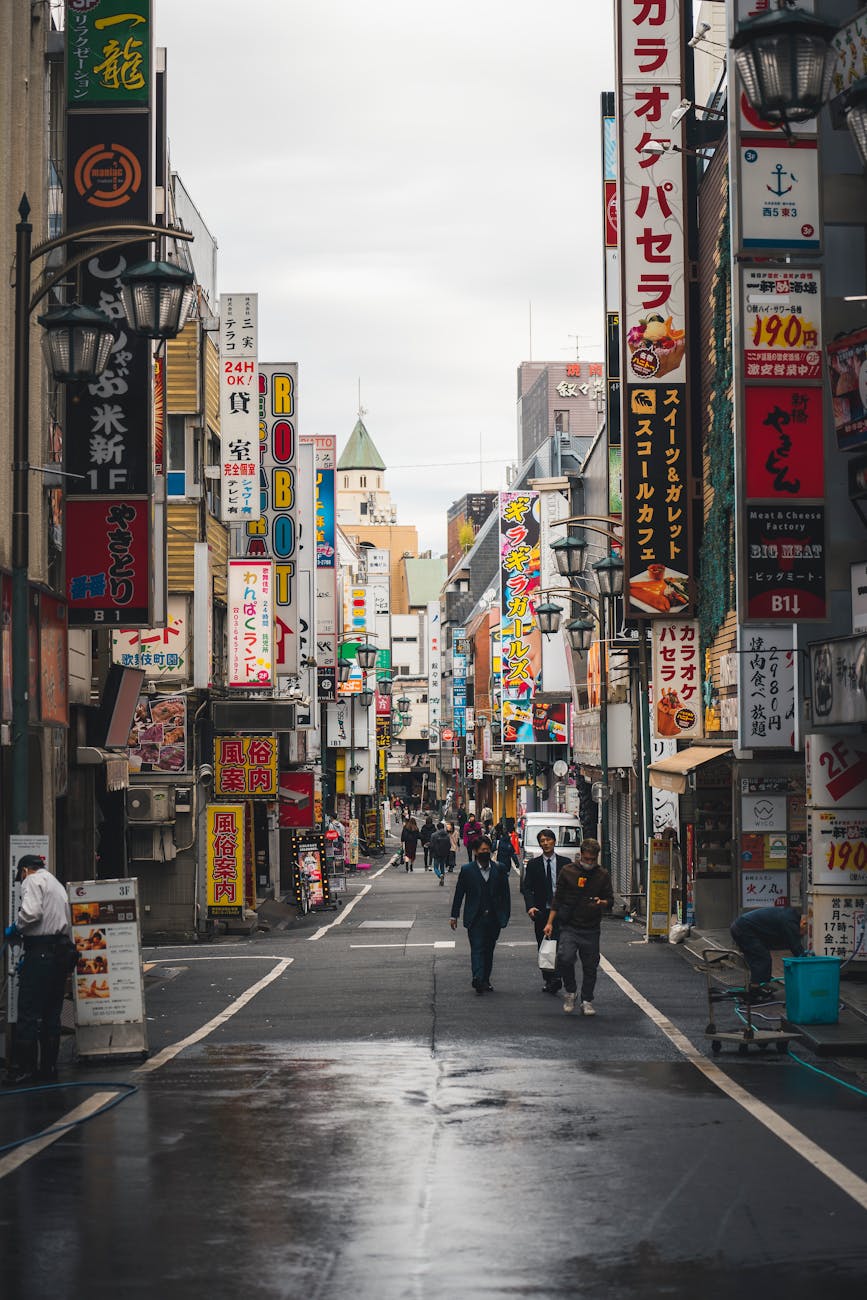
Topping the 2025 rankings is a corner of Tokyo that Time Out calls a “bibliophile nirvana.” Jimbōchō is home to some 130 vintage book stores — Time Out highlights Isseido Booksellers and Kitazawa Bookstore as great starting points for a day of bookish exploring — as well as its coffee-shop culture and delicious curry houses.

Time Out’s annual list is compiled from nominations made by its global network of editors and writers. The selections are then ranked against criteria including culture, community, livability, food and drink and what Time Out describes as “that hard-to-define sense of ‘nowness.’”

A Chicago neighborhood is a little bit down the list:

Rounding out the top five is the highest ranking US spot — Avondale in Chicago, highlighted for its wine bars, wellness studios and music venues. The neighborhood is also praised for its quirky small business scene, which includes retro bowling alley Avondale Bowl and antique mall-themed bar Consignment Lounge. Jeff Wilson, managing partner at Avondale Bowl, told CNN Travel that “seeing many of Avondale’s local, small businesses be included in a list with so many other communities around the globe really shows how many amazing things are happening right around us.”

I have multiple questions after reading about these rankings:

  1. Rankings of places often have to account for a lot of communities. Here, we could start with the many cities in the world. And then each city has numerous neighborhoods, depending on how their size is defined. There are a lot of neighborhoods to choose from.
  2. How long does “nowness” last? What is the half-life for a cool neighborhood? There is something unique about the neighborhoods at the top of list. The activity and meanings present in these neighborhoods might continue at a similar rate over time yet the neighborhood might become less cool to those experiencing the neighborhood.
  3. This list seems geared toward seeking out places to visit. But what these visitors might find attractive could differ from people who live there. Visitors want to find something unique, experience something new. How does this relate to the supply of local housing or job opportunities? Does being identified on such a list lead to more tourists, which then might alter the day-to-day life in the neighborhood? To play off the idea of Chicago as “a city of neighborhoods,” could a traveler be a connoisseur of novel neighborhood experiences?

Condos, investment properties, and limited demand in Canada

Can condos help people find reasonably-priced housing and achieve homeownership? Maybe but viewing them more as investment properties for years means there may now be less demand for condos in Canada:

Photo by Amit Batra on Pexels.com

It didn’t take long to figure out why there were so many empty units on the market: it turns out nobody wants to rent a condo, and nobody wants to buy one either. Condo rents have dropped over the past two years, and according to a recent report from the Canada Mortgage and Housing Corporation, or CMHC, condo sales have fallen by 75 percent in the Greater Toronto Area and 37 percent in the Vancouver area since 2022. The market has become so dire that buyers of pre-construction condos are having difficulty closing their purchases. Banks lend money depending on the present value of the property, and some condos are worth less now than they were when the buyers made their first deposit. As a result, developers have been cancelling construction projects. Some experts say we should have seen this coming…

The simple answer is that many condos built between the late 2010s and early 2020s were constructed not for living but for investment. Since 2000, there has been a steady increase in the proportion of condos used as investment properties. To my surprise, most of the investors were not faceless corporations or foreign investors. Research done by Statistics Canada shows that the typical condo owner is a middle-aged, middle-class Canadian couple. The reigning logic for the middle class was that buying a condo, renting it out to pay for the mortgage, and eventually selling the unit was a solid way to make money. This was especially true in the late 2010s, a period of low interest rates and weak rent control policies. Steady demand for housing, partially caused by increasing immigration, made real estate seem like a sure bet.

Developers knew that most pre-construction buyers were investors rather than people looking to live in the apartments themselves. As a result, they focused on quantity over quality. Vishakh Alex, an architectural designer working in Toronto, said that the directive from developers in the late 2010s was to squeeze in as many units as possible. It is telling that between 1971 and 1990, the median condo in the city was approximately 1,000 square feet, but between 2016 and 2020, the number dropped to roughly 650 square feet…

Yet, as city populations continue to grow, there’s nowhere to build but up. It hardly bears repeating that there is a housing crisis in Canada. Young middle-class people looking to buy their first homes can rarely afford the kinds of houses that they might have grown up in—a cute triplex on a tree-lined street in Trinity-Bellwoods, Toronto, for example, or a townhouse in Kitsilano, Vancouver, with a view of the ocean. And so it is to the condos we must go.

But it is also true that condo living does not have to be, and perhaps should not be, defined by the biggest developers looking to squeeze every drop of profit from mom-and-pop investors and homebuyers.

This shift toward investor properties sounds similar to what has happened in the United States in recent decades with homeowners increasingly viewing their properties as investments and expecting certain returns.

One difference here is that more of these condos might have been second homes. In Privileging Place: How Second Homeowners Transform Communities and Themselves, sociologist Meaghan Stiman explains how only a second home influenced how property owners viewed places and themselves with consequences for communities where these second owners were sometimes present.

If people in cities in Canada and the United States have concerns about investors buying too many properties, whether investors from other countries or institutional investors, what do they make of middle- to upper-class residents buying condos for investments? As the author notes above, these cities clearly need housing. American cities and metropolitan regions need housing. Should certain kinds of investors have limits or should developers be limited in how many investment properties they can construct?

One upside could be that the glut of investment condos does provide some attainable housing. The prices might not fall too far given their initial cost but what if investment condos and homes start becoming options for residents for whom they were not originally intended?

An ongoing negative Trump narrative about cities

President Trump and his political allies continue to discuss cities in particular ways:

Photo by Moneer Ibrahim on Pexels.com

When President Donald Trump declared his third presidential candidacy in 2022, he saved his most colorful language for America’s urban areas, bemoaning “the blood-soaked streets of our once-great cities” and adding that “the cities are rotting, and they are indeed cesspools of blood.”

Later in his campaign, Trump called Milwaukee “horrible” and described Washington, D.C., as a “rat-infested, graffiti-infested shithole.” More recently he said, “These cities, it’s like living in hell.”

Other Republicans have seized on similar dystopian urban images. When Vice President JD Vance visited New York several years ago, he compared the city to a zombie apocalypse, posting: “I have heard it’s violent and disgusting there. But is it like Walking Dead Season 1 or Season 4?”

As Trump ramps up the military presence in Washington — and hints that he may move to take over other cities — his crackdown punctuates a frequent Republican message that American cities embody chaos, lawlessness and immorality, despite widespread recent drops in violent crime. With cities increasingly liberal and rural stretches ever more conservative, Republicans have a growing incentive to attack urban areas as the epitome of all that is wrong with America…

Trump’s rhetoric culminates a long history of American politicians casting cities as hotbeds of vice and social disorder, said Michael Kazin, a historian at Georgetown University and author of “The Populist Persuasion: An American History.” Left-wing populists have often been dismayed by the vast wealth inequality on display in cities, he said, while right-wing populists have recoiled from the elites, immigrants and minorities who live there.

This resonates with some Americans because there is a broader and longer history of criticizing cities in the United States. From the beginning, a number of Americans have idealized small town or rural living. The growth of major cities was accompanied by numerous concerns. When asked today, many Americans say they would prefer to live in small towns.

At the same time, it is hard to imagine the United States today without its big cities and the good things that came with them. A United States without New York, Los Angeles, and Chicago? Or San Francisco, New Orleans, and Cleveland?

Even if voting patterns by geography seem fairly set in American national elections, it would be interesting to hear more politicians articulate messages that cross these boundaries. Are people living in cities, suburbs, and rural more different than they are similar? Breaking through the existing patterns might just require addressing issues that Americans face or care about regardless of where they live.

Housing issues are incredibly local – and they follow patterns across places

The issues of housing in the Chicago region are very local. How Chicago selected public housing sites and later handled the demolition of public housing high-rises. The discussions of affordable housing go in suburbs and the protection of single-family homes from perceived threats. Municipalities get to set their zoning maps, local officials make decisions regarding development, and residents weigh in.

Photo by Dmytro Koplyk on Pexels.com

But at the same time, these are not just local issues. There are patterns across places. What happened with public housing in Chicago may not have been exactly the same as what happened in other major cities but the effects of federal legislation and monies and public perceptions about public housing influenced numerous cities. Suburbs have unique characters but types of suburbs – say edge cities or inner-ring suburbs – can have similar experiences and trajectories. The ways zoning is used to privilege single-family homes and exclude people and undesirable uses is common. National ideologies regarding desirable and undesirable housing influences leaders and residents.

Figuring out how to link these two realms regarding housing – national and state-level policies and meanings and local action and sentiment – is very important to addressing any large-scale housing issues. Abandoning larger-scale efforts because all housing is local is not helpful. Focusing efforts only at the state or national level can ignore complexities within communities and regions.