Houston as the example of what decentralized pluralism and social trust could look like?

When David Brooks looks at the need for social trust in the United States, one example he looks to is the city of Houston:
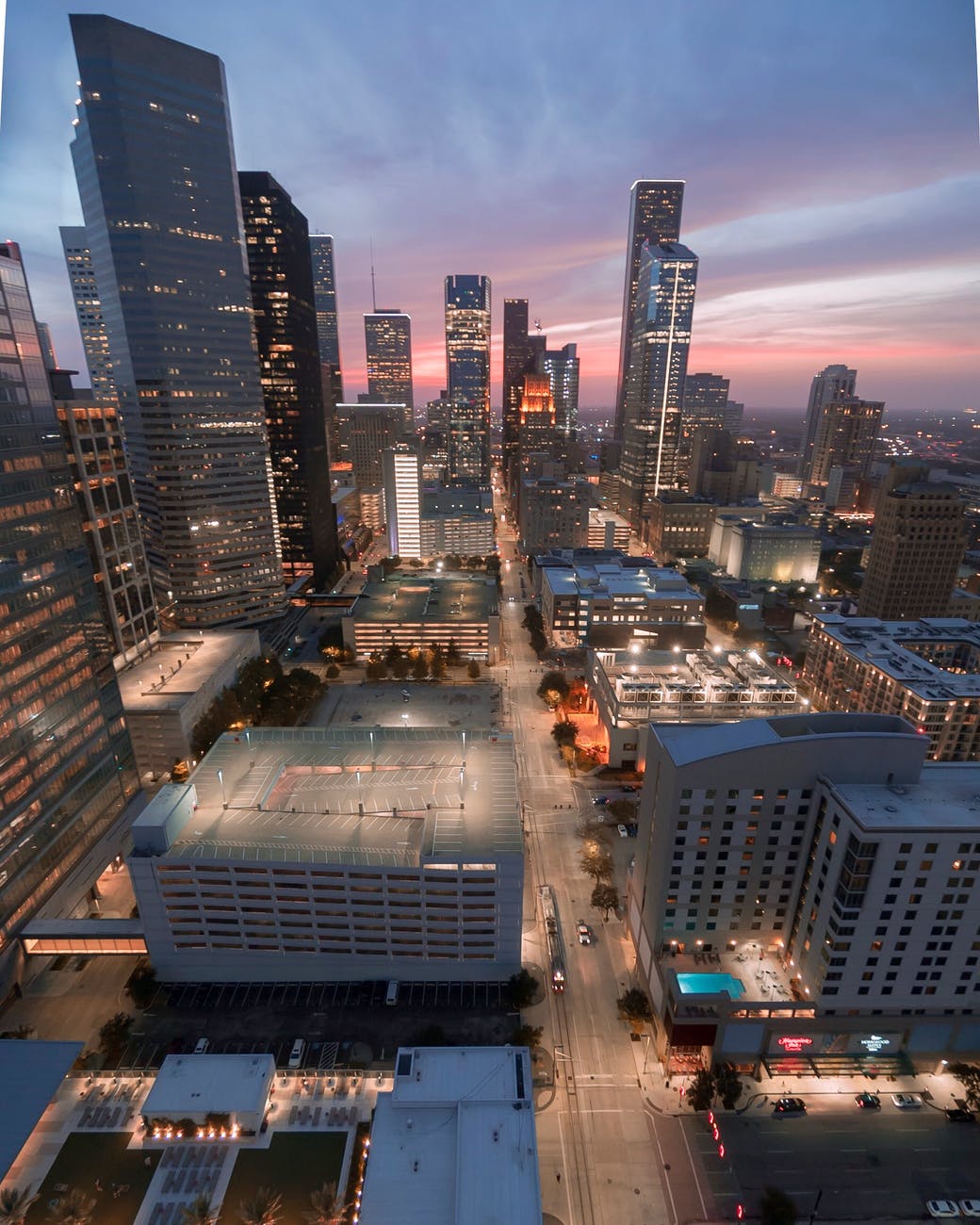
Photo by Nick Bee on Pexels.com

Can America in the 2020s turn itself around the way the America of the 1890s, or the Britain of the 1830s, did? Can we create a civic renaissance and a legislative revolution? I’m not so sure. If you think we’re going back to the America that used to be—with a single cohesive mainstream culture; with an agile, trusted central government; with a few mainstream media voices that police a coherent national conversation; with an interconnected, respected leadership class; with a set of dominant moral values based on mainline Protestantism or some other single ethic—then you’re not being realistic. I see no scenario in which we return to being the nation we were in 1965, with a cohesive national ethos, a clear national establishment, trusted central institutions, and a pop-culture landscape in which people overwhelmingly watch the same shows and talked about the same things. We’re too beaten up for that. The age of distrust has smashed the converging America and the converging globe—that great dream of the 1990s—and has left us with the reality that our only plausible future is decentralized pluralism.

A model for that can be found in, of all places, Houston, Texas, one of the most diverse cities in America. At least 145 languages are spoken in the metro area. It has no real central downtown district, but, rather, a wide diversity of scattered downtowns and scattered economic and cultural hubs. As you drive across town you feel like you’re successively in Lagos, Hanoi, Mumbai, White Plains, Beverly Hills, Des Moines, and Mexico City. In each of these cultural zones, these islands of trust, there is a sense of vibrant activity and experimentation—and across the whole city there is an atmosphere of openness, and goodwill, and the American tendency to act and organize that Hofstadter discussed in The Age of Reform.

Not every place can or would want to be Houston—its cityscape is ugly, and I’m not a fan of its too-libertarian zoning policies—but in that rambling, scattershot city I see an image of how a hyper-diverse, and more trusting, American future might work.

The key to making decentralized pluralism work still comes down to one question: Do we have the energy to build new organizations that address our problems, the way the Brits did in the 1830s and Americans did in the 1890s? Personal trust can exist informally between two friends who rely on each other, but social trust is built within organizations in which people are bound together to do joint work, in which they struggle together long enough for trust to gradually develop, in which they develop shared understandings of what is expected of each other, in which they are enmeshed in rules and standards of behavior that keep them trustworthy when their commitments might otherwise falter. Social trust is built within the nitty-gritty work of organizational life: going to meetings, driving people places, planning events, sitting with the ailing, rejoicing with the joyous, showing up for the unfortunate. Over the past 60 years, we have given up on the Rotary Club and the American Legion and other civic organizations and replaced them with Twitter and Instagram. Ultimately, our ability to rebuild trust depends on our ability to join and stick to organizations.

Houston is a growing city – now the fourth largest American city – and is a unique city in the United States. Brooks notes three features above: sprawl and a decentralized landscape, a lack of zoning policies, and diverse residents.

A fourth factor could be worth adding that might undercut Brooks’ example. Sociologists Michael Emerson and Kevin Smiley examined people-oriented cities and market-oriented cities. One of their case studies is Houston, a paradigmatic market-oriented city. Heavily influenced by the oil industry, the city has prioritized business over people. Can such a setting foster more social trust? If so, would it primarily be based on economic interdependence and would that be enough to overcome the problems Brooks suggests Americans face? If not, how can places combat the tendencies for current systems to pit interested parties against each other?

Furthermore, it would be worth hearing more how “islands of trust” can cooperate together to pursue projects for the good of the whole city. In a decentralized landscape, wealthier private residents may have what they want – access to a home and yard, for example – but it is less clear what kinds of institutions successfully bring people together over an expansive metropolitan region. A limited number of regions have tried metropolitan wide initiatives – see Minneapolis for sharing revenues, building housing across the region – but these can be difficult to sell and implement (see, for example, trying to promote mass transit in the Nashville region).

The contrast to Houston would be more established cities in the Northeast and Midwest that have long-standing institutions and coherent neighborhoods. Yet, the fault lines in these places may be too entrenched for significant coming together to happen.

Is there a growing smaller sized city that could lead the way in building social trust amid the pressures of pluralism, disagreement, and limited social trust?

The rise of a sermon phrase – “a city on a hill” – to explain American exceptionalism

An English professor describes how a sermon by John Winthrop in 1630 came to describe the United States:

Photo by Felix Mittermeier on Pexels.com

In 1630, John Winthrop, the first Puritan governor of Massachusetts Bay, declared that “we shall be as a city upon a hill.” When President Ronald Reagan used Winthrop’s words to describe America, he helped transform “A Model of Christian Charity” into a foundational text of American culture. In its own day, Winthrop’s sermon went unrecorded, unpublished, and almost entirely unnoticed. It was found and first published in 1838—at which point it continued to be ignored for another century…

Winthrop’s sermon is a communal statement of love—a “model of Christian charity,” exactly as it is called. The question behind his sermon is simple: What do we owe each other? And Winthrop’s answer is the same as Paul’s: whatever redemptive love requires…

The phrase “city on a hill” also has a fascinating and largely unknown 17th century context. The phrase comes from Jesus’ Sermon on the Mount (specifically Matthew 5:14), and in the 1600s, it was Roman Catholics, not Puritans, who loved it most. They used Matthew 5:14 to prove Protestantism false and Catholicism true. The Catholic Church, they said, was the only one visible church since the time of Christ (Jesus “set it on a hill”). Protestants, in contrast, described the true church as small or hidden, turning to Luke 12:32 and Revelation 12. When it came to Matthew 5:14, they had to reinterpret this verse to pry it from Catholic hands. Instead of the universal church being a “city on a hill,” Protestants like Winthrop claimed that “city on a hill” applied locally, to this place or that, wherever the true light of the gospel shone. Because the phrase did not refer to one universal church, it could be reapplied to individual congregations, towns, cities, and eventually—as we have come to see—a nation…

My book moves from the 1600s through the American Revolution and the making of the first national history textbooks in the 1800s to the claims and impact of the influential German sociologist Max Weber in the early 1900s. But for me, the most enjoyable chapters to write were on Perry Miller, a Harvard scholar who had a giant influence on the way we understand the Pilgrims and Puritans today. It was Perry Miller, an atheist, who above all made John Winthrop’s “city on a hill” sermon central to the American story. He did so not just to set the US apart from the USSR, but also to challenge American society, which he saw as having fallen from its Puritan origins. Just a few years before Miller died, the Harvard-educated John F. Kennedy became the first president to use Winthrop’s “city on a hill” sermon in a speech. When Reagan picked it up, it became famous—a linchpin in larger narratives of American exceptionalism.

Another example of how civil religion develops: several centuries after a sermon is given, it is picked up and interpreted by political leaders and others who want to tie several strands of social life together. Implied above is that another politician in another time period – say Grover Cleveland in the late 1800s – may not have been able to prompt the spread of this connection in American life. Ronald Reagan, who tried to be optimistic about American life, helps give the quote, which had some public airing because of John F. Kennedy, new life in a particular context.

The 17th century context of the meaning of a “city on a hill” is fascinating given what the phrase came to represent. If Winthrop meant to use the phrase in contrast to Catholic interpretations, the fact that the phrase came to represent a powerful America is a twist. The Protestant interpretation discussed above applied to a small context. When Americans use the phrase today, they tend to mean a powerful city on the hill, casting light on the countryside below or holding a fortified position or occupying the high ground. The American bastion of freedom and Christendom has replaced the prior holders of this title.

This phrase also gives more credence to cities than Americans have over the course of their history. Even with some important cities on a global stage, Americans are generally anti-urban and instead embrace suburban life. Updating the phrase, perhaps Americans would rather say “the suburban megachurch on the hill” or the “quiet yet stately suburb on the hill.”

Imagining self-driving car underground tunnels under major American cities

Elon Musk’s plan for self-driving cars to operate in tunnels under Las Vegas appears close to becoming reality:

Photo by Anthony Macajone on Pexels.com

On Tuesday, Musk announced on Twitter that, after a full year in the making, The Boring Company’s first operational “loop tunnel” in Las Vegas is “almost done.”…

The Boring Company built a test tunnel in 2018 near its headquarters in Hawthorne, California. A year later, it landed a commercial contract in Las Vegas to build a loop tunnel system for public use. According to The Boring Company’s proposal, the final system will be able to shuttle passengers in self-driving Tesla cars between any two destinations in Sin City within minutes.

Construction of the initial twin tunnels near the Las Vegas Convention Center (LVCC) was complete in May. The system is expected to be ready for public use for the Consumer Electronics Show (CES) in January 2021. But the event has been moved online due to the coronavirus pandemic.

Last month, The Boring Company won a county approval to expand its LVCC transportation Loop to include an underground station at the new Resorts World hotel located at the north end of the Vegas Strip. Ultimately, the company aims to connect all major tourist destinations along the Strip, as well as two terminals of the nearby McCarran International Airport and downtown Vegas.

This location makes sense when tourism is in full swing in Las Vegas. While the airport is relatively close to the strip, it is not necessarily close time-wise and a quick, automated car ride could please a lot of visitors. It is also fun to imagine this in other cities. The tunnels bring to mind memories of playing the Lower Wacker track on Cruis’n USA. Chicago has some of this infrastructure already in place while other cities might be able to convert or expand existing tunnels.

How this could positively affect streetscapes is fascinating. Imagine major American cities with less traffic in their denser areas, more room for pedestrians, more space for properties to extend past the building. Cars would still be in use – just moved to a different plane – but the emphasis on vehicles would be reduced. More streets could be closed, the scale of social life could change (though the towering buildings in some districts would still loom), and the streets would be safer. (I imagine taxis and others might not be pleased to have the business moved underground.)

This is likely a long project to pursue in any city; making big changes underground in many locations is very difficult. It does keep cars around (just more out of sight) and both the money spent to put the system in place and the ongoing commitment to the system could continue to inhibit other options such as promoting mass transit.

Survey data on wealthy New York City residents thinking about leaving the city

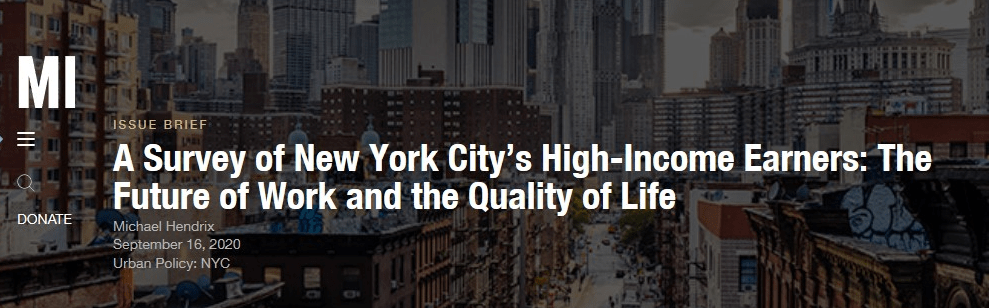
New survey data looks at what New York City residents making more than $100,000 think about leaving the city:

We found that 44% of high-income New Yorkers say that they have considered relocating outside the city in the past four months, with cost of living cited as the biggest reason. More than half of high-income New Yorkers are working entirely from home, and nearly two-thirds believe that this will be the new normal for the city…

Of those considering leaving New York City, 30% say that the possibility of working remotely makes it more likely that they will move. Of New York City residents who earn $100,000 or more annually, 44% have considered moving out of the city in the past four months (see Figure 4). Looking ahead, 37% say that it is at least somewhat likely that they will not be living in the city within the next two years…

The cost of living, more than any other factor, contributes to the likelihood of leaving New York City (see Figure 5). A total of 69% of respondents cite cost of living as a reason to leave the city; that figure is even higher among black (77%) and Hispanic (79%) respondents. Other reasons cited by respondents considering leaving New York City include crime (47%), desire for a nonurban lifestyle (46%), and the ability to work from home (30%)…

Only 38% of New Yorkers surveyed said that the quality of life now was excellent or good, a drop by half, from 79% before the pandemic (see Figure 2). Most believe that the city has a long road to recovery: 69% say that it “will take longer than a year” for quality of life to return to normal.

Finally some data on New Yorkers leaving the city! (Of course, this is more about attitudes than actual behavior.)

If I am interpreting the data above correctly, it sounds like COVID-19 has brought some other issues to light. This includes:

(1) If I can work remotely, do I value city life enough to stay there even though I do not need to be close to work?

(2) If the city is not what it was – and it is not clear when it might return to normal – because of decreased social activity due to COVID, the cost of living may not be justifiable.

Ultimately, is it worth living in a global city – with all that comes with it for high earners including jobs, cultural amenities, and a high cost of living – when the positive features of this city are muted during a pandemic?

New publication: Christian Colleges in the Locational Wilderness

Christian Higher Education just published online an article from co-author Ben Norquist and I titled “Christian Colleges in the Locational Wilderness: The Locations of CCCU Institutions.” Here is the abstract:

This article examines the locations of the 111 governing members of the Council for Christian Colleges & Universities (CCCU) and consider how these locations hinder evangelical Protestants from reaching their goal of engaging American society. We found that CCCU institutions cluster in cities in mid-sized metropolitan regions in the South and Midwest, are more likely than the United States population as a whole to be in rural areas, and have a limited presence in the largest metropolitan regions in the United States, particularly their central cities. In comparison to the top 102 liberal arts institutions and top 101 national universities, CCCU governing members were on average founded later and they have locations more similar to liberal arts schools than research universities. We argue that these patterns are physical manifestations of the modernist-fundamentalist debate, suburbanization pressure and anti-urban sentiment, and concentrations of evangelical residents. We conclude that CCCU members’ locations limit their ability to help students and constituents engage society with locations away from the largest cities and their power, resources, and networks

This project began several years ago amidst a search for data on where evangelicals in the United States are located. Given that Ben and I are in a particular location and working for a CCCU member institution, we dug into this data (with the help of my TA Rebecca Carlson) to uncover the patterns of where CCCU schools are located, particularly in comparisons to other kinds of schools and where Americans live more broadly. The last two sentences of the abstract sum up our findings and the implications: with many locations away from the biggest cities and metropolitan regions in the United States, CCCU institutions may only be able to do so much in engaging a country (and globe) dominated by cities and their metropolitan areas. More broadly, if evangelicals are not present or active in these global cities and regions, their opportunities to engage American society are limited.

Research on the power and influence Democratic mayors do or do not have

Emily Badger sums up research looking at how much big cities are affected by having a mayor from a particular political party:

https://www.nytimes.com/2020/09/02/upshot/trump-democratic-cities.html

Numerous studies suggest that the partisanship of mayors has limited effect on much of anything: not just crime, but also tax policy, social policy and economic outcomes.

The researchers Justin de Benedictis-Kessner and Christopher Warshaw have found that Democratic mayors spend more than Republican mayors. “But the differences are pretty small,” said Mr. Warshaw, a political scientist at George Washington University. “They’re not enough to drive large differences in societal outcomes in things like crime rates.”

This is partly because mayors are constrained in their ability to execute ideological agendas. Cities can’t run deficits. States limit their authority to raise taxes and enact laws on many issues. And cities lack the power the federal government has to shape labor laws, or immigration policies that can affect their population growth…

Cities have been faced with problems far beyond their making. Deindustrialization and globalization wiped out many middle-class factory jobs, destabilizing neighborhoods of blue-collar workers. The federal policy of highway construction enabled both taxpayers and employers to leave cities. Federal housing policies dissuaded or prevented Black residents initially from joining them, cementing patterns of racial and economic segregation that persist to this day…

There are plenty of fair critiques of decisions that Democratic mayors do control — regarding charter schools, or how equitably they deploy city resources, or whether their zoning laws and school policies perpetuate segregation. And there is room to criticize the Democratic Party’s failure to devise a coherent federal urban policy.

Disentangling this from the current political moment and debate about running cities, a few themes from the article stuck out to me:

  1. One argument is that mayors are more interested in pragmatic day to day city processes than larger ideological concerns. Mayors themselves make this argument. If a mayor cannot help solve a particular local problem, they may not be in office for long, regardless of what party they align with.
  2. Cities are stuck between multiple bodies of government. A city may be nested within a county (and this is what might make city-county mergers appealing), a state, and then the federal system. On one hand, cities are essential to our modern society – they are economic engines, centers of culture, gathering places for residents and jobs, anchors of entire regions, etc. – but their city interests must be negotiated with other bodies of government above them. Putting it in more sociological terms, cities are between macro and micro social scales yet often are viewed as macro entities and have some capabilities at the macro level (I am thinking of conferences of mayors, transnational conversations between mayors and other mayors or heads of government, etc.)
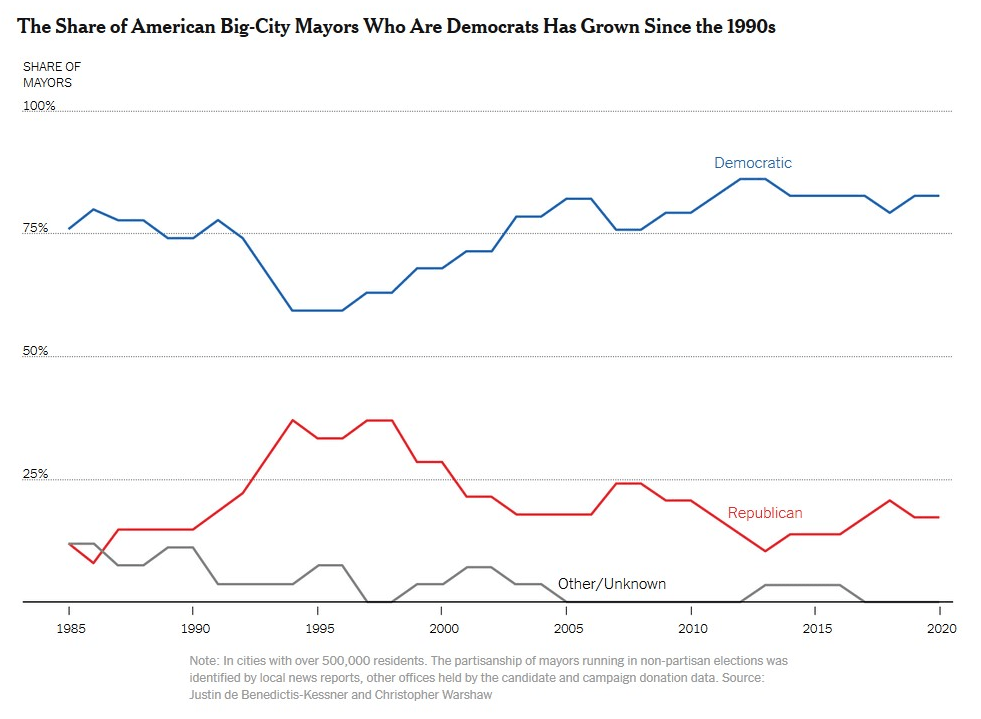
  3. As a graph in the article shows, there are more Democratic big city mayors than Republican big city mayors and this has been true for decades. Do Republicans want to be mayors of big cities? Also noted in the story: Republican policies and appeals have been made to suburbanites and rural voters for decades, less so to urban residents.
  4. This is not a new political issue; the United States has a long-standing divide regarding cities that goes back to the founding of the country. For more on this as it played out in the twentieth century, I recommend the 2014 book Americans Against the City by historian Steven Conn.

The role of religious buildings in combating global sameness in architecture

A look at the spread of the same architecture around the world – “glass-and-steel” – leaves out religious architecture:

Some time ago, I woke up in a hotel room unable to determine where I was in the world. The room was like any other these days, with its neutral bedding, uncomfortable bouclé lounge chair, and wood-veneer accent wall—tasteful, but purgatorial. The eerie uniformity extended well beyond the interior design too: The building itself felt like it could’ve been located in any number of metropolises across the globe. From the window, I saw only the signs of ubiquitous brands, such as Subway, Starbucks, and McDonald’s. I thought about phoning down to reception to get my bearings, but it felt too much like the beginning of an episode of The Twilight Zone. I travel a lot, so it was not the first or the last time that I would wake up in a state of placelessness or the accompanying feeling of déjà vu.

The primary focus of this article appears to be architectural wonders in business districts. These buildings both reflect the primary values of today’s world – capitalism, finance, power – and dominate modern skylines. They promote a particular global order.

In contrast, religious buildings often refer to other values: transcendence, community, beauty or sacredness. They can be part of hegemony or empire or the spread of a global order. But, they can also signal space that resists oppression or injustice. And, religious buildings can both reflect international styles and/or local religious interpretations.

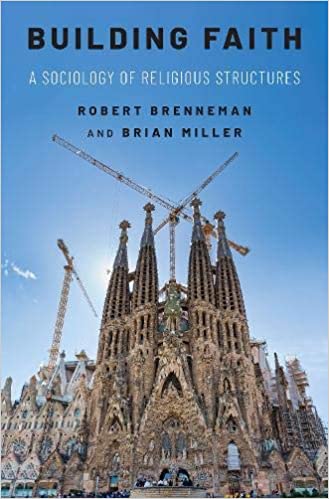
In the book Building Faith Bob Brenneman and I wrote, we tackle some of these issues. There are modernist religious buildings. There are international structures influenced by the architecture of Las Vegas or glitzy cities. But, there are also small congregations building humble structures, others mixing indigenous architecture and common forms of architecture in particular religious traditions, others converting one kind of structure to another, and others worshiping in more secular structures. Many of these buildings are the opposite of these international symbols of affluence and starchitects. At least in form, they present an alternative vision and with the actions of the congregation within, may actively counter hegemonic order.

https://global.oup.com/academic/product/building-faith-9780190883447?cc=us&lang=en&

Some of the issue may be that the stature of religious buildings have diminished in the center of many global cities. Whereas once religious structures sat at the middle of the city, office buildings and structures devoted came to dominate the central spaces. In Chicago, the central churches moved to quieter neighborhoods near residents and where property values were lower as business came to dominate the Loop. Even the tallest religious buildings are no match for the biggest office buildings or residential structures.

The coming budget reckoning for big cities

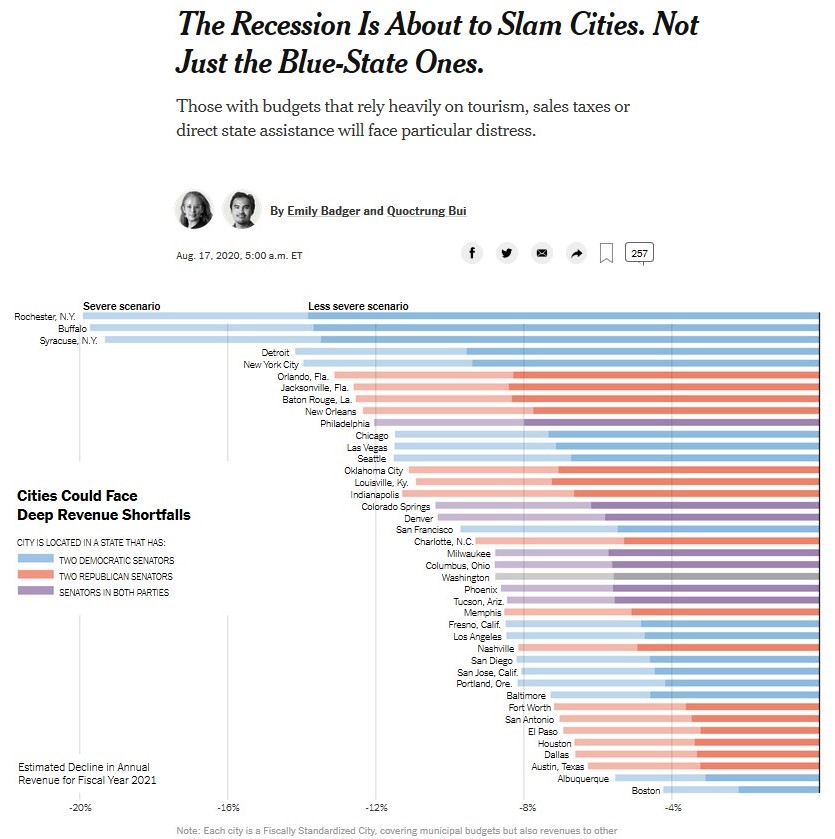
A new analysis suggests particular big cities will suffer losses in tax revenues due to COVID-19:

Describing the study results more:

What matters more in this pandemic moment is how a city generates money: Those highly dependent on tourism, on direct state aid or on volatile sales taxes will hurt the most. Cities like Boston, which rely heavily on the most stable revenue, property taxes, are in the strongest position — for now.

The estimates, to be published in the National Tax Journal by Mr. Chernick, David Copeland at Georgia State University and Andrew Reschovsky at the University of Wisconsin, are based on the mix of local revenue sources, the importance of state aid and the composition of jobs and wages in each city. The researchers predict average revenue shortfalls in the 2021 fiscal year of about 5.5 percent in a less severe scenario, or 9 percent in a more severe one.

Tax revenues can come from a variety of sources. Like recommendations for individual investors to diversify their portfolio, municipalities can benefit from a broad tax base that is not too reliant on any one sector. As the analysis suggests, relying on one single source can cause problems when that area experiences a downturn. (At the same time, creating such a robust and resilient local economy might be very difficult to do given historical patterns, current conditions, and competition in the future.)

The color coding of the graph above is interesting in that it implies that there are a number of cities that Republicans should care about helping. I wonder how this will play out: even as Republican senators would want more municipal tax revenues, it does not necessarily mean that they are pro-city or would want to go out of their way to provide funding. Are Republicans more in favor of seeing the fate of cities and suburbs as tied together when their cities are at risk?

Background noise and less seismic activity caused by humans during COVID-19

Measuring seismic activity often requires locating instruments away from population centers. During COVID-19, the seismic activity caused by humans dropped a lot:

architecture bedrock bridge building

Photo by George Becker on Pexels.com

Writing today in the journal Science, dozens of researchers from around the world show that the seismic activity from our civilization plummeted as lockdowns went into effect. This “anthropogenic seismic noise,” as seismologists call it, comes from all manner of human activities, whether that’s running factories, operating cars or trains, or even holding concerts. Seismometers pick up these activities as a kind of constant din, which actually peaks on weekdays, when more people are moving around, and falls on weekends when economies slow down. All this activity that seismometers detect mixes with the natural rumbles that scientists are really interested in, like earthquakes, volcanoes, and landslides.

But boy, are they interested in the anthropogenic seismic noise now—or the lack thereof, as humans began to shelter in place. “We see it effectively moving around the globe as a seismic lockdown wave,” says Royal Holloway University of London seismologist Paula Koelemeijer, one of the paper’s coauthors. “So starting in China originally, then in different places in Italy, and then going through Europe. And whenever lockdowns happened in different countries, we see the effect that’s up to an 80 percent reduction in the amplitude of the seismic noise in some places.” The average was about 50 percent…

Normally, seismologists don’t bother monitoring urban environments for just this reason: There’s way too much noise muddying the signals of Earth’s natural processes. But for the past few years, citizen scientists have been collecting signals thanks to a clever little device called the Raspberry Shake, a Raspberry Pi computer outfitted with sensors to create an internet-connected seismometer. “Those instruments have been popping up more and more in people’s homes,” says Koelemeijer. “And so about 40 percent of our data stations that we looked at have been these citizen science instruments. It’s just people finding it funny, geeky, to have one of them. Like, I’m one of those people. I have one in my house.”…

But it was in a remote part of Germany where seismologists recorded perhaps the most surprising lockdown data. The Black Forest Observatory is not only isolated, and thus considered to be a reference low-noise laboratory, but its instruments are stowed over 150 meters below the surface, in bedrock. Yet they, too, picked up a small noise reduction at night during the lockdown. “Germany was a big surprise for us, because that station is very much a remote station, and seen as a very good seismic station for looking at natural signals,” says Koelemeijer. “So the fact that we saw it there was quite remarkable.”

Human activity influences all sorts of spheres that we do not often consider. Here, humans create a lot of noise and activity below the surface of the earth. There are occasionally complaints about noise pollution but most people put up with a certain amount of noise and vibrations in the places where they live.

This reminds of several different aspects of working with “background noise.” Working in radio, I often used sound effects for promotional material. The sound effect CDs we had contained a variety of background noise or din. For example, the city options largely contained traffic noise with vehicle rumbling and honking mixed together.

More recently, sports broadcasts have adjusted to teams playing in stadiums with no fans present in the stands. They often use recordings of fans where a sound technician has the ability to respond to play on the field (such as cheering for a good play for the home team or a negative response from fans). Without such background noise, the broadcast sounds very different: voices echo, the players can be heard, and a comforting or familiar element of the broadcast is lost.

All together, the background noise of our lives matters in everyday activity and in scientific measurement. If COVID-19 changes human movement and interactions, what we hear by ear and scientific instruments also changes.

The current social contract: we get along by leaving each other alone

A Washington D.C. resident says he is leaving the city because social order has broken down. Here is how he describes what made city life work:

time lapse photography of people walking on pedestrian lane

Photo by Mike Chai on Pexels.com

All I asked in return was relative safety and to be left alone to enjoy the city. City-living in America, for decades, meant tolerating mild inconveniences so that you could be left alone, alongside millions of others. That was the tacit pact…

Gay? Black? Trans? No offense, but, so what? We are city people: we have seen it all—literally, all—our entire lives. You are our neighbors, our friends, the president of our HOAs, our coworkers. The great beauty of the city is that we come from all walks of life and we get along. We accomplish this by leaving each other alone.

This sounds similar to how sociologist M. P. Baumgartner described the “moral minimalism” pervasive in suburban social life:

A kind of moral minimalism pervades the suburbs, in which people prefer the least extreme reactions to offenses and are reluctant to exercise any social control against one another at all. (3)

suburbia is a model of social order. The order is not born, however, of conditions widely perceived to generate social harmony. It does not arise from intimacy and connectedness, but rather from some of the very things more often presumed to bring about conflict and violence – transiency, fragmentation, isolation, atomization, and indifference among people. The suburbs lack social cohesion but they are free of strife. They are, so to speak, disorganized and orderly at the same time. (134)

In both descriptions, residents want to be left alone. They want to live life as they see fit without interference or social control exerted by others. This does not necessarily mean there is no social interaction or residents dislike the local environment; the Washington, D.C. resident describes partaking in and enjoying urban culture and interacting with neighbors. In Baumgartner’s study, suburbanites might know each other or interact; they just do not get too deeply involved or try to pressure others.

At the root of this seems to be a deep seated individualism that provides space for people to make their own choices. Every space or community provides some constraints on what people can do (or can imagine doing) yet Americans often imagine themselves as solitary units. The strains of this are everywhere: as long as it does not hurt other people, people should be free to do it; what people do on their own time or in their own dwelling is none of my business; a man’s home is his castle; you do you and I’ll do me; and so on.

Even though this idea is widespread, it also has limits. If individuals are masters of their own fate and this should not be interfered with, it can be tough to rally people around particular causes that require collective effort. Indeed, I think a good argument could be made that some of our current political conflict is due to the fact that different groups would like to introduce ideas/values/legislation for others to consider and/or follow while wanting to claim that they also support individualism.

More broadly, this is an odd social contract to have considering the sweep of human history and societies. Much of what humans experienced took place in relatively small groups with strong bonds. Today, more of our world is organized around people with whom we have chosen to interact with more tenuous ties to traditional bonding agents like extended family, religious groups, and specific geographic locations and the communities there.

I do not know if this social contract will last. The individualism of the last few centuries has changed much. Yet, it is helpful to keep in mind as we consider how to do anything together.