
How does the religious affiliation of the members of Congress compare to the religious affiliation of Americans as a whole? This came up recently in a conversation about religiosity and government so I tracked down some data.

For the religious affiliation of Americans as a whole, here are figures from the Pew Religious Landscape Survey with data collected in 2023-24 from more than 35,000 respondents. With 62% of American adults identifying as Christian, here are the percentages for particular religious traditions:
-23% evangelical Protestant
-11% mainline Protestant
-5% Black Protestant
-19% Catholic
-2% Latter-day Saint
-2% Jewish
-1% Orthodox Christian
-1% Muslim
-1% Buddhist
-1% Hindu
-29% religiously unaffiliated
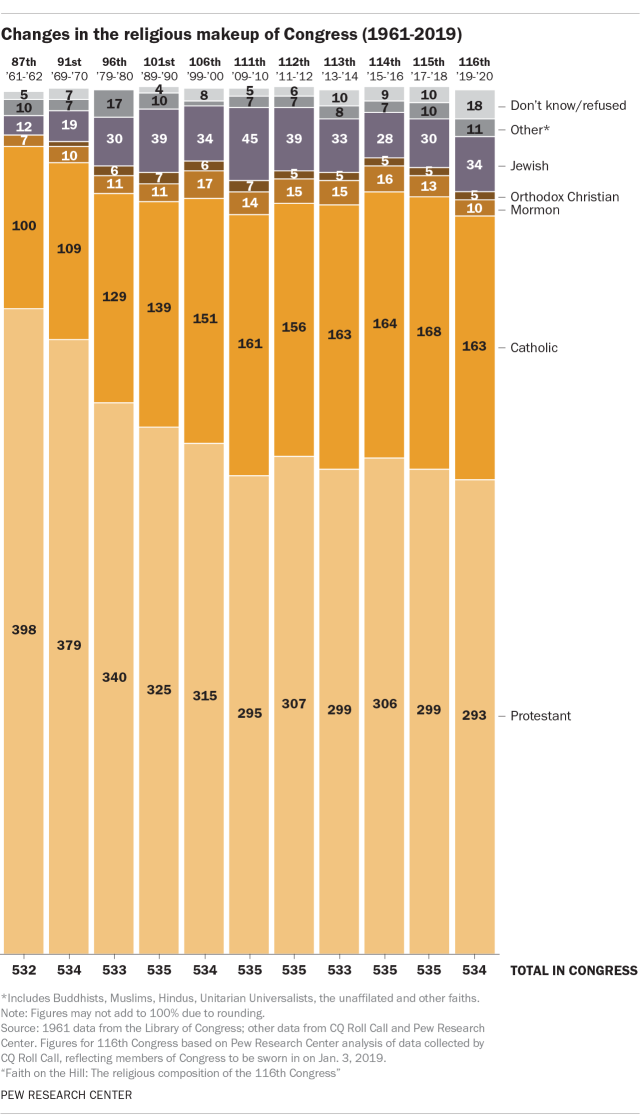
For the religious affiliations of members of Congress, here is a summary of what Wikipedia has for House members and Senate members. The categories are not the same as the religious traditions for the Pew Religious Landscape Survey but there are points to compare. Starting with members of the House of Representatives:
-375 of the 435 (86%) are Christian. Of these Christians, 236 are Protestants in specified traditions (including 63 Baptists, 22 Methodists, 16 Episcopalians, 15 Presbyterians, 13 Lutherans, 10 non-denominationals) and 88 are unspecified Protestants. Of the 375 Christians, 126 are Catholics, 7 are Eastern Orthodox, and 6 are Latter-day Saints.
-24 of the 435 (6%) are Jewish.
-4 of the 435 (1%) are Muslim
-4 of the 435 (1%) are Hindus
-2 of the 435 (0.5%) are Buddhist
-18 (4%) are unknown or refused to state.
-4 (1%) are unaffiliated.
And here is the religious affiliation for members of the Senate:
-86 of the 100 (86%) are Christian. Of these Christians, 59 are Protestants in specified traditions (including 12 Baptists, 5 Methodists, 5 Episcopalians, 12 Presbyterians, 6 Lutherans, 6 non-denominationals) and 5 are unspecified Protestants. Of the 86 Christians, 24 are Catholics, 7 are Eastern Orthodox, and 3 are Latter-day Saints.
-9 of the 100 (9%) are Jewish.
-1 of the 100 (1%) are Buddhist
-4 (4%) are unknown or refused to state.
How does the religiosity of Congress compare to the country as a whole? Pew sums up:
Christians will make up 87% of voting members in the Senate and House of Representatives, combined, in the 2025-27 congressional session. That’s down from 88% in the last session and 92% a decade ago...
And yet, at 87%, Christians still make up the lion’s share of the Congress, far exceeding the Christian share of all U.S. adults, which stands at 62% after several decades of decline…
The new Congress is also more religious than the general population by another, related measure: Nearly three-in-ten Americans (28%) are religiously unaffiliated, meaning they are atheist or agnostic or say their religion is “nothing in particular.” But less than 1% of Congress falls into this category…
In a country where a majority of adults identify as Christian, Congress is roughly 25% more Christian than the population as a whole. This may change in the coming years as more American adults do not identify with any religious tradition or group.

 Legally Sociable