What suburban leaders need from denser developments in their downtowns

One suburban political candidate describes what the community hopes for when they build residences in the downtown:

Photo by Pixabay on Pexels.com

 “We need for people to be in it. We need for them to, do as our plan: get out of the building, walk around town, eat in the restaurants, drink in the coffee shops, drink in the bars, that kind of thing.”

Once a development is built, it takes time for the suburb to consider the impact on the community. If suburbs are going to pursue more density in their downtowns, which can often contrast with lower density homes throughout the rest of the community, they want certain things from the high-density development. They want those residents to patronize downtown businesses and restaurants. They want money to flow within the downtown. They want a particular downtown atmosphere where people are out and about (and not too noisy).

What happens if this does not come to fruition? What if the new development does not fill up quickly or if the residents do not spend much time downtown? Perhaps the municipality will seek a critical mass of downtown development to be able to provide enough downtown residents. Or perhaps they will seek the right mix of downtown attractions with certain kinds of shops and eateries.

And how much development will a suburb seek in its downtown? It might depend on whether it is “successful” in the eyes of the community.

When American big cities devote much of their land to single-family homes

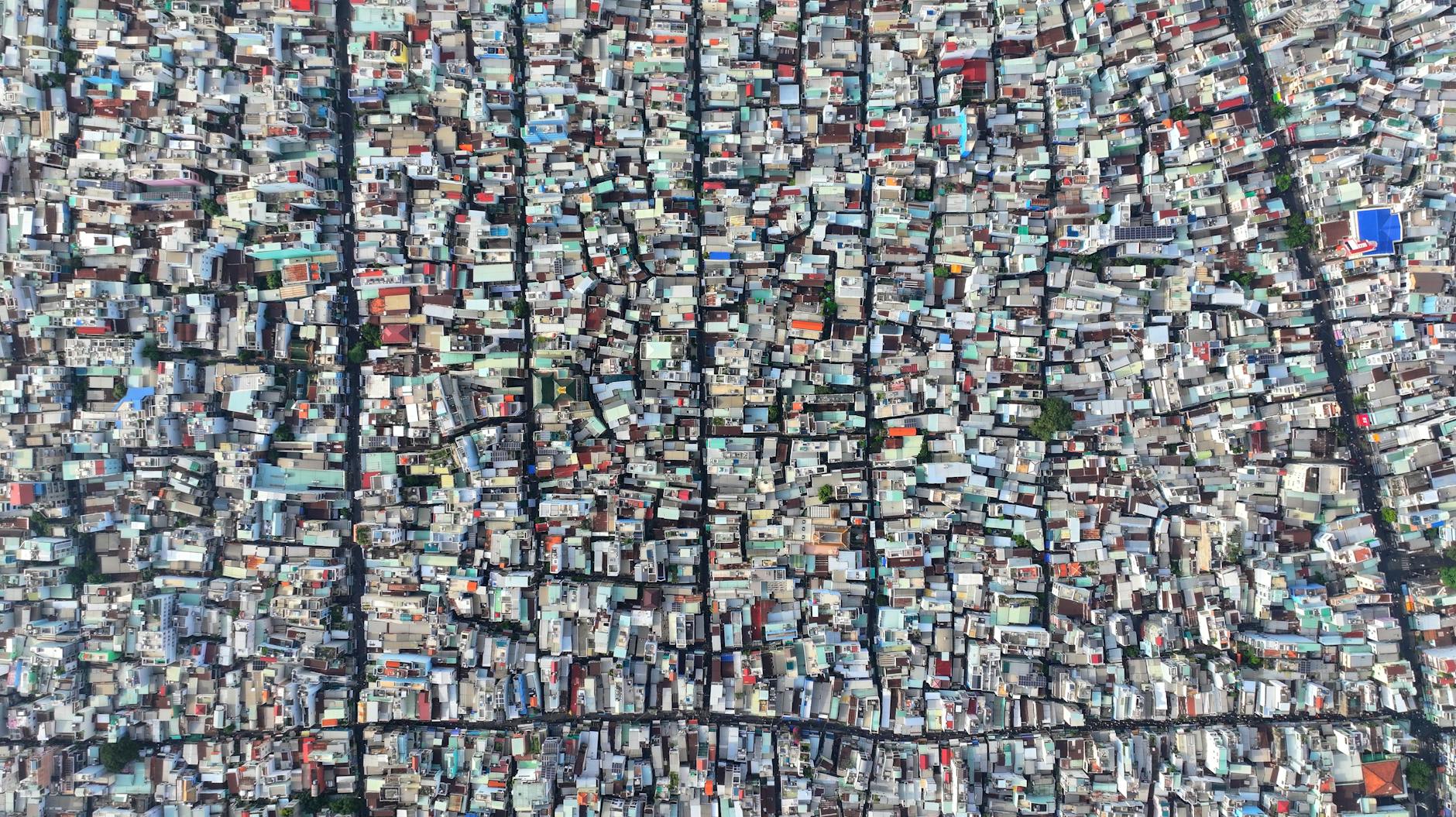
The big city in the United States is dense. It has tall buildings and busy streets. There are plenty of apartments and mixed-use structures. They look and feel different than suburbs, small towns, and rural areas.

Photo by Phu Nguyen on Pexels.com

But even American cities have lots of single-family homes. Chicago, for example, has a lot of land devoted to single-family homes:

More than 40% of the city is zoned for single-family housing…

This figure might even be higher in other cities, particularly sprawling ones.

What might this figure mean? Some thoughts:

  1. Denser populations can fit into less space. But the amount of space given to one kind of land use, homes in this case, still matters.
  2. These neighborhoods and residents are going to get at least some attention and representation. Their interests might converge and diverge in important ways from interests of other locations and residents in big cities.
  3. This fits with an American emphasis on single-family homes, even if these homes happen to be in cities.
  4. Suburbs are in between cities and more rural areas. Are city neighborhoods of single-family homes often in between denser populations and suburbs? Do these city places feel more like suburbs or like life in different densities in the big city?

Another way to think about this percentage: even the places that Americans tend not to associate with houses and the lives that go with them have lots. of single-family homes.

What allowing “build[ing] more houses on less land” in Austin could lead to

Austin, Texas recently changed its regulations to allow property owners to “build more houses on less land”:

Photo by Abigail Sylvester on Pexels.com

Homeowners now have increased flexibility to build more houses on less land, after the lot size required for a home was reduced from 5,750 square feet to 2,500 via the HOME initiative (Home Options for Middle-income Empowerment). The policy also increases the number of housing structures that can sit on that 2,500 square feet from two to three. 

The debate over these changes continues:

The debate around a policy like this comes down to whether someone believes increased density (more housing for more people on smaller footprints) will help the situation, or will lead to overbuilding, crime, and rental cash grabs. The latter tends to sound a lot like NIMBY talking points more concerned with preserving the charm of longstanding Austin neighborhoods.

Some developers and homeowners feel that the resolution alleviates just a small part of Austin’s building woes, since the zoning codes are still complex and difficult to navigate. Jason Kahle, who owns Small Home Solutions, LLC, says he and his 10 employees are “going to be all over” the changes in a market where it seems everyone with a large-enough lot has considered building a granny pod, mother-in-law suite, or backyard office. 

But being free to build on a smaller lot is not the same as being able to feasibly do it within existing rules, Kahle points out. “There’s a lot of wheels turning at the same time,” he says. “Austin Energy is a challenge. We have protected trees, impervious cover, floor-area ratio rules, the level of detail the city requires on civil engineer plans, the subchapter McMansion ordinance, temp drawings. It’s a lot to deal with.” The McMansion regulations, also known as “Subchapter F” in the city’s housing code, set detailed and strict limits, including height and setbacks from the edges of a lot.

Laura Boas, an Austin physical therapist, is building an “accessory dwelling unit” for her family behind her 1950s-era, 720-square-foot cottage in the Brentwood neighborhood. She’s seen massive 2,500-square-foot homes go up in her area, and her lot is big enough to support additional buildings. Boas lives alone and jokes, “I’m part of the problem.”

It sounds like the goal is to allow for more housing units without changing many existing lots and allowing for smaller lots. This is a different approach than promoting more multi-family housing or larger structures containing more residential units. These changes keep the single-family character and the scale of the neighborhood similar while adding more units and people.

It will be interesting to see if an approach like this solves the problems it was intended to solve. Will the number of new McMansions decrease as property owners pursue other options? Does this add enough units? Does it ease housing affordability? If not, what changes would residents and the city be willing to enact? I hope researchers and policy experts are keeping track of the changes in cities that have enabled similar regulations. This could help determine whether adding ADUs (such as in Portland) is helpful.

Two numbers that show how much space the United States devotes to parking

The United States has a lot of parking:

Photo by Brett Sayles on Pexels.com

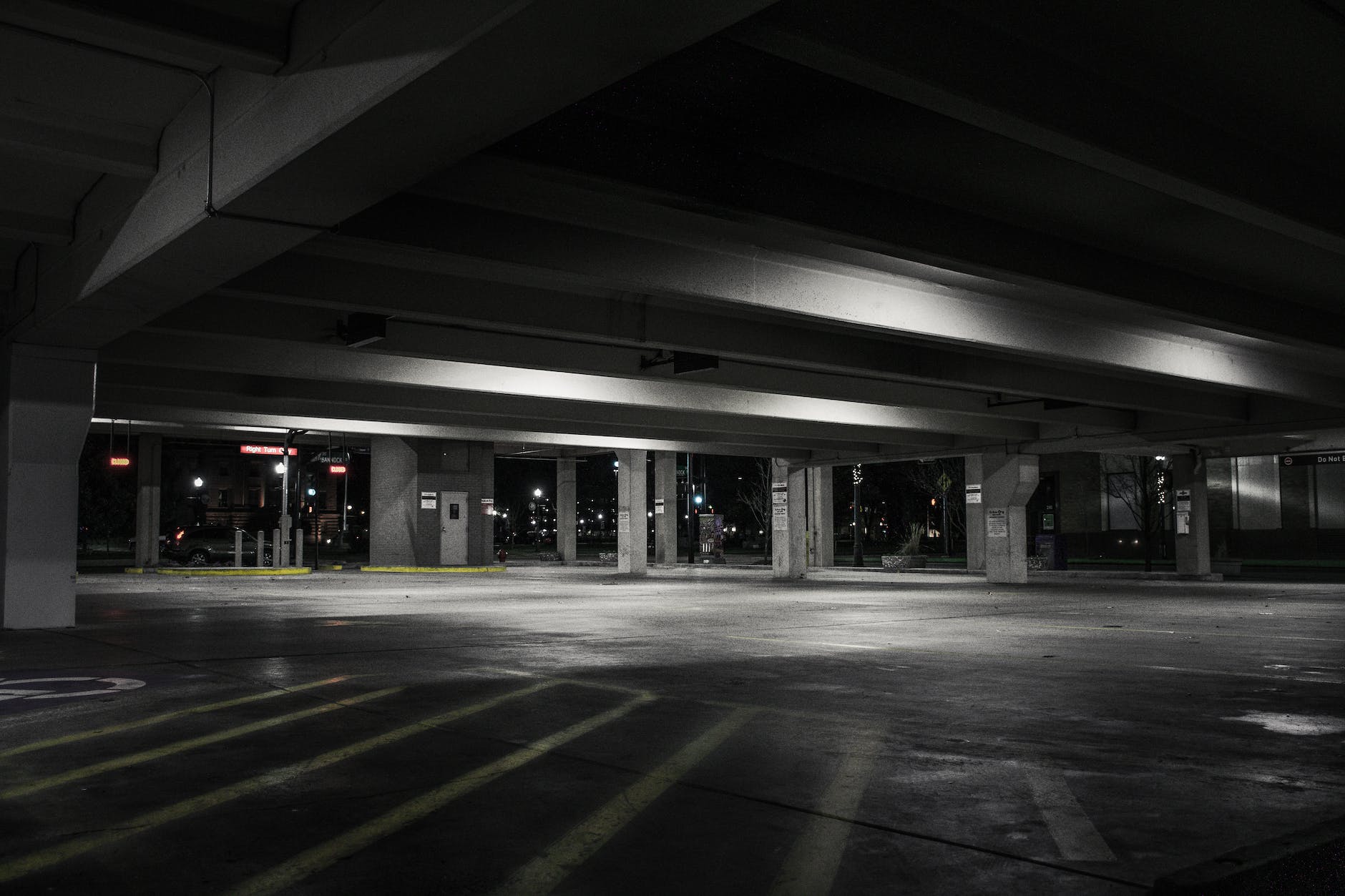
The United States has about two billion parking spots, according to some estimates — nearly seven for every car. In some cities, as much as 14 percent of land area is covered with the black asphalt that engulfs malls, apartment buildings and commercial strips.

In a country where driving is an essential part of the regular and idealized way of life, space is required for vehicles when they are not in use. Most locations requires parking so people can drive and park there. Communities accrue a lot of parking, sometimes for parking that serves multiple locations (such as a downtown parking garage) and sometimes for a single use (like a parking lot in front of a big box store).

Increased density would help solve this problem without necessarily asking for people to drive less. Put desirable locations near each other and then centralize parking or share parking facilities so that parking is not unnecessarily duplicated. If “surban” developments are more popular or “fifteen minutes cities” emerge in greater numbers, perhaps this might help.

Less driving could also help. As could expectations about how much parking is needed; it is for peak and unusual times that rarely occur?

If enough places and concerned actors are able to slow the growth of parking lots and/or eliminate some, it is interesting to imagine communities with fewer parking spaces in the future. How might such land be positively used?

The fear that people will be trapped in 15 minute cities

Online actors are suggesting leaders want to limit people to living in 15 minute cities:

Photo by Plato Terentev on Pexels.com

“Never have there been proposals for restrictions — on the contrary, this is a new opportunity: more choice, more services, more desire to thrive in one’s neighbourhood,” he said.

“Since the start of 2023, the concept of the 15-minute city has been subject to conspiracy theories, produced and shared by people already well known for spreading disinformation about Covid, the climate, vaccines and politics,” he said…

Particular claims debunked by AFP Fact Check in recent weeks have targeted the English city of Oxford and Edmonton, Canada. Claims surfaced in various languages, including English, French and Portuguese.

“You can’t leave a 15-minute city whenever you please … The city walls or restrictions or zones or whatever you want to call them won’t be used to keep others out, they’ll be used to lock everyone in,” says one man in a video viewed more than 59,000 times on Facebook, commenting on the Edmonton plan…

Supporters of 15-minute cities include the worldwide C40 cities alliance plus the United Nations and the World Economic Forum -– targets of numerous false claims that are subject to frequent fact-checks.

Would these particular fears about denser communities fit under long-running fears that a globalist structure wants to restrict the everyday lives and freedoms of workers? One way to control people is to restrict geographic mobility. Doing so would increase population densities and limit what people could access.

These fears likely find a stronger foothold in the United States where frontier and suburban motifs are strong. Americans like suburbs, in part, because they are able to have private property, can drive where and when they choose, and have closer connections to local government. Denser areas do not appeal to many Americans.

From the “walking cities” of 1815 to the sprawling cities of today

In recently teaching about the development of the American suburbs, I was reminded of the description of “walking cities” in 1815 provided by historian Kenneth Jackson makes in Crabgrass Frontier:

Photo by Ryutaro Tsukata on Pexels.com

The first important characteristic of the walking city was congestion. When Queen Victoria was born in 1819, London had about 800,000 residents and was the largest city on earth. Yet an individual could easily walk the three miles from Paddington, Kensington, Hammersmith, and Fulham, then on the very edges of the city, to the center in only two hours. In Liverpool, Birmingham, Manchester, and Glasgow, the area of new building was not even two miles from city hall. (14)

While the focus here is on congestion, the time it takes to walk through such density in a major city is notable: in a few hours, one could traverse a significant portion of the city.

Introduce technology with more speed – trains, streetcars, cars, etc. – and cities could expand in space. People could live further from work (the proximity of home to work for many is a feature of the 1815 city that Jackson also notes). The city could go on for miles. The suburbs could extend even further. But, the ability to see a significant portion of the city in a single walk became much harder.

Like Wakanda, drop the suburbs so cities and rural areas are closer

Why do we need suburbs between city and rural life? Perhaps the fictional Wakanda offers an answer:

Photo by Pixabay on Pexels.com

“One of the things I love about Wakanda, if you notice, if you watch ‘Black Panther’ carefully, there’s the city, the city’s got all this mass transit and all this housing parks and all this stuff,” explained Chakrabarti, who wrote a book called “A Country of Cities: A Manifesto for an Urban America.” “And the moment you leave the city, you’re in farmland. And there’s this connection between rural life and urban life.”

He added: “I just think that is a really interesting paradigm to think about people, either living in super dense circumstances or really living in true rural hinterland and doing the things that we need everyone to do in farmland, which is grow our food and all of that stuff. And it would mean you would use a lot less land on this planet at the end of the day.”…

Whether major American cities ever transform from where we are today — heavily suburbanized and car-dependent — remains to be seen. But all we have to do is look to Wakanda for an idea of how our cities of the future could work.

I would argue that the American suburbs are popular, in part, because they appear to offer both features of city and rural life. Suburbanites like access to housing, jobs, and cultural amenities but they also want smaller communities and proximity to nature. With cars, they can on their own schedule access these features.

I remember the first time I saw in person this cleaner break between a city and rural areas. I had a chance to spend several days in Tokyo while in college. On one day, we took a train out of the city. As we moved at a high speed away from the city center, we suddenly moved from the denser city to fields. The same break could be seen from the air when flying in and out of the city.

This is not typically the case in the United States where suburbs might stretch for dozens of miles from the city limits before finally dwindling out. Moving more people into denser locations would indeed free up land or freezing development in metropolitan regions within an established boundary would do the same.

A significant majority of Americans “believe it is better for the environment if houses are built further apart”

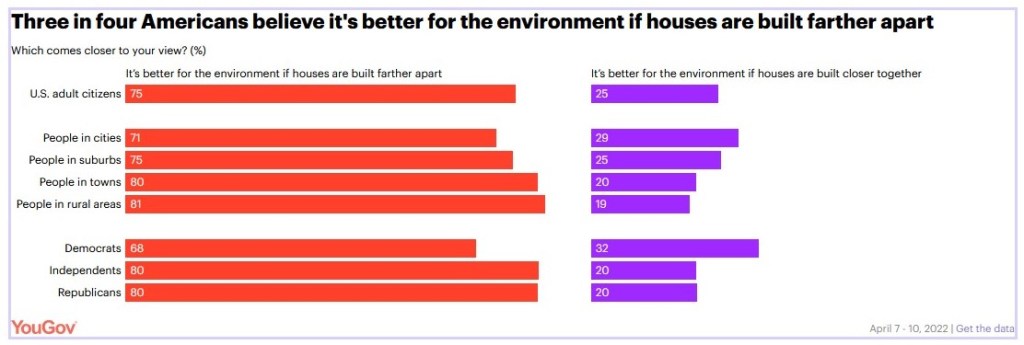
In April, YouGov reported on a survey with a series of questions on how Americans thought about high-density places. Here is how people responded when asked about the relationship between the environment and building homes:

Three in four Americans say it’s better for the environment if houses are built farther apart, while one in four say it’s better for houses to be built closer together. While Americans who live in cities are somewhat more likely than Americans who don’t to say that high density is more environmental, the vast majority of city-dwellers still believe that it’s more eco-friendly to build out rather than up. While Republicans and Independents are aligned on this issue, Democrats are somewhat more likely to say high-density living is environmental, though again, the majority still say it is worse for the environment than building farther apart.  https://datawrapper.dwcdn.net/w0YWs/3/

It would be fascinating to follow up on these survey results with interviews or open-ended questions for the respondents: “Please explain why you answered this way.”

Knowing what I know about American preferences for single-family homes and wanting to be closer to nature in the suburbs, here are some factors that could be at work:

-Americans do not know what is best for the environment.

-Proximity to nature matters for how people assess whether the environment is better off. In higher density places, there is less open space or the natural areas have to be planned and protected. If the houses are further apart leaving more room for grass and local creatures, is this better for the environment?

-People really like homes built away from other homes, even if this might not be optimal for the environment.

-It is interesting that the biggest gap in opinions is between political parties and not where people live. Even then, two-thirds of Democrats agree with this. This might suggest anyone promoting density as a solution to environmental issues will run into some opposition.

Are American cities in trouble or are we focusing too much on the business core of cities?

Recent data suggests the biggest American cities are facing several issues, including population loss. I wonder if the bigger issue is too much focus on the business and downtown core:

They are all among the 20 largest metropolitan areas in the country. All of their populations were growing in 2011. And then, in 2021, they all shrank by a combined 900,000 people, according to an analysis of census data by the Brookings scholar William Frey. That’s an urban exodus nearly the size of two Wyomings.

The great metro shrinkage is part of a larger demographic story. Last year, the U.S. growth rate fell to a record low. The major drivers of population—migration and births—declined, while deaths soared in the pandemic. But America’s largest cities are getting the worst of this national trend. In the past three years, the net number of moves out of Manhattan has increased tenfold. In every urban county within the metros of New York City, Los Angeles, and San Francisco, immigration declined by at least 50 percent from 2018 to 2021. In downtown Detroit and Long Island, deaths actually exceeded births last year.

The great metro shrinkage also appears to be part of a broader cultural story: The rise of remote work has snipped the tether between home and office, allowing many white-collar workers to move out of high-cost cities. Nearly 5 million Americans have moved since 2020 because of remote-work opportunities, according to Adam Ozimek, the chief economist for the Economic Innovation Group, a think tank in Washington, D.C…

So what might this period of urban struggle look like? Just check out what’s happening now. Mass-transit ridership has collapsed from its pre-pandemic highs in New York, Boston, the Bay Area, and Washington, D.C. Although restaurant bookings and travel have bounced back almost entirely, office occupancy remains 50 percent below its 2019 levels. In San Francisco, vacant office space has nearly quadrupled since the pandemic to 18.7 million square feet. In New York, Mayor Eric Adams has practically begged white-collar workers to return to Midtown, even as those workers patronize businesses in more residential parts of the city, closer to where they live. America’s downtown areas support millions of jobs that can’t be made remote—in retail, construction, health care, and beyond. But for millions of white-collar workers, something important has changed: They don’t work “in” cities anymore. They work on the internet. The city is just where they go for fun.

The overall numbers are what they are. Yet, the emphasis in this piece and in others I have read are about a downtown core that COVID-19 weakened. What if American cities no longer need a dense downtown core in the same way? With more work from home, less demand for downtown office space and more interest in downtown residential space, and the ways cars and mass transit allow workers to live in different places from their workplaces, how much focus should be placed on struggling cores?

This could be a larger existential issue about American cities. In the 1990s, a group of scholars in Los Angeles wrote about a new Los Angeles School of urbanism built around the unique features of the LA region. This includes a decreased emphasis on a downtown core and more sprawl and fragmentation across the region. In contrast, Chicago and New York and many other American cities stand as the established alternative: an important business core in response to which all other city activity is oriented.

So is the problem really cities are in big trouble or that the model of an ultra-dense center with all that comes with it is breaking a bit? This could be a huge change for certain places – particularly parts of Manhattan, downtown San Francisco – but there would also be opportunities throughout cities if development and business and residential activity could be more spread out. Indeed, the picture attached to the story says a lot about this:

This picture is taken from the vantage point of a sizable property just south of Chicago’s Loop. Why is it not developed? If the core did not have to be as dense, could this significant property be better woven into the fabric of the city?

More broadly, observers can think about complete cities and complete regions in addition to changes or issues facing the downtown. If activity is moving elsewhere, what does this mean and how might it improve life elsewhere?

Can a suburban newspaper call for less driving and two long-term options for minimizing driving in suburbs

The headline to an editorial earlier this week in the suburban Daily Herald said “we need to re-evaluate our relationship with cars”. More from the editorial:

Photo by Aleksejs Bergmanis on Pexels.com

If drivers have been reluctant to limit their car use and reduce mileage in the past, they now have two headline-making reasons to reconsider: painful prices at the pump and a sobering recent report on climate change.

Meeting both challenges means committing to conservation as individuals — and as a society…

Minimizing driving and maximizing the efficiency of our cars are vital tools in the battles to lower gas bills and protect our planet.

The Daily Herald covers news in the suburbs of Chicago and is based in Arlington Heights, a suburb with a denser downtown roughly 25 miles northwest of Chicago. In other words, they serve an area built on cars and driving. Their headquarters is primarily accessible by cars and is next to a major interstate.

One of the primary features of the American suburbs is that it revolves around driving. Single-family homes with larger lots are made possible by cars. Commuting to other suburbs or large cities is made possible by cars. Fast food is made possible by cars. Big box stores and shopping malls rely on cars. And so on. More broadly, one could argue the American way of life is built around cars.

I do see two longer-term and possible suburban options that could minimize driving:

-Denser suburban developments, downtowns, and communities. In the Chicago area, downtown densification has been a trend for a while as communities seek downtown residents who can then patronize local business. “Surban” communities are of interest. New Urbanists promote residences within walking distances of regular needs.

-More working from home. COVID-19 has accelerated this but technology does make it possible for some workers.

In both cases, suburbanites might not be able to give up cars all together but a household might be able to go from two to one car with less driving. That would reduce pollution, traffic, and parking needs.

However, both of these shifts are significant ones. Denser suburban areas are not necessarily ones with single-family homes on big lots. Denser areas put people in closer proximity to each other. Working from home might be technologically feasible but might not be desirable by corporations and organizations or by communities who relied on commuters and workers. These might be options more available in some communities or some residents rather than to all suburbanites.