Tag Archives: design
Asking again: who buys McMansions?
Given the negative connotations of the term McMansion, who exactly purchases such homes? The A.V. Club takes a quick shot:
It doesn’t seem likely that McMansion Hell will make these kinds of houses disappear from the landscape. Not as long as there are orthodontists and hedge-fund managers with money to burn.
This is a standard claim: the people who move into McMansions are the nouveau riche and they want the home to impress others. They are not concerned with architectural purity; they just want neighbors and people to drive by and be wowed by the grandiosity and features. But, is this actually true? We don’t know some fairly basic information, such as who lives in McMansions or what they actually think about domestic architecture.
For me, the basic question is this: if McMansions are so unquestionably bad, whether due to architecture or excessive consumption or contributing to suburban sprawl, why do people continue to move into them or live in them? There is something in the McMansion that appeals to a good number of Americans with the means to afford them (and before the housing bubble burst, more of those who maybe couldn’t afford them). And if you oppose McMansions, I’m guessing the architecture criticism simply doesn’t register with many Americans. The postwar era is littered with bad housing (I know ranch homes get some love today but they aren’t special) and aesthetics may not matter much compared to other factors (like the quest for more space or being in certain desirable locations) when purchasing a home.
A fortified skyscraper to house telecommunications hub, shield NSA spying
They called it Project X. It was an unusually audacious, highly sensitive assignment: to build a massive skyscraper, capable of withstanding an atomic blast, in the middle of New York City. It would have no windows, 29 floors with three basement levels, and enough food to last 1,500 people two weeks in the event of a catastrophe.
But the building’s primary purpose would not be to protect humans from toxic radiation amid nuclear war. Rather, the fortified skyscraper would safeguard powerful computers, cables, and switchboards. It would house one of the most important telecommunications hubs in the United States — the world’s largest center for processing long-distance phone calls, operated by the New York Telephone Company, a subsidiary of AT&T.
The building was designed by the architectural firm John Carl Warnecke & Associates, whose grand vision was to create a communication nerve center like a “20th century fortress, with spears and arrows replaced by protons and neutrons laying quiet siege to an army of machines within.”…
It is not uncommon to keep the public in the dark about a site containing vital telecommunications equipment. But 33 Thomas Street is different: An investigation by The Intercept indicates that the skyscraper is more than a mere nerve center for long-distance phone calls. It also appears to be one of the most important National Security Agency surveillance sites on U.S. soil — a covert monitoring hub that is used to tap into phone calls, faxes, and internet data.
Three quick thoughts:
- Telecommunications equipment and other vital infrastructure has to go somewhere in major cities. It is often covered up in a variety of ways. But, a 500+ foot building is difficult to disguise completely.
- Americans tend not to spend much time thinking about how many features of modern life happen. That such a large building is needed to house a “large international ‘gateway switch'” hints at what is needed behind the scenes when people use a phone to dial people outside the country.
- The article may be suggesting that the architecture of the building matches its sinister use. This sounds like post hoc theorizing. When construction started in 1969, the architecture fit what was needed: a protected building. I don’t know if it is possible to make such structures more beautiful or appealing. On the other hand, perhaps some can see past the functional approach used in the design of many infrastructure housings and admire such particular designs. Chic infrastructure?
Architecture based comedy: “McMansions have taken all of the Australianness out of the burbs”
An Australian comedian has several complaints about the McMansions of his country:
“They don’t work with the site, they’re too big on the block of land so you lose all your outdoor space. They’re too close to the neighbours and the real sadness is they’re also not great from an energy point of view,” Ross explains.
Ross says McMansions have taken all of the Australianness out of the burbs — “you could be driving down the streets of America” — and that the fashion for driving into the carport and walking into the house disconnects people from their neighbourhoods…
You might consider a comedian telling people how to live is some sort of joke. But Ross has corned a gap in the entertainment market — architecture based comedy — and it’s taken him around the world from London to Venice…
Ross’s two part series Streets of Your Town is about the contrast between the classic, well designed mid-century modernist homes and the not-so-great McMansions of today.
The TV series is coming up in a few days. As I’ve discussed before (see the most recent example here), I’m skeptical of the claim that modernist homes would entice more buyers or admirers in the United States. They may please the architectural community but not necessarily homeowners.
I am, however, very intrigued by the idea of “architecture based comedy.” I don’t know if this will be present much on the TV show – it sounds more documentary like – but seeing a standup routine based around architecture would be fascinating. For my money, one of the better architecture and urban planning based routines I have seen is James Howard Kunstler’s TED talk “The Ghastly Tragedy of the Suburbs.” On the other hand, another attempt at this – the film Radiant City – didn’t quite work as well.
Would homeowners prefer a McMansion or a home with quirky angles?
A New York City architecture firm recently designed a home intended to be “a rejoinder to the McMansion.” However, the new home is itself unusual:
Instead of building today’s typical “McMansion” of several thousand square feet, a single house of 918 ft2 is placed in the center of the site. A compressed form intersected by three spherical voids, the house has a kitchen at its center and is realized as one large room on three levels.
Instead of fossil fuel, the house is heated geothermally.
Instead of grid power, the house has electricity from the sun.
Two pictures help provide a sense of the home’s uniqueness:
![]()
I still contend that more Americans would choose the McMansion over the modernist design. Even with the McMansion’s complicated to garish architecture, it reminds more people of home. In contrast, the modernist designs seem clean but foreign, interesting but unwelcoming.
Interestingly, even the architecture firm seems to think this design is a ways from reaching the masses:
To gradually form an architecture / sculpture landscape as a nonprofit extension of “T” Space art gallery in Rhinebeck
At this point, it has a different purpose.
Watching the planes in style at SeaTac
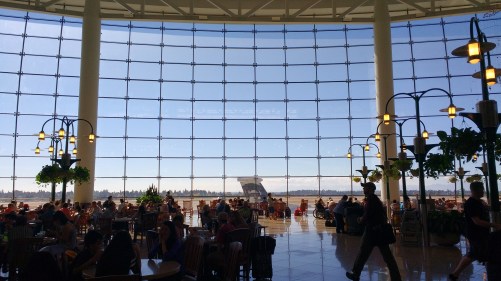
After walking through security at SeaTac, I entered the central food court and shopping area. I was greeted with this view:

From this gallery, you can watch the main runways as planes takeoff and land and you can do so seated in wooden rocking chairs (close to the windows). I assume many airports are designed with providing sufficient gates and access to planes in mind. Think of O’Hare or Atlanta where the concourses are long. Yet, this view took the mall court airport plan – common across many newer airports including ones I’ve seen in Tampa, Orlando, and Las Vegas – to another level: providing a large view of the most interesting work of the airport as planes travel at high speed.
An overview of the airport feature from when it opened in 2005:
The feature attraction, however, is the 60-by-350-foot glass wall that overlooks the runways and, in amenable weather, the Olympic Mountains. It’s more than just a big picture window. The panes are wrenched into a compound curve, convex in the vertical plane and concave in the horizontal. It looks more like a portal to a space warp than a mere window. The web of steel cables, struts and attachment spiders that allow the curtain wall to flex up to 11 inches in a worst-case windstorm or earthquake is all exposed to view, a celebration of virtuoso building technology…
Architect Curtis Fentress, the terminal’s principal designer, is convinced that people want to feel the excitement of travel again, and that it touches a deeper place than momentarily marveling at the apparent miracle of 400-ton cigars storming into the sky. He recalls a boyhood visit to the airport to see his uncle off to the Korean War. “We watched him wave to us from the plane,” Fentress recalls — an impression half a century old, burned indelibly into his mind.
Bonus: this area seemed to particularly fascinate small children. This is no small feat in the harried realm of traveling.
Adding to the design lesson: “What makes a McMansion bad architecture?”
Mcmansionhell on Tumblr begins with a well-illustrated post: “McMansions 101: What makes a McMansion bad architecture?”
We could add several additional dimensions to the negative design of McMansions:
- A lack of consistency around the entire home. (This post address the front.) Critics suggest McMansions are intended to impress others with their facades but the rest of the home gets little attention.
- Poor quality or a mish-mash of architectural materials. (Think fake stone siding.)
- Mixing a variety of architectural styles such as putting together English Tudor and Mediterranean.
- An oversized emphasis on the garage. (Hence the nicknames “Snout Houses” or “Garage Mahals.”) Critics suggest this emphasizes the private nature of large homes rather than having architectural elements that interact with the streetscape.
- A lack of proportions to the size of the lot, whether it is a large lot or a teardown McMansion sitting on a small lot and near smaller homes.
I look forward to the coming Tumblr posts on McMansions and it some of these design issues listed above will be covered.
Quick Review: A Burglar’s Guide to the City
Joining the subjects of crime and architecture, A Burglar’s Guide to the City by Geoff Manaugh is an interesting if not repetitive read. Some thoughts about a book that would intrigue many general readers:
- Manaugh’s main argument is that criminals – burglars in particular – see buildings and cities in very different ways compared to architects. While architects assume people will use the correct entrances and the rest of the building as it is intended, burglars are always looking for unique ways in and out of buildings which leads to going through walls, roofs, and floors. Additionally, the locations of buildings can significantly affect burglary – such as the banks right next to highway on and off ramps in the Los Angeles area. In other words, these criminals are hackers of the built landscape.
- Manaugh talks to a number of law enforcement people and records some interesting insights. The best people he talks to are from Los Angeles as he travels with the helicopter crews and tries to see the city from above as well as spot criminal activity from this vantage points.
- Oddly, Manaugh doesn’t spend much time talking to architects. Do they think they should pay more attention to possible criminal behavior? Do they need to change how they think about buildings? He does talk to one creator of safe rooms.
- Overall, Manaugh seems a bit in awe of the burglars who can see the landscape in the ways that no one else can. He basically admits this at the beginning of the last chapter – he likes heist films – and admits at a few points that the vast majority of burglaries are connected to drugs.
This is an interesting read and those who like examples of daring criminals – such as those bank robbers who build tunnels under bank vaults, emerge from the floor, and escape through water tunnels on 4x4s – will find plenty to like. Yet, Manaugh doesn’t go far enough to connecting of how architects and city planners should respond or even if they should – perhaps this is just collateral damage of living in American cities today.
Japan has its own shapes for some traffic signs but perhaps not for long
Japan is considering a revamp of its stop signs to suit easily confused tourists, The Japan Times reported recently. Japan’s current signs are fun and different, but they’re also red triangles that look suspiciously like the yield signs in the U.S. and other nations…
The stop-sign makeover would not come cheap. The government estimates the bill for replacing every sign in Japan with a more “global” design would total 25 billion yen, or $214 million.
The triangular stop signs are one of the last vestiges of unique Japanese signage. In 2013, Tokyo began to switch from signs using “romaji”—English transliterations of Japanese words—to signs with straight-up English translations. The Geospatial Information Authority of Japan announced earlier this month that it would change the symbols on foreign maps to reflect representations used throughout the globe: an envelope for a post office, a stick figure in a bed for hotel, and a peaked white box with a cross in the middle for a hospital, among others.
Japan has historically gone against convention when it comes to signage. It’s not among the 64 countries party to the United Nations 1968 Convention on Road Signs and Signals, which lays out global rules on, well, traffic signs. According to the guidelines, a “stop” sign is either circular, “with a white or yellow ground and a red border,” or octagonal, “with a red ground bearing the word ‘STOP’ in white in English or in the language of the State concerned.”
I suppose I shouldn’t be surprised but I am still fascinated: there are international conventions on road signs? Given the importance of driving around the world, this makes sense but it seems to be an odd signal of globalization: the exchange of goods and information is aided by the infrastructure of common road signs.
The only thing that might make this story even more fascinating would be some data on the consequences of having different road signs in Japan. How many accidents has this caused? Have their been prominent cases where tourists misinterpreted the signs?
Postwar suburban houses reviewed
The one-story ranch loosened its belt and spread out, and the Split Level, that most American hippogriff of house hybrids, took flight. The origins of the split level are murky: it originally offered a small footprint and a means to make better use of sloped northeastern sites. But it soon spread to locations where neither item was a real concern. It was an easy means to reintroduce functional separations that residents soon realized were valuable: locating bedrooms a stairway away from living rooms wasn’t merely Victorian prudishness—it made good sense. Split levels also fueled the rise of that most suburban setting, the rec room, which was usually located in basements or lower levels and almost invariably a more informal children-oriented social space, frequently enabling the relative re-formalization of the main living room.That suburban building sited homes on big lots is not news, but what is worth noting, as Lane points out, is how the houses were designed in relation to those lots. The formal and inward-oriented facades of pre-war homes gave way to houses whose facades were dominated by the living room picture window, affording a glimpse not merely of one’s own yard but those of your neighbors. As Lane comments, “The windows looked out on the new landscapes that formed around them and also enhanced the perception of spaciousness so much desired by this generation.” The scenography was often repetitive, but it was open: As John Updike commented in Rabbit Redux, “now the view from any window is as into a fragmented mirror, of houses like this, telephone wires and television aerials showing where the glass cracked.”…
Distinctive design was rarest from the larger builders, but similar trends characterized a very wide swath of construction, despite an often complicated level of agency. Jacobs cites a National Association of Home Builders study in 1959 indicating that 38.3 percent of builders designed their own homes, 34 percent used a contract or in-house architect, 12 percent hired a designer of some sort, and 6 percent purchased blueprints through a commercial service. Countless independent and uncoordinated actors who end up producing a similar monotony is unfortunately often the story of America.
And my favorite part of this review:
Suburban building has long been reviled by sociologists and ignored by architects. As Lane comments, “scholarship has been delayed and disturbed by decades of neglect and dislike.” Some of that neglect and dislike is warranted: it’s hard to find all that much architectural distinction in the vast majority of suburban homes. Their general interchangeability discourages the kind of design interest that has given us many monographs on vernacular rowhouses and bungalows and only a handful on the ranch home. There are countless books on a dozen homes in New Canaan, Connecticut, but almost no books on the remaining thousands of homes there; that balance is mainly right—and yet.
Simply the sheer number of homes built in the decades after World War II meant that these design choices would be influential. With a massive housing shortage building up through the Great Depression and World War II, homes were needed quickly and the existing economic, political, social, and design forces led to these particular kinds of homes.
But, as a suburban scholar I agree that such homes have either gotten little attention or have been reviled. These homes were incredibly influential, even if they weren’t true Modernist structures or deviated too much from existing vernacular designs or weren’t designed by architects but rather were mass-produced. Much of the scholarship and commentary on these postwar homes is done from a critical, after-the-fact angle and with an implicit alternative vision of how an urbanized America might have turned out. There is some truth in all of these critiques: these suburban communities were racist (in that non-whites were typically not welcome), initially had particular visions of gender roles and family life, promoted consumerism and driving, and took up a lot of land without much thought of the consequences. At the same time, millions of Americans enjoyed their new homes and the opportunities that came with them.