McMansions and McVulnerabilities

The Mc- prefix continues to live on in analysis of American life. As a recent example, here is a description of “McVulnerability” found in social media videos of crying and sadness:

Photo by cottonbro studio on Pexels.com

The weepy confessions are, ostensibly, gestures toward intimacy. They’re meant to inspire empathy, to reassure viewers that influencers are just like them. But in fact, they’re exercises in what I’ve come to call “McVulnerability,” a synthetic version of vulnerability akin to fast food: mass-produced, easily accessible, sometimes tasty, but lacking in sustenance. True vulnerability can foster emotional closeness. McVulnerability offers only an illusion of it. And just as choosing fast food in favor of more nutritious options can, over time, result in harmful outcomes, consuming “fast vulnerability” instead of engaging in bona fide human interaction can send people down an emotionally unhealthy path…

McVulnerability is perhaps an inevitable outcome of what the sociologist Eva Illouz identifies as a modern-day landscape of “emotional capitalism.” “Never has the private self been so publicly performed and harnessed to the discourses and values of the economic and political spheres,” Illouz writes in her book Cold Intimacies. Emotional capitalism has “realigned emotional cultures, making the economic self emotional and emotions more closely harnessed to instrumental action.” That is, not only does emotionality sell goods, but emotions themselves have also become commodities…

McVulnerability, from whichever angle you look at it, is the opposite of generous. It doesn’t require risk. It may pretend to give, but ultimately, it takes. And it leaves most of its consumers hungry for what they’re craving: human connection—the real thing.

The “Mc-” prefix makes sense given the popularity of McDonald’s. The way the term is deployed above seems similar to how the term McMansion has been used for several decades. McVulnerability is a pale substitute for true vulnerability. It is vulnerability in a popular and commodified form.

But can the term stick? It may depend on the popularity of such viral videos. Do they have staying power or will they be gone to be replaced by other trending videos? Will this pattern last for years? Or there might be other terms that describe these videos. Or the critique may not stick – what if most watchers see the emotional expressions as real and valuable? If such expressions become the new normal, perhaps McVulnerability is here to stay.

We’ll have to wait and see. McDonald’s will go on and plenty of other mass produced products and experiences will come along. Which ones will live on in “Mc-” infamy?


Trying to make the American “feeling economy” measurable and efficient

Sociologist Allison Pugh suggests we are heading toward a “feeling economy” with measurement:

Photo by Ono Kosuki on Pexels.com

Erin is one of millions, from teachers to therapists to managers to hairdressers, whose work relies on relationship. By some accounts, the U.S. is moving from a “thinking economy” to a “feeling economy,” as many deploy their emotional antennae to bear witness and reflect back what they understand so that clients, patients, and students feel seen. I’ve come to call this work “connective labor,” and the connections it forges matter. It can be profoundly meaningful for the people involved, and it has demonstrable effects: We know that doctor–patient relationships, for instance, are more effective than a daily aspirin to ward off heart attacks.

But this work is increasingly being subjected to new systems that try to render it more efficient, measurable, and reproducible. At best, firms implement these systems assuming that such interventions will not get in the way of workers and clients connecting. At worst, they ignore or dismiss those connections altogether. Even these complex interpersonal jobs are facing efforts to gather information and assessment data and to introduce technology. Moneyball has come for connective labor…

Connective labor is increasingly being subjected to new systems that try to make it more predictable, measurable, efficient—and reproducible. If we continue to prioritize efficiency over relationship, we degrade jobs that have the potential to forge profound meaning between people and, along the way, make them more susceptible to automation and A.I., creating a new kind of haves and have-nots: those divided by access to other people’s attention.

To quantify relationships could be difficult in itself. It requires attaching measurements to human connections. Some of these features are easier to capture than others. In today’s world, if a conversation or interaction or relationship happens without “proof,” is it real? This proof could come in many forms. A social media post. A digital picture taken. Activity recorded by a smart watch. An activity log written by hand or captured by a computer.

Then to scale relationships is another matter. A one to one connection multiplied dozens of time throughout a day or hundreds or thousands of times across a longer span presents other difficulties. How many relationships can one have? How much time should each interaction take? Are there regular metrics to meet? What if the relationship or interaction goes a less predictable direction, particularly when it might require more time and care?

Given what we can measure and track now and the scale of society today, the urge to measure relationships will likely continue. Whether people and employees push back more strongly against the quest to quantify and be efficient remains to be seen.

What children learn from HGTV #1: Houses are worthy of emotional investment

In watching HGTV with children and studying suburbs and housing, I have several ideas of what kids learn while watching the network’s programming.  

Photo by Ketut Subiyanto on Pexels.com

To start, HGTV shows are built around emotional stories about home repair or home acquisition. There is a regular narrative arc where people want to improve where they live or find a new place to live, they face some obstacles along the way, and then they are successful by the end of the episode. The shows are filmed, edited, and scored in such a way to create such a positive emotional payoff. The shows suggest they are helping people find happiness.

All of this weds the idea of homes with happy feelings. The shows are upbeat, the search for a better homes a success, and viewers have a positive resolution. HGTV has very few negative outcomes or unsuccessful work. The characters rarely talk about emotional distress, financial difficulties, and difficult family relationships. Only rarely do people not find what they were looking for and even then the ending is cast as a successful change in focus. Any obstacle is easily overcome.

In sum, HGTV is an emotionally positive network. I could see why parents or families might feel comfortable having kids watch such happy outcomes. A new or renovated home is good for the well-being of the resident(s) as well as the viewers.

Bambi, technology, and avoiding death

An excerpt from Sherry Turkle’s new book recalls a conversation about how technology could help us move beyond death and attachment to people:

Photo by Mike on Pexels.com

What was wrong with Bambi? Every kid sees Bambi. Marvin’s response has stayed with me for half a lifetime: “Bambi indoctrinates children to think that death matters. Someday we will conquer death by merging with computers. Such attachments—Bambi’s attachment to his mother, for example—will be unimportant. People need to learn to give that stuff up.” I knew Marvin to be a loving father and husband. But in his mind, attachment would only be an impediment to progress in a world where people and machines evolved together.

Marvin Minsky died in 2016. But I’m still fighting his idea, now more than ever part of the cultural mainstream, that it is good to have devices that can wean us from our dependency on one another. For Marvin, the burdens that come with human bonds were unnecessary and inefficient because an engineering solution was on the horizon—we are ultimately going to mate with machines or evolve into machines or become one with machines.

These ideas are seductive. Of course we want technology to bring us sharper wits and a cure for Parkinson’s. We like the idea that some kind of artificial intelligence can help monitor the safety of isolated elders. And then we are caught short. There is a red line—one I have seen so many people cross. It’s the line when you don’t want children to get attached to their mortal mothers because they should be ready to bond with their eternal robot minders. It’s the line where you take your child as your experimental subject and ignore her, registering her tears as data. It’s the line you cross when one of your classmates commits suicide by jumping out a window and you joke about the laws of physics that were at work in his descent. It’s the line you cross when you know that the car you manufacture has a design flaw and a certain kind of impact will kill its passengers. You’ll have to pay damages for their lives. What is the cost of their lives in relation to that of redesigning the car? This is the kind of thinking that treats people as things. Knowing how to criticize it is becoming more pressing as social media and artificial intelligence insert themselves into every aspect of our lives, because as they do, we are turned into commodities, data that is bought and sold on the marketplace.

At the very moment we are called to connect to the earth and be stewards of our planet, we are intensifying our connection to objects that really don’t care if humanity dies. The urgent move, I think, is in the opposite direction.

The idea of progress through technology is fairly ingrained in the American consciousness. But, is this the sort of progress people want? Death – and social interaction – comes to all people and leaning it these features in life might just lead to better lives.

At the end of this section, Turkle appeals to the environmental movement to help people back toward conversations about social interactions, empathy, and death. It would be interesting to see who from different arenas would be interested in joining a movement back toward empathy and human understanding. Numerous religious traditions? Humanities scholars? Proponents of democracy? People who own small businesses? There is a chance here to make common cause across groups that may be further apart on other polarizing issues.

Laundromats as “iconic places of loneliness”

Several experts suggest urban laundromats can be lonely, depressing places:

They’re often harshly lit and filled with strangers — weary, industrial where no one really wants to be. One could say the same of train stations, banks and other public places.

But there’s something deeper going on with Laundromats, mental health experts say, that can lead to feelings of depression and anxiety in even the most stoic dryer jockey.

Antoinette D’Orazio, a licensed mental health counselor in Hartsdale, New York, who specializes in depression, has found that Laundromats can often trigger toxic emotions…

Roger Salerno, a psychoanalyst and professor of sociology at Pace University who has written books exploring urban alienation and estrangement, calls Laundromats “iconic places of loneliness,” in part because they rouse up subconscious longings for domestic stability…

In general, Salerno added, women are more susceptible to this Laundromat-induced loneliness than men, because women have been historically more socialized toward domestic activities and the concept of having a family to care for.

This fits with some larger images of cities as lonely places: you have to go somewhere else to do laundry and there may be people around but you don’t know anyone. People may think they are good neighbors but few people are going to enjoy neighborly interactions while doing laundry.

I could think of several ways to help limit these issues:

  1. Make sure housing units have to have at least washing machines. Or, perhaps more Americans should have washer/dryer combos in one machine like many Europeans. This would be a cost to landlords and could be a space issue in many expensive neighborhoods. Additionally, this contributes to the privatization of domestic space – but perhaps this process is already irreversible in the United States.
  2. Some laundromats could set themselves apart by being more social places. The goal is to have a lot of machines yet why not charge a little more and host social activities?

Facebook’s new emoji reactions based on sociological work

Facebook used sociological work to help roll out new emojis next to the “Like” button:

Adam Mosseri has a very important job. As head of Facebook’s news feed, Mosseri and his team were assigned the task of determining which six cartoon images would accompany the social network’s ubiquitous thumbs-up button. They did not take the task lightly. To help choose the right emoji to join “like,” Mosseri said Facebook consulted with several academic sociologists “about the range of human emotion.”…

The decision was reached after much deliberation. Arriving at the best of those trivial and common picture faces followed a lot of data crunching and outside help. Mosseri combined the sociologists’ feedback with data showing what people do on Facebook, he said. The goal was to reduce the need for people to post a comment to express themselves. “We wanted to make it easier,” he said. “When things are easier to do, they reach more people, and more people engage with them.”…

In order for something to qualify for the final list, it had to work globally so users communicating among various countries would have the same options, Mosseri said. One plea from millions of Facebook users, which the company ultimately ignored, was a request for a “dislike” button. Mosseri wanted to avoid adding a feature that would inject negativity into a social network fueled by baby photos and videos of corgis waddling at the beach. A dislike option, Mosseri said, wouldn’t be “in the spirit of the product we’re trying to build.”

Operation emoji continues at Facebook while the company monitors how Spaniards and Irish take to the new feature. The list isn’t final, Mosseri noted. The first phase in two European countries is “just a first in a round of tests,” he said. “We really have learned over the years that you don’t know what’s going to work until it’s out there, until people are using it.”

Facebook and Mark Zuckerberg have been clear for years that they do not want Facebook to spread negative emotions. Rather, the social network site is about finding and strengthening relationships. The emojis both avoid dislike (though this set of six emojis includes one for sad and one for angry – but these are different than dislike) and make it easier for people to react to what others post.

Here are two factors that could affect these reaction emojis:

  1. Facebook will be pressured to add more. But, how many should they have? At what point does more options slow down reactions? Is there a proper ratio for positive to negative emojis? I’m guessing that Facebook will try to keep the number limited as long as they can.
  2. Users in different countries will use different emojis more and ask for different new options. At some point, Facebook will have to choose between universal emotions and providing country-specific options that appeal to particular values and expressions.

The formula to resettle refugees in European countries

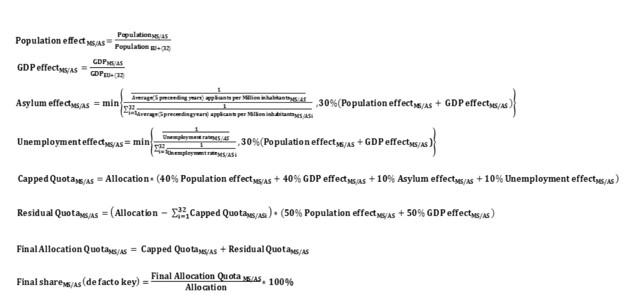
How will refugees be dispersed among European countries? This formula:

On Wednesday, shortly after European Commission President Jean-Claude Juncker announced a new plan to distribute 120,000 asylum-seekers currently in Greece, Hungary, and Italy among the EU’s 28 member states, Duncan Robinson of the Financial Times tweeted a series of grainy equations from the annex of a proposed European regulation, which establishes a mechanism for relocating asylum-seekers during emergency situations beyond today’s acute crisis. Robinson’s message: “So, how do they decide how many refugees each country should receive? ‘Well, it’s very simple…’”

In an FAQ posted on Wednesday, the European Commission expanded on the thinking behind the elaborate math. Under the proposed plan, if the Commission determines at some point in the future that there is a refugee crisis in a given country (as there is today in Greece, Hungary, and Italy, the countries migrants reach first upon arriving in Europe), it will set a number for how many refugees in that country should be relocated throughout the EU. That number will be “not higher than 40% of the number of [asylum] applications made [in that country] in the past six months.”…

What’s most striking to me is the contrast between the sigmas and subscripts in the refugee formula—the inhumanity of technocratic compromise by mathematical equation—and the raw, tragic, heroic humanity on display in recent coverage of the refugees from Syria, Afghanistan, Eritrea, and elsewhere who are pouring into Europe.

The writer hints at the end here that the bureaucratic formula and stories of human lives at stake are incompatible. How could we translate people who need help into cold, impersonal numbers? This is a common claim: statistics take away human stories and dignity. They are unfeeling. They can’t sum the experiences of individuals. One online quote sums this up: “Statistics are human beings with the tears wiped off.

Yet, we need both the stories and the numbers to truly address the situation. Individual stories are important and interesting. Tragic cases tend to draw people’s attention, particularly if presented in attractive ways. But, it is difficult to convey all the stories of the refugees and migrants. Where would they be told and who would sit through them all? The statistics and formulas help give us the big picture. Just how many refugees are there? (Imagine a situation where there are only 10 refugees but with very compelling stories. Would this compel nations to act.) How can they be slotted into existing countries and systems?

On top of that, you can’t really have the nations of today without bureaucracies. We might not like that they are slow moving or inefficient at times or can be overwhelming. How can you run a major social system without a bureaucratic structure? Would we like to go to a hospital that was not a bureaucracy? How do you keep millions of citizens in a country moving in a similar direction? Decentralization or non-hierarchical systems can only go so far in addressing major tasks.

With that said, the formula looks complicated but the explanation in the text is fairly easy to understand: there are a set of weighted factors that dictate how many refugees will be assigned to each country.

Creating a quirky and warm Twitter personality for your on-the-market housing unit

Here may be a new housing trend: personifying your for-sale home in a Twitter account.

Bob the House — a three-bedroom, one-and-a-half-bath ranch in the Chicago suburb of Mount Prospect — has been tweeting about his journey on the market since October. You’ll find Bob to be a rather inspirational house, tweeting messages of positivity and hope on a regular basis, along with fanfare for the Chicago Cubs and humorous updates about his search for the right family. (“Six showings today! You like me, you really like me!”)

Here’s the open secret: It’s not really Bob who’s doing the tweeting. It’s his “handler,” Rich Burghgraef, an account executive with sales consulting firm Randolph Sterling, Inc. Burghgraef writes in a blog post that he created Bob, whose name comes from the street the house lives on, Robert Drive, as a way to get away from typical advertising tactics. It seems Bob was a hit, with showings of the home going from one or two a weekend to six and eight after the Twitter account debuted. It may have even been responsible (or at least contributory) to the ultimate happy ending, as Bob tweeted on March 1: “My new family moved in on Friday. Thank you all for taking an interest.”…

Burghgraef says that he used Bob to make a personal connection with buyers, not just to throw marketing messages of “buy me!” at them. Bob would tweet about the school that taught him to tweet (so there’s a good school in the neighborhood!); his friend, the stop sign (safety first!); and his stepson, the swing set (don’t you see your family here?). The home’s Twitter account gave buyers a new way to “fall in love with him even before stepping in for a showing,” Burghgraef says.

A clever way to use social media. The several accounts I read of this phenomena did not provide much evidence regarding the effectiveness of this tactic. Of course, social media attention is one of the currencies of today’s social realm so why not leverage it to help sell your home?We can’t be too far away from someone automating this process so that every new housing unit on the market could take advantage of Internet available information about the neighborhood and surrounding area to develop a winning personality.

I think Burghgraef is right in suggesting that this could be particularly effective with real estate since there is a high level of emotional investment. While we could imagine all sorts of consumer goods having their own online personalities, not all of those goods might have the same emotional connections to their owners.

Pseudo equation/PR attempt to label the most depressing day of the year

Yesterday may have just been the most depressing day of the year if you believe one argument:

The idea of Blue Monday dates back to a 2005 campaign by Sky Travel. The company wanted to encourage people to take January vacations, so they reached out to Arnall, who developed his equation to find the most depressing day of the year.

Media, the public, and even other companies latched onto the idea. A U.K. group started a website dedicated to “beating Blue Monday.” Another group, bluemonday.org, encourages acts of kindness on the date.

Scientists, however, say there is no evidence that Blue Monday causes any more sadness than other specific days of the year. Burnett has been outspoken on the topic, publishing multiple blogs in The Guardian dedicated to dispelling the myth…

Burnett blames slow January news cycles, general post-holidays discontent, and “confirmation bias” for the term’s endurance.

“(People) feel down at this time of year, and the Blue Monday claim makes it seem like there are scientific reasons for this,” Burnett said in an email exchange. “It also breaks down a very complex issue into something easily quantifiable and simple, and that tends to please a lot of people, giving the impression that the world is predictable and measurable.”

And what is this equation?

http://www.foxnews.com/us/2015/01/19/today-is-saddest-day-year-and-there-blue-monday-equation-that-explains-why/?intcmp=latestnews

This is almost brilliant: come up with an equation (everyone knows equations make things more scientific and true), put it out there in January (dark and cold already), and the media eats it up (every morning show host ever hates Mondays). And the scientific data? Lacking.

That said, it would be intriguing to more into mass societal emotions around different times of the year. Is Christmas an excuse for many just to be happy for a month between Thanksgiving and the end of the year? I remember seeing a suggestion from someone that we should move Christmas later, perhaps to the middle of January, so we can enjoy the Thanksgiving high a bit longer before being pressed into another holiday. Or, what about those arguments that we need a national holiday the day after the Super Bowl? Given the amount of interaction people today have with the mass media (something like eleven hours of media consumption a day on average), couldn’t publicly displayed emotions have some effect on how we feel? Perhaps this has little or no effect compared to the effect of the emotions from the people nearby on us in our social networks.

Reactions “when your childhood home becomes a ‘teardown’”

A reporter describes seeing her childhood home make way for a teardown:

I understand why the house is being torn down. The stairs aren’t up to today’s construction codes. The bathrooms and kitchen are small. When someone slams the door in the garage, you can feel the vibrations upstairs in my brother’s old bedroom. The plumbing, windows and electric wiring haven’t been touched in decades. The metallic wallpaper with blue flowers in the bathroom my brother and I once shared says it all: The house is clearly outdated.

Still, I dread its rendezvous with a wrecking ball. When my childhood BFF’s century-old house was bulldozed last spring (goodbye high ceilings and ornate mantelpieces), the teardown trend in our old neighborhood suddenly became personal. Was some nefarious force—McMansion mania? Voldemort?—out to destroy my childhood haunts?

And what might explain such emotions?

Irene Goldenberg, a family psychologist and professor emerita at the University of California, Los Angeles, says teardowns can be more traumatic for former owners, and their children, than sales in which a house survives.

For one thing, she says, it’s hard to escape the finality of a teardown, which makes it all the more obvious “that you can no longer go back to the safety and comfort” of childhood. “It’s in your face,” she says.

There is also an obvious analogy to my aging parents. With new construction springing up all over the neighborhood, the house suddenly looks like a relic of another era. Still, when I came across the property records in my parents’ files last spring, the comparison that immediately sprang to mind was to myself. Although I had always assumed the house was older, it was actually erected just a few years before I was born in 1964.

For many people, childhood homes function like a psychological safety net, says Gerald Davison, a professor of psychology at the University of Southern California. “Even if you don’t feel comfortable knocking on the door, it’s nice to know that it’s always possible to do so” and reconnect with childhood, he says.

Neighborhoods do change over time but homes often represent permanence. This hints at the broader ideology of the American Dream as well as childhood. The first refers to the emotional attachment to single-family homes on plots of land, places that people can call their own. The second involves the development of childhood as a sort of “golden age” in the lifecourses filled with good experiences and exploring the world.

It would be interesting to hear more about the expression of and limits to such emotions. Perhaps we can add “McMansion mania” to the list of childhood bogeymen…