A scary front lawn, not full of weeds or leaves but frightening Halloween decorations

Halloween provides an opportunity for homeowners to have a scary front yard. This does not mean the green lawn is marred by weeds or leaves but rather by certain decorations:
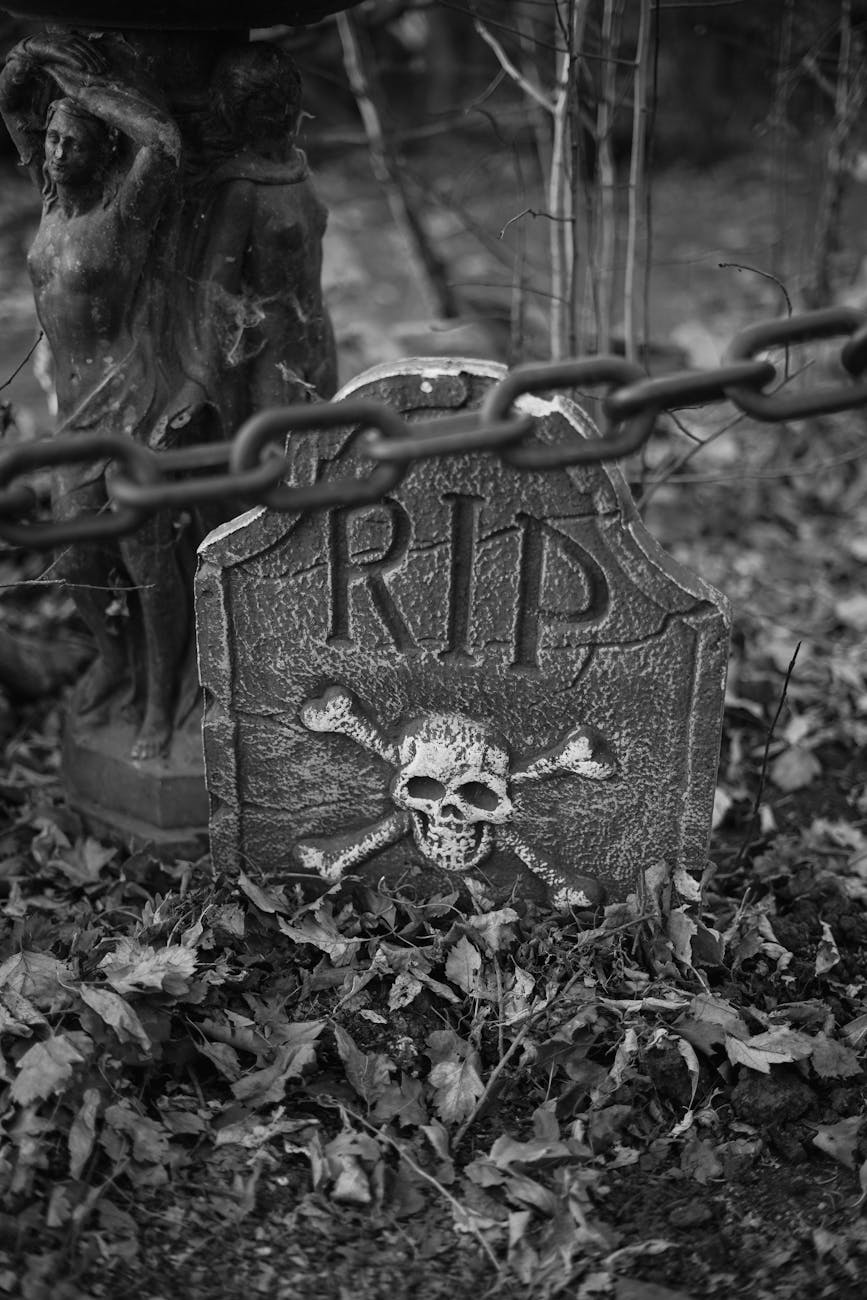
Photo by Alwin Johnson on Pexels.com

Mabon is one of a number of homeowners in and around the Chicago area who aren’t satisfied with simply slinging a fake web and plastic spiders across the front yard or spending a small fortune buying ready-made jump-scare creations. They share another important trait: the need (or maybe the obsession) to create something that wouldn’t look out of place in a professional haunted house or on a downtown stage…

When the sun goes down, Mabon’s house is transformed into a Halloween-themed faux nightclub, complete with booming music, colored lights and even a velvet rope. Mabon and his wife, Dawn Armstrong, even plan to dress up in black “Security” t-shirts to escort the V.I.P. kiddos along a red carpet to the candy stash on the big day…

Scattered upon the season’s withering plant life, the couple have erected a macabre art gallery: a thrift store still life to which Spata has seamlessly added a severed Medusa head; a copy of the Mona Lisa, her smiling face replaced with a skull and the painting’s title renamed “Moaning Lisa.” A dead shrub has become a netherworld creature — a nightmare of spiky, jutting limbs and platinum blonde hair…

Four faceless evil spirits — think the Ringwraiths from “The Lord of the Rings” or the Harry Potter Dementors — appear to float like smoke above the flowerbeds around Byrne’s otherwise perfectly normal Ravenswood Manor bungalow.

The largest evil spirit, which looks as though it is oozing out of the bungalow basement, is 16 feet long.

Halloween provides interesting social space to explore themes not always talked about or displayed. This extends to lawns, which homeowners in suburbs or city neighborhoods often keep prim and proper. For this portion of the year, the homeowners are allowed to fill what might be a lush, immaculate fall lawn with symbols of death, fright, and the macabre.

What might be truly scary is if the lawn is devoted to Halloween too early or too late. Imagine a full Halloween lawn that starts just after Labor Day. After all, if Labor Day is the unofficial end of summer, stores carry Halloween goods way before the day, and Halloween is the next major holiday, why not start early? Or, what if someone chooses to keep large Halloween displays up well into November, perhaps even past Thanksgiving and into Christmas decorations season? I am sure HOAs are on this.

Or there might be a point where the Halloween decorations pass from frightening to truly scary. What might neighbors and communities consider going too far? When does the lawn display go from celebrating the holiday to upsetting the neighborhood’s character?

All of this is part of the negotiations Americans engage in with their front lawns. On display for neighbors and people passing by, there are expectations what they can look like and be used for. Halloween may push the boundaries but there are still boundaries with ideas about the good or proper lawn.
Naperville now top trick-or-treating community in the United States

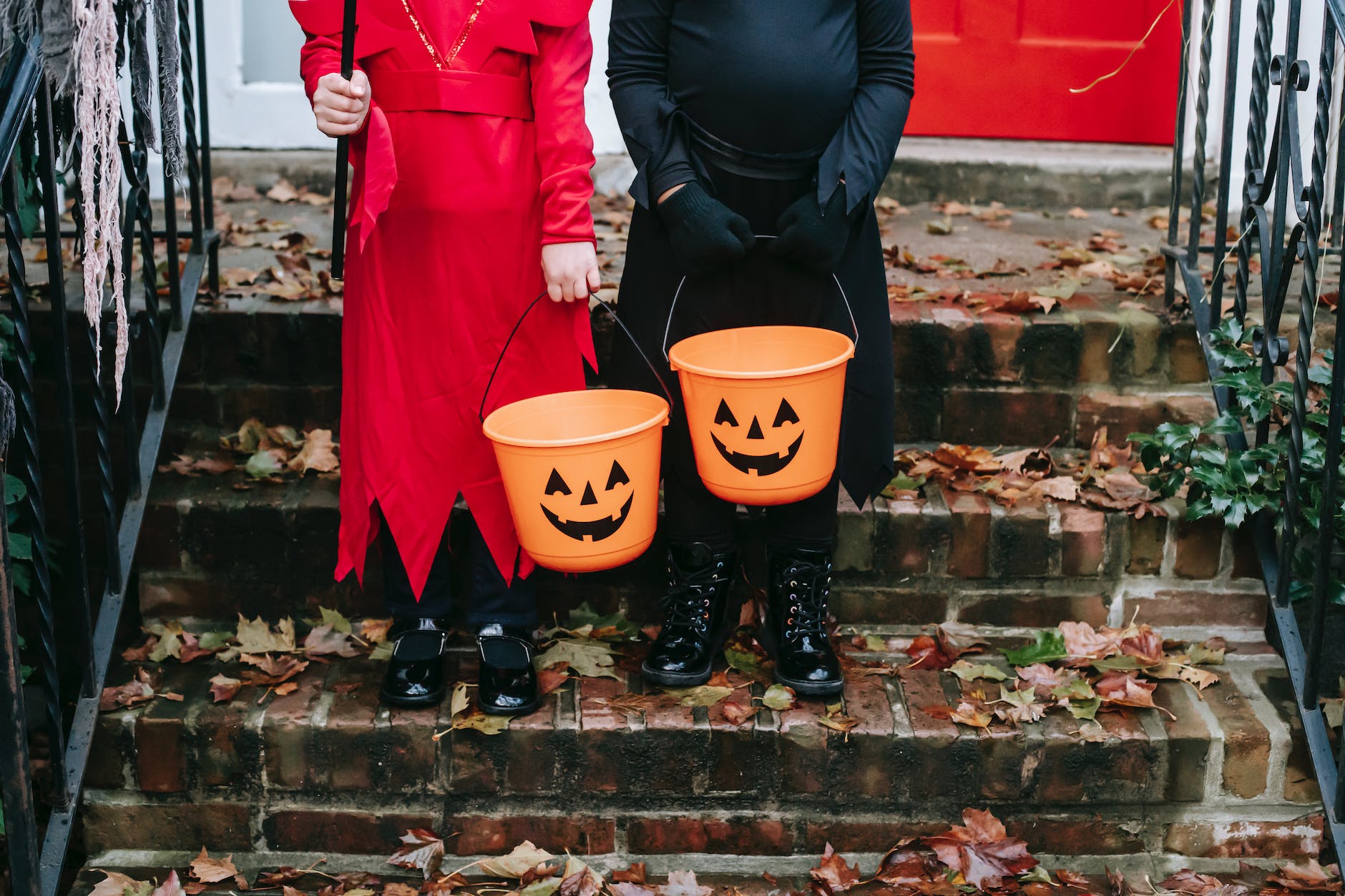
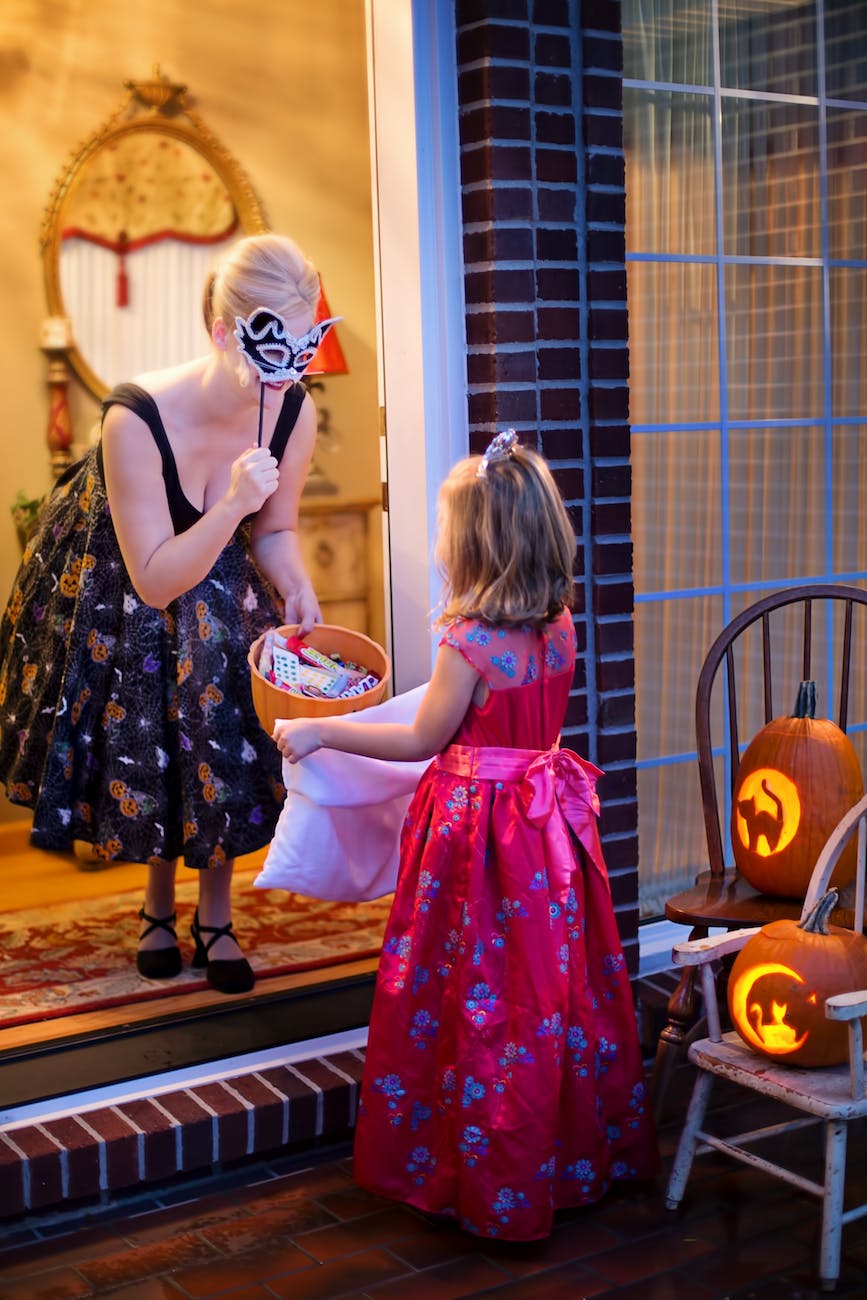
Naperville has accumulated a number of high rankings over the years and now it can claim to be the best place to trick-or-treat in 2023:

Photo by Charles Parker on Pexels.com

For innocuous thrills and chills, the city is No. 1, according to a recently released study ranking the top safest U.S. cities to go trick-or-treating. The list, compiled by product research company Chamber of Commerce, considers factors like crime, pedestrian deaths and law enforcement presence to determine where a worry-free Halloween is most likely to happen.

Naperville came in first out of more than 300 places evaluated across the country. That’s a step up from even last year, when the city ranked No. 4 on the same tally heading into Halloween 2022…

For Naperville, the company found the city “retains the charm and security of a tight-knit community” with few registered sex offenders, an “excellent record of property crime” and relatively few violent crimes reported across the whole city over the past year.

No word on the quality of candy available among the city’s households and businesses? There has to be some way to get at the experiences of people trick or treating in the community.

This adds to earlier rankings that had Naperville as a best place to live, a good place for families, and high level of wealth within the region.

Do McMansion neighborhoods do Halloween better?

In all of my thinking about McMansions, I have not considered this:

Photo by Jill Wellington on Pexels.com

Certain neighborhoods just do Halloween better, drawing folks from ho-hum suburbs because the McMansion community three hidden-oaks-fox-glens over is the place to be.

In this consideration of social class and who is welcome to trick-or-treat in which neighborhoods, this might just be a throwaway example. Perhaps McMansions just quickly refers to homeowners with means.

But, it does raise a possible question: is Halloween celebrated in particular and better ways among McMansion owners? How would this be measured: more enthusiasm for the holiday? More and bigger decorations? Specific candy handed out? Lots of children on relatively quiet streets on Halloween?

I am guessing there are at least plenty of folk theories out there on what neighborhoods – in the abstract and specific locations within communities – are best at Halloween. I am not sure McMansion-lands would necessarily come out on top but they have some qualities that suggest they could be in the running.

Would less door-to-door trick-or-treating and more community Halloween events decrease or increase social interactions?

If Halloween is indeed evolving away from neighborhood trick-or-treating (good discussion here), are the replacement or alternative or additional events in downtowns, at churches, and activities organized by other groups leading to more or less community and social interactions? Thinking out loud:

-Going door-to-door often involves interacting with people who are near you in physical proximity. Even if neighborhood interactions are declining, people would be more likely to run into each other at other times just because they live near each other.

-Going to centralized Halloween events in other locations means more people might gather together. But, their interactions might be limited. Perhaps it depends on what commonalities people at the event may share – a church event could involve a number of core community members as could a downtown event where local luminaries or figures are involved. On the other hand, community or organized events could involve more people just dropping in and out after acquiring candy and a lower likelihood of later interactions.

In both cases, the practice of getting candy could do little to build community if (1) candy is the only goal and (2) the likelihood of subsequent interactions is limited. It would be easy to turn Halloween into an exercise is gathering a commodity with few opportunities to interact with people.

And more broadly, how much is Halloween a family or community holiday compared to other big celebrations like Christmas, Thanksgiving, and July 4th?

Linking great trick-or-treat neighborhoods to traditional neighborhood design

Maybe a good trick-or-treat location should be defined less by the available candy and more regarding its design:

Great neighbourhoods for trick-or-treating also tend to be great neighborhoods for families everyday:

  • Tree-lined streets designed for walkers more than speeding cars.
  • Enough density and community completeness, to activate what I call “the power of nearness” – everything you need, nearby.
  • Good visual surveillance through doors and stoops, windows (and I don’t mean windows in garages), porches and “eyes on the street.”
  • Connected, legible streets that let you “read” the neighbourhood easily -grids tend to be good for this, but other patterns work too…

If kids ARE being driven in, that can mean it’s a great neighbourhood from a design perspective (or perhaps just that it’s a more affluent community, with “better candy”) — but having too few local kids can show that there isn’t enough housing diversity, new infill, and family-friendly “infrastructure” to keep kids in the neighbourhood. In fact, in many beautiful, tree-lined neighbourhoods popular on Halloween, the number of local kids may be actually dropping, with resulting pressures on local schools to close. This as household sizes decrease, and new density and “gentle infill” that could stabilize the population and keep kids in the neighbourhood, is often locally resisted.

From this point of view, good neighborhoods promote walkability and ultimately sociability. There are few times of years where this matters as much as Halloween as many Americans do not regularly walk down their streets to visit a number of neighbors at once.

More broadly, the practice of trick-or-treating is closely tied to social trust. Even with no documented cases of poisoned candy, parents want to know that their kids are safe. And with declining social trust in the United States, again, there are limited numbers of opportunities where Americans ritually interact with physical neighbors as opposed to seeking out people they whom they share an identity or interests.

It sounds like there is an empirical question to be answered here: do neighborhoods with (1) more traditional design and (2) higher levels of social trust (which may or more not be related to the neighborhood design experience more satisfying trick-or-treat experiences (measured by numbers of children trick-or-treating, percent of households providing candy, and perceptions of whether the neighborhood is a good place for this)?

Time of year for HOAs to crack down on holiday decorations

As Halloween decorations emerge, homeowner’s associations are back to patrolling displays. See this example in Naperville:

After neighbors complained to the Ashbury Homeowners Association board about the traffic and noise created by the celebrated house decorations, the group installed rules that thwarted Thomas’ plans.

“I am disappointed,” said Thomas, who has lived in the 1100 block of Conan Doyle Road in south Naperville for 21 years and has decorated his house for the past 18 years. “For a lot of people, the house has become a tradition and it is something people look forward to.”

Thomas’ display has grown over the years, and now includes over 2,000 pieces with lights and synchronized music. Visitors to the cul-de-sac have also grown — he estimates about 8,000 people visited last year alone — which is why neighbors raised concerns about traffic and safety with the Ashbury Homeowners Association board.

The board notified neighbors via its October newsletter that a “Holiday Decorations Rule” was voted on and passed at its Sept. 21 board meeting. The rule limits a person’s decorations to 50 percent of the yard, excluding lights, and restricts the display to 30 days before and after the holiday.

I can see both sides to this story. The homeowner may be asking why the association is now instituting these rules. He has had displays for years; why now? The HOA might say that the displays keep growing and attracting thousands of people disrupts the neighborhood. On the other side, suburban residents tend to prefer quiet streets and neighbors that don’t draw negative attention to themselves (even if they are raising some money for charity). The owner could respond that these are just temporary decorations. The final guidelines may be reasonable: a homeowner could still do a lot with 50 percent of their yard and thirty days before and after provides around 60 days for the displays.

To avoid issues such as these, wouldn’t homeowners associations be better off having such guidelines on their books from the beginning or before such situations arise where single owners feel like they are being singled out? Associations are often pilloried for having silly rules on their books but they can help cut off situations such as these.

Zillow back with Trick or Treat ratings for major cities

Zillow is back with its 2014 rankings of “Best Cities for Trick or Treating.” San Francisco, Los Angeles, and Chicago round out the top three. The methodology has not changed much compared to 2013:

We take data seriously here at Zillow, even when it comes to trick or treating. While wealthier neighborhoods are often known for their frightfully sweet harvest on Halloween night, we calculate the Trick-or-Treat Index using a holistic approach with four equally weighted data variables: Zillow Home Value Index, population density, Walk Score® and local crime data from Relocation Essentials. Based on these variables, the index represents cities that will provide the most candy, in the least amount of time, with the fewest safety risks.

In the era of Internet lists, this is a potentially catchy list. The factor of housing values filters out a lot of places with the top 10 dominated by coastal cities with Chicago as the only Midwestern or Southern entry.

Yet, it also seems limited to major cities, not even metropolitan regions, so its scope is limited. Many Americans live in suburbs or smaller big cities and those don’t seem to make the cut here. Perhaps Zillow doesn’t have the same availability of data in these places.

I suspect that people within these cities would not all appreciate it if people took these rankings seriously and in large numbers flocked to the highest-rated neighborhoods just to get better candy more quickly. But, it would certainly be interesting if large numbers did show up…

Sociologist who studies fear at and collects stats for a haunted house

Here is one way to put sociological training into practice: working for a haunted house.

Ms. Kerr’s equivalent of a coffee break was the ScareHouse in Etna, which bills itself as “Pittsburgh’s ultimate haunted house” and has earned accolades from national publications, trade magazines, horror movie directors and other outlets to buttress the claim…

A part-time professor at Pitt and Robert Morris University, Ms. Kerr’s appreciation for the macabre also led to a job at ScareHouse, where she’s worked since 2008 as an administrator, statistician and resident sociologist…

Though the ScareHouse, which opened in 1999, had long taken customer surveys, Ms. Kerr added a new dimension, he says, polling not just on what aspects of the haunted house worked but what customers’ fear most deeply…

Ms. Kerr’s book, based on her haunted house experiences, deals with “the real benefits of experiencing thrilling or scary materials.” Those can range from the endorphin and adrenaline rush and confidence boost of surviving a dicey encounter to the stronger bonds formed in social groups that experience a scary situation together. Of course, there’s an important caveat.

“To really enjoy thrilling situations, you have to know that you’re safe,” she added.

“Thanks for experiencing our haunted house – now please take our exit survey.” Yet, it sounds like an interesting place to collect data. It would be interesting to hear how generalizable the findings about fear at a haunted house might be to other situations.

I often tell my statistics and research methods students that all sorts of organizations, from NGOs to corporations to religious groups to governments, are looking to collect and analyze data. Here is another example I can use that might prove more interesting than some other options…

The “trick or treat index” for metropolitan areas and Chicago neighborhoods

In a ranking sure to bring in some Internet traffic, Zillow has put together a “trick or treat index”. The top ten cities: San Francisco, Boston, Honolulu, San Jose, Seattle, Los Angeles, Chicago, Washington D.C., Portland, and Philadelphia. You can also see the top neighborhoods for these cities. Here is what goes into the index:

Zillow takes numbers seriously, even when it comes to trick or treating. Taking the most holistic approach, the Trick-or-Treat Index is calculated using four equally weighted data variables: Zillow Home Value Index, population density, Walk Score and local crime data from Relocation Essentials. Based on these variables, the Index represents cities that will provide the most candy, with the fewest walking and safety risks.

A brief and clear explanation. The index includes four equally weighted factors: the price of homes (giving some indication of the wealth in the neighborhood), density (how many people/households are available to go to for candy), walkability (can easily walk to more candy locations), and crime rates (safety while trick-or-treating). All of this presumably adds up to identifying the best places to get candy: wealthy people are likely to give better candy, there are more households within a short walk, and it is safe. But, why don’t we get the actual ratings in these four categories for the top cities?

It is probably not worth anyone doing a serious research project on this but it would be interesting to crowdsource some data from Halloween to see how this index matches up with experiences on the ground. In other words, does this index have validity? This seems like a perfect Internet project – think GasBuddy for Halloween candy.

Chicago McMansion battle reaches the McMansion pumpkin stage

One battle over a proposed McMansion in Chicago recently turned to pumpkins:

The large pumpkin popped up over the weekend next to his lot at 829 S. Bishop St. It was painted with the words, “When size matters … McMansion Pumpkin.”

Many neighbors have referred to Skarbek’s plan for his home as a “McMansion.” He plans to build a home much larger than the row home that had been there, and the home will eventually interrupt a string of front yards that are all set back from the street…

Later Tuesday, Skarbek’s next-door neighbor, Paul Fitzpatrick, said his wife decorated the pumpkin, which actually sits on his yard to the north of a fence surrounding Skarbek’s lot while the new home is being built.

“I meant it as a good gesture,” Carrie Fitzpatrick said. “He likes big houses, so I thought he’d like a big pumpkin. I spent a lot of money on that pumpkin, and if it backfired, I’ll feel really stupid.”

A holiday-themed McMansion fight turned petty. Both sides appear to be trying to pass it off as no big deal but even in a country of moral minimalism (the argument of M. P Baumgartner in The Moral Order of a Suburb), this is an odd way to go about things. If the neighbors are already pursuing a lawsuit, the other main way for Americans to settle irreconcilable differences, why move to the pumpkin stage?