Forgetting the railroad tracks in downtown Chicago when they are covered up by developments

As Chicago grew at a rapid pace in the nineteenth century, the railroad lines that helped make the city largely converged in one place: the south bank of the Chicago River alongside Lake Michigan where goods could be loaded and unloaded for the city or for ships. A 1948 image on the Maggie Daley Park website gives some indication of the scene:

Later development of land, such as Millennium Park, helped eliminate and then cover up more of the tracks. And a new proposed development south of Grant Park may cover up more:

Even as city officials weigh other proposed megadevelopment deals in and near downtown, a Wisconsin developer who played a key role in building Ford Field in Detroit and rebuilding Lambeau Field in Green Bay is pitching another: a multibillion-dollar plan to deck over Metra Electric rail tracks west of Soldier Field to build a mix of residential, office and retail space.

Several sources close to the matter say a partnership headed by Wisconsin executive Bob Dunn has briefed City Hall and other officials on plans, set to be officially unveiled next month, to build over 34 acres of Metra Electric tracks and storage facilities just west of South Lake Shore Drive, from McFetridge Drive south to roughly 20th Street.

Air rights to build over the tracks were acquired more than 20 years ago by developer Gerald Fogelson, who built the huge Central Station residential complex just to the north, south and east of Roosevelt Road and Michigan Avenue. Fogelson had hoped to develop the adjacent air-rights property himself as a sort of a Central Station 2.0, and as late as 2015 he was looking for a partner, describing then a $3 billion long-term plan with 3,000 apartments and 500 hotel rooms.

But Fogelson’s plans never jelled, and a new group named Landmark Development has emerged, with Fogelson still involved but Dunn, who is president of Milwaukee-based Hammes, now serving as lead developer.

Few would argue that the railroad tracks downtown and along the lakefront contributed to a beautiful aesthetic. Between the noise and the sights, most residents and leaders would prefer to see buildings, parks, and water than tracks. But, I wonder if the continued covering of tracks and building on the air rights might help lead Chicagoans to forget both the historical and current importance of the railroads to Chicago.

As Chicago grew, the railroads helped Chicago become the center of the Midwest as commodities came in from north, west, and south and were turned around for the Chicago market or markets out East. (See Nature’s Metropolis for all the details.) Today, Chicago is still a railroad center with numerous important railroad lines and a lot of freight traffic. The move in recent years to relieve accidents, ensure on-time trains, and traffic congestion is to move more and more of the railroad traffic to the outskirts of the region.

It might be easy today in a world of smartphones to forget the basic railroad infrastructure that helps undergird Chicago and the country. Chicago itself has shifted away from a commodity based economy and joined the ranks of finance and corporate capitals (and done so successfully). Yet, the railroad will continue to be important for Chicago even if it is no longer visible in some of the city’s most iconic locations.

Data centers in the suburbs

Data centers are important elements in the infrastructure of a Internet-based, networked world. So, it should not be a surprise to see them pop up in suburbs in the Chicago region:

Data center provider Element Critical is expanding into the Chicago market with the acquisition of two data centers in suburban Wood Dale, Illinois, the company announced today. The deal provides a third market for Element Critical, which currently has operations in Silicon Valley and Northern Virginia…

The two data centers the company has acquired in Chicago encompass 195,000 square feet of data center space. Wood Dale is in the suburban Chicago market, 17 miles west of downtown Chicago and two miles from O’Hare International airport. Element Critical did not identify the seller, but Sungard Availability Services is listed as operating two facilities in Wood Dale…

Last week CIM Group and fifteenfortyseven Critical Systems Realty (1547) acquired a data center at 725 South Wells in Chicago’s business district. The 66,000-square-foot facility was purchased from Digital Capital Partners, a wholesale data center provider. The building has 5 megawatts of capacity.

On Monday, New Continuum said that it has acquired its flagship data center at 603 Discovery Drive in West Chicago, Illinois. The company has been leasing the site since 2013, and was supported with financing by Post Road Group, a leading real estate bridge lender

I would guess that (1) very few Internet users think about data centers and (2) very few nearby residents could identify a data center from another kind of facility. For example, here is a Google Street View image of the Discovery Drive facility mentioned above:

DiscoveryDriveDataCenter.png

There are numerous good reasons to not widely broadcast what is taking place in such facilities – with similarities to urban buildings that house telecommunication centers – yet such buildings will increasingly become regular parts of urban and suburban landscapes.

Small Illinois town becomes intermodal facility and warehouse central; long-term benefits are not good

Elwood, Illinois is home to facilities of a number of important American companies but the small community experiences few benefits:

It’s hard to find anyone who will admit to it now, but when the CenterPoint Intermodal freight terminal opened in 2002, people in Elwood, Illinois, were excited. The plan was simple: shipping containers, arriving by train from the country’s major ports, were offloaded onto trucks at the facility, then driven to warehouses scattered about the area, where they were emptied, their contents stored. From there, those products—merchandise for Wal-Mart, Target, and Home Depot—were loaded into semis, and trucked to stores all over the country. Goods in, goods out. The arrangement was supposed to produce a windfall for Elwood and its 2,200 residents, giving them access to the highly lucrative logistics and warehousing industry. “People thought it was the greatest thing,” said Delilah Legrett, an Elwood native…

But this corporate valhalla turned out to be hell for the community, which suffered a concentrated dose of the indignities and disappointments of late capitalism in the 21st century. Instead of abundant full-time work, a regime of partial, precarious employment set in. Temp agencies flourished, but no restaurants, hotels, or grocery stores ever came, save for the recent addition of a dollar store. Tens of thousands of semis rumbled through Will County every day, wreaking havoc on the infrastructure. And as the town of Elwood scrambled to pave its potholes, its inability to collect taxes from the facilities plunged it into more than $30 million in debt…

According to the Will County Center for Economic Development, at least 25,000 tractor trailers a day come through the Intermodals. That amounts to three million containers annually, carrying $65 billion worth of goods. A staggering $623 billion worth of freight traversed Will County infrastructure in 2015 alone, roughly equivalent to 3.5 percent of the U.S.’s total GDP…

But when it comes to the long-term prospects for the region, optimism is scarce. Paul Buss’s son, who works as a building inspector in Joliet, told his dad there’s concern “these companies are gonna come in, they’re gonna build these buildings, and they’re gonna use them for however long they can get a tax break on them, and then they’ll move someplace else.” The threat of empty warehouses looms large.

The freight industry, composed of both railroads and trucks, has to be placed somewhere. The southern edge of the Chicago region is a logical place with close connections to major highways, cross-country railroad lines, airports, and both the Great Lakes and the Mississippi River as well as proximity to the third largest metropolitan area in the United States. And there are likely benefits to these companies and industries to have a concentration of facilities rather than scattering them across multiple communities and regions.

But, the article suggests we should not view the communities where these facilities are placed just as collateral damage. There are real consequences to the trucks and trains that ship all the goods we need on a daily basis. People’s lives are affected. Could the facilities should be placed outside of towns and away from residences as possible?

Perhaps the true test of all of this is whether the next town that is chosen or selects itself as the possible next facility center turns down the opportunity or they dive headlong into the same issues.


Illustrating the importance of truck deliveries to American life

A 2012 infographic shows how vital truck delivers are in the United States:

Infographic Trucking Industry Facts

Four quick thoughts:

1. By days two and three, things are getting ugly. No new food? Certain supplies not available? No more gasoline?

2. This highlights the on-demand nature of many of our underlying social systems. We expect to have supplies readily available if needed and do not stockpile much (from food to medicine to fuel).

3. Many fictional apocalyptic tales feature major natural disasters, diseases, or government issues but a much more prosaic reason could cripple the trucking industry. It may not make for a thrilling story but this could be the real way the apocalypse comes quickly.

4. Shouldn’t we consider the trucking industry part of the national infrastructure? We often consider highways and railroad tracks important but the trucking industry itself matters.

Deep Tunnel as the wrong solution to water issues (plus alternative uses)

Henry Grabar poses an interesting question: what if the Deep Tunnel project, one of the largest civil engineering feats in the world, does not solve flooding and stormwater issues in the Chicago region?

What if Chicago took a wrong turn in 1972 when, in the spirit of civic grandee Daniel Burnham (“Make no little plans”), it opted to build the world’s largest sewers instead of making all possible efforts to keep rainwater out of them? Scott Bernstein, the founder of the Center for Neighborhood Technology, says that the Deep Tunnel imposed a massive opportunity cost because the city and the district did little else to adapt. The MWRD spent billions on what engineers call “gray infrastructure” (pipes, tanks, pumps) and virtually nothing on “green infrastructure”: rain barrels, detention ponds, green roofs, porous pavements, and other adaptations that would have kept water out of the system…

The project proceeded regardless. Even with downsized reservoirs and a longer time frame, Chicago’s ambition captured the attention of civil engineers around the world. Today, most U.S. cities whose combined sewer overflows are governed by consent decrees with the EPA are working on Chicago-style digs. St. Louis, which has the fourth-largest sewer system in the country, is under a consent decree to commit $4.7 billion to ending its overflows through deep tunnels…

While engineers’ penchant for megaprojects endures, some American cities are preaching deterrence. If Chicago built a bathtub, Philadelphia is trying to transform itself into a sponge with park space, street trees, and permeable pavement. The city is spending $2.4 billion to implement the nation’s largest green infrastructure plan, an experiment that positions it as the anti-Chicago. The city thinks keeping water out of the system will save billions of dollars compared to a rejected tunnel proposal—and that green initiatives will produce positive externalities, like improving air quality and creating verdant streets.

In Chicago, meanwhile, the MWRD has committed to creating just 10 million gallons of green infrastructure capacity under its EPA consent decree. Compare that to neighboring Milwaukee, a deep-tunnel city that now believes its green infrastructure will, by 2035, surpass the capacity of the tunnels and hold up to 740 million gallons of rain where it falls.

Hindsight may always be a little tricky in these cases as we have the advantage now of being able to see the Deep Tunnel project in action. Does it actually accomplish its goals? Was all the spent money worth it? At the same time, a project of this magnitude should have generated plenty of discussion and at least a few alternative options.

If Deep Tunnel does not work as intended or does not solve all of the flooding and stormwater problems, I wonder if it could be used in other ways. I’m thinking of other major infrastructure projects that have been reversed or reused, like urban highways that are torn out (like in Boston or San Francisco) or former railroad lines turned parks or recreation areas (think the High Line). Some other options for the Deep Tunnel:

  1. Underground roads. With Elon Musk’s Boring Company working on underground roads plus Chicago’s legacy of Lower Wacker Drive, perhaps traffic could be rerouted deep underground.
  2. Underground freight movement. Given Chicago’s railroad bottleneck, this could be an interesting solution.
  3. An underground park and recreation area. It would certainly be unique. Think a combination of spelunking, rock climbing, and exploration.
  4. A military installation and testing area.

Comparing 4 years to finish rebuilding a major interchange to other major undertakings

After the Illinois Department of Transportation recently announced construction on the Jane Byrne will take four more years, the Chicago Tribune compared this time frame to other tasks:

Two world wars were fought and won in less time. Rows of skyscrapers went up in less time. The transformation of Navy Pier, less time. New Comiskey Park, less time. Dan Ryan reconstruction, less time. Millennium Park, less time. The Deep Tunnel Project — oh, wait. That engineering feat began in the mid-1970s and isn’t expected to be completed until 2029. Somebody, go pick on them…

Still, four years is a long delay. Especially for a network so central to Chicago. We’ll never understand why IDOT didn’t order more intense work or bigger crews around the clock and on weekends. Let’s just say that if Gov.-elect J.B. Pritzker shares Emanuel’s devotion to penalties and accountability, he’ll make new friends by the thousands.

Is this part of a larger trend of major infrastructure projects today running over schedule and over budget? There are hints yet people are unlikely to hear much about or celebrate projects that are completed on time and near budget.

Comparing the completion time to other projects may not be fair. Some of these sites were closed or not in use when the construction happened. Some happened with some private money at play. Others had more space to work with. Doing the work when the state and other taxing bodies had more money (or were less worried about debt) could help. And World Wars have their own logic compared to construction projects. (That said, I am still amazed how much the United States was able to mobilize and produce in a roughly 5 year span during World War II. Such devotion to the war mission led to unbelievable change.)

Would it simply be better for the Chicago region to accept a Carmageddon week where the interchange is closed and all the possible crews are brought in for 24 hour shifts for that time to rush work forward? Find a week with less traffic, probably a summer week, and give drivers plenty of notice about other options (ranging from mass transit to alternative highways, such as I-294, that can route traffic around the center of the city). Suffer short-term pain, make some serious progress, and show that efforts are underway to reduce the long-term burden of the interchange construction.

Teaching kids about Chicago’s Deep Tunnel project

Kids should know about one of the largest civil engineering projects in the world: the Deep Tunnel project in and around Chicago.

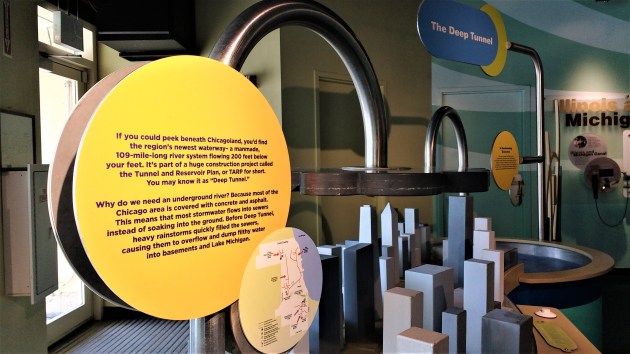
DeepTunnelNotebaertNatureMuseum

This is from the Riverworks exhibit at the Peggy Notebaert Nature Museum in Chicago. While some of the pieces of the exhibit failed to work the day we visited, I think I could see the purpose of the The Deep Tunnel exhibit: the floodwaters would be diverted away from the city.

The concept may appear simple and explainable to kids but the execution in real life is not. The exhibit suggests the flooding the past is now alleviated by Deep Tunnel. Yet, the problems are likely to go on in a region that continues to expand and change. Remediating water and flooding issues is a very difficult task compared to altering development at the beginning.

It is interesting to think how else this engineering feat could be presented to children. I could imagine a scaled model that kids could walk through to help give them a sense of the size of the sewers needed as well as the size of some of the water reservoirs. Deep Tunnel is not intended for minor amounts of water; this is supposed to help protect millions of people on a fairly regular basis. Communicating the sheer size could fascinate kids. Or, perhaps some sort of computer game where kids play the role of an engineer or expert as they make choices about where to divert water. Come to think of it, where is this version of Simcity or Roller Coaster Tycoon – “Infrastructure Builder” or “Sewer Wars” or something catchier.

Photo reminders that railroads ran into the heart of Chicago into the mid-1900s

Chicago’s Loop today is associated with gleaming skyscrapers and the finance and banking industries. Here are some great photos that provide a reminder that Chicago’s rise and wealth depended on railroads that ran right to the center of the city: the south bank of the Chicago River as well at the lakefront (which is now Grant Park).

Historically, railroads helped make Chicago what it is. As detailed in Nature’s Metropolis, Chicago became the center for gathering commodities and goods from the fertile Midwest (corn, cattle, etc.) as well as distributing other goods back to the growing Midwest. This thriving trade helped prompt other businesses and industries to form, such as the development of commodity futures.

These railroads still matter tremendously in the Chicago region, even if they are less visible. There are still railyards in Chicago (such as near Midway Airport), just outside the city (such as near O’Hare Airport), and other ones a long ways away (such as the intermodal facilities in Joliet or New Rochelle which facilitate transferring materials between trains and trucks). The trains may block traffic but they help ensure Chicago remains a transportation center.

In praise of What Do People Do All Day? by Richard Scarry

I raised the question yesterday regarding why children’s books often address infrastructure and construction but older kids receive little instruction in this. Today, I highlight one children’s book I enjoyed as a kid and enjoy now having kids: Richard Scarry’s What Do People Do All Day?

From my point of view, the book performs multiple important tasks:

  1. Shows a range of jobs and how they intersect. A community needs farmers, plumbers, train operators, people running paper mills, and so on in addition to the typical tales of police, firefighters, and medical personnel.
  2. Shows all sorts of infrastructure including the production of electricity and water as well as building roads, using fire to put out fires, and how to build a house.
  3. Introduces economic principles. For example, the first story traces the path of money as producers sell goods to retailers and then how those producers might use the money they received.
  4. The book has a good balance of instruction and whimsy. There is much for kids to learn here as well as wacky situations such as Huckle ending up in the cockpit for landing an airplane and the various adventures of Lowly Worm.
  5. Children prominently feature in the stories, even if they are not the main characters, which helps give them a sense of contributing to the work going on around them.

Admittedly, the book has its quirks. The architecture is unusual – I usually think it matches French Canadian architecture (and I have little exposure to this outside of a few trips to Montreal). The characters can conform to stereotype. I’m thinking of Mommy Cat who receives a new dress because she works so hard at home. Some of the characters are simply strange – what does Wild Bill Hiccup do outside of serving as town eccentric? There must be some important community roles that are left out – no mention of religious groups? Leisure activities? Garbage collection? Truck drivers?

Yet, the informative stories, depictions of community life, and recurring characters mean that I keep enjoying this book.

Why do children’s books spend so much time on infrastructure and construction yet there is little formal instruction on these topics later?

Yesterday, I walked to the nearest bank and watched some construction going on. The work appeared to involve digging underneath the side of a street, possibly to deal with a pipe or some kind of wire. I was struck that while many neighbors or drivers would find such a sight a nuisance, many kids would be fascinated.

Plenty of books for children involve infrastructure and construction. These books discuss vehicles, what is underground, and how items get from one place to another. The emphasis on big machines doing physical work and the mobility of it all seems attractive to kids. (I would guess much of this attraction is due to socialization.) But, if I think back to my schooling, we spend little time analyzing and discussing these basic systems that are essential to all of our lives: electricity and electrical lines, plumbing and sewers, Internet cables, roads and highways, pipelines, gas lines, railroads, trucking, waterways, airplanes and airports, and other crucial pieces of infrastructure. Why?

In many ways, it would not be hard to incorporate these topics into multiple subjects. The first example that came to mind would be a unit about railroads. These are essential for moving goods long distances. Various subjects could tackle aspects of the railroad. Plenty of history and geography to note. The natural sciences could discuss steam engines, coal, diesel engines, and how such heavy objects move. The humanities have a wealth of stories, poems, songs, and other works that involve railroads. Math could involve analyzing timetables or schedules. Language arts could involve writing promotional materials for railroads or describing particular historical events involving trains.

Without more formal instruction on infrastructure, American adults may not (1) think often about how we all need to contribute to maintaining and building infrastructure and (2) have a good understanding of how it all works (not just the infrastructure itself but also related industries and aspects of social life). In other words, a lack of attention paid to infrastructure in school and learning may just contribute to a public that does not want to address the infrastructure issues facing the nation today.