Many don’t seem to like a 50 year mortgage; some lenders already offer a 40 year mortgage

As people reacted – mostly negatively, from what I saw – to the possibilities of 50 year mortgages in the United States, one article noted that 40 year mortgages has a history and can be obtained now:

Photo by Pixabay on Pexels.com

I remember a time when a 40-year mortgage — and a 50-year adjustable rate mortgage — built some buzz back around 2006 and 2007 for people who were struggling to buy a home. It didn’t work out well if you had to sell when home prices collapsed.

The 40-year mortgage has a history going back to the early 1980s, according to an earlier report in the Detroit Free Press, part of the USA TODAY Network, when 18% fixed-interest rates were squeezing consumers out of buying homes. It never proved to be the most popular product…

If you shop around, some lenders are offering 40-year mortgages now.

Rocket Mortgage notes online that the Detroit-based giant offers a 40-year mortgage with the first 10 years being interest-only payments. These mortgages can be available for loan amounts between $125,000 to $2 million.

I wonder how many people apply for and receive 40 year mortgages.

Reading the reactions to the idea of a 50 year mortgage, I was struck by how much of the conversation was dominated by financial details. How much equity would a homeowner have after 20 years? When would the interest parts of the payment taper off compared to paying down principal? How would interest rates be different for a 50 year loan? I should not be surprised given how much homeownership is now seen in the United States as a financial investment. It is a tool to build wealth, perhaps the biggest tool most people will have.

But homes are about more than that. Americans have ideas about the virtues of owning a home compared to being a renter. A homeowner might feel differently and act differently regarding their property if they have a mortgage. Numerous neighborhoods and communities are structured around homeownership (such as many suburbs). Having a stable and affordable residence can help contribute to numerous positive outcomes.

Are we at a stage when public discussions about housing then are exclusively or are primarily about the finances of owning a home – which are certainly important – and not any influential factors that might encourage or discourage people from owning homes in the United States?
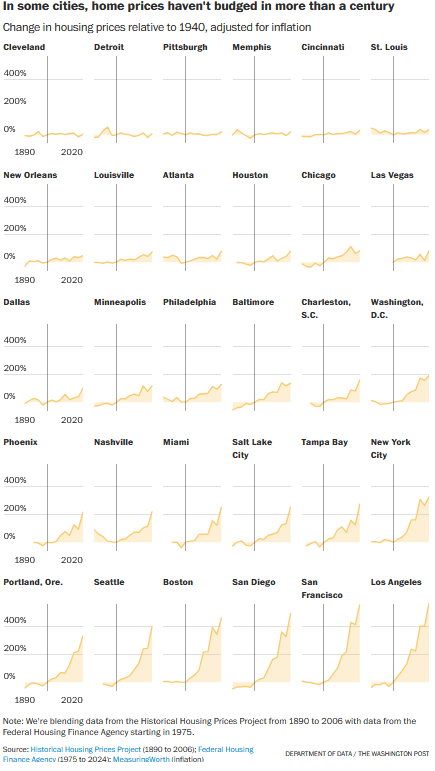

Some American cities have seen no gain in housing values for decades, others with large gains

Looking at long-term data regarding housing values in different American cities shows large differences across places:

What drives these differences?

When we stopped to think about that, we couldn’t get it out of our heads. So many of us have internalized the lesson that homes are speculative, flippable investment vehicles, yet in much of the country — Cleveland, Memphis, Detroit, we could keep going — housing has been a truly quotidian commodity. There, home prices simply keep pace with inflation over the long run, no different from spaghetti or sprockets…

Consider that Dallas, Houston, Seattle and Portland, Oregon, all had what the researchers would classify as high demand for housing. But prices in Dallas and Houston have only roughly doubled in price since 1890, compared with a more than sixfold jump in Portland, or almost fivefold in Seattle…

“If prices go up,” Lyons asked us rhetorically, “does supply come on stream to follow? Do people look to build homes?”

Since 1970, the metros where housing stock grew the least relative to population growth — think Los Angeles, San Francisco, San Diego or Seattle — saw the some of the fastest home price growth. While metros that built enough housing — such as Atlanta, Phoenix and Charleston, South Carolina, saw home prices rise much less rapidly, even as their populations soared.

Does this suggest that Americans have come to view houses as investments when some places in the country have not experienced large increases in housing values over time?

For the cities with big increases over time, how do local leaders and residents see the jump in property values? It clearly leads to issues with affordable housing: rising housing values prices some people out of the market, particularly compared to what that market was and what residents had previously experienced. But rising housing costs can be viewed positively: people can sell their properties for more money and rising values can be associated with success.

This might be another reason why it is difficult to address housing issues at a national level. Housing is a very local issue and the cities in the top row of the graphic above have very different conditions compared to the cities in the bottom row.

Condos, investment properties, and limited demand in Canada

Can condos help people find reasonably-priced housing and achieve homeownership? Maybe but viewing them more as investment properties for years means there may now be less demand for condos in Canada:

Photo by Amit Batra on Pexels.com

It didn’t take long to figure out why there were so many empty units on the market: it turns out nobody wants to rent a condo, and nobody wants to buy one either. Condo rents have dropped over the past two years, and according to a recent report from the Canada Mortgage and Housing Corporation, or CMHC, condo sales have fallen by 75 percent in the Greater Toronto Area and 37 percent in the Vancouver area since 2022. The market has become so dire that buyers of pre-construction condos are having difficulty closing their purchases. Banks lend money depending on the present value of the property, and some condos are worth less now than they were when the buyers made their first deposit. As a result, developers have been cancelling construction projects. Some experts say we should have seen this coming…

The simple answer is that many condos built between the late 2010s and early 2020s were constructed not for living but for investment. Since 2000, there has been a steady increase in the proportion of condos used as investment properties. To my surprise, most of the investors were not faceless corporations or foreign investors. Research done by Statistics Canada shows that the typical condo owner is a middle-aged, middle-class Canadian couple. The reigning logic for the middle class was that buying a condo, renting it out to pay for the mortgage, and eventually selling the unit was a solid way to make money. This was especially true in the late 2010s, a period of low interest rates and weak rent control policies. Steady demand for housing, partially caused by increasing immigration, made real estate seem like a sure bet.

Developers knew that most pre-construction buyers were investors rather than people looking to live in the apartments themselves. As a result, they focused on quantity over quality. Vishakh Alex, an architectural designer working in Toronto, said that the directive from developers in the late 2010s was to squeeze in as many units as possible. It is telling that between 1971 and 1990, the median condo in the city was approximately 1,000 square feet, but between 2016 and 2020, the number dropped to roughly 650 square feet…

Yet, as city populations continue to grow, there’s nowhere to build but up. It hardly bears repeating that there is a housing crisis in Canada. Young middle-class people looking to buy their first homes can rarely afford the kinds of houses that they might have grown up in—a cute triplex on a tree-lined street in Trinity-Bellwoods, Toronto, for example, or a townhouse in Kitsilano, Vancouver, with a view of the ocean. And so it is to the condos we must go.

But it is also true that condo living does not have to be, and perhaps should not be, defined by the biggest developers looking to squeeze every drop of profit from mom-and-pop investors and homebuyers.

This shift toward investor properties sounds similar to what has happened in the United States in recent decades with homeowners increasingly viewing their properties as investments and expecting certain returns.

One difference here is that more of these condos might have been second homes. In Privileging Place: How Second Homeowners Transform Communities and Themselves, sociologist Meaghan Stiman explains how only a second home influenced how property owners viewed places and themselves with consequences for communities where these second owners were sometimes present.

If people in cities in Canada and the United States have concerns about investors buying too many properties, whether investors from other countries or institutional investors, what do they make of middle- to upper-class residents buying condos for investments? As the author notes above, these cities clearly need housing. American cities and metropolitan regions need housing. Should certain kinds of investors have limits or should developers be limited in how many investment properties they can construct?

One upside could be that the glut of investment condos does provide some attainable housing. The prices might not fall too far given their initial cost but what if investment condos and homes start becoming options for residents for whom they were not originally intended?

Move at the right time to reap the benefits of an American boomtown

At the end of a listing of the “Top Boomtowns in America” in 2022, here is some advice about timing a move to one of the boomtowns:

Photo by Lukas on Pexels.com

“Moving to a boomtown at its earliest stages can be a great opportunity for entrepreneurs and investors, as there’s still plenty of room for growth. And for those who are looking for a job, there are usually plenty of opportunities available in rapidly growing cities,” says Edith Reads, senior editor at TradingPlatforms. “However, if a city has already reached its peak, it may be too late to get in on the action. In this case, it may be wiser to wait until the city’s growth slows down before making the move. This way, you can avoid getting caught in the midst of a housing or job crunch.”

In other words, a resident or business wants to get in on the earlier parts of the boom, not in the latter stages or after it is over. Why? A few reasons listed above:

  1. There is money to be made. Whether owning a business or a home, an investment early on could pay off down the road. (For more on American homes as investments, see this earlier post.)
  2. A growing community means numerous job opportunities.

Mess up your timing in moving to one of these boomtowns and these two opportunities are not as good.

Another thought that is not accounted for in this ranking: how does the community change because of the boom period? Is it just as an attractive place to live and work after the rapid population growth? How do the old-time residents view the change? If the community grows enough, it will not exactly be the same place. Ultimately, other boomtowns will reign in future years. Will the boomtown be a good place to be in a few decades?

The suburbs are about homeownership but some property owners see more money in rental units

The American suburbs revolve around single-family homes. But, in recent years some property owners see more money to be made in converting housing units into rentals. Here is a recent example from Arlington Heights, Illinois:

Photo by Alexander Mils on Pexels.com

Interra Realty, a Chicago-based commercial real estate investment services firm, announced this week it brokered the transaction — equating to $242,500 per unit — for the property at 1 N. Chestnut Ave. The firm represented both the seller, the Chestnut Street Condominium Association, and the confidential buyer, according to the announcement…

“As long as there remains potent rental demand in desirable communities like Arlington Heights, I expect to see continued deconversion opportunities in select Chicago suburbs,” Interra Managing Partner Patrick Kennelly said in the company announcement. “This submarket, in particular, has become more of an investment target following headlines related to Arlington Park.”

If homes, single-family dwellings and otherwise, are now primarily about financial investments, is this one of the logical consequences?

Suburbanites can often have negative perceptions of renters and apartment-dwellers. How do residents of Arlington Heights feel about more housing units becoming rentals? Does it matter if the conversions are happening in or near suburban downtowns compared to in single-family home subdivisions?

If this continues to spread – and I saw numerous stories in the last few years about single-family homes turned into rentals as well – I would imagine there will be some concern and attempted regulations.

Rising property values and “passive income, which is the real American dream”

Why do so many homeowners care about protecting their property values? While recently reading about social class and Hollywood, I found this observation:

Photo by Karolina Grabowska on Pexels.com

That passive income, which is the real American dream, is no longer something that the actual artists—not just actors but writers and directors and everyone else who ever made a dime off of residuals—involved in the entertainment business get to enjoy.

The context here involves the actors and others involved with long-popular television shows that could reap the financial benefits for decades.

Isn’t this passive income also what American homeowners in the early 21st century expect when they purchase a residence? Scholars have noted the shift to Americans viewing their homes as a positive investment. Instead of needing a home for shelter and enjoying that residence while there, homes and residences are now supposed to make money for their owners. In this arrangement, property owners are not expected to be completely passive; they should maintain their property or possibly even improve it. In return, their property values go up and they can cash out in the future. A loss is very undesirable and even staying roughly at the same value over time is not much help given expenses. A nice profit requires a decent uptick in value. Such a profit can help owners climb the economic ladder, have a comfortable retirement, and pass along wealth and advantages to children and family.

This can help explain why so many homeowners fight against perceived threats to their property values. People want to change the use of land or alter the neighborhood in ways that might limit the rise of property values. It is a threat to passive income. (Whether those changes to the neighborhood and/or community actually lower property values is another story.)

Buy self-storage for Christmas

Need a gift for Christmas 2021? Self-storage is a hot commodity. Here is how it can enhance the holiday season:

Photo by RODNAE Productions on Pexels.com
  1. Give someone or yourself the gift of self-storage. Instead of purchasing a bigger house to store all that stuff, gift a self storage unit. Buy a month, several months, or even a whole year!
  2. Buy stock in a self-storage company. American is #1 in self-storage and you can ride the investment train.
  3. Take the long view and take those gifts and turn their value into your own self-storage property. Then, you gain from others who need to use your facility.

This may not be what your family and friends want for Christmas but it could be useful and/or valuable down the road.

Big drop in construction of starter homes of under 1,400 square feet

For younger adults looking for smaller homes to purchase as their first home, there at least one reason they are not easy to find: few have been built in recent years.

Photo by Kindel Media on Pexels.com

The supply of entry-level housing, which Freddie Mac defines as homes up to 1,400 square feet, is near a five-decade low, and data on new construction from the National Association of Home Builders shows that single-family homes are significantly bigger than they were years ago.

Homeowners from previous generations had access to smaller homes at the start of their financial lives. In the late 1970s, an average of 418,000 new units of entry-level housing were built each year, according to data from Freddie Mac. By the 2010s, that number had fallen to 55,000 new units a year. For 2020, an estimated 65,000 new entry-level homes were completed…

“What was really striking to me was the consistency in the decline in the share of entry-level homes, irrespective of geography,” Mr. Khater said. “The thing that struck me the most was that really, it’s all endemic. It’s all over the U.S. It doesn’t matter where.”…

Homeownership leads to greater wealth for those who buy earlier. An analysis from the Urban Institute estimates that those who became homeowners between the ages of 25 and 34 accumulated $150,000 in median housing wealth by their early 60s. Meanwhile, those who waited until between the ages of 35 and 44 to buy netted $72,000 less in median housing wealth.

Three things stand out to me from this article:

  1. The decline in the construction of these smaller homes is real. The numbers cited above suggest roughly 15% of these smaller homes are constructed now compared to the late 1970s.
  2. At the same time, the definition of an entry-level homes is contingent on square footage. These days, 1,400 square feet is not that large for a home. These standards have changed over the decades; new homes in the 1950s in Levittown were more around 1,000 square feet while many new homes today are over 2,500 square feet. As builders construct larger homes (presumably making more money) and some buyers want larger homes, what is now an entry-level home may have changed.
  3. The final paragraph above considers the wealth implications about being able to buy a home earlier on. This is important: homes are one of the biggest generators of wealth for Americans. Yet, this also marks a shift in viewing homes as investments as opposed to good spaces for people to live.

Homes as investments in continually increasing national median home values

The national median house value kept going up through November 2020:

Photo by Karolina Grabowska on Pexels.com

Despite a global pandemic and an economic downturn, U.S. home prices pushed new boundaries last year: The national median sale price for existing homes hit $310,800 in November, marking 105 straight months of year-over-year gains, according to data from the National Association of Realtors.

This could reinforce the now common viewpoint that homes are investments. Increasing median values for over eight suggests reinforces the idea that homes generally go up in value. Except for big economic crises – think the burst housing bubble of the late 2000s – houses accrue value over time. Even COVID-19 could not derail this.

This is often viewed as a good thing. Homeowners like that their homes are increasing in value because they can make more money when they sell. Communities take this as a marker of status. Realtors and others in the housing industry benefit. No one wants a drop in housing values across the board. (Of course, this is the median so the values can differ a lot by location.)

The commodification changes how owners, developers, and communities think about houses. They are not just the private spaces to escape the outside world – an established idea in the American Dream – but goods to profit from. An increasing value must be good and steps in other areas should be taken to protect home values.

This has numerous effects. It encourages Americans to invest resources in buying housing when that money could be put to use elsewhere. It contributes to single-use zoning where homes are protected from any other possible uses. It can exacerbate the inequality gap between those who can buy homes and those who cannot or between those with homes in places where the values keep going up versus those with homes in places with stagnant values.

McMansion values still slow to recover in one wealthy Chicago suburb

The values of McMansions may be proportionally down and evidence from one well-off Chicago suburb suggests they are selling at similar prices to 15 years ago:

In South Barrington, home to swathes of McMansions, the market has been slow to recover. There, large single family homes regularly hit the market at the same prices they sold for in the ’00s, indicating an enduring lack of demand in the northwestern suburb.

Despite the risk that these homes presented leading up to the recession, it would seem they’re a more sensible investment today — so long as buyers know what they’re getting into. Pound for pound, McMansions are a ton of house for the money. But they’re not speculative equity, and they’re not a retirement account.

It would be helpful to see more data across suburbs. Without such figures, it is hard to know if:

  1. Is this an issue related to Barrington and its location and amenities? The suburb is almost all white and Asian and has a median housing value of just over $800,000. Is there less demand for housing in this particular location?
  2. Is this a problem for all McMansions in the Chicago area? If people are indeed seeking more “surban” locations or Baby Boomers are all trying to unload their McMansions at once, there might be relatively few buyers for such homes in a region of over 9 million residents.
  3. Are the particular features of these homes limiting the value? This could be due to particular features of the homes or many are now up for updates that have not been done.

The issue may not be McMansions at all: perhaps it is the mindset common among Americans that houses should be investments that increase significantly in value.