How many American communities want super big houses?

Americans have large houses. But not every community wants a lot of really big houses:
Photo by Chris Goodwin on Pexels.com

“How big is a house?” mused Jeremy Samuelson, planning director for East Hampton, N.Y., where a working group recently proposed slashing the town’s maximum-allowed house size in half, from 20,000 square feet to 10,000 square feet…

Towns from Aspen to Martha’s Vineyard are in a big-house brouhaha. Critics say mushrooming mansions cramp scenic vistas and local charm, consume excessive energy and inflate prices…

Truro capped new homes at 3,600 square feet in 2017, but then, Shedd says, officials stuck in an amendment allowing bigger builds with special permits. “I’m not saying it was done on the sly,” says Shedd. “Our town meetings drag on. I was probably glazed over.”…

Routt County, Colo.—home to Steamboat Ski Resort—adopted a proposal capping house sizes at 7,500 square feet in June. Debated for months, the hot-button issue packed public meetings…

In Pitkin County—home to Aspen—officials slashed the maximum new home from 15,000 to 9,250 square feet last November, noting that a big house raises “greenhouse gas emissions and increases environmental havoc.”

What strikes me about these discussions is something I first discovered when researching the use of the term McMansion: the size of a big house is relative in terms of size and quantity. In the case of McMansions, a 3,000 square foot new house might be normal in newer neighborhoods but it can be considered a monstrosity next to a 1,100 square foot postwar ranch house. Or is an 8,000 square foot home a McMansion or a mansion? Depends on who is considering the home and where it is located. Or one teardown McMansion might not be a big deal but dozens or hundreds over a decade or two might be considered going too far.

In the cases of these even larger homes, how big is too big or how many is too many? The discussions here do not appear to be taking place within communities where they are contemplating going from no big houses to some. They are considering whether to have no more big houses. Apparently there is some limit to be reached soon or no more might be allowed.

Will such moves push those who desire giant houses to other communities? Will they end up in municipalities just outside these jurisdictions? Are there other communities who would see this as an opportunity rather than a problem?

The Home Alone house as one of the most newsworthy houses in America?

I saw the news: the Home Alone house has been sold.

Photo by Alena Darmel on Pexels.com

The red brick Georgian Revival mansion in Winnetka made famous by the 1990 film “Home Alone” garnered much attention when it was listed on May 24 for $5.25 million — more than three times what it had sold for in 2012 to its current owners — and in a testament both to the condition of the home and the popularity of Winnetka, the mansion found a buyer just one week later.

How many houses generate this much interest when they are on the market or even when they are not? The same story above noted the number of visitors to the fictional home of the McCallisters:

A 1992 Chicago Tribune headline for a story about the home being placed on a local house walk called the mansion “a “home that’s never left alone.” Then-owner Cynthia Abendshien told the Tribune even back then that “there are a lot of people, especially children, that will knock on the door and ask to see the house.”

It’s not much different today, although the mansion now is set behind a wrought iron fence and gate. On a nice day, a visitor showing up to gawk at the mansion soon will discover that there’s company — other visitors there for the same purpose.

There are historic mansions that get a lot of visitors. Think Hearst Castle, Biltmore. Lots of communities have preserved older homes or historic preservation districts. Homes designed by well-known architects, like Frank Lloyd Wright, draw the attention of visitors.

But homes made famous by a movie? Particularly a movie aimed at kids? That when it goes on sale prompts articles by the New York Times, Architectural Digest, and the Today Show? It may be an particular confluence of when the movie was made, the way news outlets today report similar stories, and the interest people have in famous or celebrity houses. I am sure the home will be back in the news at some point, though the movie is now over 30 years old and real estate markets change.

The newly constructed modern farmhouse is…a scourge? A McMansion? Popular because of a TV show?

A story about an LA teardown describes the rise of the modern farmhouse:

Photo by Pixabay on Pexels.com

Hollywood actor Chris Pratt, best known for his roles in the sitcom Parks and Recreation and Marvel’s Guardians of the Galaxy, has spurred the wrath of architecture enthusiasts over his decision to raze a historic 1950s house, designed by Craig Ellwood, to make way for a 15,000-square-foot mansion.

The move to demolish came shortly after Pratt purchased the mid-century home in an off-market sale for $12.5 million in January 2023. The house is located in the Brentwood neighborhood of Los Angeles, across the street from Pratt’s mother-in-law, former first lady of California Maria Shriver. The historic house will be replaced by a modern farmhouse designed by architect Ken Ungar, Architectural Digest reported, and is now in the early stages of construction. Until its completion, Pratt is waiting it out with his wife, Katherine Schwarzenegger, in a $32 million estate in Los Angeles’ Pacific Palisades neighborhood…

Pratt’s new home is adjacent to Shriver’s two homes, each valued at over over $10 million, carving out a family compound of sorts in the neighborhood. The demolition reflects the rising trend of modern, multimillion-dollar farmhouses cropping up in America’s suburbs that has gone on for decades and was newly revived after TV personality couple Joanna and Chip Gaines launched their debut show Fixer Upper, in which they remodeled old farmhouses, according to a National Association of Realtors report. Ungar has designed several multimillion-dollar mansions, including modern farmhouses, in Los Angeles.

This raises at least a few questions. Here are mine:

  1. Are the typical new farmhouses McMansions? In this particular case above, this is a home much larger than a McMansion. But, many modern farmhouses might fall into McMansion territory if they are a teardown, have some strange architectural features, and/or are part of suburban sprawl.
  2. In this particular case, the modern farmhouse is replacing a unique single-family home. But, one reading of the summary above is that the issue goes beyond this one property. The farmhouse has spread everywhere. Are there too many? Is it just a passing fad? Will a new style – and problem – be in play ten years from now?
  3. Could one TV show have significantly fed this trend? It is easy to point to a popular show – and then brand – as leading the charge. It would be interesting to see some numbers: how many builders and buyers were directly influenced by Chip and Joanna? Were they the only ones pushing modern farmhouses or were there other influencers? In this one case, who was Chris Pratt influenced by?

Seeing a 24/36/56,000 square foot home in DuPage County

I recently viewed from the road possibly the largest house in DuPage County, Illinois. Depending on which real estate site you look at, it is either 24,500 square feet, 36,000 square feet or 56,000 square feet. It took years to build and was up for auction at one point. Here is a 2007 description of the property in Chicago:

Photo by Iva Muu0161kiu0107 on Pexels.com

The biggest of these latter-day Xanadus, a colossal 41,000-square-footer, is about midway through construction in a far less plum location in the southwest suburbs: an out-of-the-way cul-de-sac outside Burr Ridge. Its only neighbor is a modest ranch house; a pizzeria, a gas station, and the entrance ramp to Illinois Highway 83 are just around a bend in the road…

What’s more, that whopper of a house will be home to only three people. Nick Memeti, the 30-year-old owner of Freedom Mortgage Team, is building it for himself and his parents-and the hundreds of guests he plans to have at the frequent parties he expects to throw in the cavernous basement. Down there, he will have an indoor pool (he is also planning an outdoor pool), slot machines, a dance floor, a 30-seat movie theatre, and a full gym. “It’s really built for entertaining,” Memeti says. “I have about 200 employees, and this will be the place for them to come and break bread with the boss and hang out.”

From the outside, this looks like a large home but even with the pictures online, it is hard to imagine that much space in a single home. This is not just a mansion; this is a supermansion that few homes can match. This is not the only large house in Burr Ridge. A 2016 story describes a different 30,000 square foot home. Chicago in 2023 named the suburb as great for “space chasers” seeking bigger homes:

This is another burg that’s not cheap, but you get “a lot more for your money in terms of space inside and out,” notes Jack Brennan of Second City Agents. A six-bed, five-bath home that was listed for $860,000 this spring, for instance, boasts 4,553 square feet, a four-car garage, and a full acre lot. The $189-per-square-foot price is good value compared with the $213 you’d pay for a comparable listing five miles north in Hinsdale. Burr Ridge offers the kind of quiet living you’d expect 19 miles southwest of the Loop. Yet the days when residents had to drive to Hinsdale or La Grange for dinner are gone: The Burr Ridge Village Center, built in 2007, features familiar names from the city, like the restaurant and bar Hampton Social and the breakfast joint Yolk.

Here is a description of the community on the Burr Ridge website:

Nestled 19 miles west of the Chicago loop, Burr Ridge is home to distinguished houses on large lots in quiet neighborhoods, fine dining, upscale shopping, quality hotels, excellent recreational opportunities, highly rated schools, open land for new business and a progressive business environment. The thriving business community ensures that Burr Ridge, year after year, maintains one of the lowest tax rates in DuPage County.

Worth magazine named the community one of the top 250 wealthiest communities in the country. In 2011, The Business Journals exclusive ‘On Numbers’ report ranked the quality of life in Burr Ridge second out of 955 Midwestern communities.

Straddling the border of DuPage and Cook Counties, Burr Ridge is conveniently located at the intersection of I-294 and I-55, just minutes from I-355 and 290. These expressways provide direct access to O’Hare and Midway airports. Three train stations in neighboring communities, hotel shuttles, and a Pace Bus facility in downtown Burr Ridge provide easy access to regional transportation and downtown Chicago without all the congestion.

Home to over 500 large and small local and national businesses, occupying more than 6 million square feet of floor area and employing over 10,000 people, Burr Ridge has a carefully planned mix of office and industrial parks and two well-designed retail areas in a natural setting. The two retail centers, County Line Square and Burr Ridge Village Center, are conveniently located at the southeast corner of County Line Road and host exciting community events each year. From an annual 5k race and Car Show to a weekly outdoor summer concert series, thousands of residents and visitors come from the region to enjoy the amenities in Burr Ridge.

The biggest houses tend to be located in certain communities with resources (Burr Ridge has a median household income over $174,000), desirable locations, and zoning that allows large homes.

Consequences of the mansion tax in Los Angeles

Los Angeles has a new mansion tax since April 1 and here are some of the consequences:

Photo by Roberto Nickson on Pexels.com

Measure ULA adds a transfer tax of 4 percent for sales above $5 million and 5.5 percent for deals above $10 million; real estate transactions in the city below those levels pay the already-established transfer tax rate of .56 percent.

“The flurry of activity that happened up until April 1 was pretty phenomenal,” says real estate attorney Loretta Thompson, a partner at Withers Worldwide. “And then, of course, after that, people started pulling their listings. There’s been a quantifiable pause in anything that’s over $5 million. It chilled the market immediately, which was what everyone expected it would do.”…

There are some winners. Independent Los Angeles County cities like Beverly Hills and Malibu have become more desirable since the measure does not apply to them. It is also shifting the balance of power in luxury real estate, long a seller’s market. “Buyers are being picky right now,” says Nourmand, adding that some people are willing to wait in hopes that sellers bring down prices on mansions: “They feel they have the upper hand in the high-end market. They don’t feel like they have to rush — they think time is on their side.” James Corden, for instance, listed a Brentwood house in January for $22 million, then dropped it to $18 million before selling it in July for $17.1 million. According to Dirt.com, Corden’s sale is subject to nearly $1 million in taxes under the ULA Measure.

However, many hope the tax will be revamped or rescinded. With two lawsuits already challenging the measure, the City of Los Angeles finance director has been instructed to hold any monies received, rather than use them as planned to create affordable housing options in the city.

Will any of these consequences affect legal rulings? Whether this is allowable is a different kind of question compared to how it is working out in practice.

Will the new revenue effectively address affordable housing? At the moment, the revenue is tied up. But, put together taxes from several of these sales and some new housing units could emerge.

It will be interesting to see where the turning point in the market is. Wealthier homeowners will still want to buy and sell property. There will likely still be demand from those outside the region who want to move into these homes.

The McMansion riches of ’80s TV versus the massive dwellings of today’s Succession

TV depictions of what constitutes a house for the wealthy can change over time:

Photo by Pixabay on Pexels.com

And if the “Succession” audience is smaller, the money is, pointedly, bigger. Rewatched in 2023, the idea of luxury in “Dallas” looks quaint, almost dowdy. The aesthetic is Texan country club; the Ewing homestead, the size of a decent suburban McMansion, is a toolshed next to the Manhattan aeries, Hamptons manors and Italian villas that the Roys flitter among.

Some of this is a matter of modern premium-cable budgets vs. the grind of old-school network-TV production, of course. But it also reflects the changed, distorting nature of modern riches. In 1980, American wealth inequality was still near its postwar lows. Since then, the wealth of the top .01 percent has grown at a rate roughly five times as much as that of the population overall. Today, the very rich are very, very, very richer.

The holdings of Waystar Royco — Hollywood studios, cruise lines, newspapers, amusement parks, a king-making right-wing news channel — make Ewing Oil look like a franchise gas station. We know only vaguely how Logan Roy built his empire, but it was enabled partly by the media-consolidation and antitrust deregulation, beginning in the “Dallas”/Reagan era, that allowed his real-life analogues like Rupert Murdoch to make their own piles.

American homes do broadcast messages about a resident’s status and wealth. McMansions are supposed to signal that the owner can afford a big home in a particular style (even if the imitation of traditional styles are odd).

On the other hand, mansions are even bigger, more extravagant, and can be of better build quality. Having multiple such dwellings extends far beyond the McMansion owner in the suburbs.

Another question: do the super wealthy make use of all that square footage and the features or are these part of a real estate investment? The McMansion owner is also hoping to get a return on their investment but the amount of money involved with extra-large properties is at another level.

Courtesy of Architectural Digest, see more about some of Succession’s dwellings here.

Asking again: did Kevin McCallister live in a McMansion!?

An overview of movies where Santa is the bad guy included this aside about Home Alone:

Photo by Irina Iriser on Pexels.com

The 1989 film (which is about a boy setting booby traps in his mansion on Christmas Eve to stop a killer Santa) earned a small measure of fame when its creators sued the makers of Home Alone (which is about a boy setting booby traps in his McMansion on Christmas Eve to stop some robbers) for the similarities between the two.

Is the Winnetka, Illinois home a McMansion or a mansion? Several pieces of evidence for the latter:

Atlas Obscura calls it a mansion and says, “Built in the 1920s, the building is comprised of red brick and was built in the colonial Georgian style.” It is hard to call a home as old as this as a McMansion. Additionally, it is built in a classic style, not imitating a classic style.

According to Zillow, the home has 5,398 square feet, 6 bedrooms, and 6 bathrooms. It is worth over $2 million. While the home size is in McMansion territory, that price is not.

-Did director John Hughes have a thing for suburban McMansions? This discussion in reddit.com/r/McMansionHell suggests no.

For more discuss, see my 2019 post.

Bonus information: according to Tripadvisor, seeing this home is the #1 thing to do in Winnetka.

Do not dream of McMansions; picture really large houses and properties

Architectural Digest features images of 12 “extra-large properties.” Here is the introduction:

Photo by Ingo Joseph on Pexels.com

There are few fantasies more persuasive or alluring than that of the expansive estate. When you think of big houses, your mind may immediately jump to the McMansions of yore, those garish homes you’d expect to see on an episode of MTV Cribs. The ones we can’t stop daydreaming about more closely resemble graceful, though still boldly luxurious, homes like the central property of Downton Abbey or the setting of Bodies, Bodies, Bodies before the horror film took a dark turn. Below we highlight 12 properties featured in AD that contain enviable amenities, from indoor tennis courts and home spas to guest houses and verdant gardens. 

Three features of this that struck me:

  1. Dreaming of McMansions exhibits poor taste. Dream bigger, more refined. Do not settle for the garish cookie-cutter version of a big house.
  2. The scale of these homes goes beyond the McMansion in numerous key ways. They are often far beyond the 3,000-5,000 square feet of a suburban McMansion. Some have much more square footage, others have numerous buildings. The properties are often much larger than the typical city or suburban lot. And the amenities are more plentiful and higher-end. Think special pools, gardens, and gathering spaces.
  3. The McMansion is much more attainable for people than the extra-large property. Does the McMansion offer enough of a taste of the high-end property?

When a McMansion feels more like an estate

Defining a McMansion is doable. But, at what point does a McMansion become an estate?

Photo by Mike B on Pexels.com

He liked how certain details — the neighborhood of manses behind gates and shrouded with trees; the house’s circular drive and imposing view — gave the ordinary McMansion an estate feel. He eventually dotted the lawn with gargoyles and Renaissance-style statues.

In this example, a McMansion feels more like an estate when it has added levels of privacy (gates, lots of trees blocking views of houses), a particular kind of driveway, and a particular view. Presumably, normal McMansions do not have these features or have imitations of these features. The suburban subdivision of McMansions offers limited privacy. The straight driveway leads to a big garage. The view is not imposing.

Is there a market for upselling McMansions? Take your typical newer McMansion, whether in a new development or in a teardown setting. What small features would differentiate it from similar homes and translate to a higher value? At the same time, adding special touches to McMansions goes against the mass-produced image of such homes.

Are the boundaries between McMansion and estate different than those between McMansions and mansions? In this second comparison, the size of the home itself seems to matter. The McMansion is roughly 3,000 to 10,000 square feet while the McMansion is larger.

Is it about the home or the location of the home?

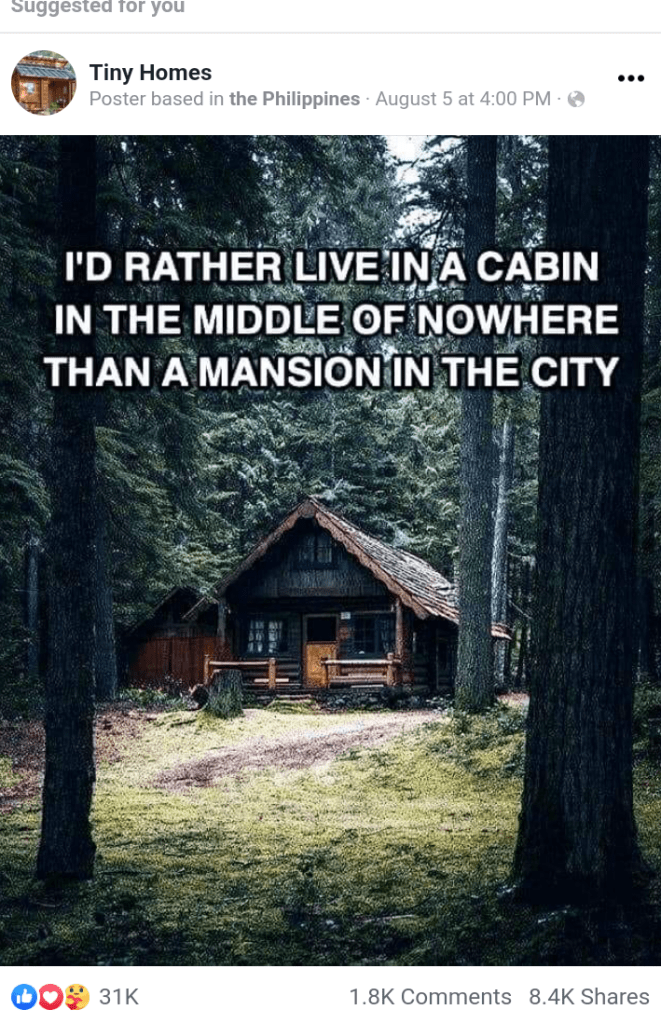
I recently saw this:

I think this is promoting living in the country as the person making the statement would be okay with a cabin rather than a mansion. The cabin looks like it is in decent shape, but it is no mansion.

However, this gets at a question I wonder about a lot: what exactly is it that motivates many people to select where they live? Here are several of the major factors:

-How many resources they have? What can they afford?

-What kind of neighborhood or community do they want to live in?

-Proximity to work.

-Quality of schools.

-Proximity to family.

-Preferences for kind and style of residence.

If you choose to live in a cabin in the country, you are elevating some of these factors as more important than others. But, is the choice primarily about the country and nature, the relative lack of people, the different kind of house, or something else? Reducing it to a binary choice of cabin/country versus city/mansion is simple but the decision might be much more complicated.