McMansions as short-term rentals, fake images of downtown Chicago, and news about housing

I search regularly for interesting news about McMansions. I recently ran across a headline that seemed plausible: “The Rise of Suburban Tourism: How Empty McMansions Are Redefining Vacation Stays.” But the headline was paired with a particular picture:
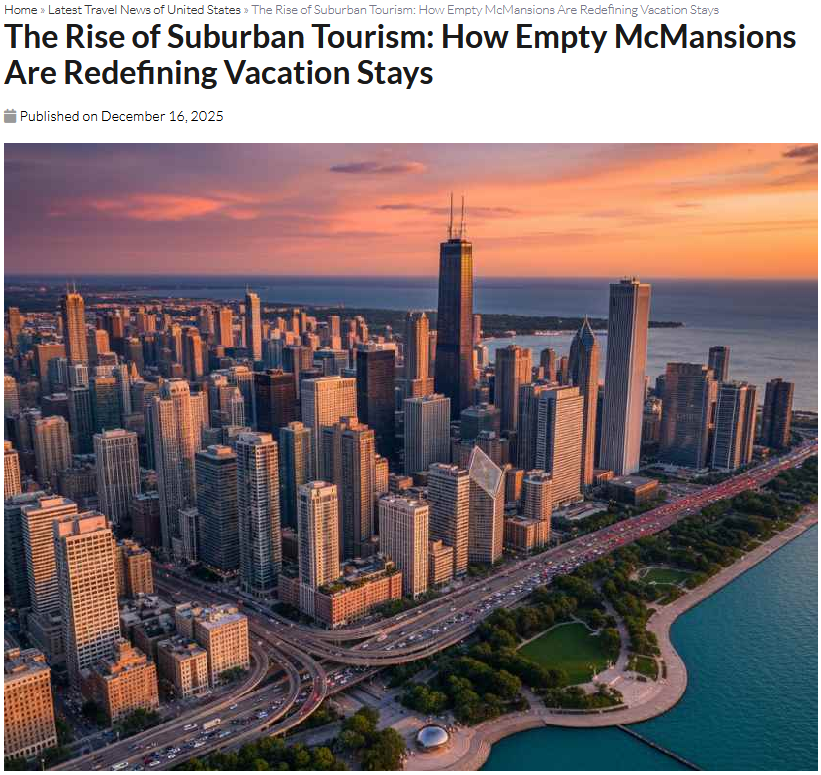
Image at link

I am familiar with the Chicago skyline and lakefront. This image is…interesting. It has elements of the Chicago lakefront. A big body of water. Some iconic buildings. The Bean. Jean Baptiste Pointe du Sable Lake Shore Drive and parks along the water.

But it is also clearly wrong. The buildings are not where they should be. The lakefront is not in the right pattern. The Bean is not located on a pedestal next to the water. The local highway does not empty onto the lakefront road in that manner. And so on.

So is the McMansion story true? The summary/conclusion:

Empty McMansions in the suburbs of the United States are reshaping tourism patterns, with many tourists now seeking more dynamic urban destinations. However, these empty homes also present new opportunities for suburban areas to adjust and offer new experiences for visitors. Through creative uses of space, a focus on sustainable tourism, and rebranding efforts, suburban regions can continue to evolve as attractive destinations for a new generation of travelers.

Are more McMansions being rented out? Is this changing tourism patterns in metropolitan regions? is there any evidence of this happening? There is little in the story to provide evidence for the argument.

I will keep my eyes open for similar news but the fake image of Chicago does not inspire confidence.
McMansions are now just another established housing style in the United States

There are a number of established residential architectural styles in the United States. Victorian. Colonial. Ranch. Split-level. And the McMansion.

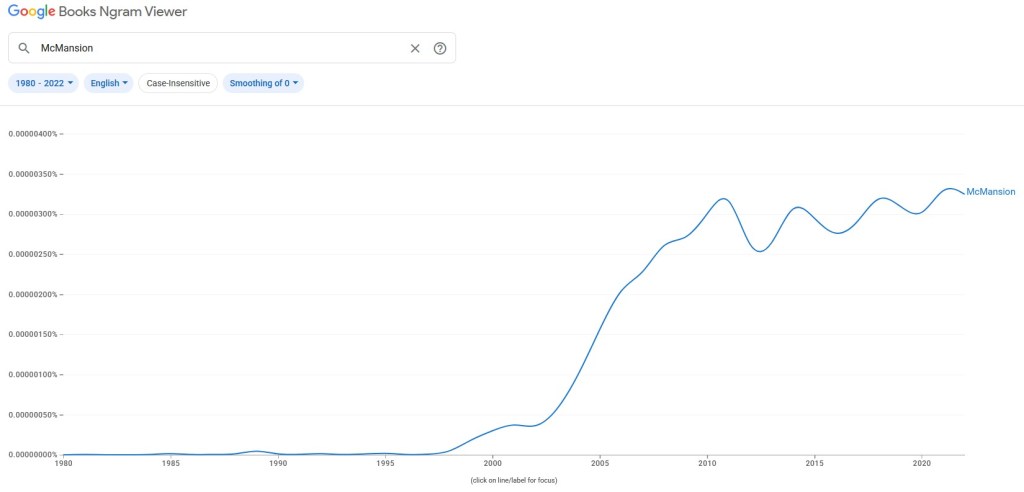
According to this Ngram viewer result, the term McMansion entered use in the late 1990s and then its use went up a lot between 2002 and 2011.

This roughly fits with what I found in my 2012 article on defining McMansions. The multi-faceted term described a newer wave of houses in a particular cultural moment.

What the Ngram above shows since 2011 matches what I have informally seen about McMansions since 2011: they are now just part of the landscape. They are not new. Americans build, sell, and buy them. They still are derided. There are dips up and down in the Ngram viewer but it has not changed much since 2011.

New residential styles will come in the future. Changes to society, the economy, housing, and preferences will lead to new designs that will then be assessed and critiqued. Perhaps they will bear some resemblance to McMansions, perhaps they go in completely different directions. The McMansion will live on among existing and new housing styles.

Castle houses and McMansions

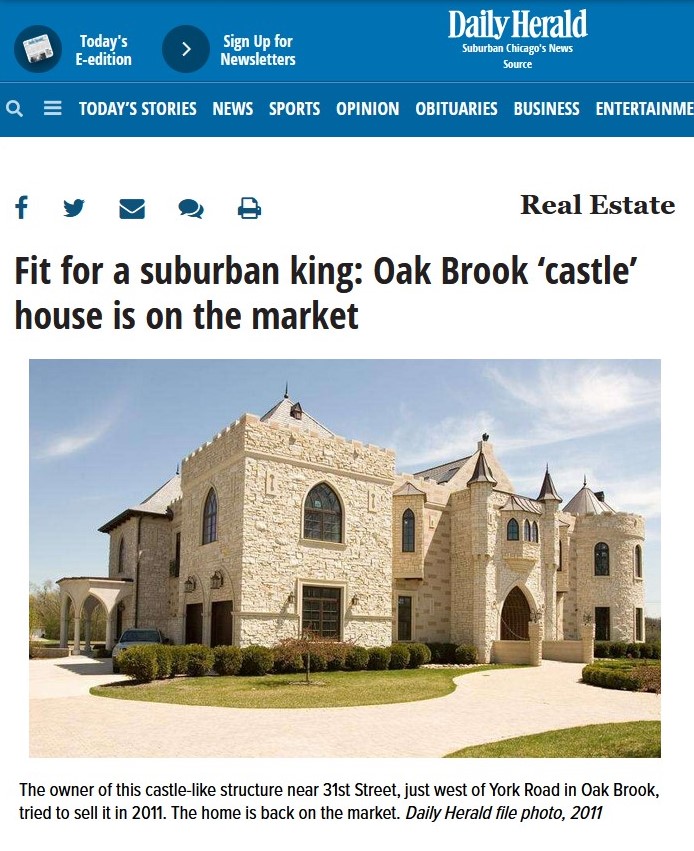
How might a large suburban house that looks like a castle fit the definition of a McMansion?

The home is large, roughly 12,000 square feet. It has lots of rooms and amenities:

The five-bedroom, seven-and-a-half-bath house, which is in the 3000 block of Lincoln Street, features a master-bedroom suite that takes up about 2,500 square feet. The listing says the house is 12,000 square feet.

It has a wine cellar, a movie-screening room, room for a pool table and a Ping-Pong table, a bar and an exercise area, all in the basement, an outdoor swimming pool, and a four-car garage.

This is the first trait of McMansions: they are large. I have suggested that being over 10,000 square feet should be considered mansions as they are beyond McMansions.

The other primary trait that might connect this home to McMansions is the architecture. It is a suburban home intended to look like a castle. Is it a pastiche or gimmick? How about the quality of the construction?

The walls average more than 20 inches thick, and there is 10-inch reinforced concrete between the floors.

Perhaps the builders were serious about making this a castle? This may not be the builder-designed cookie-cutter home that McMansions are often said to be; this could be a house more carefully designed to look outside and inside like a castle.

Thus, I am inclined to suggest this is not a McMansion castle. It is a mansion castle designed in a more coherent way.

The McMansion size of human pride

A recent Ash Wednesday poem starts with the imposition of ashes and then mentions a McMansion in this line:

Photo by Ralph on Pexels.com

That burned down the McMansion of my hubris

I would guess this references one of the traits of McMansions: their size. A super-sized house is analogous to the level of pride humans can construct. Their pride puffs them up in their own eyes. They impress themselves, just as a McMansion through its size and dubious architecture, tries to do in impressing neighbors and people passing by.

But the idea of the poem then is that the McMansion of hubris is demolished by the ash-delivered reminder that “Remember that you are dust, and to dust you shall return.” Large amounts of pride and large McMansions too will be brought low. McMansions might live on longer than many humans but they too will not last forever.

Can tiny houses knock out McMansions?

McMansions exist. Tiny houses exist. Can the latter exceed the former?

Pound for pound, Tiny Houses pack a punch that would put any McMansion on the canvas.

There are several possible interpretations of this statement (and the subsequent featuring of three tiny houses in three different US locations). It could refer to the value of tiny houses (“pound for pound”). Even with a small footprint, tiny houses can offer a lot. Second, it could be that tiny houses are superior to McMansions. Hence, they could “put any McMansion on the canvas.”

Has this happened, have tiny houses knocked out McMansions? I have argued before the tiny house movement has not taken off. And McMansions are out there, even if the term is highly negative and few seem to want to defend it. If it a battle of sentiments, I would guess more people have positive associations with tiny houses compared to McMansions. If it is a matter of numbers, I would guess there are more McMansions than tiny houses.

All of this could change in the future. Perhaps both will become part of housing eras gone by and trends will move on to other kinds of residences. Perhaps one will take a decisive advantage in the public view and/or in prevalence. In the meantime, few people are likely choosing directly between the two.

McMansions and McVulnerabilities

The Mc- prefix continues to live on in analysis of American life. As a recent example, here is a description of “McVulnerability” found in social media videos of crying and sadness:

Photo by cottonbro studio on Pexels.com

The weepy confessions are, ostensibly, gestures toward intimacy. They’re meant to inspire empathy, to reassure viewers that influencers are just like them. But in fact, they’re exercises in what I’ve come to call “McVulnerability,” a synthetic version of vulnerability akin to fast food: mass-produced, easily accessible, sometimes tasty, but lacking in sustenance. True vulnerability can foster emotional closeness. McVulnerability offers only an illusion of it. And just as choosing fast food in favor of more nutritious options can, over time, result in harmful outcomes, consuming “fast vulnerability” instead of engaging in bona fide human interaction can send people down an emotionally unhealthy path…

McVulnerability is perhaps an inevitable outcome of what the sociologist Eva Illouz identifies as a modern-day landscape of “emotional capitalism.” “Never has the private self been so publicly performed and harnessed to the discourses and values of the economic and political spheres,” Illouz writes in her book Cold Intimacies. Emotional capitalism has “realigned emotional cultures, making the economic self emotional and emotions more closely harnessed to instrumental action.” That is, not only does emotionality sell goods, but emotions themselves have also become commodities…

McVulnerability, from whichever angle you look at it, is the opposite of generous. It doesn’t require risk. It may pretend to give, but ultimately, it takes. And it leaves most of its consumers hungry for what they’re craving: human connection—the real thing.

The “Mc-” prefix makes sense given the popularity of McDonald’s. The way the term is deployed above seems similar to how the term McMansion has been used for several decades. McVulnerability is a pale substitute for true vulnerability. It is vulnerability in a popular and commodified form.

But can the term stick? It may depend on the popularity of such viral videos. Do they have staying power or will they be gone to be replaced by other trending videos? Will this pattern last for years? Or there might be other terms that describe these videos. Or the critique may not stick – what if most watchers see the emotional expressions as real and valuable? If such expressions become the new normal, perhaps McVulnerability is here to stay.

We’ll have to wait and see. McDonald’s will go on and plenty of other mass produced products and experiences will come along. Which ones will live on in “Mc-” infamy?

The gang nail plate and McMansions

I have seen gang nail plates before but did not know their name nor consider their possible contribution to the rise of McMansions:

The more that I think about it, the more that I come to believe that this invention is responsible for the suburbs as we know it. This unassuming little piece of metal, it’s called a gang nail plate or a truss plate, and its job is to affix pieces of wood together at their joints.

What’s really unique about it though is that it can securely connect wood members positioned at almost any angle. With the aid of these plates houses made of standard 2×4 studs can have open floor plans, cathedral ceilings, and complicated roof shapes all constructed with ease. You might recognize all those three traits as the common features of modern suburban homes, especially the so-called McMansions. Yeah, these things make McMansions possible.

One feature of many McMansions is a roof line with numerous gables. The front may have multiple gables popping up above windows. Or there might be gables pointed different directions. The roof line might mix several architectural styles. These options give McMansions a distinct profile, one that critics often note is odd or garish.

The argument of this video is that this is made possible by the gang nail plate. Without it, the roof is more expensive and not as strong. The big spaces that Americans expect in their single-family homes are more difficult to construct.

This reminds me of the importance of other construction techniques that enabled suburban housing. Balloon framing. The systems developed in mass suburbs, such as Levittown, to build homes in stages and with a set number of floor plans.

Improving a home’s interior design so it does not feel like a McMansion

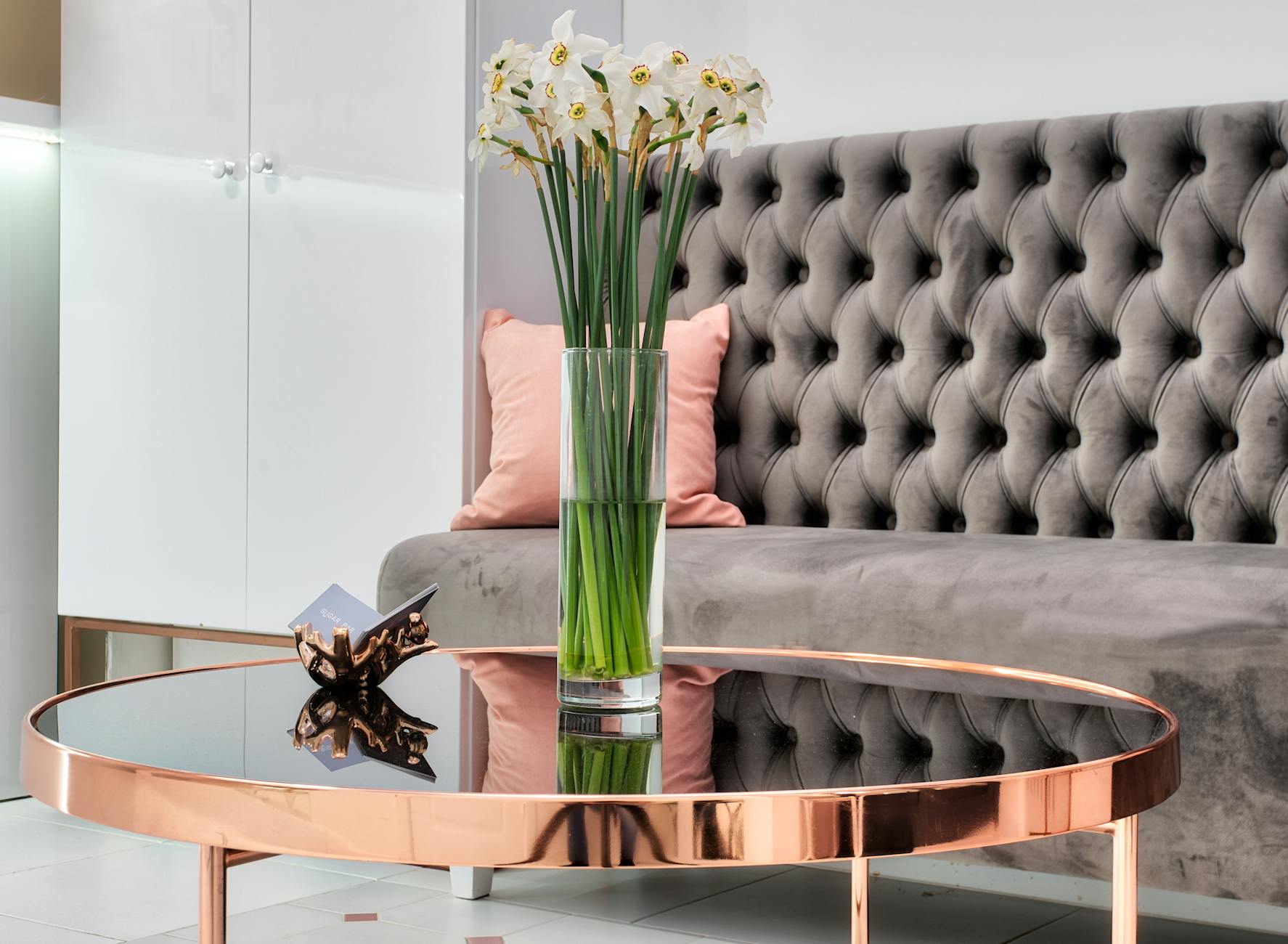
Is a house a McMansion regardless of what it has inside? One recent discussion of interior design hints that it depends on what the inside looks like:

Photo by Max Vakhtbovycn on Pexels.com

Everyone loves a good feature in a house. Wainscotting adds texture to a boring room, stone on a fireplace makes a living room cozier, and a simple ceiling beam can elevate an entire room. These architectural flairs make a house feel more memorable. Without them, a space can feel like a developer rather than an architect created the design, building something of a McMansion. But while it’s important to add thoughtful features, HGTV’s Drew Scott points out that there can be too much of a good thing. While one of those accents can help make a house feel special, muddling them all together can make everything too busy.

Often, the features of McMansions are visible from the outside: a large size, a mish-mash of architectural styles, and/or a location in a suburban subdivision of similar mass-produced homes.

But could a McMansion be redeemed if the inside does not look like a McMansion? Or could a home be a McMansion if the outside does not look like it but the interior has McMansion features? Imagine a 2×2 table:

McMansion interiorNot McMansion interior
McMansion exterior
Not McMansion exterior

The “typical” McMansion is in the top left cell: the outside and inside shows McMansion traits. The mixed categories are what is at stake here with the emphasis on interior spaces. Have the right design element inside and it could push a home out of the McMansion category.

I am not sure how this works. Who gets to render the ultimate McMansion judgment? Since McMansion is a negative term, does any shade of McMansion-ness mean the home is a McMansion?

Where the houses are large and household size is declining, Australia edition

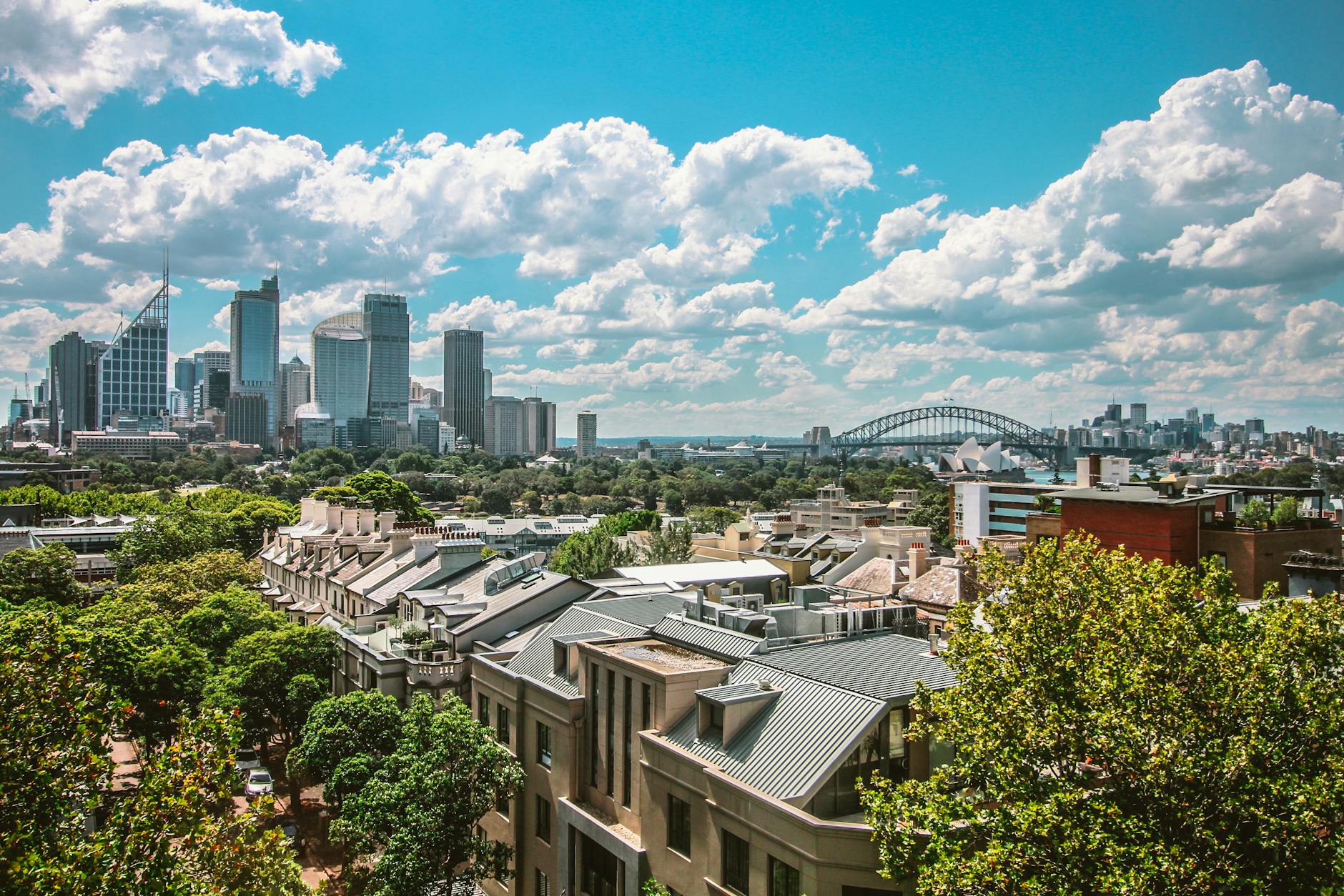
A recent report suggests Australia has the biggest houses in the world even though the number of people living in their homes is declining:

Photo by Belle Co on Pexels.com

The research found two thirds of homeowners across the nation live in a house with an average size of 214 sqm, followed by New Zealand and the United States with a typical home 200 sqm in size…

Australia has an average household size of just 2.5 people, with nearly half of the population living in 2-3 person households, the figures found…

Nearly a quarter of Australian households consist of only one person, although that’s not as bad as Denmark, where almost 40 per cent of citizens live by themselves…

The data was collected from reports provided by World Population Review, Statista, Eurostat and official census data.

This has some parallels to the United States where more people are living alone and houses are large.

Are there causal effects between these two statistics? Do people today generally want more individual living space? Does having a larger house lead to having a smaller household? Or are these two social features produced by separate factors?

One other interesting feature of this article: large houses are called McMansions. The opening line of the story:

It’s official: Australia is the king of the McMansion.

I would argue not all large houses are McMansions. For example, a 2,500 square foot home in the United States is likely not a McMansion (though it could be due to its architectural features or it is a tearown next to smaller homes). A 10,000 square foot home is probably too big to be a McMansion. Using McMansion as shorthand for large houses in general obscures the different kinds of big houses and how they interact with neighborhoods and communities.

How many American communities want super big houses?

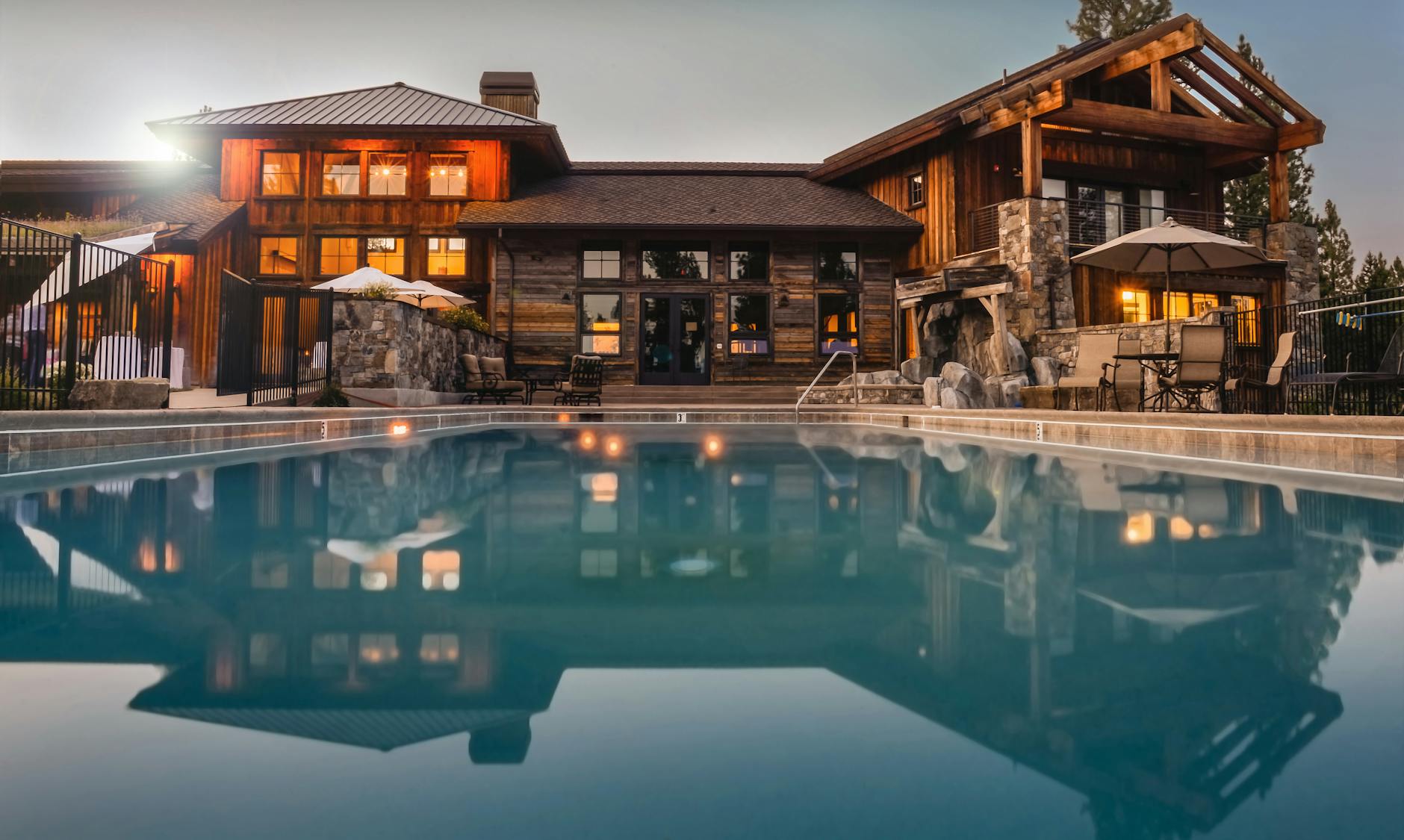
Americans have large houses. But not every community wants a lot of really big houses:

Photo by Chris Goodwin on Pexels.com

“How big is a house?” mused Jeremy Samuelson, planning director for East Hampton, N.Y., where a working group recently proposed slashing the town’s maximum-allowed house size in half, from 20,000 square feet to 10,000 square feet…

Towns from Aspen to Martha’s Vineyard are in a big-house brouhaha. Critics say mushrooming mansions cramp scenic vistas and local charm, consume excessive energy and inflate prices…

Truro capped new homes at 3,600 square feet in 2017, but then, Shedd says, officials stuck in an amendment allowing bigger builds with special permits. “I’m not saying it was done on the sly,” says Shedd. “Our town meetings drag on. I was probably glazed over.”…

Routt County, Colo.—home to Steamboat Ski Resort—adopted a proposal capping house sizes at 7,500 square feet in June. Debated for months, the hot-button issue packed public meetings…

In Pitkin County—home to Aspen—officials slashed the maximum new home from 15,000 to 9,250 square feet last November, noting that a big house raises “greenhouse gas emissions and increases environmental havoc.”

What strikes me about these discussions is something I first discovered when researching the use of the term McMansion: the size of a big house is relative in terms of size and quantity. In the case of McMansions, a 3,000 square foot new house might be normal in newer neighborhoods but it can be considered a monstrosity next to a 1,100 square foot postwar ranch house. Or is an 8,000 square foot home a McMansion or a mansion? Depends on who is considering the home and where it is located. Or one teardown McMansion might not be a big deal but dozens or hundreds over a decade or two might be considered going too far.

In the cases of these even larger homes, how big is too big or how many is too many? The discussions here do not appear to be taking place within communities where they are contemplating going from no big houses to some. They are considering whether to have no more big houses. Apparently there is some limit to be reached soon or no more might be allowed.

Will such moves push those who desire giant houses to other communities? Will they end up in municipalities just outside these jurisdictions? Are there other communities who would see this as an opportunity rather than a problem?