Can you say you are from a city when you actually live in its suburbs?

The debate continues on whether suburban residents can claim to be from the big city:

Fowler was criticizing Trump for bashing Chicago while failing to reach out to Gov. Bruce Rauner about potential solutions. When he says “I’m from Chicago,” he’s quickly cut off by Caldwell whose “Bruh, you’re from Evanston” comment quickly excited Chicagoans on Twitter…

Perhaps this is even a bigger issue in Chicago where identification with a neighborhood or community area is very common among urban residents.

While suburban residents shouldn’t try to boost their image by claiming to be from the big city when they aren’t, they are in a difficult place when talking to people from outside of the region. When meeting someone, telling them the name of your suburb can often produce blank stares. The Chicago region has hundreds of communities of varying sizes and it is difficult to expect people to know even most of them (even if they are from the region). The big city becomes a kind of shorthand of where you are from. One other option that might work could be to identify a noteworthy or large suburb that others may know – I’ve been surprised how many people register some familiarity when I say I live near Naperville.

Additionally, there are certainly instances when saying you identify with the big city does make sense. Sports teams are the first example that comes to mind. There are very few American major sports franchises that identify with the suburbs. The only two that come to mind are the Long Island Islanders and the New Jersey Devils but they are from the largest region in the country and there are three hockey teams to differentiate. There are certain resources that big cities have that suburbanites could identify with, such as major airports (many people who have spent little time in the Chicago region can hold some kind of conversation about O’Hare Airport) or museums and cultural attractions.

Majority of American jobs in the suburbs

An analysis at New Geography shows the metropolitan locations of American jobs:

The 2014 data indicates that more than 80 percent of employment in the nation’s major metropolitan areas is in functionally suburban or exurban areas (Figure 3). The earlier suburbs have the largest share of employment, at 44 percent. The later suburbs and exurbs combined have 37.0 percent, while the urban cores have 18.9 percent, including the 9.1 percent in the downtown areas (central business districts, or CBDs).

These numbers reveal dispersion since 2000. Then, the earlier suburbs had even more of the jobs, at 49.4 percent, 5.3 percentage points higher than in 2014. Virtually all of the lost share of jobs in the earlier suburbs was transferred to the later suburbs and exurbs, which combined grew from 31.4 percent in 2000 to 37.0 percent in 2014. The urban cores had 19.4 percent of the jobs (8.8 percent in the CBDs), slightly more than the 18.9 percent in 2014.

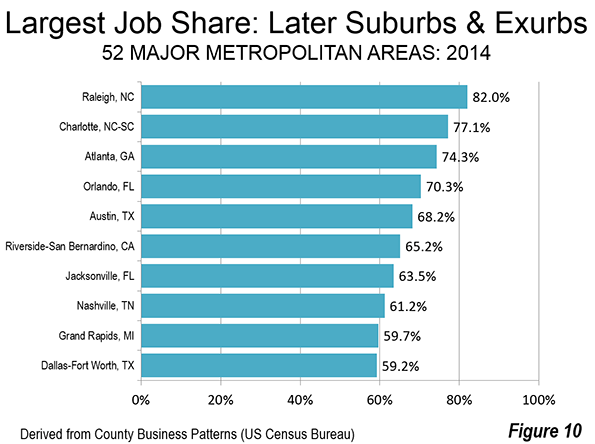
While Chicago is one of the cities with a higher percentage of jobs in the city, Sun Belt locations dominate the list of cities with more jobs in outer suburbs:

These figures counter claims or stereotypes that (1) suburbs are primarily bedroom communities where people sleep but work in the city and (2) urban cores are the primary job centers of metropolitan regions. Of course, some suburbs are bedroom suburbs and big city downtowns are still important, particularly for certain industries (think global finance). At the same time, it would be interesting to envision some of these Sun Belt cities with no downtown…how different would Raleigh or Atlanta or Orlando really be?

Middle class declines in the majority of US metropolitan areas

A new study from Pew shows that the middle class did not do well in many metro areas between 2000 and 2014:

The report by Pew Research Center found that the share of the middle class fell in 203 of the 229 U.S. metropolitan areas examined from 2000 to 2014, including major cities such as New York, Los Angeles and Chicago, which saw a relatively sharp drop in its middle class.

For many areas, a big culprit in the declining middle was the falloff in manufacturing jobs during that 14-year period, when factories shed about 5 million workers from their payrolls nationally…

The news was not all downcast, especially for metro areas in coastal and border regions that have benefited from the boom in technology, trade and resources…

Among the 229 metro areas, which constitute about 76% of the U.S. population in 2014, there were slightly more areas that saw a bigger increase in the share of upper-income population than lower-income adults. Still, Pew’s Kochhar did not view that as a big win for the American economy. The median incomes of the lower, middle and upper tiers all shrank between 2000 and 2014, he said.

Three quick thoughts:

  1. The continued effect of losing manufacturing jobs cannot be overstated: this has hurt numerous cities for decades. It is not easy for any large city to transition from such jobs to opportunities in new sectors.
  2. Looking at this data at the level of a metropolitan region is helpful because it hints at broad patterns within regions that are often segregated by social class and race. The phenomenon of the rich and poor living right next to each other as well as trendy and wealthy communities getting a lot of attention is not exclusive to cities; similar patterns can be found in suburban areas.
  3. Connected to the second point is that solutions to income issues could come at the level of the entire region rather than within individual communities. How might entire regions help the middle class? Why don’t more large cities and surrounding suburbs work together on these issues? (I know why they don’t but that doesn’t mean that it wouldn’t benefit many local residents.)

Predicting resegregation in 35% of metro area neighborhoods

A new study looks at the possibility of numerous metropolitan neighborhoods becoming less diverse in the coming decades:

Neighborhood integration is a great goal, but just because a place is currently home to more than one race doesn’t mean it will retain this diversity in the decades to come. A new study published in Sociological Science explores this potential future for New York, Chicago, Los Angeles, and Houston. It finds that 35 percent of all neighborhoods in these cities—around 3,800 total—are likely to resegregate in the next two decades…

Bader’s analysis predicts that, in the next two decades, many of the neighborhoods in the pale green (“steady black succession”), navy blue (“Latino enclaves”), royal blue (“early Latino growth, white decline”), teal (“early Latino growth, black decline”), sky blue (“recent Latino growth”), and pink (Asian growth) categories are the ones where a single racial group will become dominant over time. Here’s Bader on that process, again via the study website:

“We were disappointed to learn that many integrated neighborhoods were actually experiencing slow, but steady resegregation — a process that we call “gradual succession.” The process tended to concentrate Blacks into small areas of cities and inner-ring suburbs while scattering many Latinos and Asians into segregating neighborhoods throughout the metropolitan area.

Meanwhile, the fuchsia “quadrivial” neighborhoods, located in the suburbs like Aliso Viejo, California, and Naperville, Illinois, are likely to retain their diversity for some time. (Of course, as my colleague Amanda Kolson Hurley has noted, in general, diverse suburbs aren’t immune to the threat of resegregation.) Despite fair housing and civil rights legislations, housing discrimination is an ongoing problem with multigenerational effects—and one of the possible reasons behind the trends Bader has highlighted in the study. Another is the tendency of white Americans to self-segregate.

Given the complexity of race and ethnicity in the United States plus its regular manifestation in residential patterns, this makes sense. Just because certain locations were once diverse doesn’t mean they will remain so in the future. City neighborhoods provide plenty of examples of this, whether looking at places that have had waves of immigrant groups or other locations where blacks moved in and whites never returned. And that these patterns will be reproduced across suburban areas has already been happening for decades.

What seems to be new here is the possibility of predicting these changes. If a suburban community knew that demographic change was likely, would they do things differently? Or, how about a city neighborhood that had a particular character and identity? Now that there are scholars out there working on this, might the research itself have an effect on future population changes?

American exurbs continue to grow

Joel Kotkin points out that despite claims to the contrary, the exurbs are growing:

We first noticed a takeoff in suburban growth in 2013, following a stall-out in the Great Recession. This year research from Brookings confirms that peripheral communities — the newly minted suburbs of the 1990s and early 2000s — are growing more rapidly than denser, inner ring areas.

Peripheral, recent suburbs accounted for roughly 43% of all U.S. residences in 2010. Between July 2013 and July 2014, core urban communities lost a net 363,000 people overall, Brookings demographer Bill Frey reports, as migration increased to suburban and exurban counties. The biggest growth was in exurban areas, or the “suburbiest” places on the periphery…

Far from being doomed, exurbia is turning into something very different from the homogeneous and boring places portrayed in media accounts. For one thing exurbs are becoming increasingly ethnically diverse. In the decade that ended in 2010 the percentage of suburbanites living in “traditional” largely white suburbs fell from 51% to 39%.  According to a 2014 University of Minnesota report, in the 50 largest U.S. metropolitan areas, 44% of residents live in racially and ethnically diverse suburbs, defined as between 20% and 60% non-white.

And how about the seniors, a group that pundits consistently claim to be heading back to the city? In reality, according to an analysis of Census data, as seniors age they’re increasingly unlikely to move, but if they do, they tend to move out of urban cores as they reach their 60s, and to less congested, often more affordable areas out in the periphery. Seniors are seven times more likely to buy a suburban house than move to a more urban location. A National Association of Realtors survey found that the vast majority of buyers over 65 looked in suburban areas, followed by rural locales.

This article throws out a lot of reasons why they might want to do this: wanting to own a single-family home, wanting more space (both in the home and in the community), feeling part of a smaller community, sending their kids to good schools, having communities with low crime, and accessing plenty of available jobs. Put another way, the exurbs have downsides but enough Americans consistently seem to want to live on the metropolitan fringe.

At the end, Kotkin suggests that planners and others need to own up to this reality: cities cannot provide these desirable traits. I wonder if that is the case; is the answer that it is either dense inner cities or sprawling exurbs? I think many cities and closer suburbs would want to be able to claim the positives cited above. And there are likely many pockets where this is possible even if not all residents of major cities have these advantages. But, instead of trying to suggest that all people should get used to dense city life or exurban life, why not look for more ways to enhance opportunities throughout an entire region? Perhaps it is a problem of government layers as every community looks out for their own interests first. Or perhaps this is still impossible in a country where race and social class matter tremendously for the kinds of places where people live. Rather than suggest Americans want to live in a certain kind of setting, we need solutions to issues in a variety of communities throughout metropolitan regions (and beyond).

Suing Bay Area suburbs to provide denser housing

Changed plans for a new development in Lafayette, California have housing advocates looking to sue the suburb:

The California Renters Legal Advocacy & Education Fund has launched the website Sue the Suburbs to bring attention to the situation in Lafayette. The site is also set up to find people who could have rented one of the 315 apartments from the original housing plan, had it been approved. If the group can successfully find plaintiffs, this could be the opening salvo for potential legal action against other Bay Area cities to force them to kick in to help house the region’s explosive population growth…

Lafayette is a “semi-rural” town looking to stay that way. It actually lost 15 residents between 2000 and 2010. During that period, the number of renter-occupied housing units dropped significantly from 2,128 to 1,186 units. Meanwhile, Lafayette’s white population also dropped, from 86.8 percent to 84.7 percent, while its Latino population rose from 4 percent to 5.8 percent. The black population was mostly static at less than 1 percent over the 10-year period.

In 2013, the city outlined a number of reasons for its opposition to the apartments based on its general plan for land use. One of those: “The character and pattern of the proposed development is unprecedented in Lafayette and not compatible with the residential neighborhoods in the vicinity of the project, which are characterized by one-and-two story residences fronting on a network of residential streets.”…

Those amenities will fulfill Lafayette’s needs, but they leave the Bay and San Francisco hanging. The Association of Bay Area Governments set goals for new housing production for each municipality in the region, called the Regional Housing Needs Allocation, to accomodate population growth. Lafayette built just 65 percent of its goal between 2007 and 2014. Actually, none of the Bay Area counties are pulling their weight in the housing plan.

This highlights how affordable housing is an issue for all of metropolitan regions to address. Many wealthier areas, whether neighborhoods in large cities or suburban communities, are unlikely to promote affordable housing on their own. Even when studies suggest affordable housing won’t lower property values, these communities are worried about their quality of life – which also can be seen as code for not wanting certain racial/ethnic groups or poorer residents to move in.

Yet, most regions do not have effective mechanisms for compelling metropolitan wide action. Lawsuits are one route to go with a long history: see the Gautreaux case in Chicago or the Mount Laurel case in New Jersey as notable examples. Other options including combining city and county governments and developing metropolitan wide bodies with the ability to enforce regulations. None of these routes are particularly easy as many residents of wealthier areas did so in order to retain local control.

And if all the Bay Area counties are behind in promoting affordable housing, perhaps this lawsuit is only the beginning…

What about American mid-sized metropolitian areas with 500,000 to 1 million residents?

The biggest American cities get a lot of attention but what about the population changes in smaller big cities? Here is a look at population trends among the 53 metropolitan areas that have between 500,000 and 1 million residents:

The United States has 53 mid-sized metropolitan areas, with populations from 500,000 to 1 million. These metropolitan areas together had a population of nearly 38 million in 2014, according to the most recent Census Bureau population estimates (Table). In number, they match the 53 major metropolitan areas (over 1 million population), though they have only one fifth of the population (178 million). The mid-sized metropolitan areas are growing somewhat slower than the major metropolitan areas, at an annual rate of 0.81% between 2010 and 2014, compared to 1.00% in the major metropolitan areas. Combined, the major metropolitan areas and the mid-sized metropolitan areas have two-thirds of the US population…

The 10 fastest growing mid-sized metropolitan areas are from every major region of the country except for the Northeast. Cape Coral, FL was the fastest growing between 2010 and 2014. Its growth rate picked up substantially in 2013 to 2014. Cape Coral (formerly called Fort Myers) was hit particularly hard by the real estate bust of the late 2000s. The core municipality itself has not only the usual street system, but an extensive canal system (photo above). It is hard to imagine a metropolitan area that feels less urban…

Virtually all of the slowest growing mid-sized metropolitan areas are former industrial behemoths that lost out in the competition for survival in the Northeast and Midwest. A visit to any of these cities will reveal either a relatively strong pre-World War II central business district or the remains of one. Each of these has a built form that looks more like Louisville or Cincinnati than the dominant pattern for new metropolitan areas that developed with a far more modest density gradient and with much weaker cores…

The list of mid-sized metropolitan areas is fluid. As noted above, a number of mid-sized metropolitan areas could move into the major metropolitan category before 2020 or 2030. On the other hand, there will be new mid-sized metropolitan areas. Three seem likely to be added by the 2020 census (Lexington, KY, Lafayette, LA and Pensacola, FL). There should be a rush of new mid-sized metropolitan areas between 2020 and 2030, at current growth rates. This could include Visalia, CA; Springfield, MO; Corpus Christi, TX; Port St. Lucci, FL; Reno, NV; Asheville, NC; Huntsville, AL; Santa Barbara, CA; and Myrtle Beach, SC.

A lot of this seems to mirror broader trends: continued Sunbelt population growth, declining populations in the Northeast and Midwest, big effects of the economic crisis and housing bubble, and slow but steady population growth overall.

While the population data is interesting, it all raises some interesting questions that I know some scholars have taken up even as the lion’s share of attention rests on the bigger cities:

1. Is the experience of living in these cities and regions qualitatively different than living in a larger city? What are the advantages and disadvantages?

2. How does the size of the region affect all sorts of things including a region’s resiliency or ability to grow? In other words, are these places simply scaled down versions of bigger cities or are they something quite different?

3. Given the proclivity of Americans to choose small towns as their preferred places to live, would these kinds of cities offer a preferred lifestyle? (Of course, people still need jobs and want certain amenities so if they had to make tradeoffs between that but a manageable size, does that lead residents to cities like these?

Best American cities for getting to jobs by mass transit

A new report looks at which American cities and regions offer access to more jobs through public transportation:

The report, by Andrew Owen and David Levinson, defines accessibility as “the ease of reaching valued destinations,” in this case jobs. Simply put, it’s an examination of how easy it is for people to get to work.

Each metro region is ranked by how long it takes people to get to work: Jobs that can be reached within 10 minutes are worth more than those accessible with 20 minutes, and so on, up to 60 minutes. Data for job locations is drawn from the Census Bureau, and the time it takes to get there is measured using “detailed pedestrian networks” and full transit schedules for weekdays between 7 and 9 am.

The method accounts for things like how long it takes to walk from a transit stop to a destination and transfer times from one bus or subway line to another. Importantly, it also factors in service frequency and includes the time people spend waiting for a bus or train to arrive…

The authors offer two approaches for improving accessibility. The first is obvious: Offer more and better service that reaches more people. But where jobs and homes are located matters, too. Atlanta has a heavy rail system comparable to those in New York, San Francisco, and Chicago, but because its job centers aren’t as concentrated, that service is less useful, and accessibility suffers. Cities can respond with land-use policies and zoning codes that encourage density around existing transit networks. The height limit on buildings in Washington, D.C., for example, triggers sprawl (away from transit). Oregon’s urban growth boundary laws restrict how much land can be developed, which encourages density. If cities follow the latter example, “encouraging both residents and employers to locate in parts of the city already served by transit,” they can improve accessibility and limit the burden each new residents puts on the transit system.

Given their density, the first two regions in the rankings are not a surprise: New York City and San Francisco. After that, you get a variety of more sprawling cities and regions.

Chicago comes in at number five. Here is the map of the Chicago with redder areas having more jobs accessible by mass transit within 30 minutes.

As the caption notes, the map suggests “Job accessibility in Chicago closely follows the network of the metro region’s rail system.” My interpretation: the rail system built largely on railroad lines from the mid-1800s continues to influence Chicago development and job patterns. Still, most jobs for suburbanites in the Chicago region are not accessible by mass transit, even if you expand the time to 90 minutes.

Watching metropolitan sprawl from space

Check out a set of interesting GIFs showing sprawl in metropolitan regions:

A couple things jumped out at him while studying these animations. “It is interesting to see the ‘greening’ of the mid-ring suburbs of the ’70 to the ’90s as the tree canopies matured,” he says. “This is in contrast to the concrete jungles of prewar neighborhoods and the virgin developments of the 21st century.” (Look again at Dallas/Fort Worth for a good example.)

A few other trends he noticed: Some cities, like Chicago and Philadelphia, grow lighter over time, an apparent consequence of newer, white-roofed buildings crowding out older ones with dark roof tiles. And the shrinking of water sources, whether manmade or natural, is a “sad site to behold,” Williams says. “On the other hand, the creation of artificial land in coastal metropolises is increasingly larger in scale (re: Shanghai).”

If one thinks that any sort of sprawl is bad because it takes up more land, leads to deconcentrated regions, necessarily leads to McMansions and more driving, or other reasons, the images of American cities may look bad. But, the animations of American cities show sprawl on a different scale than that of some global cities. The American regions show more filling in between existing settlements, particularly in more established Northaast and Midwest cities. Sunbelt cities may look more like cities in developing countries where cities have simply exploded rather than filled in.

It is also interesting to consider sprawl from this particular vantage point: via satellites. The average suburbanite might consider sprawl at a closer level; the nearby field that disappeared for a housing development, the increase in traffic as new residents add to the local congestion, the notices about cheaper houses on the metropolitan fringe. But, satellite images and maps help remind us of the broader nature of sprawl: if the region is a circle with the city in the middle, expanding sprawl moves out the outer ring of the circle, adding more and more square miles that is only generally bounded by a large body of water (or perhaps another metropolitan region).

More sprawl = more Republicans

Richard Florida summarizes research that shows cities with more sprawl have more Republicans:

Hickory, a small industrial city in western North Carolina, lies within the state’s 10th congressional district, one that the Washington Post has called “one of the most Republican in the nation.” Its representative, Congressman Patrick McHenry, proudly boasts that, on family values issues, he is tied for the “most conservative voting record in Congress.”

Last week, Hickory topped another list. Researchers at Smart Growth America named the metro it anchors (Hickory-Lenoir-Morganton, population 350,000) the most sprawling in the country (PDF). At the other extreme, the metros topping the list of “most compact” are also some of the country’s true blue strongholds, with New York and San Francisco ranking as the two most “compact metros” in America.

These two sets of metros reflect a more pervasive pattern. In recent decades, America’s politics have exhibited a new trend, where Red America finds its home base in some of the country’s most sprawling places, while Blue America is centered in denser, more compact metros and cities…

Researchers have identified a tipping point of roughly 800 people per square mile where counties shift from Red to Blue, as I noted in the weeks following Barack Obama’s reelection. Princeton historian Kevin Kruse similarly explained this spatial link between a spread-out landscape and Republican political positions to the New Republic. “There are certain things in which the physical nature of a city, the fact the people are piled on top of each other, requires some notion of the public good,” he said. “Conservative ideology works beautifully in the suburbs, because it makes sense spatially.”

While I’m not sure Florida’s correlations that are strong, his arguments are in line with other researchers who have uncovered this pattern in recent decades. But, the data could be even more fine-grained than just comparing metro areas (which have varying degrees of sprawl within them): dense cities are more Democrat, exurbs are more Republican, and the parties are fighting over middle-suburb residents, places that may have been more traditional suburbs but have recently experienced more demographic and economic change.