Poor residents displaced by Hurricane Katrina moved to better places

Sociologists typically find poor city residents have difficulty leaving poor neighborhoods but a large event like Hurricane Katrina may provide a bigger push:

One of the tragedies of Katrina was that so many of New Orleans’ residents were forced to move. But the severity of that tragedy is a function of where they were forced to move to. Was it somewhere on the Salt Lake City end of the continuum? Or was it a place like Fayetteville? The best answer we have is from the work of the sociologist Corina Graif, who tracked down the new addresses of seven hundred women displaced by Katrina—most of them lower-income and black. By virtually every measure, their new neighborhoods were better than the ones they had left behind in New Orleans. Median family income was forty-four hundred dollars higher. Ethnic diversity was greater. More people had jobs. Their exposure to “concentrated disadvantage”—an index that factors in several measures of poverty—fell by half a standard deviation.

The women weren’t going to Fayetteville but, rather, to places like Houston. “For low-income people in the South, Houston is a pretty darn great place,” Hendren said. “It’s not a beacon of phenomenal upward mobility like Salt Lake City. But it’s kind of the Salt Lake City of the South.” The odds of going from the bottom to the top in Houston are 9.3 per cent, which puts it fifteenth out of the top fifty U.S. metro areas.

“I think that what’s happening is that a whole new world is opening up to them,” Graif said. “If these people hadn’t moved out of the metro area, they would have done the regular move—cycling from one disadvantaged area to another. The fact that they were all of a sudden thrown out of that whirlpool gives them a chance to rethink what they do. It gives them a new option—a new metro area has more neighborhoods in better shape.”

That is, more neighborhoods in better shape than those of New Orleans, which is a crucial fact. For reasons of geography, politics, and fate, Katrina also happened to hit one of the most dysfunctional urban areas in the country: violent, corrupt, and desperately poor. A few years after the hurricane, researchers at the University of Texas interviewed a group of New Orleans drug addicts who had made the move to Houston, and they found that Katrina did not seem to have left the group with any discernible level of trauma. That’s because, the researchers concluded, “they had seen it all before: the indifferent authorities, loss, violence, and feelings of hopelessness and abandonment that followed in the wake of this disaster,” all of which amounted to “a microcosm of what many had experienced throughout their lives.”

Nearly ten years later, tracking the outcomes to this “natural experiment” is providing plenty of material for social scientists. Few major cities experience such catastrophes so there aren’t even many comparisons that can be made. Yet, Katrina helped spark interest in studying resilient cities as leaders and citizens think about ways that cities can bounce back from a broad range of major issues.
Three reasons Millennials are driving less and going fewer places overall

A new study attributes less driving among Millennials to three factors:

The truth might be a little of this, a little of that, and even some of the other. That’s the takeaway from a new analysis of Millennial driving habits from transport scholar Noreen McDonald of the University of North Carolina. Writing in the Journal of the American Planning Association, McDonald attributes 10 to 25 percent of the driving decline to changing demographics, 35 to 50 percent to attitudes, and another 40 percent to the general downward shift in U.S. driving habits…

What makes McDonald’s work especially useful and compelling is that she compared the travel patterns of Millennials (born between 1979 and 1990, by her definition) with those of Generation X (born 1967-1978) at the same age. So she looked at driving data (both trips and miles) from tens of thousands of individuals in 1995, 2001, and 2009 alike.

But, it isn’t just that Millennials are driving less – they are going fewer places overall.

This analysis provides evidence of a long-term decrease in automobility that started in the late 1990s with younger members of Gen X and has continued with the Millennial generation. The decrease in driving has not been accompanied by an increase in other modes of travel or a decline in average trip length, meaning that younger Americans are increasingly going fewer places.

Those smartphones are media gadgets are pretty compelling and make accessing the rest of the world easier. Perhaps there is less need to wander and display independence by leaving the house. Maybe all those fears about crime out there have crept in for a whole generation.

If local mobility is reduced, does this mean this newer generation of Americans will have less geographic mobility within the United States (fewer moves or significant moves throughout their lives)?

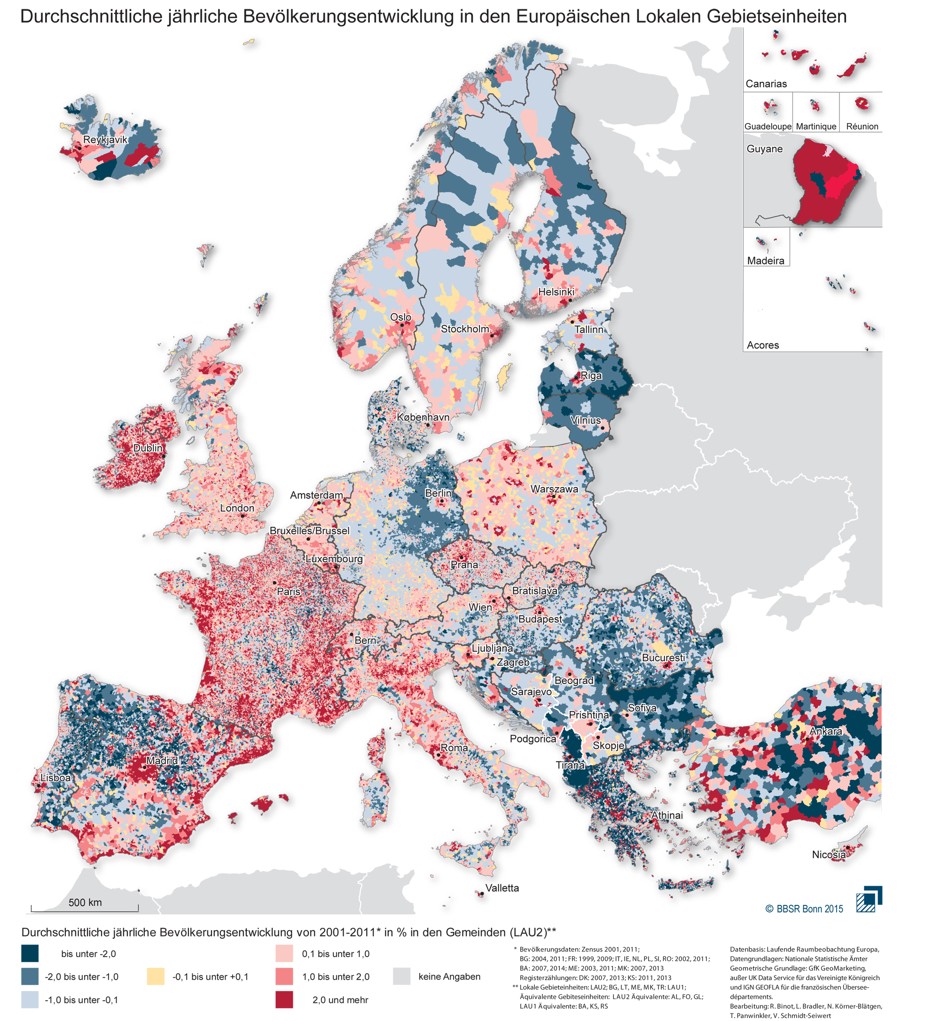
Detailed map of population changes in Europe, 2001-2011

A new map shows the population trends at work in Europe between 2001 and 2011:

Look at the Eastern section of the map and you’ll see that many cities, including Prague, Bucharest, and the Polish cities of Pozna? and Wroc?aw, are ringed with a deep red circle that shows a particularly high rise in average annual population of 2 percent or more. As this paper from Krakow’s Jagiellonian University’s Institute of Geography notes, Eastern cities began to spread out in the new millennium because it was their first chance to do so in decades…

We already know from other available data that Europe is experiencing a migration to the northwest, but the BBSR map adds complexity to this picture and reveals some interesting micro-trends. The dark blue coloring of the map’s Eastern section shows that the lean years for Eastern states are by no means over. Residents have continued to leave Albania, Bulgaria and Latvia in particular in search of jobs, while even relatively wealthy eastern Germany has been hollowed out almost everywhere except the Berlin region.

Population growth in the Northwest, meanwhile, is far from even. While large sections of Northern Scandinavia’s inland are losing people, there’s still modest growth on the Arctic coasts. And while the Scottish Highlands contain some the least peopled lands in all of Europe, Scotland’s Northeast shows remarkable population gains, a likely result of the North Sea oil industry concentrated in Aberdeen…

Spain’s trends look a little different from those of Europe as a whole. It’s actually in the country’s Northwest where the population has dropped most sharply, notably in the provinces of Galicia and León, which have long been known to produce many of Spain’s migrants.

But other previously impoverished regions, such as Southwestern Murcia, have grown, a trend continuing along the Mediterranean coast where population levels have risen sharply.

All of this may help explain reactions to migrants – population pressure is high in some places, particularly wealthier regions, while population loss is occurring in more economically depressed areas. It is also a helpful reminder of how relatively free people are to move between places. I don’t know how exactly this lines up with historic migration rates – particularly before the rise of nation-states which presumably allowed more of an ability to control population flows – but the industrialized world (and much of the rest of the world as well) is quite a mobile one.

New gadgets, apps want more location data from users

Location data is valuable and more new gadgets make use of the information:

Location-tracking lets developers build fast, useful, personalized apps. They’re enticing, but they come with tradeoffs: your gadgets and apps maintain a log of where you’ve been and what you’re doing, and more of them than you think are sharing that data with others.

It’s going to advertisers, mostly, so they can lure you into the Starbucks a block away or the merch tent at Coachella. It’s as creepy as any other targeted marketing, but most of us have come to accept that it comes with the territory. Jennifer Lynch, a senior staff attorney at the Electronic Frontier Foundation, says it goes deeper. Your data might get sold to your credit reporting agency, which wants to know more about you as it determines your credit score. It might go to your insurance company, which is very interested in your whereabouts. It might be subpoenaed by the government, for just about any reason. Maybe none of that is happening. Maybe all of it is. There’s really no way for us to know…

Your phone’s ability to pinpoint your exact location and use that info to deliver services—a meal, a ride, a tip, a coupon—is reason for excitement. But this world of always-on GPS raises questions about what happens to our data. How much privacy are we willing to surrender? What can these services learn about our activities? What keeps detailed maps of our lives from being sold to the highest bidder? These have been issues as long as we’ve had cellphones, but they are more pressing than ever.

Another major trade-off that I suspect most users will make without much fuss in the coming years. The cynical take on the advantages for the user is that this is primarily about customizable marketing that can account for both your individual traits and where exactly you are. In other words, sharing location data will give consumers new opportunities. More consumerism! On the flip side, it is less clear how or when location data might be used against you. But, when it is, it probably won’t be good.

The broader issue here is whether people should have geographical freedom that is not known to others. This is increasingly difficult in today’s world even as we would celebrate the mobility Americans have within their own communities, country, and to travel throughout the world.

When broken sidewalks limit mobility

This story from Shreveport, Louisiana discusses how poorer neighborhoods in the city tend to have more problems with sidewalks:

But Murphy’s citation for walking in the street along Highland’s crumbling sidewalks spotlights the city’s infrastructure failures in the era of the new mayor’s promises to repair and beautify Shreveport’s streets…

For now, there’s no set date when Shreveporters can expect to see most sidewalks installed or fixed, though plans are in progress. And 25 years after the Americans with Disabilities Act went into effect, unsafe sidewalks with missing or poorly-maintained ramps are a common sight…

“If they contact our offices and let us know, we will do what we can to correct those places and make it accommodating for them because a lot of the places around town don’t have those ramps available and we are aware of the issues,” Harris said.

But in terms of fixing the city’s roads and sidewalks, Harris said residential neighborhoods take a back seat to downtown and other highly-trafficked areas…

The Shreveport-Caddo 2030 Master Plan includes a transportation component to address pedestrian issues, but it likely will be years before Shreveport is brought in line with major cities, according to Loren Demerath, a Centenary sociology professor who studies the importance of pedestrian spaces to communities and has been active in local efforts to make Shreveport more bikeable and walkable.

An interesting mix of race, social class, and disabilities all having to do with a simple piece of infrastructure: sidewalks. Without well-maintained sidewalks, it is difficult to be a pedestrian as it either requires a more dangerous route on the road or walking through grass or other areas. If anything, this would be a safety issue in many neighborhoods and discussing safety, particularly when it comes to kids or others who need more protection or space (the disabled or perhaps the elderly), tends to lead to better outcomes. But, it sounds like Shreveport has some work to do in this area and I would guess the city would cite funding issues as a reason the sidewalks are so uneven.

And for those who subscribe to broken windows theory, do broken sidewalks have a similar effect? While the residents may not have much to do with breaking sidewalks, it might just suggest that the city doesn’t care as much about the neighborhood.

Chicago named top metro area for business location

For the second straight year, Site Selection picked the Chicago metropolitan area as its top metro of the year:

In fact, 385 companies either expanded or located in Chicago in 2014, resulting in the city being named Site Selection’s Top Metro in the US for the second straight year. The consecutive wins are a pleasant endorsement, says Jeff Malehorn, president and CEO of World Business Chicago…

Chicago’s appeal is hardly surprising. The city’s boasts outstanding transportation and logistical assets, including two international airports, a rail hub and seaport, and stands at the crossroads of major Interstates. Chicago and the region are home to a wealth of talent educated at some of the nation’s premier colleges and universities. Foreign companies looking for a US home are drawn to the city’s diverse ethnic population. “Any company outside the US can look to Chicago and see a home,” says Malehorn.

Project highlights for Chicago in 2014 include:

  • Valence Health — a health services company based in Chicago adding 500 jobs over the next five years;
  • Yelp — the online review and advertising site based in San Francisco, Calif., is opening an office in Chicago and plans to hire 300 employees;
  • Braintree — the global payments platform expanded into a 65,000-sq.-ft. (6,000-sq.-m.) headquarters on the eighth floor of the Merchandise Mart. The company is adding 360 new jobs by 2017.
  • ADM — the food services company opened its new global headquarters in downtown Chicago in August 2014…

In figures released in January, Chicago posted its lowest unemployment rate since April 2008, 6.2 percent. The number of city residents employed in December 2014 increased by more than 38,000. The jobs were mostly attributed to professional and business services, education and health service and transportation and warehousing. Malehorn says diversity is a theme in Chicago’s growth, but so is innovation and disruption.

I wonder how the city’s critics would respond. Even with a perilous budget, state issues, Chicago corruption, and cold weather, Chicago continues to be a desirable site for business. They might say that this all happens in spite of the problems..but how would we know? Regardless, this is another piece of evidence that Chicago deserves its lofty ranking among the top global cities in the world.

Tiny houses may be easy to steal

A tiny house in San Antonio was relatively easy to steal: the thieves simply drove off with the trailer.

An advocate for so-called green living, Friday and his wife had invested 2 1/2 years and $35,000 into building a tiny home from the ground up.
They had just moved it to a plot of land they had purchased in Spring Branch.

However, someone stole it, leaving behind only a damaged paver driveway they had recently built.

After a local TV station reported on the theft, the house was reported being found on the south side of town. Neighbors had apparently seen it for days but did not know it was stolen…

As for how the house was stolen, it was on a trailer that the thief simply attached to a truck and drove off with.

On his blog, Friday wrote:  “I’ll be completely honest – I didn’t even know that a hitch lock was a ‘thing’ before our house was stolen. I only researched them after the house was gone. I am now WELL aware of multiple forms of security that I hope ALL tiny housers will implement on their own Tiny House builds.”

A typical homeowner may worry about thieves entering their home and taking things but usually isn’t very concerned with the whole house disappearing. The same kind of mobility that tiny house builders/owners want also means it can be taken away. (Interestingly, a second downside of being so mobile is that a tiny house may not easily fit zoning laws.) Even with a hitch lock or boots for the tires, it would still be possible to take the house (though it would take a lot more work than simply driving off with the trailer.

Own a houseboat or RV rather than a McMansion

Instead of building a waterfront McMansion with a boat slip, buy a boat or a RV instead:

But once in the channel, you see a new vista: On the north side there are at least a half-dozen, arrow-straight canals lined with houses. Most of the houses are large, but few are McMansions. Most have docks for their boat, or boats. And most are worth at least $1 million, not counting their nautical toys. If you’ve got the money, owning one of these places would be the start of a great retirement…

So let’s ask a question: Is there a reasonable substitute? Is there a way we can have the same kind of experiences of water, nature and easy living without the very large financial footprint of an expensive house with its monthly operating costs and taxes?…

Take the boat I chartered. At 33 feet, a couple could live on the San Souci. The cost: Maybe $25,000 for the used boat and about $600 a month for the rental slip. A larger powerboat would have more room and wider appeal. The slip for a 36-foot Grand Banks trawler is about $700 a month. You can buy them used for under $100,000. Keep the diesel engine in good shape and you can relocate at will…

Is living on a boat too eccentric for you? Not to worry. Walk up the street and try an RV. The Seabreeze RV and Mobile Home Park is less than a half-mile from Treasure Harbor Marina. Its 7.5 acres are right on the ocean — something you can’t get in a canal home that costs a mere million. Some of the RVs and park models are on the water. (Park models are RVs built to travel just once. They look like beach cabins.) And you can dock your fishing boat on site.

The RV or boat certainly offers less space and lower financial commitment compared to a McMansion. At the same time, McMansions tend to offer some land, a lot more space, and usually a facade intended to impress visitors.

Perhaps one of the biggest issues here is less about the size or financial commitment but about mobility. McMansions can’t really be moved, regardless of their price. In contrast, RVs, boats, and many tiny houses can be moved rather quickly. Mobility allows the owner to move to chase jobs. Mobility allows for a change of scenery – perhaps someone doesn’t want to live along the water forever. Of course, all three options require somewhere to park the habitat and this can cost a decent sum of money. But, if you don’t like the deal or financial circumstances change, the move is relatively easy compared to selling and buying a house.

Really low mortgage rates may be limiting mobility

Here is how low mortgage interest rates may be restricting the mobility of lots of homeowners:

But what does the uptick mean for those homeowners who did take advantage of ultralow rates? According to researchers at DePaul University’s Institute for Housing Studies, it has created a new population of homeowners who are seemingly stuck in their homes.The housing crisis created a large class of people who couldn’t sell their homes because they were underwater, owing more on the mortgages than the properties were worth. But in addition, another class of homeowner has formed, those who took advantage of the low rates and would have to give them up if they sell their homes.

Compounding the increase in interest rates is that the home price gains seen in Chicago and other markets last year are moderating. As a result, homeowners who refinanced, and those who bought homes at the low rates, could see smaller home price appreciation going forward. Yet even if they buy a house for the same price as the one they are selling, it will cost them more because of the higher interest rates. That scenario could affect their mobility and, as a result, the overall number of homes that change hands, the study concluded.

Similar scenarios have played out in the past, according to the researchers, who noted that the average monthly rate for a 30-year, fixed-rate mortgage rose from 10.1 percent in November 1978 to 17.8 percent in November 1981. An earlier study of that period found that every 2 percentage-point increase in rates lowered household mobility by 15 percent.

Generally, lower rates are seen as good things for homebuyers as it gives them more purchasing power. However, if rates then go back up, having a lower interest rate may not help in the step up to the next more expensive house. It will take some time for the market to balance out. Although it is unlikely there will be such a swing like in the late 1970s/early 1980s, the housing market is still quite delicate in many places and even small changes could lead to bigger disruptions.

All that said, higher rates of mobility are assumed in the United States. In order to have a thriving economy, workers need to be able to move to where they can find economic opportunities and moving up the ladder of houses (starter home, family home, retirement home, etc.) keeps the housing industry going.

A “single lifestyle” the primary factor in making a city one of the worst for singles?

A recent list of the “10 Worst Cities for Singles” uses this criteria:

How did we come up with our list of the worst cities for singles? We started by looking for metropolitan areas with more than 125,000 people. Then we penalized places with small populations of singles, including the never-married, divorced and widowed. The share of unmarried residents in each of these bottom-ten cities is well shy of the national average.

Financial indicators didn’t boost the cities’ attractiveness. Although many of these areas boast below-average living costs, paychecks typically are way below average, too. We also factored in education level, keeping in mind that people with bachelor’s and advanced degrees are more likely to be gainfully employed. After all, you can’t exactly rock the single lifestyle without the earnings to fund it.

So there two primary factors in this analysis:

1. The number of single people. Presumably this has something to do with an exciting social scene, a la the culture and scene sought by the creative class. However, just measuring the number of single people doesn’t necessarily signal a more or less exciting cultural and entertainment scene.

2. The financial indicators are mainly about income, suggesting that single workers don’t want to be in places without high incomes. Does this mean younger workers only want higher-paying jobs? Is a high paying job the number one goal? The last line in the second paragraph above drives this point home: younger workers want a flashier “single lifestyle.”

All this seems to make some assumptions about single workers: they want high incomes, they want other singles around, and they want to “rock the single lifestyle.” While this may be the case for a number of them, it does highlight some different reasons for moving that are fairly accepted in American society today:

1. Economics. People need jobs. They should move where the jobs are. Young workers are particularly assumed to be more mobile and willing to move.

2. Finding exciting cultural centers. Places like Austin are held up as cities where one should move to enjoy life.

Are there other acceptable reasons for choosing where to live?