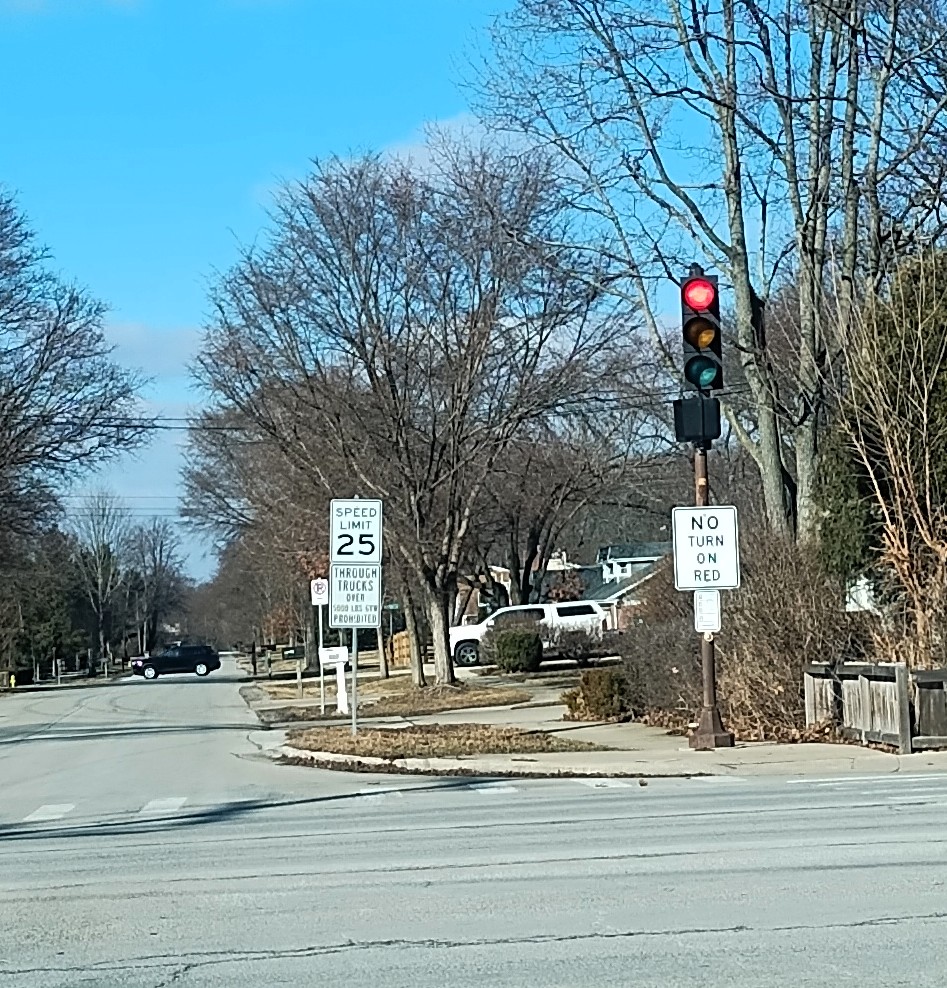
I regularly drive past a sign at the beginning of a residential neighborhood that says: “Through trucks over 5000 lbs GVW prohibited.”
I would guess the primary purpose of the sign is to limit trucks from cutting through this residential area. A driver might want to avoid a busy intersection about a half mile from this sign and driving through the neighborhood could be a shortcut. Residents do not want to hear trucks, breath their exhaust, or have to maneuver around them while out and about their neighborhood.
At the same time, the vehicle weight might matter as well. Heavier vehicles put more stress on roads. Having heavy trucks regularly travel on a road will damage the surface more quickly. These are residential roads, not heavy-duty roads that handle tens of thousands of vehicles each day. The roads are meant to funnel drivers from single-family homes to the major roadways that can handle more traffic.
It is hard to get an exact figure quickly but there appears to be plenty of passenger vehicles that are over 5,000 pounds. Pickup trucks and large SUVs can exceed this weight regularly. Suburbanites drive plenty of these vehicles. Some of the homeowners in this neighborhood may have them.
So even as this sign likely is trying to keep trucks off neighborhood streets, it also hints at the increasing weight of passenger vehicles sold in the United States. They have gotten heavier over time. All roadways could be strained more, not just because of trucks.
My family went on a cruise last year over Christmas, and our week aboard the ship convinced me that we’ve got our ideals around home all wrong. The ideal American house shouldn’t be a single-family home with a big yard out in the suburbs. It should be a stateroom on a cruise ship.
Staterooms on cruise ships are famously compact and likely smaller than the bedroom you’ve left behind. But here’s what you get instead: a top deck with multiple pools, hot tubs, and a splash pad, layered atop a mall food court, stacked on top of entertainment venues ranging from a piano bar and a pub with live music to a comedy club and theaters with multiple performances a night. If you want to relax, you can grab a seat by the pool or hot tub. If you want activity, there’s a track, a gym, rock-climbing walls, and a basketball court that transforms into a bumper-car track a couple of hours a day. If you’re hungry, or if a small person is pestering you for a snack, there’s pizza, tacos, soft serve, and just about anything else you might want available nearly all day long. Whatever you and your family enjoy in a vacation, chances are you can find it on board.
Royal Caribbean’s new Oasis class of ships labels its different zones “neighborhoods,” as if to invoke the longing so many of us have for distinct, walkable communities. The “Central Park” neighborhood, for example, really does provide a kind of uncanny valley version of an urban street scene, where you and your spouse can sit outside at a wine bar while your kids wander freely. The “Boardwalk” neighborhood calls up nostalgic memories of festivals and ocean-front piers…
And that’s the lesson of a cruise, I think: A dream home doesn’t need a spacious primary bath or walk-in pantry. What matters even more than a grand entryway or a two-car garage is space and time to gather with people we love, and people we haven’t met yet.
This argument would resonate with those who like denser, walkable neighborhoods and communities. Residents can still have private settings they find comfortable but they have easy access to social and entertainment options.
But I wonder how many people would find this model attractive when single-family homes are an option many like. Is a stateroom big enough for household members to have their own space? It may not need to be a lot of private space but I also recall the conversations during COVID when all the people stuck at home tried to carve out spaces in their residences. Where would households store all their stuff? Does that stateroom come with a garage, basement, or storage facility? Some may not like shared walls or the homeowner’s association that comes with the stateroom or the parking issues they fear in denser settings. This may all work for a vacation when people have a short-term commitment but how many American residents would adopt this for years.
I wonder if there is a developer who would simply plop a cruise ship model into an existing American community. This version might not be able to sail for interesting locales but the idea of having many options nearby for a price would appeal to some. Imagine the Royal Caribbean development in a suburb.
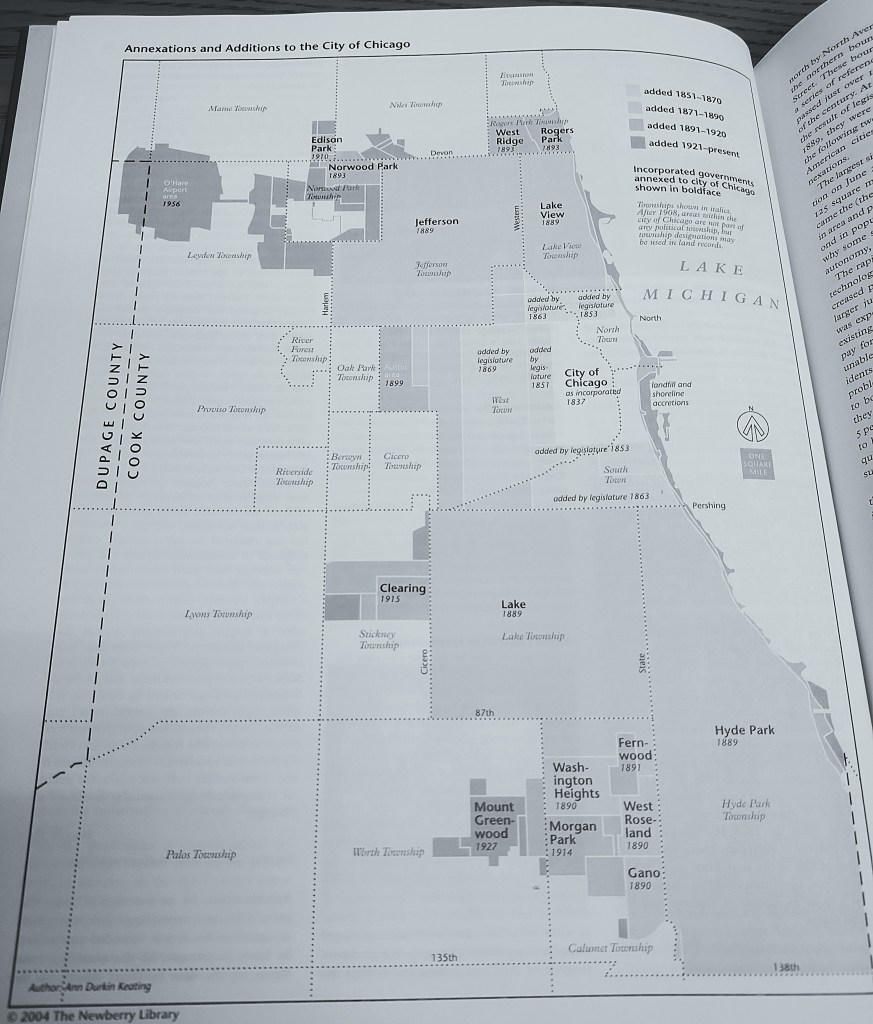
Chicago grew in a way that many American cities have grown: they annexed land and communities just outside their borders. Famously, New York City annexed Brooklyn in 1898 when the separate community across the East River was one of the most populous communities in the United States. But Chicago also had its share of large annexations that helped it add neighborhoods and expand to the borders it has today. The Encyclopedia of Chicago summarizes this process:
The Encyclopedia of Chicago (The University of Chicago Press, 2004), 22
For Chicago, the period of extensive annexations extended from 1851 to 1920. The largest annexation occurred in 1889, when four of five incorporated townships surrounding Chicago (as well as a part of the fifth) were annexed to the city. Most annexations to Chicago during these years came because Chicago offered superior services, from better water connections in the nineteenth century to better high schools in the early twentieth. Later, prior incorporations and suburban resistance to the power and urban complexity of Chicago halted the process.
As these suburban areas became part of the city, they received city services and became part of the larger city’s fabric. They added residents and structures. But they also have hints of suburban life. Row upon row of single-family homes. Strip malls and big box stores. Residents might drive more.
Such neighborhoods can be found in many American cities. Big cities are not just the dense downtowns with skyscrapers, major corporate offices, and certain cultural institutions. They include numerous residential, commercial, and industrial neighborhoods on their edges where the borders of municipal boundaries can blur.
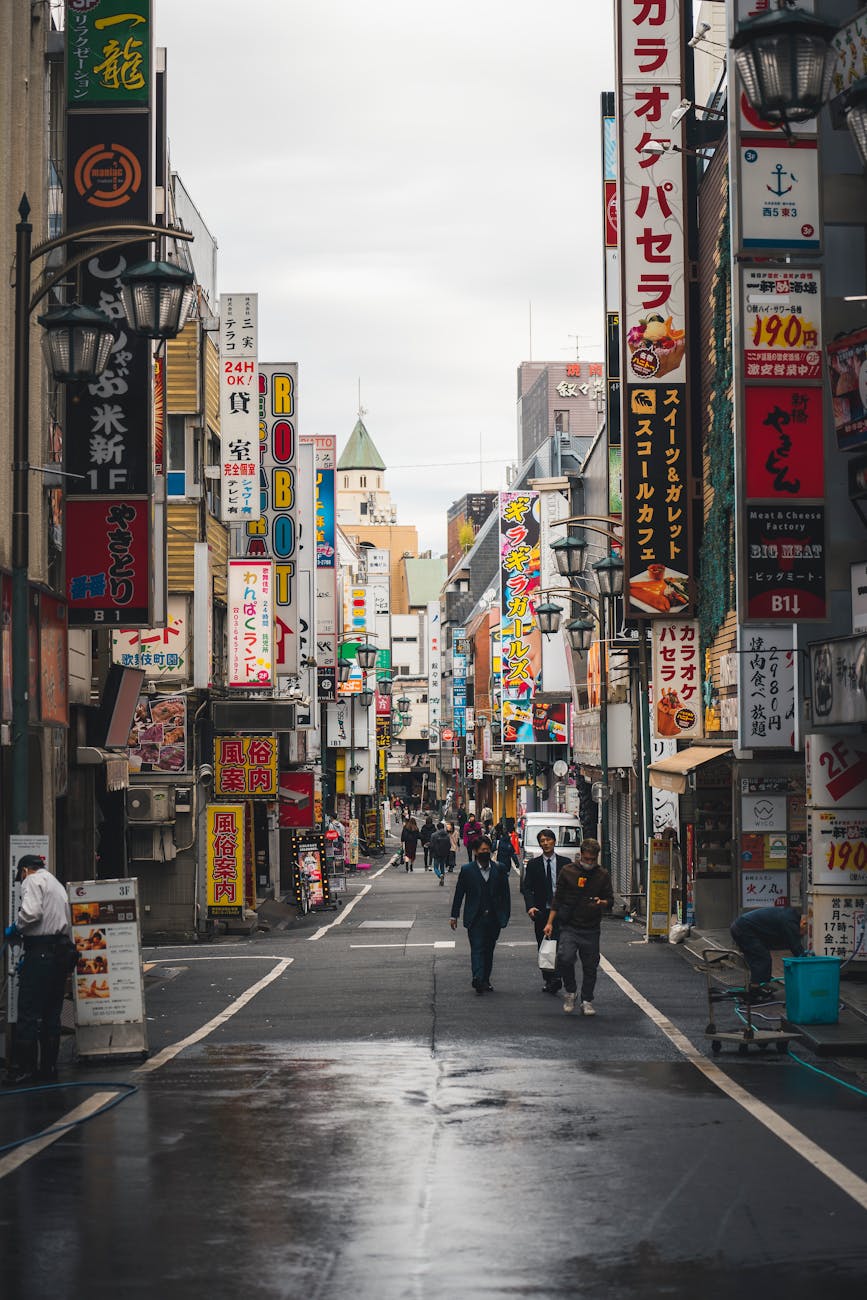
Topping the 2025 rankings is a corner of Tokyo that Time Out calls a “bibliophile nirvana.” Jimbōchō is home to some 130 vintage book stores — Time Out highlights Isseido Booksellers and Kitazawa Bookstore as great starting points for a day of bookish exploring — as well as its coffee-shop culture and delicious curry houses.
Time Out’s annual list is compiled from nominations made by its global network of editors and writers. The selections are then ranked against criteria including culture, community, livability, food and drink and what Time Out describes as “that hard-to-define sense of ‘nowness.’”
A Chicago neighborhood is a little bit down the list:
Rounding out the top five is the highest ranking US spot — Avondale in Chicago, highlighted for its wine bars, wellness studios and music venues. The neighborhood is also praised for its quirky small business scene, which includes retro bowling alley Avondale Bowl and antique mall-themed bar Consignment Lounge. Jeff Wilson, managing partner at Avondale Bowl, told CNN Travel that “seeing many of Avondale’s local, small businesses be included in a list with so many other communities around the globe really shows how many amazing things are happening right around us.”
I have multiple questions after reading about these rankings:
Rankings of places often have to account for a lot of communities. Here, we could start with the many cities in the world. And then each city has numerous neighborhoods, depending on how their size is defined. There are a lot of neighborhoods to choose from.
How long does “nowness” last? What is the half-life for a cool neighborhood? There is something unique about the neighborhoods at the top of list. The activity and meanings present in these neighborhoods might continue at a similar rate over time yet the neighborhood might become less cool to those experiencing the neighborhood.
This list seems geared toward seeking out places to visit. But what these visitors might find attractive could differ from people who live there. Visitors want to find something unique, experience something new. How does this relate to the supply of local housing or job opportunities? Does being identified on such a list lead to more tourists, which then might alter the day-to-day life in the neighborhood? To play off the idea of Chicago as “a city of neighborhoods,” could a traveler be a connoisseur of novel neighborhood experiences?
Demsas: How does this compare to the level of partisan segregation that we observe in other places? We know, for instance, that there’s partisan segregation happening in schools or in dating markets and churches and stuff like that. Is the workplace the most segregated based on party in America, or is this in line with other places?
Chinoy: Yeah, so it’s hard to answer this directly for every other social environment or every other group of people. I can tell you a couple things. So one is: I think a natural comparison is residential partisan segregation. This is something that people study a lot, right—the extent to which Democrats live on the same block as Democrats, and Republicans live next to other Republicans. And so we can sort of compare what I told you—that 10 percent number, that overexposure ratio—against partisan segregation across neighborhoods.
And you can define neighborhoods in different ways. One way to do it is a zip code. And when we do that, we find that partisan segregation at work is pretty similar. So, like, a little bit less than but overall pretty similar to partisan segregation across zip codes. We can go one step further and say, you know, maybe the zip code is a little bit bigger than what you have in mind when you think of neighborhood-level sorting. And so we have individual addresses in our data, and so we can say, you know, You have 15 co-workers. Let me figure out how many of them share your party affiliation, and let me look at our sample of the 15 people who live closest to you and figure out how many of those people share your party affiliation.
And when we do that, we find that workplace-level segregation, workplace-level overexposure ratio is a little bit less pronounced than that sort of nearest neighbor level of segregation, but still pretty similar, not so different. It’s not orders of magnitude different. So that’s kind of why we say that it’s a little less pronounced than residential segregation as a whole but still pretty sizable.
It sounds like the levels of political sorting are similar: what people tend to experience where they live is similar to what they experience at work.
I wonder how much it is experienced differently at work compared to a neighborhood. Where are politics more visible? In a neighborhood, a resident may have different indicators of political affiliation. It could come through conversation or yard signs or particular behaviors. At work, people might interact with each other or be in physical proximity more. Would political ties then be more apparent through conversation? Or are people sharing other signs of political leanings (things at a desk/cubicle/office, etc.)? Across both settings, are political views most visible on social media or online activity? Are people more comfortable with partisan sorting with neighbors or coworkers?
Temperature inversion layers, like the one happening the night Tamblyn heard Billy Joel from her backyard, occur when cool air gets trapped underneath a layer of warm air.
The warm air prevents the cool air from rising, along with smog and sound. The sound waves bend away from the inversion layer and back to the ground, bouncing across further distances.
This is more likely to happen during the fall season, as well as during certain times of day.
The second example involves different kinds of surfaces:
Skyscrapers lining the street can amplify city sounds, according to acoustic consultant Scott Pfeiffer.
That’s because sound waves easily reflect off rigid, hard surfaces, like glass and brick, Pfeiffer said. Sounds bounce back and forth like the two sides of the street are playing tennis.
The end result is a sound “canyon,” which often creates an echo…
Trees, grass and other plant life act as natural absorbers and deflectors of sound.
Three thoughts in response:
Does public noise matter less in an era where lots of people use AirPods and other headphones? People have used headphones for decades but the noise-cancelling features of today’s devices plus their ubiquity might mean more people are in their own soundscapes.
If cities are greener in the future, particularly with more plants and greenery among the buildings, does this mean they would be quieter? Having fewer motorized vehicles could also help.
It is common to think of cities in terms of neighborhoods or scenes. These are often defined with physical boundaries. Do sound boundaries roughly match these boundaries or are there different sonic neighborhoods in places?
New York City just unveiled its newest effort, which will hand 15 homeowners up to $395,000 to build an additional apartment. This could mean an extra unit in a garage, basement, or attic, or a tiny home in the backyard. The idea is to boost housing density in a city in desperate need of new housing.
New Yorkers can apply online for the funding, but high-income residents aren’t eligible — the income limit for a family of four is $232,980, the New York Times reported. And the ADUs that are built will have a limit on rent: a one-bedroom can’t be rented for more than $2,600.
The city’s department of housing preservation and development on Tuesday unveiled the “Plus One ADU” pilot program, similar to a state-wide initiative with the same name that has doled out tens of millions of dollars to help homeowners across New York State build ADUs in their backyards…
The effort is part of the city’s sweeping new housing reform proposal, which seeks to pave the way for 100,000 new homes in the city by encouraging conversions of commercial buildings into residential, boosting density near mass transit, and reducing space devoted to parking. The proposal also aims to legalize ADU construction across much more of the city.
Adding 100,000 units would be helpful as the city, like many major cities, needs lots and lots of units to provide more housing options and address housing costs. But, how quickly can these units be added and how much can they ease the housing issues? It would be worth looking at the math on this; at what point do the government funds lead to long-term savings? Hopefully, this is part of a comprehensive strategy that tries to add housing units in multiple ways.
Not all New York City is as dense as Manhattan but it is a pretty dense American city. How dense are city residents willing to go? Like many cities, there are different clusters of housing units in different neighborhoods. Adding a housing in basements or backyards can only happen in certain places and these changes would add residents. ADUs might be less visible than other means of providing more housing units – for example, high-rises would not be welcome in many residential neighborhoods – but Is there a point where residents feel there are enough ADUs?
Perhaps the opponents are beginning to accept that their community is not, has never been, exclusively their own domain.
Who owns a neighborhood? In many American communities, the people who live there might feel this way. They expect to provide input and exercise some oversight of what happens in their neighborhood. They want to exercise control over their own properties and those around them.
But, they do not do this on their own. They interact with other property owners and also engage with local governments. These local governments typically represent a broader community and have regulations about what can and cannot be done in neighborhoods.
Or, here is another way to address the same questions: if every neighborhood will change over time, who gets to street this change and/or benefit from this change? Those with means and vested interests will have their own perspective and goals while a broader community might have another point of view.
The simplest explanation is that collectively our Chicago stores have not been profitable since we opened the first one nearly 17 years ago – these stores lose tens of millions of dollars a year, and their annual losses nearly doubled in just the last five years. The remaining four Chicago stores continue to face the same business difficulties, but we think this decision gives us the best chance to help keep them open and serving the community.
Over the years, we have tried many different strategies to improve the business performance of these locations, including building smaller stores, localizing product assortment and offering services beyond traditional retail. We have invested hundreds of millions of dollars in the city, including $70 million in the last couple years to upgrade our stores and build two new Walmart Health facilities and a Walmart Academy training center.
It was hoped that these investments would help improve our stores’ performance. Unfortunately, these efforts have not materially improved the fundamental business challenges our stores are facing.
Nedra Sims Fears, executive director of the Greater Chatham Initiative, said the closure of the store and health center in Chatham was “deeply disappointing.”…
“All communities in Chicago should have access to essential goods and services,” Lightfoot said in the statement. “That is why I’m incredibly disappointed that Walmart, a strong partner in the past, has announced the closing of several locations throughout the South and West sides of the City. Unceremoniously abandoning these neighborhoods will create barriers to basic needs for thousands of residents.”…
In a statement, Mayor-elect Brandon Johnson said his administration “will be committed to identifying ways to fill the gaps these closures will leave in neighborhoods, and also to finding other ways to ensure families have direct access to groceries in their communities.”
Ald. Sophia King, 4th, and Ald. Jason Ervin, 28th, whose wards include locations slated to close, both called the closures disappointing in statements Tuesday. “The west and south sides need committed partners to reverse decades of disinvestment and discrimination, and I hope Walmart will work hard to invest in the communities in Chicago that desperately need their presence,” Ervin said.
Whole Foods Market opened a new “flagship” branch Downtown, at Eighth and Market near the Trinity Place development, with much fanfare in March 2022. But just 13 months on, the supermarket chain has decided to close the store, which was shuttered at the end of business on Monday.
Residents and leaders expressed disappointment:
News of the store’s closure also sparked dismay online. Residents on Twitter described losing the supermarket as “disappointing,” and “disheartening,” while one warned: “As whole foods goes, so goes the neighborhood.”
The Whole Foods Market fell within the district of San Francisco District 6 Supervisor Matt Dorsey, who posted a thread about its closure on Twitter on Monday.
“I’m incredibly disappointed but sadly unsurprised by the temporary closure of Mid-Market’s Whole Foods,” he wrote. “Our neighborhood waited a long time for this supermarket, but we’re also well aware of problems they’ve experienced with drug-related retail theft, adjacent drug markets, and the many safety issues related to them.”
Residents of all communities need access to food. Certain neighborhoods are invested in less than others. A sizable grocery store can help anchor other business activity. Filling a vacant large commercial space can be difficult.
If a company says it cannot keep a store open – the two companies give different reasons above – what reasons might be acceptable to a community?
I would hope retailers and corporations want to go beyond just making money in a location. At the least, as corporations and politicians often remind us, they provide jobs. But, they can also be much more.
To answer this question requires thinking less in terms of months and years, and more in terms of decades. It requires thinking less about specific neighborhoods and cities where violence is common, and more about larger metropolitan areas where inequality is extreme and the affluent live separated from the poor. And it requires thinking less about individual criminals and victims, and more about bigger social forces, including demographic shifts, changes in urban labor markets, and social policies implemented by states and the federal government. All told, nearly six decades of data on violence in Chicago’s neighborhoods point to an unmistakable conclusion: Producing a sustained reduction in violence may not be possible without addressing extreme, persistent segregation by race, ethnicity, and income…
But we must also expand outward in time and space, and consider why American neighborhoods are vulnerable to violence. Zooming out can help reveal the truth about violence in our cities: This is a whole-society problem, not one isolated in the neighborhoods where it roars. Addressing it requires our whole society’s concern, investment, and attention, and that attention must be sustained well beyond the periods when gun violence is surging.
This is a good example of a sociological approach. Look at deeper, underlying issues. Consider patterns and relationships across contexts and time. Analyze evidence across decades. Think about institutions, structures, and networks at multiple levels (neighborhood, city, nation). Examine multiple causal factors and how they interact with each other.
Whether such a perspective is welcomed or utilized is another story. For many social issues in the United States, it is easier for the public to look for the one factor that many believe will address the concern. Or, it can be difficult to wrestle with longer histories and patterns that involve many. Some might ask if this is just academics making something more complex than it needs to be or they might want proof that a sociological perspective is helpful.
I hope to explain something similar when teaching sociology, whether in Introduction to Sociology to Statistics to Urban Sociology. As Americans consider society, what does a sociological approach look like and bring to the table? At the least, it can help broaden perspectives beyond individualistic mindsets or ones that only highlight a few individual and social forces. At its best, it can be a lens that sheds light on how a large-scale society actually operates with institutions, structures, networks, and relationships shaping contexts and lives.





 Legally Sociable