Reading into a decreasing poverty rate, increasing median household income

Here are a few notable trends in the new data that shows the poverty rate is down in the United States and median household incomes are up:

Regionally, economic growth was uneven.
The median household income in the Midwest grew just 0.9 percent from last year, which is not a statistically significant amount. In the South, by contrast, the median income grew 3.9 percent; in the West, it grew 3.3 percent. “The Midwest is the place where we should have the greatest worry in part because we didn’t see any significant growth,” said Mary Coleman, the senior vice president of Economic Mobility Pathways, a national nonprofit that tries to move people out of poverty. Median household income was also stagnant in rural areas, growing 13 percent, to $45,830. In contrast, it jumped significantly inside cities, by 5.4 percent, to $54,834, showing that cities are continuing to pull away from the rest of the country in terms of economic success…

African Americans and Hispanics experienced significant gains in income, but still trail far behind whites and Asians.
All ethnic groups saw incomes rise between 2015 and 2016, the second such annual increase in a row. The median income of black families jumped 5.7 percent between 2015 and 2016, to $39,490. Hispanic residents also saw a growth incomes, by 4.3 percent, to $47,675. Asians had the highest median household income in 2016, at $81,431. Whites saw a less significant increase than African Americans and Hispanics, of 1.6 percent, but their earning are still far higher, at $61,858.

The poverty rate for black residents also decreased last year, falling to 22 percent, from 24.1 percent the previous year. The poverty rate of Hispanics decreased to 19.4 percent, from 21.4 percent in 2015. In comparison, 8.8 of whites, or 17.3 million people, were in poverty in 2016, which was not a statistically significant change from the previous year, and 10.1 percent of Asians, or 1.9 million people were in poverty, which was also similar to 2015…

Income inequality isn’t disappearing anytime soon.
Despite the improvements in poverty and income across ethnic groups, the American economy is still characterized by significant income inequality; while the poor are finally finding more stable footing following the recession, the rich have been doing well for quite some time now. The average household income of the the top 20 percent of Americans grew $13,749 from a decade ago, while the average household income of the bottom 20 percent of Americans fell $571 over the same time period. The top 20 percent of earners made 51.5 percent of all income in the U.S. last year, while the bottom 20 percent made just 3.5 percent. Around 13 percent of households made more than $150,000 last year; a decade ago, by comparison, 8.5 percent did. While that’s something to cheer, without a solid middle class, it’s not indicative of an economy that is healthy and stable more broadly.

Both of these figures – the poverty rate and median household incomes – are important indicators of American social and economic life. Thus, that both are trending in the right direction is good.

Yet, we also have the impulse these days to (1) dig deeper into the data and (2) also highlight how these trends may not last, particularly in the era of Trump. The trends noted above (and there are others also discussed in the article) can be viewed as troubling as the gains made by some either were not shared by others or do not erase large gaps between groups. Our understandings of these income and poverty figures can change over time as measurements change and perceptions of what is important changes. For example, the median household income going up could suggest that more Americans have more income or we may now care less about absolute incomes and pay more attention to relative incomes (and particularly the gap between those at the top and bottom).

In other words, interpreting data is influenced by a variety of social forces. Numbers do not interpret themselves and our lenses consistently change. Two reasonable people could disagree on whether the latest data is good for America or suggests there are enduring issues that still need to be addressed.
More findings on poverty in the suburbs

Following Confronting Suburban Poverty in America published in 2014 comes a new book – titled Places in Need and also published by Brookings – with additional findings regarding suburban poverty:

Allard spent years studying Census data and speaking with social service providers across the country, and discovered that while concentrated poverty is still a stubborn issue in cities, it’s also becoming a much larger issue in suburbs. In 1990, there were 8.6 million poor people in the suburbs and 9.5 million in the city. In 2014, the numbers had shifted; 17 million poor Americans living in the suburbs, while 13 million poor were in cities. And it’s not just in the inner-ring suburbs; roughly two-thirds of poor suburbanites live in communities built after 1970, and poverty is growing fastest in suburbs built after 1990…

Allard also found that concentrated poverty was on the rise in the suburbs. He looked at areas with a 20 percent poverty rate, lower than the traditional 30 to 40 percent poverty rate used in many studies, and found many more people in traditional suburban areas falling into this threshold. At that point, there are serious problems, such as discrimination from labor market opportunities, public safety issues, and access to quality housing…

Allard says that sometimes, people mistakenly assume that the poor in suburbs have come from elsewhere and are new arrivals to the neighborhood, a preconception that has made it harder for suburban regions to find the political support to tackle poverty issues.

His research shows the opposite, especially since the Great Recession, which he says hit the suburbs much harder than the rest of the country. The housing crisis hit the mortgage and real estate industry as well as the home improvement business, and the changes in poverty actually became more severe in the suburbs after the larger national recovery started. Grocery markets and retail shops were having a harder time staying afloat in hard-hit suburban regions. The impact inspired the book’s cover image: a strip mall filled with closed or vacated commercial space.

If the poor do become more visible in suburban communities – either because of their numbers or because of increased attention from academics, local officials, and nearby residents – it will be interesting to see how suburban communities and residents respond. Given the exclusionary nature of American suburbs, there could be several possible responses:

  1. Ignore this as long as possible. Suburbanites are not exactly known for their social interactions with a broad range of people so if those living in poverty are outside their immediate social circles, perhaps it can simply be ignored.
  2. Not provide many social services to the suburban poor. This might be with the goal of ignoring the nearby poverty or hoping that the residents go away. Or, communities might refuse to do much on the local government level and wait for non-profits and state agencies to respond.
  3. Move away from communities where there are visible numbers of suburban poor to wealthier suburbs. If this happens, the process of white flight continues as the wealthy just keep moving away from poorer residents.

It will be worth checking in a decade or so down the road to see how exactly suburban poverty has been addressed.

Can’t ignore race when discussing poverty in America

Ta-Nehisi Coates cites several sociologists in making the argument that white and black poverty is different in the United States:

In its pervasiveness, concentration, and reach across class lines, black poverty proves itself to be “fundamentally distinct” from white poverty. It would be much more convenient for everyone on the left if this were not true—that is to say if neighborhood poverty, if systemic poverty, menaced all communities equally. In such a world, one would only need to craft universalist solutions for universal problems…This chart by sociologist Patrick Sharkey quantifies the degree to which neighborhood poverty afflicts black and white families. Sociologists like Sharkey typically define a neighborhood with a poverty rate greater than 20 percent as “high poverty.” The majority of black people in this country (56 percent) live in high-poverty neighborhoods. The vast majority of whites (94 percent) do not. The effects of this should concern anyone who believes in a universalist solution to a particular affliction…

But the “fundamental differences” between black communities and white communities do not end with poverty or social mobility.

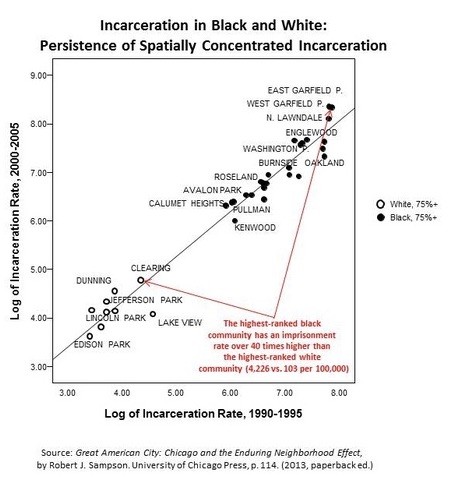
In the chart above, Sampson plotted the the incarceration rate in Chicago from the onset imprisonment boom to its height. As Sampson notes, the incarceration rate in the most afflicted black neighborhood is 40 times worse than the incarceration rate in the most afflicted white neighborhood. But more tellingly for our purposes, incarceration rates for white neighborhoods bunch at the lower end, while incarceration rates for black neighborhoods bunch at the higher end. There is no gradation, nor overlap between the two. It is almost as if, from the perspective of mass incarceration, black and white people—regardless of neighborhood—inhabit two “fundamentally distinct”worlds.

Coates might also cite Massey and Denton’s classic American Apartheid that convincingly shows residential segregation between whites and blacks is of a different magnitude than residential segregation between other groups. Additionally, there is evidence that whites and blacks with equal characteristics are not treated equally (see a number of audit studies involving mortgages, renting, car loans, and jobs) and even that blacks who are wealthier than whites do not have access to the same opportunities. Ultimately, Coates uses these sociological findings to argue policies intended to float all lower-class boats won’t really work because they ignore the fundamental differences between black and white poverty.

Put another way, given America’s history perhaps we should require scholars and policy makers to show that race doesn’t matter in the issue they are addressing rather than the other way around.

Majority of Americans wrong about the decline in global poverty

Nicholas Kristof discusses the role of the media in contributing to incorrect knowledge about global poverty:

One survey found that two-thirds of Americans believed that the proportion of the world population living in extreme poverty has almost doubled over the last 20 years. Another 29 percent believed that the proportion had remained roughly the same.

That’s 95 percent of Americans — who are utterly wrong. In fact, the proportion of the world’s population living in extreme poverty hasn’t doubled or remained the same. It has fallen by more than half, from 35 percent in 1993 to 14 percent in 2011 (the most recent year for which figures are available from the World Bank).

When 95 percent of Americans are completely unaware of a transformation of this magnitude, that reflects a flaw in how we journalists cover the world — and I count myself among the guilty…

The world’s best-kept secret is that we live at a historic inflection point when extreme poverty is retreating. United Nations members have just adopted 17 new Global Goals, of which the centerpiece is the elimination of extreme poverty by 2030. Their goals are historic. There will still be poor people, of course, but very few who are too poor to eat or to send children to school. Young journalists or aid workers starting out today will in their careers see very little of the leprosy, illiteracy, elephantiasis and river blindness that I have seen routinely.

Kristof and a growing number of others have noted that certain aspects of life are getting better for many people – like decreasing violence around the world or lower crime rates in the United States – yet the general public is not aware of this. The media is certainly complicit but they are not the only social forces at work here.

Turning to my own discipline of sociology, several sociologists, including Ulrich Beck, Barry Glassner, and Harvey Molotch, have written books on the topic of fear. Yet, it doesn’t seem to get much attention from the discipline as a whole. Of course, sociologists are regularly pointing out social problems (critics may say even inventing social problems) and often trying to offer arguments for why people and those in power should do something.

If there is positive psychology, how about positive sociology? Here is a rumbling or two

More Americans living on $2 a day

A sociologist finds more Americans suffering extreme poverty:

The number of U.S. residents who are struggling to survive on just $2 a day has more than doubled since 1996, placing 1.5 million households and 3 million children in this desperate economic situation. That’s according to “$2.00 a Day: Living on Almost Nothing in America,” a book from publisher Houghton Mifflin Harcourt that will be released on Sept. 1…

“Most of us would say we would have trouble understanding how families in the county as rich as ours could live on so little,” said author Kathryn Edin, who spoke on a conference call to discuss the book, which she wrote with Luke Shaefer. Edin is the Bloomberg Distinguished Professor of Sociology at Johns Hopkins University. “These families, contrary to what many would expect, are workers, and their slide into poverty is a failure of the labor market and our safety net, as well as their own personal circumstances.”…

“Time and time again, we would constantly see people’s hours cut from week to week,” said Shaefer, associate professor of social work at University of Michigan. “Someone might have 30 hours one week, down to 15 the next and down to 5 after that. We saw people who would remain employed but were down to zero hours. This was incredibly common in this population.”…

Many of the families Edin and Shaefer interviewed saw themselves as workers, the researchers noted. Rather than the negative stereotype of the “welfare queen” created by President Ronald Reagan, the families that are suffering with less than $2 a day want to work and are using self-reliance to get by. That hasn’t stopped the stereotype from proliferating, even though Edin and Shaefer note that extreme poverty in America is an equal-opportunity affliction: It hurts single parents, married couples, white, blacks and Hispanics, as well as rural and urban families.

While this is a small percent of the American population (less than 2% based on the figures cited in this story), Edin is likely right: few Americans could imagine this level of poverty that they would tend to associate with developing countries. And these are often people willing to work but job opportunities are limited.

It will be interesting to see reactions to this. Because of the relatively small numbers as well as the relative powerlessness of poor groups, this could be easy to sweep under the rug. Yet, I would guess many Americans would want something to be done for the poorest members of society even if they vehemently disagree on the means by which to do this. (This article suggests not much is being done in any sector, from government to charities.) I hope I’m not overestimating the compassion of the American people…

All whites fleeing minorities bought McMansions?

In an article about the reconcentration of poverty, the journalist includes this description of how white residents responded to more minorities moving to the suburbs:

As newly middle-class minorities moved to inner suburbs, though, the mostly white residents of those suburbs moved further away, buying up the McMansions that were being built at a rapid pace. This acceleration of white flight was especially problematic in Rust Belt towns that didn’t experience the economic boom of the mid-2000s. They were watching manufacturing and jobs move overseas.

The use of McMansions is interesting here. It could be doing three things:

1. It could simply be referring to larger houses. The size of new American homes has increased in recent decades and McMansions are often held up as the exemplar of this.

2. It could be shorthand for suburban sprawl. McMansions are often viewed as emblematic of big lots and expensive houses in whiter communities. Using the phrase McMansion here could reinforce the idea that all wealthy suburbanites live in McMansions.

3. This could be more negative as substituting “large homes” for “McMansions” doesn’t carry the same kind of negative connotations.

And for the data on the number of Americans living in neighborhoods where more than 40% of residents are under the poverty line:

The number of people living in high-poverty areas—defined as census tracts where 40 percent or more of families have income levels below the federal poverty threshold—nearly doubled between 2000 and 2013, to 13.8 million from 7.2 million, according to a new analysis of census data by Paul Jargowsky, a public-policy professor at Rutgers University-Camden and a fellow at The Century Foundation. That’s the highest number of Americans living in high-poverty neighborhoods ever recorded.

Not a good trend.

Linking longer commuting times to limited upward economic mobility

A recent study suggests that longer commute times are related to fewer people moving up the economic ladder:

Novara cites “recent research from Harvard University highlighting that commuting time has emerged as the strongest factor in determining whether a person escapes the cycles of poverty.”…

“These results are consistent with the view that the negative impacts of segregation may operate by making it more difficult to reach jobs or other resources that facilitate upward mobility. But any such spatial mismatch explanation must explain why the gradients emerge before children enter the labor market, as shown in Section V.E. A lack of access to nearby jobs cannot directly explain why children from low-income families are also more likely to have teenage births and less likely to attend college in cities with low levels of upward mobility. However, spatial mismatch could produce such patterns if it changes children’s behavior because they have fewer successful role models or reduces their perceived returns to education.”…

By Chetty’s numbers, commute time is up there with the fraction of single parents in terms of correlation. Family structure, is, of course, an age-old social concern; commuting time, not so much. All Chetty and his co-authors do is correlate, though they take a little stab at causation…

It’s not that commuting time is a magic bullet; no one factor Chetty studied is. But among the factors he did study—family structure, race and income segregation, school quality, social capital—it doesn’t get a lot of attention for its effects on social outcomes. And (as Yonah Freemark details) it’s something local governments can play a direct role in addressing.

“Spatial mismatch” is the idea that workers don’t live near the jobs they are likely to get. This happens often in metropolitan areas; cheaper housing is not necessarily near the jobs that those residents have or want to get. And I’m not sure cities and regions can do much about this; residential segregation tends to mean that higher-income and lower-income residents don’t often live near each other. The sort of white-collar jobs that could help people escape poverty may be located in suburban office parks, places that are not easily served by mass transit even if officials were willing to pour the money needed to get them up and running. If affordable housing and where businesses locate are simply left up to the market, they may have little incentive to locate near their workers.

Studying poor neighborhoods alongside “Racially Concentrated Areas of Affluence”

Scholars in recent decades have spent a lot of time studying neighborhoods with concentrated poverty but what about those areas of concentrated wealth?

Cities such as St. Louis, Boston, Baltimore, and Minneapolis have more racially concentrated areas of affluence (RCAAs) than they do racially concentrated areas of poverty (RCAPs). Boston has the most RCAAs of the cities they examined, with 77. St. Louis has 44 RCAAs, and 36 RCAPs. Other cities with a large number of racially concentrated areas of affluence include Philadelphia, with 70, Chicago, with 58, and Minneapolis, with 56.

In Boston, 43.5 percent of the white population lives in census tracts that are 90 percent or more white and have a median income of four times the poverty level. In St. Louis, 54.4 percent of the white population lives in such tracts…

Public policy has “focused on the concentration of poverty and residential segregation. This has problematized non-white and high-poverty neighborhoods,” said Goetz, the director of the Center for Urban and Rural Affairs at the University of Minnesota, when presenting his findings at the Lincoln Institute of Land Policy. “It’s shielded the other end of the spectrum from scrutiny—to the point where we think segregation of whites is normal.”…

In racially concentrated areas of affluence, federal dollars come in the form of the mortgage-interest deduction. In areas of poverty, they come through vouchers and subsidized housing units. In the Twin Cities, the total federal investment in the form of housing dollars in RCAAs was three times larger than the investment in RCAPs. On a per capita basis, it was about equal.

Federal dollars are now being spent to “subsidize racially concentrated areas of affluence,” Goetz said.

Three quick thoughts:

1. Sociologists studying such topics may not spend enough time studying elites and the wealthy. This could be for a variety of reasons: those with power and money can limit access (hence moving to smaller exclusive communities or compounds or towers of the uber-wealthy); sociologists tend to be middle to upper-class themselves; poverty presents a more visible social problem compared to the shadowy actions of those with money and influence.

2. Suburban scholars have long noted the government support for wealthier areas. The American suburbs came about partially due to certain cultural values (individualism, private property, racism) but may not have been possible on such a grand scale without federal money for mortgages (as the industry was altered in the first half of the early twentieth century), highways (interstates as largely paid for by the federal government), and diverting money away from cities to suburban areas.

3. From a policy perspective, is it easier to move those in poverty to wealthier areas (though programs like Moving to Opportunity) rather than encouraging the wealthy to move to less advantaged areas? Policy sometimes gravitates to solutions that seem doable (as opposed to what might be most effective in the long run) and I imagine the wealthy really don’t want to move to areas with more poverty.


Should tranpsortation also be covered by social services?

With the geographic spread of poverty to the suburbs, should transportation be considered a necessary social service?

“One thing that’s pretty incredible, if we start to think about it, is that transportation has been outside of what we define as a human service,” says Alexandra Murphy, a sociologist who studies poverty at the University of Michigan. “Even though it’s widely acknowledged that transportation creates opportunity and hardship.”

This week, however, saw the launch of one of the U.S.’s largest-ever subsidized bus-fare programs. King County, a Washington State county that includes Seattle, will now allow low-income residents to ride buses, trains, and ferries for $1.50, when standard fares can be more than $3. Other U.S. cities will watching closely to see if the program works, the New York Times reported…

“Transportation agencies don’t often have a poverty mission at their core like health and human services agencies do,” says Scott Allard, a public affairs researcher at the University of Washington. Providing lower-than-average fares “has typically not been in their mandate,” says Howard Chernick, an economist with the University of Wisconsin-Madison’s Institute of Research on Poverty.

Human services departments may be reluctant to take on transportation because of liability issues that don’t exist with food and housing, Murphy, the University of Michigan sociologist, thinks. What if someone driving a subsidized car gets into an accident? “It’s the perception that it’s a quagmire that people don’t even want to walk into,” she says.


Owning a car is not cheap and with more jobs and poorer residents in the suburbs, cheap and reliable transportation becomes a bigger necessity. Public transportation options in the suburbs are often limited (hours, perhaps only bus or train) or do not go all the places with jobs. I don’t see why it would be difficult to provide some sort of credit or voucher for public transportation based on income limits. While this might limit employees to living in existing public transportation corridors, it would be a start.

This reminds me of a program I remember hearing about a few years where the state of Wisconsin was piloting a program that provided cheap yet reliable cars for lower-income residents.

Following the ideals of Gautraux to deconcentrate poverty in the Chicago suburbs

The Gautreaux Program in Chicago preceded Moving To Opportunity and now there are more recent efforts to deconconcentrate poverty in the Chicago region:

After all, suburbs are no longer the bastions of privilege they once were (though majority white suburbs still, for the most part, are). Since the recession, it’s the exurbs in Chicago that have had job growth, while affordable housing near those jobs is often hard to find. Poverty is growing in suburbs across the country, including in Chicago, and moving families blindly out of the city may do more harm than good.

That’s why Chicago’s leaders are now focusing on helping low-income people live in mixed-income neighborhoods in both the suburbs and the city that have good access to transit and jobs, high homeownership rates, low commute times, walkable areas and a low percentage of people receiving public-housing assistance, said Robin Snyderman, a non-resident senior fellow at the Brookings Institution who also works as a consultant on housing policy in Chicago.

Nine housing authorities now participate in a regional pool of resources that began more than a decade ago. They include authorities in counties such as DuPage, Lake, and McHenry, using the money to build nearly 30 mixed-income developments in “opportunity areas” that are near transit and job opportunities.

“Just getting rental housing into some of these communities was hard to do for many years,” said Snyderman said.

A pilot program launched in 2011, the Chicago Region Housing Choice Initiative (CRHCI), encourages families to use vouchers to move to some of these locations, giving them counseling to help them do so.

Regional authorities and mayors have “adopted new tools for promoting inclusion and diversity, building on the lessons learned from Gautreaux,” she said. “I feel more hopeful that the historic segregation in the Chicago region can be transformed—because it’s now not all on the shoulders of the public housing authority,” she said.

See this earlier post about some of the results of the Moving To Opportunity program. These programs aren’t immediate panaceas and progress is often slow. It took decades to get Gautreaux into action and more time to assess results from MTO. Additionally, it can be difficult to get wealthier suburbs to buy in – if they do talk about affordable housing, it tends to involve seniors, young college graduates, or civil servants, not actually poorer residents.

In all, residential segregation is a difficult problem to address. If it is all left to the market, wealthier residents will move to nicer suburbs, maintaining or increasing their life chances, and then limit the access of others to move into their communities (even if they need them as workers in that community). Social programs can help but they can be costly, it takes time to assess their effectiveness, and it requires wealthier communities to get on board. This is one of those social problems that requires patience, active efforts, and time to see social change occur.