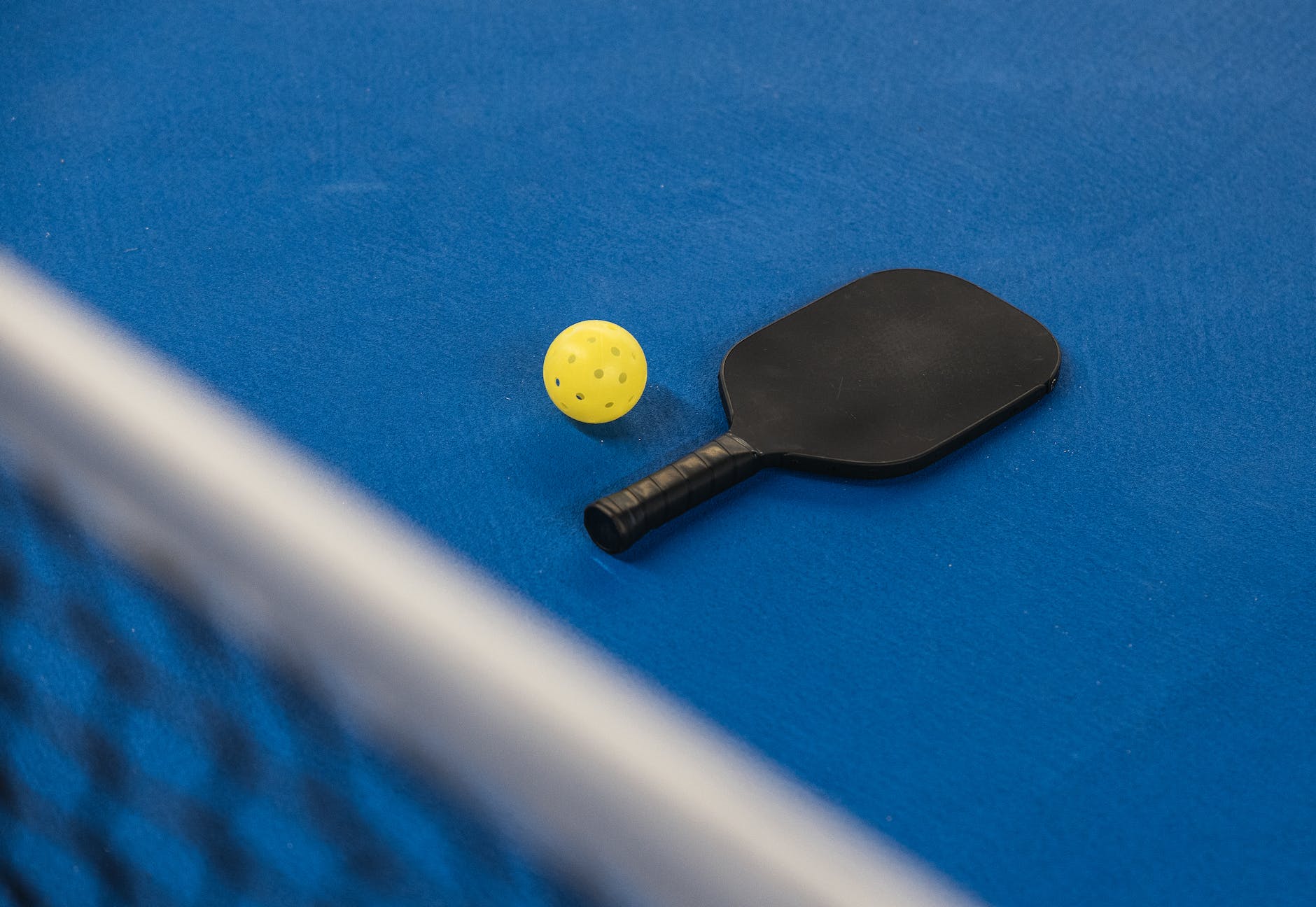
Who can use space in the United States? FOIAed emails and pickleball

One journalist finds in emails that there is a lot of reaction to pickleball in American communities as well as concerted efforts by pickleball enthusiasts to play:

Photo by Mason Tuttle on Pexels.com

“I live near a paddle tennis court, which is basically tennis but on a small court. And at these courts, I saw this big sign that said, ‘Pickleball players, go home’ or ‘Pickleball was not welcome here.’ And I was like, What is going on? What happened was that pickleball players were sneaking onto the courts when they were open and playing pickleball when this was supposed to be a court for paddle tennis only,” Koebler said. “When I saw that sign, I was like, I bet these people are complaining to the government about the pickleball people.”

It turns out that these people were complaining. A lot. And not just in Koebler’s neighborhood. The city of Dallas told him that it had more than 100,000 emails mentioning the word pickleball. They couldn’t even begin to forward them all. The city of Fort Lauderdale said it would need $10,000 to produce all of its pickleball discourse.

These emails are about who can take up public space, and whether pickleballers are taking up too much of it. And if you’re thinking, Who cares?, Koebler says that the fight over who can take up space in this country—it’s kind of at the heart of the whole American project…

I’m going to generalize here and stereotype. But pickleball players are far more organized than other players of other sports, based on thousands of emails that I read. There are these people in city after city who are “pickleball ambassadors.” And they are given a tool kit from this group called USA Pickleball about how to talk to local government to gain access to more public spaces. And USA Pickleball’s strategy is to try to convince city council or the parks department or your local politician to build new pickleball courts. But because of this NIMBY aspect where homeowners don’t want pickleball in their backyard, it’s really hard to build new pickleball courts in certain places. And so what is happening is pickleball players have to use already-existing public infrastructure. This means basketball courts, hockey courts, tennis courts, of course. And if there’s a permitting system, they’re organized and they make sure to book out all of the permits. If there is not a permitting system, I saw emails where it’s like, I will bring my net for crack of dawn to the tennis court and set up my pickleball net. And then we will play in shifts all day so that we keep the court and the tennis players can’t get on here.

I am not surprised property values are mentioned in this interview. The sound and activity on pickleball courts can be a threat to a quiet residential existence.

I am surprised that taxes did not come up in the conversation. Americans pay property taxes to local government bodies that, among other things, build and maintain parks and public spaces. Homeowners, renters, and businesses contribute these taxes. They can all make requests or demands about how this public space is used. In this case, there is a limited public good – courts where people can play tennis or pickleball or in engage in other activity – and people could claim they are paying to provide space for the activity they want to pursue.

Given how American space is used, is this a zero-sum game: if pickleball players play, does that mean other sports must lose? Can tennis courts and pickleball courts stand side by side and be available to players of each sport? Will private pickleball facilities or clubs help alleviate these issues?

The difficulties for public institutions and spaces after COVID-19

Reopening and repopulating public spaces during and after COVID-19 might provide difficult:

Yet can you reopen a society — particularly a republic built on openness and public interaction — without its physical institutions at full capacity, without public spaces available for congregation?…

Something else unites these places. In each, the woman on the next bench, the man ahead in the checkout line, the family down the pew are suddenly potential vectors — or potential victims. So we’re assessing the public realm in the way we assess a salad bar when we walk into a restaurant…

“Democracy depends to a surprising extent on the availability of physical, public space, even in our allegedly digital world,” John R. Parkinson writes in “Democracy and Public Space: The Physical Sites of Democratic Performance.”

“How do you define the ‘public realm’ when an enormous percentage of the American public spends the majority of its day in its pajamas?” Stilgoe says.

This piece raises great questions for a COVID-19 world. The emphasis on how architecture and design shapes public behavior as well as how others in those spaces can be trusted or not is right on. At the same time, there are several elements I would add to this analysis:

1. The definitions of “institution” and “spaces” are pretty broad. Some of the listed locations, like shopping malls, colleges, and grocery stores, are not public spaces. They are owned by private groups that can and do dictate how the space can be used. Some of the other locations, like parks and squares, are public spaces. Government buildings are generally more open to all. Americans privilege private space even though we need some of the private spaces – grocery stores, workplaces – to survive. But, the same rules or expectations do not apply in each of these spaces. We saw this in the Occupy Wall Street protests where gatherings in what looked like public spaces could be ended when they spaces were actually owned by private groups or the government pushed people out. We actually do not have that many public spaces where people regularly gather; many of our “public spaces” are actually privately owned and this matters. The private public spaces require both private groups and the public to cooperate – and they may not always do so.

2. Even before COVID-19, it is not clear that many Americans value public spaces or use them regularly. As noted in #1, Americans like their private spaces. Homes may be less attractive when you are trapped in them but we have a society where success is owning your own suburban single-family home. Add to this declining trust in numerous institutions and it may be hard to make the case that we should put more resources and effort into creating and maintaining public spaces.

3. More broadly, many would argue a thriving society and democracy depends on regular interaction between people. And face-to-face interaction provides benefits that online communication does not regarding communicating clearly and building relationships. Yet, again, this has been on a decline for a while now. Twitter is not a good approximation of public conversation nor a good medium (at least as currently constructed or experienced) for public conversation. Telecommuting may provide efficiencies and allow people more private lives but something will be lost. See my earlier thoughts on sociologist Eric Klinenberg’s Palaces for the People where he takes up these issues (Part One, Part Two, Part Three, Part Four).

Even in a country of sprawl and limited public life, there are plenty of places where people come in contact with many others

Watching reactions to the coronavirus in recent weeks presents a paradox connected to American social life and addressing contagious diseases: the country has pushed sprawl and private homes for decades and public life and community life is said to be in decline; yet, there are numerous spaces, public and private, where Americans regularly come together. And under the threat of disease, shutting down locations and/or quarantining large numbers of people would change social life dramatically even in an individualized, spread out society.

A few examples illustrate this well. One essential private space is the grocery store. Even in the age of the Internet deliveries and eating out, many Americans need to acquire food and other supplies for daily life. The experience of going to Walmart or another grocery chain is not necessarily a public experience – direct interaction with people there is likely limited – but the number of people who can cycle through a major store on a daily basis is high. Another semi-private space is churches. By choice, Americans attend religious services at a higher rate than most industrialized countries. Once there is a congregation of one hundred people or more, this brings together people who participate in a wide range of activities and go to a wide number of places.

An example of public spaces that would change dramatically are mass transit lines and transportation hubs. In a country where relatively few people take mass transit on a daily basis, there are a good number of Americans dependent on buses, trains, and subways and people who use multiple forms on a regular basis. Plus, the United States has relatively busy airports. A second example involves schools. Americans tend to think education is the secret to success and getting ahead and students from preschool to post-graduate settings gather in buildings to attend class and do related activities. For these students, school is about learning and social life, classrooms and lunchrooms, eating areas, and play or recreation areas. Schools and colleges can draw people from a broad set of backgrounds and locations.

Our public life may not be at the same level as it is in Italy; instead of sidewalk cafes, Americans can go through the drive-through of Starbucks. Perhaps this means it will be relatively easy for some Americans to quarantine or keep their social distance: many live in their private homes and have limited social interactions anyhow. At the same time, significant public health measures would change social life in ways that are noticeable and that some might miss. Indeed, could a national reminder of the social ties Americans do have lead to a revival in social interactions in times of more stability?

Will more cameras tracking public activity push Americans to be even more private?

More communities are putting together networks of cameras that show what is happening in public spaces. Some of this comes at the municipal level, often in the name of preventing or solving crimes, and is increasing happening at the private level as homeowners add cameras to monitor around their home.

If people are concerned about the rise of cameras and analysis (particularly through algorithms and predictive software), will this change their behavior? The United States already has a tendency in recent decades toward private spaces. Scholars and commentators lament the decline of public spaces, the shift toward privatized settings between work and home (think Starbucks or shopping malls), and the primacy of single-family homes. Imagine a society where people are fearful of cameras and decide to curtail their public activity. A variety of technologies could help them limit the time they spend outside their residences: think working from home, grocery and food delivery, and the delivery of all sorts of goods and services to an address.

If this comes to pass, the public realm might be even more impoverished. Will the often think social life and outside activity of suburban neighborhoods continue to dry up? Where will people of different backgrounds and interests interact? What will happen to the thrill of being around crowds and dynamic activity? Would this simply lead to more suspicion and calls for even more cameras and surveillance to figure out who would be so bold to go out (or to turn the surveillance into more private spaces)?

This all may sound pretty dystopian. When I walk down the street in my neighborhood or my community (regular activities for me), I rarely think about the cameras that might be watching. I try to be observant and I do not notice too many surveillance devices. My neighbors may indeed be watching (or able to watch) but it does not feel like a threat. But, sometime soon, just the threat of being watched, let alone different actors using the video and data, may influence the feeling of community.

(Of course, it may not be the cameras that truly could limit public life. Perhaps the true threat comes from the smartphones we all carry and that track us.)

McMansion owners as against preserving green space

A letter to the editor connects Mcmansion owners with an unwillingness to look toward the public good:

It seems that more often than not folks who live in huge McMansions on private estates, drawing big government pensions and other income streams, are the ones making the biggest noise about keeping things the same in the county (Letter to the Editor, “Snapshot of Rappahannock’s Future,” Demaris Miller, July 19).

Of course they would! They don’t need to worry about finding decent paying jobs or affordable housing without having to move out of the county as so many people here do. They’ve got plenty of fine space to take walks and entertain their grandkids.

The county has many choices for where to go — we could allow factories and warehouses, or suburban sprawl, or tourism with a NASCAR track, an amusement park, skate boarding and all. Or we could stick to a plan for growth that preserves our scenic rural character while encouraging people to visit and share that beauty and spend a little money here. A safe bike and walking path with gorgeous views of the Blue Ridge certainly fits in that category.

The McMansions cited here must have larger properties where owners can enjoy the outdoors. This would contrast with one possible trait of McMansions where they are the result of teardowns.

On the other hand, McMansions are linked here to sprawl. This is a common argument as McMansions are often part of an expanding suburbia where homes, roads, and development gobbles up open land, green space, and public space. Additionally, these are wealthy sprawling suburbanites who can take care of their own financial interests.

More broadly, this letter gets at broader issues involving McMansions and suburbs: just how much growth is desirable? How does a community weigh the construction of housing versus protecting natural space that residents and visitors can enjoy? Growth is generally good in suburban areas and even if certain spaces are protected, the general tenor of development can overwhelmingly change the character of a place from a more rural or open area to a denser one.


We need more public art along highways

I recently embarked on the Troll Hunt at Morton Arboretum. The best troll I saw sat on a hill overlooking I-88. One week ago, I viewed this troll from the highway coming back from an early morning trip to O’Hare Airport. Here are two views of the troll looking toward the highway:

TrollOverHighway2

Joe the Guardian at Morton Arboretum. Created by Thomas Dambo.


TrollOverHighway1

Joe the Guardian at Morton Arboretum. Created by Thomas Dambo.

This is a busy stretch of road with over 160,000 cars passing by daily (as of 2014). As the pictures suggest, this is not a particularly scenic area. At this point, the highway is at a lower point with a hill to the east near the interchange with I-355 and to the west at the Naperville Road exit. The north side has hills at the edge of the Morton Arboretum and large power lines. The south side has various office buildings and residences. A driver here is in the middle of the western suburbs just over 26 miles from State and Madison in Chicago’s Loop.

Having art here is a great idea. The troll certainly catches your eye as you drive by. It adds whimsy to what is a fairly typical stretch of highway. It enhances the brief stretch of greenery provided by the Arboretum. Perhaps most importantly, it presents something unique and thought-provoking. It is not another billboard trying to catch your attention. It is not a building with a sign displaying its inhabitants. It is not something that your eye quickly passes over. It is there for you to enjoy, to ponder. I do not know if it would make the daily commute any shorter but it may make just a little bit more enjoyable.

Inserting a number of installations or figures along major highways would not take much. This would require the cooperation of private landowners – for example, the Arboretum has six more trolls to see that require admission while only this one is visible from the highway. I realize that this art may not generate much money. Just imagine if the land on which this troll stands could be converted into office space or luxury condos. Or, at the least, a billboard could sell advertisements. Instead, put public art on the sides and tops of buildings. Find spaces between structures. Highlight interesting topographic features. Use private land and structures to benefit many. Give drivers and visitors something to look forward to as they file away yet another highway mile.


Bringing art and renovation to outdoor basketball courts

Project Backboard seeks to both renovate and bring public art to urban basketball courts:

The transformation of mural-style courts across America has its roots in Memphis, where Daniel Peterson noticed the majority of courts had fallen into disrepair. It was then, in 2014, that Peterson founded Project Backboard, a nonprofit that has renovated public basketball courts in cities from Los Angeles to St. Louis. More renovations in Memphis, Maryland, and New Rochelle, New York, are underway, and Peterson has consulted on projects in Oregon, Virginia, and Belgium, and talked to several other urban parks departments.

In Memphis, where one in four residents lives beneath the poverty line, Peterson found in 2014 that around two-thirds of basketball courts across the city didn’t even have basic lines: foul, three-point, or out-of-bounds. Backboards were tagged with Coke logos or vinyl stickers. The courts just didn’t work. Today, mostly teen boys and young men play on more than 20 renovated courts, whose 30 public works of art include whimsical silhouettes on Lewis-Davis Park, bright profiles and symbols in Chickasaw Park, and geographic shapes in Pierotti Park.

All of this is in the context of making basketball courts more inviting spaces. This is not necessarily easy to do when some residents dislike outdoor courts:

Fear-driven efforts to shut down outdoor courts seem to disproportionately affect people of color. A so-called “kill-the-hoops movement” has spread across small towns and cities, including Chicago, Cleveland, and Los Angeles, as a maneuver against guns, noise, fights, and drugs. In 2016, a neighborhood group in Brooklyn proposed replacing basketball courts with tennis courts to curb crime, and was accused of racist motivations.

“Obviously, I don’t subscribe to the belief that inviting more people into an area is going to have a negative impact on your community,” Peterson said. “We think the more people you bring into the community, into public spaces, the more positive impact it’ll have in the community.”

See these earlier posts from 2011: Thinking about the lack of outdoor basketball courts – Part One and Thinking about the lack of basketball courts – Part Two. Compared to some other park options, basketball courts can be relatively low maintenance (concrete, poles and backgrounds, replace the nets fairly regularly) and they require participants to bring little more than a basketball (and you may only need one for a large group). Yet, basketball courts tend to attract young males and this may not be welcomed by nearby residents.

The idea of infusing public art with outdoor courts is a clever one but I am curious about the long-term effects. Do the courts help attract a broader range of nearby residents? Is the artwork maintained? Does the artwork change behaviors on and near the court or perceptions from insiders and outsiders about the neighborhood? I could see some interesting opportunities arise with artwork and competitions; NBA and college teams have similar gotten into some crazier court designs in recent years to create a home court advantage as well as attract attention.

Fighting for dog space in cities

With ownership of dogs on the rise, it is trickier to find public space in cities for the canines and their owners:

It’s not surprising that relations between dog walkers and dog owners are fraught: They’re competing for finite real estate. Market research shows dog ownership has skyrocketed some 29 percent nationwide in the past decade, an increase propelled largely by higher-income millennials. As young adult professionals increasingly put off having families, dogs have become “starter children,” as Joshua Stephens wrote in The Atlantic in 2015. With demand growing, cities and developers are building more dog-friendly zones both in response to and in anticipation of more four-legged residents. Off-leash dog parks are growing faster than any other type of park in America’s largest cities, with 2,200 counted as of 2010.

And when square footage is at a premium, dog parks are the setting of some of the most contentious fights for public space….

Resistance to dog parks takes on a different tenor when animals seem to displace humans in housing-crunched cities. New dog owners are disproportionately younger and whiter than the residents of the cities they move into, and that has real estate implications: For one third of Americans aged 18 to 36 who’d purchased a first home, finding better space for a dog was the primary motivator, according to a SunTrust Mortgage poll. When young, white, affluent dog owners snap up properties in historically lower-income neighborhoods of color—and start advocating for amenities like dog parks, which can bump up property values further—the optics are complicated…

Consider that, on Chicago’s predominantly black South Side, there’s not a single designated dog park, despite the efforts of local dog-owners and city aldermen. To address the needs of lower-income communities like this—as well as gentrifying ones—planners should approach dog parks as they do any other, says Wolch: listen to, and account for, their needs in an ingenuous way. To mitigate the displacement effects of a property value pick-up, affordable housing solutions should come to the dog-park planning table, too.

Three quick thoughts:

  1. It would be nice to know more about the “average” dog park. What does it cost to build and maintain compared to the typical park? How many people does it serve and what population does it cater to? Is it a good public use of space compared to other options? (One thing that article above does not address is whether there is an overall shortage of public space.)
  2. I’m surprised there isn’t more creativity in developing solutions. If land is at a premium, could there be some dog parks inside structures? Imagine a high-rise where one of the amenities is half a floor of dog park space. (I assume this is feasible.) Where there is more available land, such as on Chicago’s South Side, why couldn’t community groups or private interests put together a dog park? Imagine a non-profit that buys vacant lots and improves them for this purpose or an organization that charges a membership fee to their dog parks.
  3. At this point, it sounds like dog parks are more of a luxury good usually located in wealthier or whiter neighborhoods. What would it take to incorporate dog parks into public planning processes and/or see dog parks as necessary parts of thriving neighborhoods? Dog owners could band together and demand dog parks.

Designing “porous cities” for regular interactions by all people

Sociologist Richard Sennett observes a heterogeneous marketplace in India and wonders why more urban spaces can’t have a broad mix of people:

Nehru Place is every urbanist’s dream: intense, mixed, complex. If it’s the sort of place we want to make, it’s not the sort of space most cities are building. Instead, the dominant forms of urban growth are mono-functional, like shopping centres where you are welcome to shop but there’s no place to pray. These sorts of places tend to be isolated in space, as in the offices “campuses” built on the edge of cities, or towers in a city’s centre which, as in London’s current crop of architectural monsters, are sealed off at the base from their surroundings. It’s not just evil developers who want things this way: according to Setha Low, the most popular form of residential housing, world-wide, is the gated community.

Is it worth trying to turn the dream of the porous city into a pervasive reality? I wondered in Nehru Place about the social side of this question, since Indian cities have been swept from time to time by waves of ethnic and religious violence. Could porous places tamp down that threat, by mixing people together in everyday activities? Evidence from western cities answers both yes and no…

If the public comes to demand it, urbanists can easily design a porous city on the model of Nehru Place; indeed, many of the architects and planners at the Urban Age events now unfolding in London have made proposals to “porosify” the city. Like Nehru Place, these larger visions entail opening up and blurring the edges of spaces so that people are drawn in rather than repulsed; they emphasise true mixed use of public and private functions, schools and clinics amid Tesco or Pret; they explore the making of loose-fit spaces which can shift in shape as people’s lives change.

Three quick thoughts:

  1. These thoughts sound similar to what sociologist Elijah Anderson was getting at in The Cosmopolitan Canopy. Anderson asked of American cities: what happens in the rare public spaces where people of different class, race, and ethnic backgrounds regularly mix? Sennett has asked this of international contexts which have their own unique mixes of people.
  2. Key to the mixing of people may be the presence of “normal” commercial activity. Anderson observed a shopping mall in central Philadelphia; Sennett references an electronics market in India. Prices have to be low enough for everyone to have access and there needs to be a range of mixed use activity with some nearby places to work, shop, and eat.
  3. It strikes me that exclusivity is something imposed by the upper classes. One function of higher priced stores is that it tends to keep certain people out. Gated communities, cited by Sennett, are a function of class. As people acquire more wealth, they tend to design or buy into settings where people below them are minimized or removed. Thus, having more porous cities or spaces within cities would likely require significant changes from those with more power and wealth.

Fighting to protect Chicago’s parks from mini-banks, tea stores, and the Lucas Museum

Curbed Chicago sets up the likely coming battle over using public space for the Lucas Museum:

Since late Spring, a small “pop-up bank” operated by PNC Bank has sat in Grant Park. It’s a bright orange and blue shipping container with doors and windows and an ATM. The park district earns $120,000 annually from the small structure, but many folks are not happy with its location in the park. DNAInfo has reports of numerous complaints about the very idea of a bank opening “It seems to go against the nature of the park itself,” a citizen tells DNAInfo.

The Park District is okay with it, obviously, in part because of the payola but also because, according to them, it’s not a permanent structure. In their mind, it’s a temporary vendor like you might find several dozen of in the park during Taste of Chicago. But is it the same? And where are the limits? What if Starbucks wants to open a mini-cafe right next to the PNC to capture the millions of visitors Grant Park will receive this summer? Why wouldn’t they?…

And consider Connors Park, to the north of downtown a few blocks from John Hancock tower. The squat little park is now home to an Argo Tea pavilion which just celebrated its one year anniversary of the location. Initially there was confusion about whether the park was still a park, and if it was okay to sit and enjoy the park without buying a tea. At a celebration for the one year anniversary, staff told us that with recent changes to the signage that confusion has dissipated and that neighbors know they’re welcome…

But the fact that these two issues are even issues at all speaks to the city’s constant vigilance against abuse of the parks, and it explains why despite being a seeming “slam dunk,” the Soldier Field parking lot location chosen for the Lucas Museum won’t come without a fight. This isn’t a quarter-block tea house or a 160 square-foot mini-bank, it’s a massive, multi-million-dollar development that has already captured the attention of the nation. As Chicagoist puts it, The Debate Over The Lucas Museum Has Only Started.

There are two levels to this:

1. What seems like an increased interest in many cities in ensuring that public spaces stay public. What can happen in these parks? Is there enough public space as opposed to private space masquerading as public space?

2. The special circumstances in Chicago that suggest the land near the lake needs to remain for public use. All sorts of ideas can pop up for a lakefront – I was reminded again recently about the older Mayor Daley’s suggestion that Chicago should build a major airport out in Lake Michigan – so having these guidelines has been a big boon. Yet, it is hard for a city that is chasing elite status (perhaps due to its own insecurity) to turn down a figure like George Lucas in such a location. Additionally, such a battle could give opponents of Rahm Emanuel an excuse to pick a battle.

Maybe all this represents one of the major trade-offs in today’s world: just how much do want corporate interests or the interests of powerful people overrule the rights of others? Constructing a museum like this isn’t the end of the world for Chicago but it may seem like another event in a long line of concessions to growth machines.