Wealthier Americans looking for homes away from urban COVID-19 cases

With the spread of COVID-19 within major metropolitan areas, particularly New York City, some residents might be looking for new homes outside the big city:

At the same time, well-off suburbs in areas like Greenwich, Connecticut, and Westchester County in New York, which had been relatively sluggish in recent years, quietly recorded strong performances in the first quarter, with few signs of slowing down…

For prospective buyers reacting specifically to the threat of coronavirus in New York City, suburban infrastructure may also hold a stronger appeal than what’s available in a typical vacation town.

“The general consensus is once this is over, you’re going to see a big surge in sales,” Mr. Pruner said. “But a lot of the traditional vacation spots may not necessarily see that. One of the issues is that they don’t necessarily have good medical facilities—even if you own a big house there, they don’t have the hospital or the resources”to go with it.

Though tastes have been trending toward smaller homes in recent years, buyers coming off the experience of their home suddenly becoming their entire family’s office, gym, school and recreation area are unsurprisingly now coming to their searches with a heightened appreciation for space, a fact that could bode well for suburban markets.

A few thoughts in response:

  1. This likely applies to a small segment of the real estate market: people with the resources and jobs to move during the COVID-19 crisis. Plus, the analysis here seems mostly geared toward higher-end homes. Could be worth keeping an eye on for the near future: how many well-off Americans make real estate decisions within the next few months?
  2. Conventional wisdom suggests potential homebuyers care about high quality school districts (for their kids’ education and the effect on property values). How many buyers going forward will also consider medical facilities? And what is the correlation between high-performing suburban school districts and nearby high-quality medical facilities?
  3. Given the moves in vacation spots – like the Hamptons or in the state of Michigan – to try to limit travel to second homes, might there be any long-lasting consequences? The influx of vacationers can already cause tensions but they can also be a very important source of business and income.
  4. The flip side of this analysis is the development of urban residences that emphasize health in different ways. It is not about providing a gym or a pool (which are not helpful during social distancing guidelines); it is about having buildings and residences with lower likelihoods of contracting illnesses. Imagine all antimicrobial resistant surfaces, units on their own air systems, separate entrances and hallways that limit contact with others, particular cleaning protocols, and other possibilities.

Addressing “green gentrification”

As American cities develop land in ways to combat climate change, researchers have examined who benefits from the new development:

Fighting climate disasters is a good idea for the planet, but can have unintended consequences for neighborhoods. “In order to construct a green, resilient park or shoreline, we get rid of lower-income housing … and behind it or next to it, you’ll have higher-income housing being built,” says Isabelle Anguelovski, an urban geographer at the Autonomous University of Barcelona who co-wrote an article about green gentrification in December’s PNAS. It can get even worse, she says. Hardening one neighborhood so that water can’t flow inland there means the water goes somewhere else. “The flooding and storm events go into the basements of the public housing next door,” she says.

That’s double jeopardy. And it turns into triple jeopardy, thanks to economics. New amenities plus new luxury housing drive up local housing prices, which drive out working-class and poorer residents. “The question is not only what Boston is facing, which is middle-class gentrifiers with a slightly higher income and education. It’s über-rich people who end up taking over cities until they are unable to fulfill their direct functions,” Anguelovski says. The gentrification wave is its own kind of economic apocalypse. If it hits, none of the people who make a city work—teachers, police officers, health care workers, bus drivers—can afford to live there. “Or it becomes so important from an economic standpoint, so desirable and hardened with infrastructure that entire buildings are empty—purchased by real estate funds or individuals from the Middle East or Russia,” Anguelovski says.

The problem that cities face is the difference between physics and real estate. Climate change happens on the scale of decades or centuries; real estate development and politics happen on fiscal and electoral timescales. “I get it. Green space is great, and while it may not be much of an improvement in terms of climate adaptation, it’s good for people’s well-being and quality of life,” says Ken Gould, an environmental sociologist at Brooklyn College and coauthor of Green Gentrification: Urban Sustainability and the Struggle for Environmental Justice. “Does it sequester much carbon? Not really. It’s fine. But you have to manage the real estate markets, because markets left to themselves, when you put in an amenity, are going to generate development.”…

Obviously, cities are facing more and more climate-related hazards. It’d be policy malpractice to not get ready for them. “It’s not too difficult for a city to make green infrastructure investments in neighborhoods that have been historically underinvested in, but the housing side needs to kick in,” says Constantine Samaras, an energy and climate researcher at Carnegie Mellon University. “The people who live in these underinvested neighborhoods deserve a neighborhood with bike lanes and green space. It’s up to city policy to make sure they can stay.” The trick is to build new housing while not uprooting people who live in the old stock—so that everyone benefits from the protection against disaster, not just a wealthy, lucky few.

This sounds like a twenty-first century version of urban renewal programs in American cities. In the name of the good of the whole community – now to protect neighborhoods and cities against environmental risks – lower-income housing is removed and the land eventually ends up in the hands of wealthier residents and property owners.

The sociological literature on urban development would suggest this is not surprising. Through a variety of means, leaders and wealthier people find ways to procure desirable land and profit from them. Redevelopment, whether undertaken to improve properties or make places greener, tends to benefit those who move into the neighborhood, not the ones who have been there a long time.

As is noted in the portion above, what is good for real estate and property values may not be good for the community even though the changes themselves – such as putting up barriers to water or creating more green space – would be welcome. At least now, the American system tends to privilege the real estate side, not the community improvement and well-being side. What could be done to limit the real estate market for the good of the city? Which city leaders will lead the way in arguing that green improvements should not be tied to market forces?

Suburban dream: have a McMansion 12 miles from Times Square

A profile of Hasbrouch Heights, New Jersey in the New York Times highlights the variety of housing styles available in close proximity to Manhattan:

A mile-and-a-half square atop a hill, Hasbrouck Heights is hardly the boondocks. Times Square is 12 miles east, and the Manhattan skyline is visible from some streets. On the northern end, Interstate 80 swipes past and Route 46 cuts through. Route 17, with office buildings, hotels and chain restaurants, runs down the town’s eastern edge, and Teterboro Airport is just on the other side.

Driving through Hasbrouck Heights on Route 17 offers little inkling of the residential community up the hill or beyond the cliff to the west. Bordered primarily by Hackensack and the boroughs of Lodi, Wood-Ridge and Teterboro, Hasbrouck Heights has an eclectic housing stock of Capes, Victorians, ranches, split-levels, boxy contemporaries, Tudors, McMansions and colonials of all stripes, many on 50-foot-wide lots. The architectural variety, spanning the late 1800s to the current decade, is evident on nearly every block.

“With the new construction, builders have done a good job adding style and character,” said Susan LeConte, the president and chief executive of LeConte Realty, in Hasbrouck Heights. “The homes are not cookie-cutter.”

Four quick thoughts:

  1. This kind of real estate profile, a staple in many newspapers, tend to be very positive about each community or neighborhood highlighted. This profile is no exception: it has the feeling of a small town (bikes can stay unlocked!), there is a little noise from a nearby airport but not too much, and residents can commute to New York City. If this is not an advertisement for the American Dream – single-family home in a quiet suburb not too far from the big city – then I do not know what is. (Thinking more about these profiles: it would be funny to follow them with the opposite perspective of each community.)
  2. The paragraph on different housing architecture is interesting in two ways. How would a suburban community end up with an “eclectic housing stock”? Perhaps development took place in fits and starts. Perhaps the community has a mix of housing needs (with McMansions sitting on the more expensive end). Perhaps the community is more open to different kinds of development.
  3. The second interesting part of the housing paragraph is that the mix of architectural styles only hints at two more modern styles: “boxy contemporaries” and McMansions. Neither descriptions are endearing. Boxy and sleek homes are not preferred by many. McMansions are often viewed as taking up too much space and having poor design. Does this hint that home styles have hit a dead end in recent decades? Would more buyers prefer an older, more established style that they can then update to fit their own needs?
  4. For all the density and glamour of Manhattan, there are plenty of McMansions in the New York City region (including famously in New Jersey and elsewhere).

“Trophy ranches” may disappear with Baby Boomers

One segment of the luxury property market does not appeal to younger buyers or those who do not understand the appeal of a “trophy ranch”:

Decades ago, a generation of America’s wealthiest, raised on television shows like “Howdy Doody” and “The Lone Ranger,” headed west with dreams of owning some of the country’s most prestigious ranches. Now, as those John Wayne- loving baby boomers age out of the lifestyle or die, they or their children are looking to sell those trophy properties…

Jeff Buerger, a local ranch broker with Hall & Hall in Colorado, said there are more large trophy ranches on the market right now than he can recall in his nearly three decades in the business. There are about 20 ranches priced at over $20 million on the market in the state, according to a Wall Street Journal analysis of listings…

Unlike other sectors of the U.S. high-end real-estate market, ranches can’t fall back on international purchasers. Broker Tim Murphy said there is virtually no demand for ranches from international buyers, many of whom “don’t get it.”…

“The last wave of buyers was the baby boomers who fell in love with John Wayne and wanted that experience for themselves,” Mr. Buerger said. “Today, it’s more about conservation. You’re starting to hear more landowners talking about wildlife habitat enhancement and ecological work.” Other targeted groups include wealthy families from the East Coast or Silicon Valley.

I would guess this is not just about baby boomers: it is about broader conceptions of what is the ideal property if someone came into significant money. The implication in the story above is that media, particularly John Wayne films, created a desire for these locations. Presumably, other media depictions would fuel desires for other properties. Depending on the tastes and background of buyers, this could range from:

1. Pricey downtown condos or penthouses in the middle of urban action (whether in well-established wealthy neighborhoods or in up-and-coming places).

2. Suburban McMansions that offer a lot of space and unique architecture.

3. Traditional mansions with sprawling homes whose size and design imply old money (in contrast to the flashy yet flawed McMansions).

4. Impressive vacation homes right on desirable beaches.

Perhaps the trick of any of these is to try to ensure that there are future buyers for your property. If demand drops, your hot high-status property may not hold up as a desirable location for the long-term.

I have always lived within roughly 15 minutes of a major highway: easy access, no noise

In the homes in which I have lived, I have always had relatively easy access to highways. A short ten to fifteen minute drive is all it would take to get to a major highway and, barring traffic, an additional thirty minutes could take us to a major airport, downtown, or out of the metropolitan area.

On one hand, this is a major convenience. Metropolitan regions have areas that are closer or further away to transportation options. In the Chicago region which features a hub and spoke model of transportation (particularly the railroads but also the highways past I-355), living further out from the city means residents could be located further away from major roads. Trips get longer when it takes more time to get on the faster roads.

Additionally, we get the benefit of living near the highway without the negative externalities of being too close. We do not hear the highway. We do not live near the businesses that tend to collect at a highway exist (gas stations, fast food restaurants, etc.). The lights along the highways and exits are beyond our sight.

One way to see these advantages at play is in real estate listings. In the Chicago region, locations near major highways (and rail lines), tend to have this listed in the property description. Of course, some properties may be too close and this can detract from the home and property. These properties can still sell – they may still be in desirable locations and be nice residences – but that road noise can detract from the private experience many suburbanites desire. In our last housing search, we saw a number of homes within hearing distance of highways and this is not something we wanted.

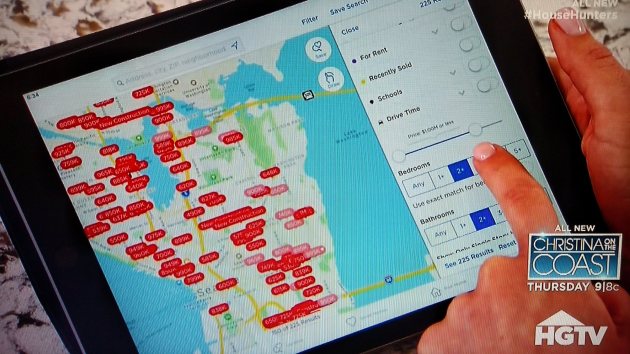
Watching TV to see people use Zillow

In watching a recent episode of House Hunters on HGTV, I was treated to brief scenes of the couple using Zillow:

HGTVZillow

Caveats:

-I know this is how people shop for houses today. I have done it myself.

-I would guess this means HGTV and Zillow are working together on the show in some capacity. (See a similar clip on ispotTV.)

-House Hunters tries (!) to show what looking at houses might look like.

Commentary:

Even though the scene was brief, I found it odd. It either seemed like obvious product placement (use Zillow rather than Redfin or MLS or other options!), uninteresting storytelling (watch people look at a screen!), or signaled some major change. As the couple then moved to driving around by themselves and looking at houses, I thought for a short moment that they would not even need a realtor: they had found listings online, arranged their own details, and would tour on their own. (Alas, the realtor just met them at the first house tour.)

While there is a lot of potential for HGTV and other similar programming to incorporate devices and screens (mainly smartphones and tablets) into their portrayals of finding property, there is a bigger issue at play for television and film: how can you interestingly portray handheld screens that so many of us are buried in on a daily basis within a story that has to move at a rapid pace? This is not easy.

Considering the Wall Street Journal’s “mansion porn”

The Wall Street Journal sends a special supplement each week to readers looking at the houses of the wealthy:

Mansion, The Wall Street Journal’s real-estate supplement, arrives each Friday slipped into the middle of my newsprint edition, the way pornography (so I’m told!) used to come in unmarked envelopes back before the internet placed it at everyone’s fingertips. I’m satisfied with my weekly print version, but you may prefer reading Mansion on the web, where the photographs are more numerous, detailed, lurid, and explicit…

The comparison to porn is apt. It’s also unoriginal and incomplete. A little more than a decade ago, when the century was young and right before their real-estate holdings drove millions of people into bankruptcy, New York magazine ran a regular feature about how fabulous it was to own real estate. And not just to own it, but to fantasize about it, drool over it, caress the photos and the sales price as though they were objects of sensual desire. The feature was called “Real Estate Porn,” in keeping with the salacious content.

Mansion invokes the same feelings of naughtiness: You’re watching people do something that, in a fairer and more just world, you’d be doing yourself. I think of Vivian Dixon and John Chapple, a married couple that Mansion introduced us to not long ago, as the exemplars of the Mansion character. They are voluptuaries of real estate. They grab houses the way the rest of us scoop mints from the little bowl as we leave a restaurant. At the time of the article’s publication, in May, they owned six residences, though by the time the piece ends you suspect their trigger finger is getting itchy again…

This willingness to take the wealthy on their own terms is a rarity in American business journalism. Reporters are usually more leery in their treatment of such subjects, when not nakedly hostile. Few people in the world despise the winners of the capitalist lotto more than the sorry drudges who are called to write about them. You’ll find a higher percentage of committed socialists in the newsroom of the Financial Times than at a lakefront party at Bernie Sanders’s dacha.

I have not seen this section but I wonder if tackles several darker essentials of American culture from the beginning:

  1. The presence of really wealthy people in the midst of an egalitarian/middle-class public discourse.
  2. The importance of real estate in American life. Sure, citizens can vote and a few people can move from the bottom to the top in unique ways but the real answer to getting ahead is real estate (from moving the frontier for 150+ years to gobbling up expensive properties in  global cities).
  3. The work that goes into homeownership in both maintaining and improving properties.
  4. The interest in seeing what the rich are up to and uncertainty about whether to critique their excess or celebrate their success.

It would be interesting to know how many Americans exist at this elite level of real estate. This is not the typical homeowner hoping to make money on their single-family home or the small market house flipper or the “dream hoarders” in the top quintile of earners; these are people buying and selling with large amounts of capital (perhaps some even thinking like the current president).

Beware of buying a 1×100 plot of land between villas at a real estate auction

One man was surprised to find out what he actually purchased in a Florida real estate auction:

Kerville Holness thought he’d done a great job snapping up a $177,000 Tamarac villa for only $9,100.

He got a 1-foot-wide, 100-foot-long strip of land on Northwest 100th Way — valued at $50.

It starts at the curb where two mailboxes have been installed, goes under the wall separating the garages of two adjoining Spring Lake villas, then extends out to the back of the lot…

The message from county officials and real estate experts is that auction participants need to do their homework and make sure they’ve checked for all possible problems a property might have…

Real estate is a hot investment option these days. Add the interest people across the United and world may have in property in southern Florida plus the ability to purchase online and you could get more situations like this. How many people would be willing to purchase a property without ever seeing it?

Perhaps the answer going forward is that a lot of people would be willing to do this. If you can buy a car without driving it first, then more and more properties and units could go this way. In hot markets where properties go fast and the competition is fierce, it probably already happens at higher rates.

I wonder if at some point there could be a local backlash about Internet property sales. Just the idea that someone from anywhere could purchase land or buildings might make some nervous. Takes places like Vancouver or southern California where outsiders are making a lot of purchases. Or, perhaps the backlash from angry buyers who did not get what they thought they would (such as in the story above) could change Internet property sales. What format or what details are needed to truly make physical property a salable commodity to Internet buyers all over?

Reporting on the return of investment for house flippers

Selling flipped homes is up while the average return on investment for flipping a home is down:

Homes that were resold within 12 months after being purchased made up 7.2 per cent of all transactions in the first quarter, the biggest share since the start of 2010, Attom Data Solutions reported Thursday. Meanwhile, the average return on investment, not including renovations and other expenses, dropped to 39 per cent, an almost eight-year low…

“Investors may be getting out while the getting is good,” Todd Teta, chief product officer at Attom Data Solutions, said in the report. “If investors are seeing profit margins drop, they may be acting now and selling before price increases drop even more.”

Three quick thoughts:

  1. The return on investment for flipping a home is down. Changes in the real estate market mean there are fewer homes with large return potential. I wonder how much of the lack of such homes is due to fewer homes on the market versus sellers getting better at pricing their homes versus multiple kinds of investors driving up prices at the lower price points.
  2. The return of investment of 39% sounds high…until you factor in “renovations and other expenses” which are not part of the figure. So what is the actual average return on investment once factoring in everything? 5%? 15%? This initial figure then helps make sense of the need of flippers to reduce expenses and make cost-effect renovations because those decisions directly connect to profits.
  3. Thinking of the money in house flipping, I have seen little about the accuracy of HGTV shows and other shows that often provide a purchase price, expenses summary, and then give a profit at the end. Are those figures normal? Do they represent unusual housing markets and/or unusual advantages to being part of a TV crew doing house flipping?

Argument: Trump “is acting like a real estate developer”

Want to understand the behavior of President Donald Trump? Megan McArdle suggests he is simply doing what a real estate development might do:

Because what you see on TV shows about house-flippers is, writ large, the nature of the whole business: To compete in a highly capital-intensive industry, almost everyone takes on a lot of debt. Like most real estate people, Trump loves debt — “There’s nothing like doing things with other people’s money,” he told a rally in 2016. “Because it takes the risk, you get a good chunk of it and it takes the risk.”…

That’s why the real estate business rewards a certain willingness to put everything you have on a long shot; if you can’t cheerfully take risks with horrific potential downsides, you need a different job. The best argument for this approach is that some problems can’t be solved any other way — if developers demanded steady, predictable incomes like the rest of us, most of America would still be farmland.

In its best form, the developer’s way of thinking can achieve the impossible — or at least what the more staid and methodical folks said was impossible. I opposed moving the U.S. Embassy to Jerusalem and was at best ambivalent about sticking with Kavanaugh, but I have to admit that the apocalyptic doom predicted by Trump’s opponents has so far failed to materialize, while the political gains were immediate, and large.

Then again, there’s a reason most of us don’t live like real estate developers, or want to. Bankruptcy is a sadly normal fact of life in the real estate business, which is why Trump can tout his extensive experience negotiating with creditors. The cost of gaining wins with big bets is that you never know when you might lose everything.

Analyzing behavior and motives from afar is a difficult task. Yet, this argument raises some interesting questions:

  1. Could an average American describe how a real estate developer operates? A few might be known to a broad number of people but I’m guessing many operate behind the scenes. And these developers can significantly effect communities.
  2. It would be interesting to know how the president polls among real estate developers. Would they proudly call him one of their own? Would they recognize the approach?
  3. Are there examples of other real estate developers who became political leaders? If so, did they act in similar ways?
  4. Is there a way to quantify or easily explain the amount of influence real estate developers have had in cities or places? Donald Trump was a big name developer: widely recognized, some degree of wealth, and a number of large buildings with his name on it. Yet, how much did he influence New York City or other locations?