An influential Naperville office building now with plenty of available parking

In 1964, Bell Labs announced plans to construct a new building just north of Naperville, Illinois and near an interchange on the East-West Tollway. That facility would later come to contain thousands of workers; “about 11,000,” according to Wikipedia. As I discuss in “A Small Suburb Becomes a Boomburb: Explaining Suburban Growth in Naperville, Illinois,” this suburban property helped set Naperville on a particular trajectory.

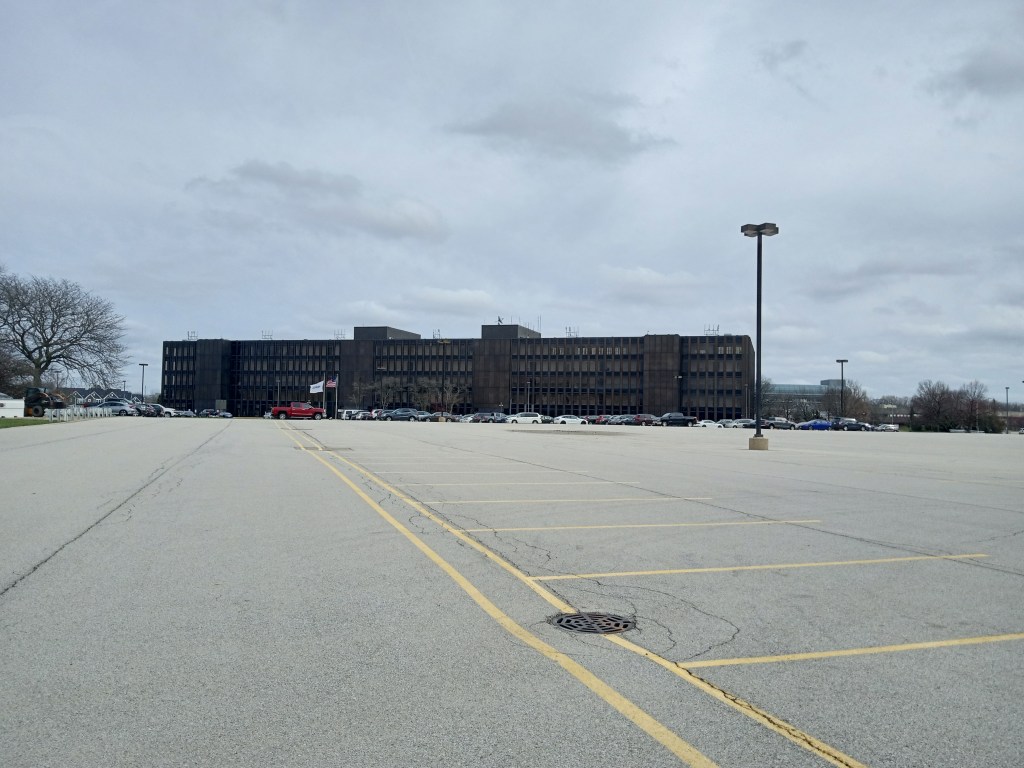
Here is a recent view of the back parking lot:

I know this is a far out view of the parking lot but it struck me that there were a limited number of cars here for such a large set of buildings. The number of workers on site is a lot smaller in recent years:

The 175-acre property near the intersection of Naperville and Warrenville Roads has the address of 1960-2000 Lucent Lane.

Nineteen-sixty Lucent Lane includes a vacant five-story 613,620-square-foot steel and glass office building, two three-story parking decks and surface parking lots. Nokia has consolidated its offices into the five-story 1-million-square-foot steel and glass building at 2000 Lucent Lane. The company occupies about 33% of the building, according to city documents.

At the north end of this property, behind where this picture was taken, is a new residential neighborhood of townhouses and single-family homes from Pulte.

What will become of this full property in the next few decades? Could it become a “metroburb” like another Bell Labs facility in a northwest Chicago suburb? The same property that helped lead Naperville to white-collar jobs and office buildings could become part of numerous transformations of suburban office parks into new uses.

Paris discourages use of cars so underground parking garages need to change

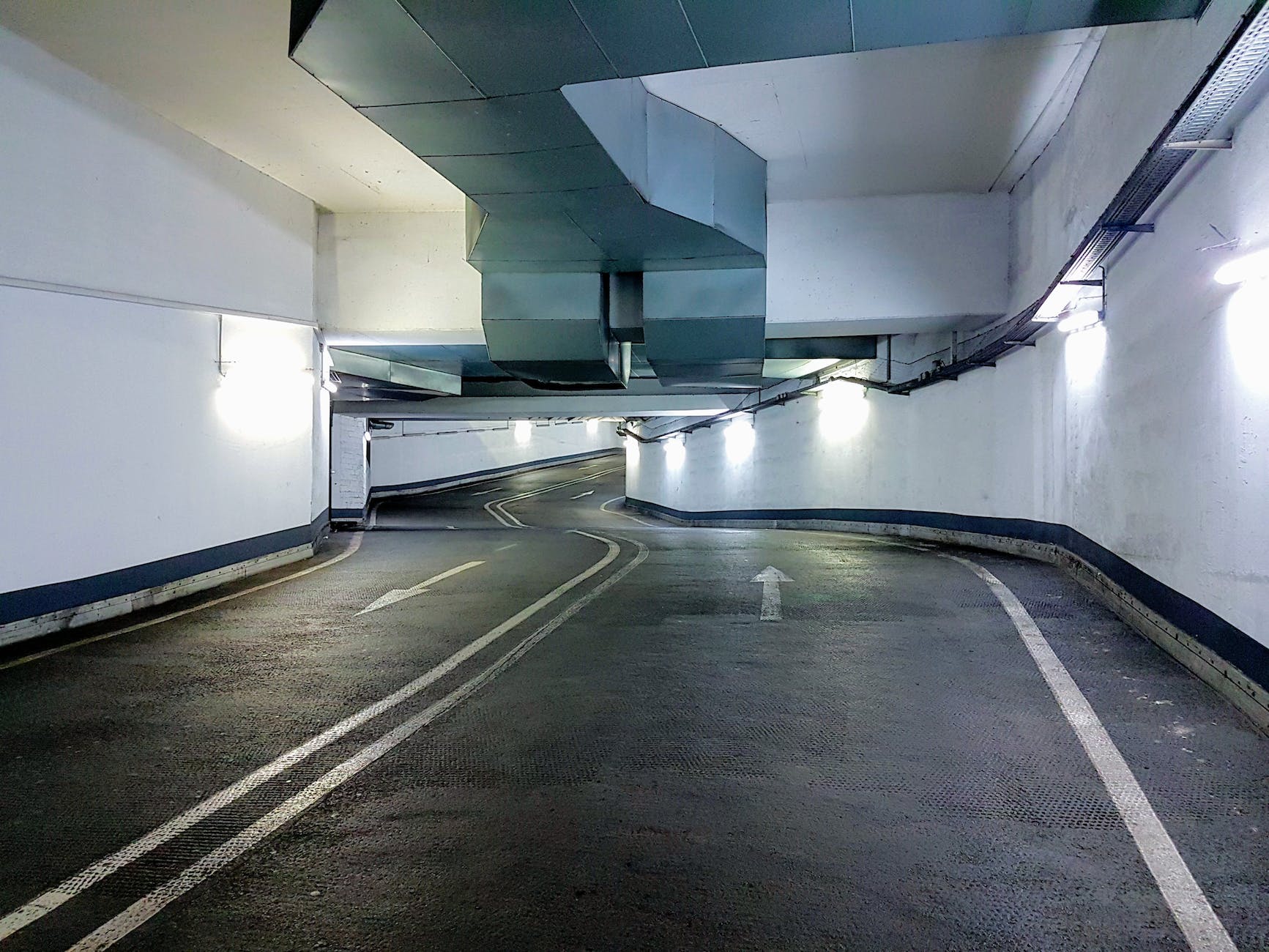
If Paris has fewer cars on its streets, what happens to its underground parking?

Photo by Daniel Frese on Pexels.com

Today Indigo operates 2,700 garages on three continents. But it’s here in Paris, where the company now manages more than a third of publicly accessible garage parking, that Indigo is beginning to develop a new underground commercial ecosystem. There are car repair shops, car rental offices, and click-and-collect lockers from Amazon. Larger-scale ventures the company is pioneering for lower levels include storage facilities and data centers. One private, non-Indigo garage has even been turned into a farm for mushrooms and endives.

Retrofitting parking is complicated, said Arnaud Viardin, Indigo’s director of partnerships. Counterintuitively, garage floors have less load-bearing capacity than homes or offices. Garages also have very low ceilings, threaded with beams and utility conduits that can limit adaptive reuse: It’s hard to market a storage facility that’s not accessible by box truck. Energy-intensive vehicle chargers require drilling through concrete to lay new electrical cables, and just about anything you do demands a time-consuming review with the Fire Department. Rarely do these new leases pay more than a constant stream of drivers charged hourly parking rates. But they pay more than an empty parking garage.

Indigo’s underground real estate has few competitors. Hundreds of thousands of square feet are now dedicated to alternative uses across France, mostly in Paris. “Finding real estate under Place Vendôme, under Place Dauphine?” Fraisse put it to me, pointing to two of the capital’s ritziest addresses. “We’re capable of proposing square footage at prices that have nothing to do with what you’ll find aboveground. Ten, 20, 50 times cheaper.”…

For logistics clients, the value of Indigo’s space is hard to beat. MonMarché is a spinoff of a larger French grocery chain, Grand Frais, whose stores are suburban big boxes with ample parking. “We had to find another solution for the Parisian market, which is the biggest,” said Demond, slicing open the packing tape on a Styrofoam box of durian, the odoriferous East Asian fruit. “The cost of real estate is so high.”

Cities have gone underground for numerous reasons: space above ground is limited, certain land uses are less desirable, underground uses can be more efficient. Putting cars underground made a lot of sense in previous decades when there was a lot of traffic and parking aboveground takes up a lot of space.

How far can underground redevelopment of parking garages go? Would people be willing to spend long amounts of time in such spaces if they were adapted for commercial, office, or residential use?

If these underground spaces become desirable opportunities, how high might rents and resale values go?

How much easier is it to build a new Chipotle than repurpose a vacant storefront nearby?

Near our suburban house is a shopping center consisting largely of strip malls and several anchor grocery stores. This development constructed in the late 1980s has fallen had hard times in recent years with numerous vacant storefronts.

Thus, it was surprising to see the construction that started last year at the site of a former national chain restaurant in this shopping center. This spot had been vacant for several years. The building came down and a new strip mall is going up. The new commercial space has an easy turn-in off a busy arterial road.

I have heard that it is easier to build a new big box store than to repurpose an old one. For example, numerous grocery stores in the Chicago region sat empty for years. Some big box businesses have moved out of older buildings and reopened in new structures not that far away.

The new Chipotle building will certainly be geared toward exactly what this business needs. Additionally, there will be at least one new storefront next to the restaurant. The old building had a different layout inside, one more fitting for a sit-down restaurant, and with on additional commercial space.

At the same time, how many strip malls, shopping malls, big box stores, and restaurants are torn down each year because the space they have is not exactly what a different business wants? What happens to all of these materials? How much time goes into tearing down? How substantially are these shopping areas changed by adding a few new buildings here and there? This Chipotle could have moved into a vacant property within the shopping center.

I could imagine more modular structures or incentives for reusing buildings or asking businesses to adapt to existing spaces. But, if it is cheaper or more efficient to tear down one building and redevelop another, then that is what businesses will do.

A suburban hospital creating a medical and commercial district

Northwestern Medicine is developing and opening multiple properties around its hospital in the small suburb of Winfield, Illinois:

Photo by Pixabay on Pexels.com

The once-blighted corner now boasts a $38.8 million medical office building designed to anchor the redevelopment of Winfield’s Town Center…

The health system also has built a parking garage and amenities in Riverwalk Park since forming an agreement with the village to inject new life into Winfield’s small-town downtown. Northwestern has set aside commercial and restaurant space on the ground floor of both the parking deck and the medical office building…

Winfield Station, a five-story apartment complex, is almost fully leased, Sorgatz said.

The site that once housed John’s Tavern is available for development directly west of the medical office building. The restaurant owner closed the business in 2017 after deciding to retire. Northwestern purchased the property.

The hospital and the town have not always seen eye to eye.

This story highlights the potential for a hospital to drive redevelopment. The hospital has money, nearby property is available. The new projects can theoretically benefit everyone: the hospital needs space, the village has property that would benefit from new buildings, the municipality can get more tax revenues, community members could hold jobs.

Bigger question: should hospitals drive development and redevelopment? There is a lot of money in health care, they provide employment, and they are often a long-term presence. Numerous communities in the United States have long-standing facilities that drive activity and local status. How many communities, cities, suburbs, or more small towns can happily connect in public-private partnerships involving hospitals?

How much time it could take to get the municipal funding to redevelop a shopping mall

As shopping malls decline, finding the money to redevelop the property could prove difficult. Here is the experience of one Chicago area suburb:

Photo by Karolina Grabowska on Pexels.com

When West Dundee trustees approved a special taxing district in 2016, they were hopeful it would breathe new life into Spring Hill Mall.

The mall showed some signs of hope when a new theater opened in late 2016. Overall, however, the mall stagnated and key anchors closed shop. By 2021, the village saw the property value of its share of the mall drop from a base value of $7.6 million in 2016 when trustees created a tax increment financing district for the mall to $2.5 million in 2021.

Now trustees are considering scrapping the 2016 TIF district and creating a new — and larger — one. The new TIF district would extend to Huntley Road to the north, Route 31 to the east and Route 72 to the south and would take in a Jewel grocery store to the west. And much like in 2016, officials are hopeful a new TIF with larger borders and a lower base property value would help transform the mall…

Despite the failure of the first TIF district, developers have indicated to village officials the money a TIF district could bring for redevelopment would be key to any transformation of the mall area, West Dundee Village President Chris Nelson said.

A successful TIF can help a municipality capture property tax revenues to put toward redevelopment, often in the form of infrastructure. This means that a developer does not need to pay for some of the necessary improvements – and presumably could profit more.

But, how much time and money is enough to entice a develop to go through with a significant redevelopment? At this point, the first TIF has existed for roughly six years. It did not work as intended; property values fell so there was not tax revenue to capture. Will expanding the district create enough revenue?

TIFs have timelines built into them; they are not intended to last forever. Should a suburb commit to decades for a TIF? At what point does a community throw in the towel in efforts to raise revenue or a commitment to a particular tax structure?

Many communities with shopping malls, big box stores, and other brick and mortar establishments will face these questions in the coming years. TIFs are one tool to use; what other options will emerge as popular and/or successful paths for communities to follow for redevelopment?

Do not call it a shopping mall; call it a campus

With the opening of several hundreds units of housing on a former portion of the Fox Valley Mall, one leader used a different term than “mall” to describe what was unfolding on-site:

Photo by Armin Rimoldi on Pexels.com

While the mall has been around since 1975, Samson said he even has stopped calling the burgeoning “live, work, play” development by that name.

“Notice how I didn’t say mall,” Samson said. “It’s a campus.”

A shopping mall is primarily about commercial activity. A campus implies something different. Probably the most common usage of the term refers to college campuses. On such a campus, there is a variety of activity: residential spaces, social spaces, academic spaces, athletic spaces, and more.

Many shopping malls are hoping for transformations that help them move beyond just stores and a few eateries. The shopping malls that survive the next decade or two could include apartments, condos, townhouses, hotels, restaurants, entertainment venues, and cultural attractions in addition to stores. All of these options would help make the mall/campus more lively throughout the full day rather than just during shopping hours. In this sense, the goal is not that different than numerous mixed-use developments in suburbs and cities: create a home base of residents plus a steady flow of visitors who spend money and contribute to social activity.

Will the term campus catch on to describe former shopping malls? Time will tell and certain influential actors, such as developers, architects, and local leaders, can help make it happen.

Another suburban Chicago mall goes in on denser housing to revive its fortunes

Yorktown Mall in Lombard is planning to replace a vacant anchor store with hundreds of apartments:

Photo by Pixabay on Pexels.com

The department store closings have turned other enclosed malls into retail ghost towns. But Yorktown has sought to reinvent itself by thinking outside the big box…

Pacific is now teaming up with Chicago-based Synergy Construction on a major overhaul of the west side of the 54-year-old mall. Plans call for replacing the cavernous, three-level Carson’s store and its vast parking lot with an apartment complex and a public park. The residential portion of the development will cost an estimated $201 million over two phases, Lombard officials say…

Pacific and Synergy have not finalized a unit count, but village memos indicate the latest project could bring approximately 700 apartments to Yorktown.

“You start having a critical mass of maybe 1,500 or 2,000 new residents,” Niehaus said. “And when you look at the rent rates that the apartments are generating, it typically lends itself to people that have disposable income that will want to shop or eat or participate in activities.”

Not all malls will survive the coming years. The idea behind replacing stores with apartments or housing is that it is a better use of the space rather than trying to chase a dwindling number of successful retail options and adding residents next to stores, restaurants, and entertainment options means they will spend some of their money in the remaining mall spaces.

Will this ultimately be the successful tactic that either saves some portion of the mall or revitalizes/transitions the space from retail to other uses? Housing is needed in many communities with shopping malls. Will communities recoup the revenue that used to come in through sales taxes? Will the footprint of the mall eventually disappear into the sprawling suburban landscape? As noted in the article, this is not the only Chicago mall pursuing this. See the example of the Fox Valley Mall in Aurora. Wait another thirty years or so and the legacy of the suburban shopping mall – roughly a century old at that point – might be very different.

How much a declining mall can cost a community in sales tax revenue: almost $20 million a year

The decline of Stratford Square Mall in Bloomingdale, Illinois meant the sales tax revenue for the community dropped dramatically:

Photo by Pixabay on Pexels.com

Stratford was still a cash cow in 2012, generating $20.3 million in sales tax revenue. But that number has quickly dwindled in the last 10 years, with the mall producing just $466,080 in 2021, village officials say.

Dead malls” or struggling malls are a problem in numerous American communities. Popular for decades, these properties provided shopping, entertainment, and social space for visitors, jobs, and tax revenues for communities.

As communities look to transform these properties (and the possibilities are broad), one large factor will be how much tax revenue the new land use generates. Can they ever come close to generating that kind of sales tax revenue? Restaurants and entertainment or experiential spaces can help close that gap. Residences, however, do not bring in that kind of money (unless those new residents shop regularly at local businesses). If not, what other clear benefits will the reconfigured properties offer the community?

McMansions as part of or outside of a changing suburbia?

This description of the changing American suburbs includes McMansions:

Photo by Jeswin Thomas on Pexels.com

The demand for something like urban living is real. Even at the outer edges of growing metro areas, mixed-use walkable developments pop up alongside familiar subdivisions and McMansions. “Mixed-use centers—often in suburban locations—continue to be built from the ground up in many communities across the US,” wrote the Congress for the New Urbanism in 2019.

As more immigrants and millennials become suburbanites, and as Covid and remote work give the suburbs another growth spurt, they are evolving into something different. Between 2019 and 2020, the share of millennials who live in suburbs increased by 4 percentage points; and in 2014, more than 60 percent of immigrants lived in suburbs, up from just over half in 2000.

Many communities that were once white, exclusionary, and car-dependent are today diverse and evolving places, still distinct from the big city but just as distinct from their own “first draft” more than a half-century ago…

If a “second draft” of the suburbs is now being written — at least in some of America’s growing and expensive metro areas — what might it actually look like?

This is part of the complex suburbia we have today. Where do McMansions fit into this? The selection above suggests “mixed-use walkable developments” are near McMansions. But, what happens to the McMansions in the long run? Here are a few options:

  1. The McMansions continue in their neighborhoods for those that want them. Even amid proclamations that McMansions are dead, there are some homebuyers and suburbanites that want such homes.
  2. McMansions themselves are altered in ways to fit the new landscape. Perhaps they are subdivided into multiple units for more affordable housing. They could be added to. Their properties could host accessory dwelling units.
  3. McMansions are demolished and replaced with something else. This could be because the quality of the homes does not stand the test of time or the land is more valuable used another way (some of the teardowns become teardowns).
  4. Some McMansions live on through historic preservation marking a particular era of housing and American life.

For some, McMansions represent the peak of an undesirable suburban sprawl and excess. For others, they are homes that provide a lot for a decent price. Their long-term fate is to be determined both by those who like them and those who detest them as the suburbs continue to change.

How many suburbs will be willing to replace suburban office parks with denser housing?

If the golden age of the suburban office park has passed, what will some of the empty properties be used for? One option is denser housing:

Photo by Pixabay on Pexels.com

It will mean taking land long zoned for offices, and allowing townhomes to be built among them, or permitting apartments or industrial-scale warehouses for the first time. Amid a nationwide housing crisis, many obsolete office parks could be ideal sites for denser housing.

However, this is a very pertinent issue:

The problem for some suburban officials: “It’ll be, ‘Oh, what do you mean we can’t just zone for single-family homes and offices? That’s our thing. That’s why we exist,’” said Tracy Hadden Loh, a researcher at the Brookings Institution. “So now it’s like an existential crisis.”

This is an issue that comes up for numerous kinds of large suburban properties, whether they are shopping malls, golf courses, or grocery stores: how to convert a vacant property into a useful long-term use? The number one goal is probably to generate significant property tax and sales tax revenue. In other words, to keep it at its original as approved by the community years before.

But, if that is not possible – and communities might go years trying to fulfill this vision – then the discussions get interesting. Expensive single-family homes, fitting with the upscale suburban character of some suburbs, would fit in. Zoning protects single-family homes for a reason: suburbanites and suburban communities prefer these homes and their lifestyle.

However, single-family homes can bring more children to local schools and add to the loads of local services. They do not necessarily produce the revenues that offices and retail do. Denser housing is even less desirable because it adds even more residents, which can add to community services and traffic, and some suburbanites are concerned with apartment dwellers.

My guess is that mixed-use redevelopment will be a popular path a number of these communities will try to pursue. Replace that office park with a “metroburb.” But, it remains to be seen how many such developments are viable and how eager suburban leaders and residents are to pursue them.