While the mall has been around since 1975, Samson said he even has stopped calling the burgeoning “live, work, play” development by that name.
“Notice how I didn’t say mall,” Samson said. “It’s a campus.”
A shopping mall is primarily about commercial activity. A campus implies something different. Probably the most common usage of the term refers to college campuses. On such a campus, there is a variety of activity: residential spaces, social spaces, academic spaces, athletic spaces, and more.
Many shopping malls are hoping for transformations that help them move beyond just stores and a few eateries. The shopping malls that survive the next decade or two could include apartments, condos, townhouses, hotels, restaurants, entertainment venues, and cultural attractions in addition to stores. All of these options would help make the mall/campus more lively throughout the full day rather than just during shopping hours. In this sense, the goal is not that different than numerous mixed-use developments in suburbs and cities: create a home base of residents plus a steady flow of visitors who spend money and contribute to social activity.
Will the term campus catch on to describe former shopping malls? Time will tell and certain influential actors, such as developers, architects, and local leaders, can help make it happen.
The department store closings have turned other enclosed malls into retail ghost towns. But Yorktown has sought to reinvent itself by thinking outside the big box…
Pacific is now teaming up with Chicago-based Synergy Construction on a major overhaul of the west side of the 54-year-old mall. Plans call for replacing the cavernous, three-level Carson’s store and its vast parking lot with an apartment complex and a public park. The residential portion of the development will cost an estimated $201 million over two phases, Lombard officials say…
Pacific and Synergy have not finalized a unit count, but village memos indicate the latest project could bring approximately 700 apartments to Yorktown.
“You start having a critical mass of maybe 1,500 or 2,000 new residents,” Niehaus said. “And when you look at the rent rates that the apartments are generating, it typically lends itself to people that have disposable income that will want to shop or eat or participate in activities.”
Not all malls will survive the coming years. The idea behind replacing stores with apartments or housing is that it is a better use of the space rather than trying to chase a dwindling number of successful retail options and adding residents next to stores, restaurants, and entertainment options means they will spend some of their money in the remaining mall spaces.
Will this ultimately be the successful tactic that either saves some portion of the mall or revitalizes/transitions the space from retail to other uses? Housing is needed in many communities with shopping malls. Will communities recoup the revenue that used to come in through sales taxes? Will the footprint of the mall eventually disappear into the sprawling suburban landscape? As noted in the article, this is not the only Chicago mall pursuing this. See the example of the Fox Valley Mall in Aurora. Wait another thirty years or so and the legacy of the suburban shopping mall – roughly a century old at that point – might be very different.
Stratford was still a cash cow in 2012, generating $20.3 million in sales tax revenue. But that number has quickly dwindled in the last 10 years, with the mall producing just $466,080 in 2021, village officials say.
“Dead malls” or struggling malls are a problem in numerous American communities. Popular for decades, these properties provided shopping, entertainment, and social space for visitors, jobs, and tax revenues for communities.
As communities look to transform these properties (and the possibilities are broad), one large factor will be how much tax revenue the new land use generates. Can they ever come close to generating that kind of sales tax revenue? Restaurants and entertainment or experiential spaces can help close that gap. Residences, however, do not bring in that kind of money (unless those new residents shop regularly at local businesses). If not, what other clear benefits will the reconfigured properties offer the community?
The demand for something like urban living is real. Even at the outer edges of growing metro areas, mixed-use walkable developments pop up alongside familiar subdivisions and McMansions. “Mixed-use centers—often in suburban locations—continue to be built from the ground up in many communities across the US,” wrote the Congress for the New Urbanism in 2019.
Many communities that were once white, exclusionary, and car-dependent are today diverse and evolving places, still distinct from the big city but just as distinct from their own “first draft” more than a half-century ago…
If a “second draft” of the suburbs is now being written — at least in some of America’s growing and expensive metro areas — what might it actually look like?
This is part of the complex suburbia we have today. Where do McMansions fit into this? The selection above suggests “mixed-use walkable developments” are near McMansions. But, what happens to the McMansions in the long run? Here are a few options:
The McMansions continue in their neighborhoods for those that want them. Even amid proclamations that McMansions are dead, there are some homebuyers and suburbanites that want such homes.
For some, McMansions represent the peak of an undesirable suburban sprawl and excess. For others, they are homes that provide a lot for a decent price. Their long-term fate is to be determined both by those who like them and those who detest them as the suburbs continue to change.
It will mean taking land long zoned for offices, and allowing townhomes to be built among them, or permitting apartments or industrial-scale warehouses for the first time. Amid a nationwide housing crisis, many obsolete office parks could be ideal sites for denser housing.
However, this is a very pertinent issue:
The problem for some suburban officials: “It’ll be, ‘Oh, what do you mean we can’t just zone for single-family homes and offices? That’s our thing. That’s why we exist,’” said Tracy Hadden Loh, a researcher at the Brookings Institution. “So now it’s like an existential crisis.”
This is an issue that comes up for numerous kinds of large suburban properties, whether they are shopping malls, golf courses, or grocery stores: how to convert a vacant property into a useful long-term use? The number one goal is probably to generate significant property tax and sales tax revenue. In other words, to keep it at its original as approved by the community years before.
However, single-family homes can bring more children to local schools and add to the loads of local services. They do not necessarily produce the revenues that offices and retail do. Denser housing is even less desirable because it adds even more residents, which can add to community services and traffic, and some suburbanites are concerned with apartment dwellers.
My guess is that mixed-use redevelopment will be a popular path a number of these communities will try to pursue. Replace that office park with a “metroburb.” But, it remains to be seen how many such developments are viable and how eager suburban leaders and residents are to pursue them.
On the heels of the Naperville City Council’s decision to deny landmark status to the downtown Kroehler YMCA facility, officials are proposing changes to the city’s landmarking procedures.
The changes, which need city council approval, are intended to reduce the impact on property owners and make it more difficult for applicants to achieve landmark status for structures.
The idea of forcing landmark status on property owners emerged as a key issue in February when the city council voted 8-1 to reject the request by Naperville Preservation to landmark the Kroehler YMCA against the owners’ wishes. The vote freed the owners to demolish and sell the site.
After numerous speakers at last week’s city council meeting debated the idea of creating more-stringent landmarking regulations, and based on recommendations by Councilman Ian Holzhauer, city staff was directed to return with an ordinance preventing individual citizens from applying for landmark status.
For at least several decades, historic preservationists in communities across the United States have argued that older buildings are worth preserving. Acquiring landmark status is a way to help ensure the structure retains its original form even as neighborhoods and streetscapes change.
It is less clear how well historic preservationist arguments work in suburbs where communities can be used to growth and the rights of individual property owners can reign supreme. As suggested above, landmark status can be seen as an impediment to property owners who can profit from changing or selling a property. Why save an older structure when there is money to be made and progress to be pursued?
If this logic wins out in suburban communities, how many older buildings will remain and in what format? It is one thing to save older buildings and move them or recreate them in a historical museum setting. It is another to preserve important older structures that mark important community locations even as communities continue to change.
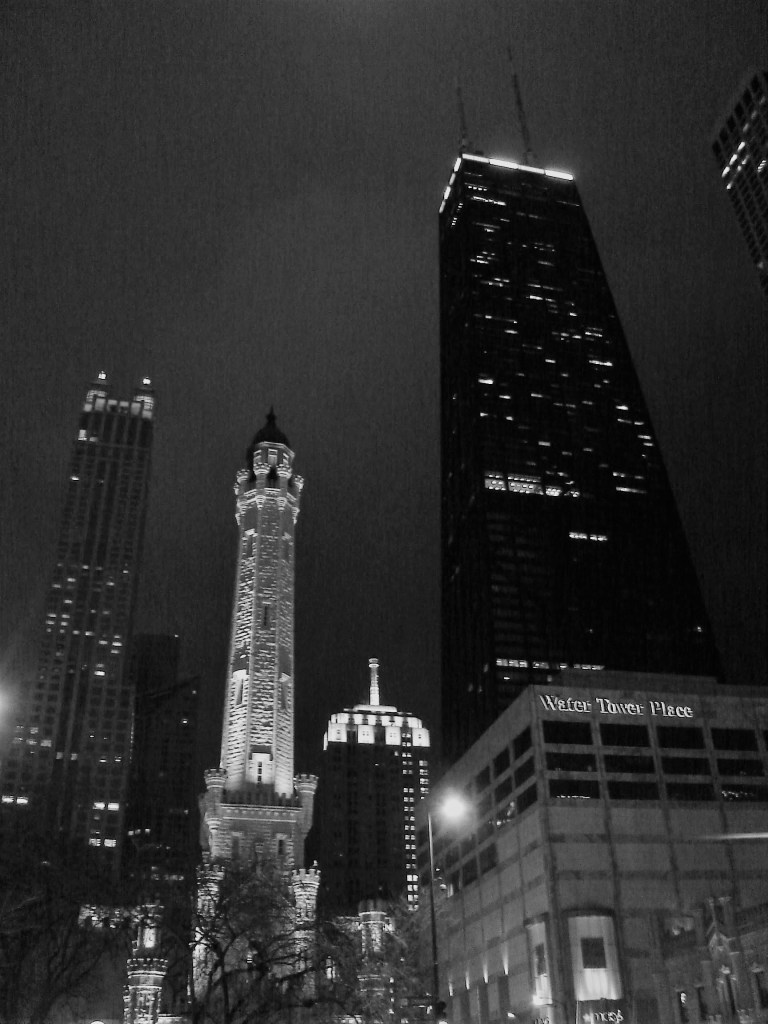
In consultant-speak, today’s juice is “experiential” retail. It means that people not only want something they haven’t seen before, but they want an experience to go along with their purchase. The Apple Store and the Starbucks Reserve Roastery further south on Michigan Avenue are examples of that — places where shoppers come to see and feel as well as to buy. A pop-up show called the “Dr. Seuss Experience” filled Macy’s former space in Water Tower Place this winter. Down the street, a “Museum of Ice Cream” is opening at the base of the newly renovated Tribune Tower this summer…
But she and her colleagues are already thinking big. A report titled “North Michigan Avenue: Strategies for a Vibrant Future” issued in March by a group of business and city leaders envisions a grand promenade running from the historic limestone Water Tower, past the Museum of Contemporary Art, to the lake along Chicago Avenue; and a soaring pedestrian bridge stretching from Michigan Avenue, over DuSable Lake Shore Drive, to Oak Street Beach. The bridge, modeled on a structure in Moscow, would make it possible to see and get to Lake Michigan from the Mag Mile without descending into dank tunnels under the beachfront drive.
Also in the report: a more run-of-the-mill property tax on landlords raising about three quarters of a million dollars passed the City Council this year; it will be used for cultural events like “Music on the Mile” and for security cameras. The city also awarded Bares’ group money from a federal grant to deploy a team of uniformed “ambassadors” — unarmed security personnel with radios to help tourists, assist the homeless and report criminal activity on the Mag Mile — starting in June.
But most of the report is focused on getting people excited about going downtown to enjoy attractions such as music, art and culture, and Water Tower Place recently scored its own big get on that front. In April, the world-renowned Hubbard Street Dance Chicago surprised everyone and moved from a temporary home on the North Side into the mall’s fourth floor.
For years, shopping in a lively context was enough “juice” to bring in both serious shoppers, curious shoppers, and other visitors. Shopping was one of the most popular activities for Americans and the glamor of a downtown mall plus at least a decent-sized crowd would make it feel exciting.
Now that shopping is decoupled from physical space, these former shopping spaces do not have enough “juice.” They need more experiences, ranging from music to arts to unusual sights to places where people can post intriguing social media images.
Can cities and communities be flexible enough to shift spaces and experiences? And how many experiential areas can there be? On the first question, communities need to open to how spaces might be used in different ways when conditions change. Shopping malls may have worked for decades and brought in significant revenue, but when they struggle, what is next? For the second question, Chicago already has some of these experiential spaces: Navy Pier, the Museum Campus, a Riverwalk, and other concentrations of interesting activity. Can these work together in that a visitor could access several of these in a single day or trip or at some point do they start competing against each other?
The decline of in-person shopping is a big deal and a shift that many communities are struggling to address. Those who find successful alternative uses for these shopping spaces and also develop a mindset of needing to refresh certain places may just come out ahead.
The peculiar yet profound way in which historic preservation bound together issues of aesthetics, finance, and urban change is key to understanding why its popularity grew so rapidly in the middle of the 20th century. It also explains why a culture of historic preservation took root in some places more than others. Most suburbs—like the one on Long Island where Geller I once stood—relied on a different set of tools to stop development, such as open-space requirements and zoning codes that limited the number of new homes. To this day, historic preservation remains a less potent force in such places, largely because these other rules ensure that homes like Geller I are unlikely to be replaced by anything but McMansions. In cities with significant numbers of old buildings, however, preservation became an essential part of the process by which communities fended off urban-redevelopment projects.
Cities also have zoning regulations and NIMBY responses to new structures but the presence of more buildings and uses in denser areas can make this all more complicated. Particularly in areas where redevelopment is hot, a new building might be very different than what has stood there for a long time.
But, as the article notes, historic preservation can be a tool used in a lot of places to halt plans:
Historic preservation not only gave this process of hyper-gentrification an imprimatur of political and legal legitimacy it might otherwise have lacked, but also continues to enable it in the present day. The LPC’s own website still notes that one of the purposes of New York’s landmarks law is to “stabilize and improve property values.” While the commission’s press releases paint an image of a body focused on protecting a diverse new array of buildings, the historic districts that already exist are, right now, a significant intervention in the city’s real-estate markets, whose main beneficiaries are the people who own land within them. Nor is this dynamic unique to New York. In California, wealthy cities like Pasadena and Palo Alto have recently tried to expand their landmarking powers in order to circumvent a new state law encouraging the construction of sorely needed housing. Simsbury, Connecticut, which is 87 percent white, just finalized a sale of nearly 300 acres to a land trust—killing an affordable-housing project in the process—on the premise that the site is historically significant because Martin Luther King Jr. once worked there. In Washington, preservationists have long tried to block the redevelopment of a water-filtration plant that hasn’t been used in 35 years on the basis that it is historically significant.
Anyone interested in mediating the worst ongoing outcomes of the present climate catastrophe must also disconnect the idea of development from our notion that it proceeds only in cycles of demolition and new construction—a pattern that prevails because it is maximally legible to our existing structures of debt, financialization, and speculation. About 80 percent or more of a typical new house’s lifetime ecological and energetic impact comes through the operations of initial material extraction, manufacturing, transportation, and construction; and then of eventual demolition, further transportation, and decay. Sustainable buildings are therefore not new buildings—however fuel-efficient their machines and materials. Sustainable buildings are buildings that have been sustained. Merely by being seventy-five years old and in working order, Geller I was radically sustainable. For that matter, any dumb 1990s McMansion down the block is almost as ecologically precious as Geller I. That McMansion’s judicious conservation, too, is part of ecological stewardship.
This kind of conservation comes not by preserving any one house exactly as it is, but by shifting from a fantasy of perpetual newness or untouchable oldness to the best practices that Gropius and Breuer cherished in old New England farmhouses: renovation, addition, retrofitting, and all manner of adaptive reuse that allows ever more lively and dignified density. The model of development becomes less one of the sudden appearance and disappearance of structures, and more one of continuous emendation and repair. Not incidentally, this affords ever more innovative ways of living intergenerationally and integratively—rather than dwelling in the built residue of past generations’ conventions about how families and communities ought to live.
Demolition and rebuilding takes a lot of resources. Additionally, rehabbing existing homes can help keep the character of a neighborhood or community consistent.
Plans were to raze the majority of the largely vacant mall to make way for 560 apartments and townhouses, a hotel, new restaurants and retail spaces along East Main Street…
“It’s a good plan but the question is, is this the best use of space?” 2nd Ward Alderman Ryan Bongard said at the meeting. “In speaking with constituents, they don’t want to see 500 apartments.”
On Friday, St. Charles Mayor Lora Vitek confirmed the developers have pulled out of the project. The partnership of S.R. Jacobson Development Corporation and Lormax Stern Development Company LLC had previously entered into a purchase agreement for the former Charlestowne Mall property with current owners The Krausz Companies LLC.
In December 2017, Krausz closed Charlestowne’s interior shops and enclosed mall space at the center. Anchors Von Maur and Classic Cinemas Charlestowne 18 remains…
“That’s the overwhelming comment that I have heard through the city council,” Vitek said. “And I do believe that we can try to accomplish that. We shouldn’t settle. We’ve got a lot going for us. We know there needs to be more people here and we’re going to bring residential, but there needs to be a balance over there, too. The east side is very important to our town, but we do want to see the right fit.”
On one hand, I can understand this common suburban concern: if you eliminate commercial property and rezone it for other uses, will you ever get the same amount of money in tax revenues from the property? A successful shopping mall or entertainment area brings in sales tax revenue in addition to paying property taxes.