The mostly Christian US House and Senate

How does the religious affiliation of the members of Congress compare to the religious affiliation of Americans as a whole? This came up recently in a conversation about religiosity and government so I tracked down some data.
Photo by Kendall Hoopes on Pexels.com

For the religious affiliation of Americans as a whole, here are figures from the Pew Religious Landscape Survey with data collected in 2023-24 from more than 35,000 respondents. With 62% of American adults identifying as Christian, here are the percentages for particular religious traditions:

-23% evangelical Protestant

-11% mainline Protestant

-5% Black Protestant

-19% Catholic

-2% Latter-day Saint

-2% Jewish

-1% Orthodox Christian

-1% Muslim

-1% Buddhist

-1% Hindu

-29% religiously unaffiliated

For the religious affiliations of members of Congress, here is a summary of what Wikipedia has for House members and Senate members. The categories are not the same as the religious traditions for the Pew Religious Landscape Survey but there are points to compare. Starting with members of the House of Representatives:

-375 of the 435 (86%) are Christian. Of these Christians, 236 are Protestants in specified traditions (including 63 Baptists, 22 Methodists, 16 Episcopalians, 15 Presbyterians, 13 Lutherans, 10 non-denominationals) and 88 are unspecified Protestants. Of the 375 Christians, 126 are Catholics, 7 are Eastern Orthodox, and 6 are Latter-day Saints.

-24 of the 435 (6%) are Jewish.

-4 of the 435 (1%) are Muslim

-4 of the 435 (1%) are Hindus

-2 of the 435 (0.5%) are Buddhist

-18 (4%) are unknown or refused to state.

-4 (1%) are unaffiliated.

And here is the religious affiliation for members of the Senate:

-86 of the 100 (86%) are Christian. Of these Christians, 59 are Protestants in specified traditions (including 12 Baptists, 5 Methodists, 5 Episcopalians, 12 Presbyterians, 6 Lutherans, 6 non-denominationals) and 5 are unspecified Protestants. Of the 86 Christians, 24 are Catholics, 7 are Eastern Orthodox, and 3 are Latter-day Saints.

-9 of the 100 (9%) are Jewish.

-1 of the 100 (1%) are Buddhist

-4 (4%) are unknown or refused to state.

How does the religiosity of Congress compare to the country as a whole? Pew sums up:

Christians will make up 87% of voting members in the Senate and House of Representatives, combined, in the 2025-27 congressional session. That’s down from 88% in the last session and 92% a decade ago...

And yet, at 87%, Christians still make up the lion’s share of the Congress, far exceeding the Christian share of all U.S. adults, which stands at 62% after several decades of decline…

The new Congress is also more religious than the general population by another, related measure: Nearly three-in-ten Americans (28%) are religiously unaffiliated, meaning they are atheist or agnostic or say their religion is “nothing in particular.” But less than 1% of Congress falls into this category…

In a country where a majority of adults identify as Christian, Congress is roughly 25% more Christian than the population as a whole. This may change in the coming years as more American adults do not identify with any religious tradition or group.
America’s religious nones: “They. Really. Don’t. Like. Organized. Religion.”

New data on the growing number of “religious nones” in the United States, those who do not identify with any religion , shows they do not like organized religion:

Photo by Francesco Ungaro on Pexels.com

While the nones’ diversity splinters them into myriad subgroups, most of them have this in common:

They. Really. Don’t. Like. Organized. Religion.

Nor its leaders. Nor its politics and social stances. That’s according to a large majority of nones in the AP-NORC survey.

From a related article with some numbers on this:

Among the nones who say they are also not personally religious, 68% cited their dislike of organized religion as a very or extremely important reason. For 63%, a top reason is their dislike of the stances religious faiths take on social and political issues, while 54% say the same about reports of abuse or misconduct by religious leaders. Forty-six percent cite disbelieving in God as a top reason. That was true of 81% of atheists, but just 40% of agnostics and 32% of nothings in particular.

The last paragraph suggests there are multiple influential reasons the nones cite, with a dislike for organized religion leading the way.

It is interesting to see this alongside recent figures showing declines in trust in all sorts of institutions in American life.

This also makes me think about how religious or spiritual ideas can begin or start and then there are processes that transform them into institutionalized religion. Beyond just leaving religion and spirituality solely up to individuals, how do different religious groups push against institutionalization and rationalization?

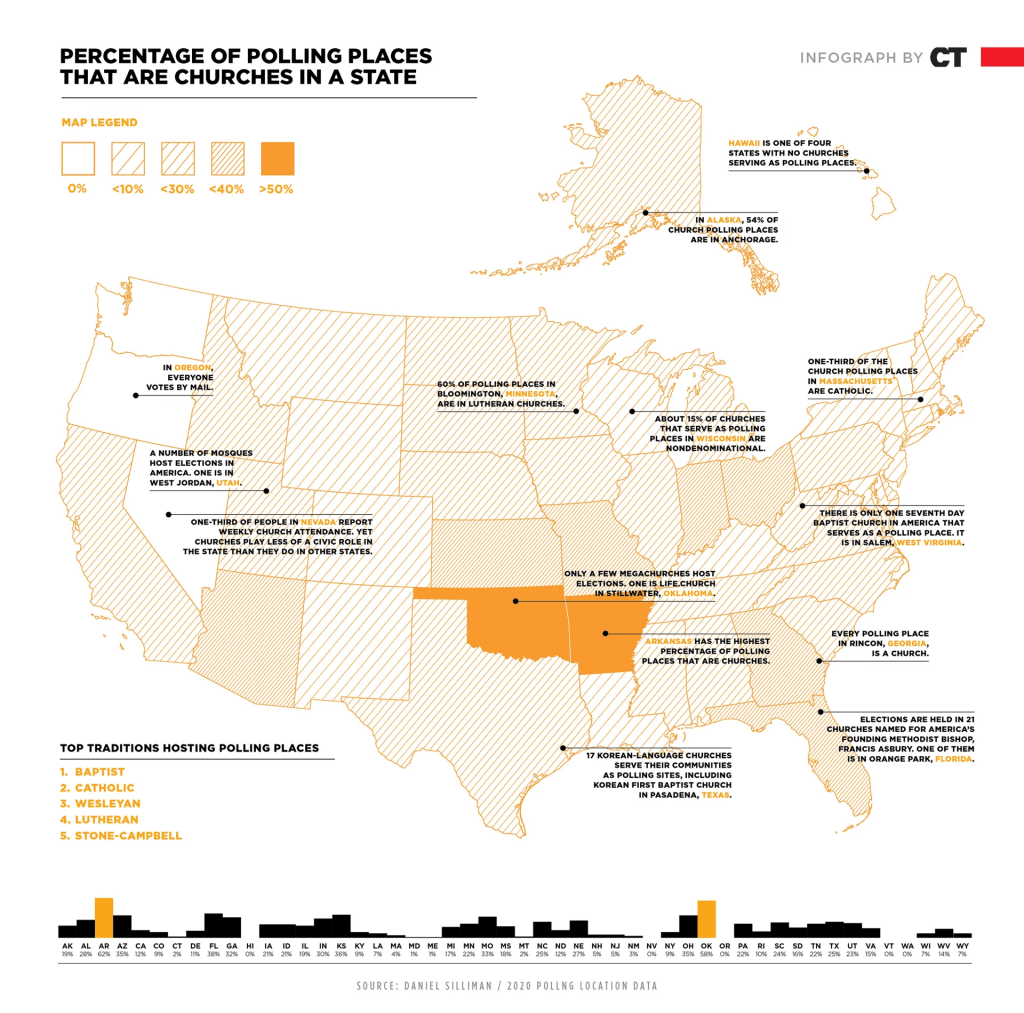
The % of polling places in churches by state

An infographic in Christianity Today highlights how many polling places are in churches:

If I am reading this correctly, here are two patterns:

  1. The percent of polling places that are churches can differ quite a bit from state to state. Generally, some of the Northwest and Northeast are less likely to have churches as polling place. The highest percentages are in more “heartland” states with some interesting exceptions (Arizona, Florida).
  2. Which religious groups host the most polling places can differ as well. It would be interesting to see more fine-grained data/ do these patterns of particular traditions hold up across states or is it because certain states have higher concentrations of certain traditions?

I imagine there might be all sorts of additional factors to consider when examining this.

Given the current political sentiments regarding the role or involvement of religious groups in politics, do these figures go up or down significantly in the coming years? And among which groups and locations?

“Top Three Religious Traditions in Major Metropolitan Areas”

Data from the 2014 American Values Atlas compiled by PRRI shows the top three religious traditions in a number of large American metro areas:

Top-Three-Religions-by-City

Here are some of the takeaways according to PRRI:


  • Urban areas attract the unaffiliated; the religiously unaffiliated are among the top three religious groups in every metro area polled.
  • Catholics also love cities; Catholicism is among the top three religious groups for nearly every metro area—only Nashville, Charlotte, Indianapolis, Kansas City, and Atlanta don’t have Catholics among the top three.
  • Atlanta is the only metro area that doesn’t have Catholics, the religiously unaffiliated, or white evangelical Protestants in the number one slot; that prize goes to black Protestants.
  • Nashville has the largest percentage of one singular religious group: nearly four in ten (38 percent) residents identify as white evangelical Protestant.

Related to these takeaways, two things stuck out most to me looking at this data:

  1. The relative evenness of major religious traditions (and unaffiliated) in major cities. Few large regions have one religious tradition that comprises of more than 33% of the population. This suggests a lot of pluralism at the metropolitan region level.
  2. The pattern does not hold in every case but the leading cities for having the percent of different religious traditions tend to fall into certain regions: Catholics in the Northeast and Midwest, unaffiliated in the West, white evangelical Protestant in the Bible Belt and Midwest.

Put these two factors together and it would be fascinating to consider how the experience of religiosity differs across metropolitan regions. For example, a comparison across traditions such as between Nashville (dominated by white evangelicals) and Portland (dominated by the unaffiliated) could be interesting as would regional differences within the same leading tradition such as between Miami and Milwaukee. If metropolitan regions could be considered fields of religious activity, how might they differ in significant ways?


Religious change: Americans identifying as Christian drops to 70.6%

New data from Pew Research shows a drop in how many American adults identify as Christians:

The Christian share of the U.S. population is declining, while the number of U.S. adults who do not identify with any organized religion is growing, according to an extensive new survey by the Pew Research Center. Moreover, these changes are taking place across the religious landscape, affecting all regions of the country and many demographic groups. While the drop in Christian affiliation is particularly pronounced among young adults, it is occurring among Americans of all ages. The same trends are seen among whites, blacks and Latinos; among both college graduates and adults with only a high school education; and among women as well as men.

To be sure, the United States remains home to more Christians than any other country in the world, and a large majority of Americans – roughly seven-in-ten – continue to identify with some branch of the Christian faith.1 But the major new survey of more than 35,000 Americans by the Pew Research Center finds that the percentage of adults (ages 18 and older) who describe themselves as Christians has dropped by nearly eight percentage points in just seven years, from 78.4% in an equally massive Pew Research survey in 2007 to 70.6% in 2014. Over the same period, the percentage of Americans who are religiously unaffiliated – describing themselves as atheist, agnostic or “nothing in particular” – has jumped more than six points, from 16.1% to 22.8%. And the share of Americans who identify with non-Christian faiths also has inched up, rising 1.2 percentage points, from 4.7% in 2007 to 5.9% in 2014. Growth has been especially great among Muslims and Hindus, albeit from a very low base.

Changing U.S. Religious Landscape


While the drop in religious affiliation will get a lot of attention, this report has other interesting information: American Christians have become more non-white; religious intermarriage is up; Black Protestants have been stable while Evangelical Christians are growing whereas Catholics and Mainline Protestants have lost large numbers; and non-Christian groups have grown but are still quite small.