Community disparities in COVID-19 cases mean districts and schools will need to respond differently

Given disparities in who is more at risk for COVID-19 (higher proportions of Blacks and Latinos, differences across suburban communities), school districts and possibly even schools within districts might need different plans to address the situation. In the Chicago suburbs, many districts have already announced plans for the start of school.

interior of abandoned building

Photo by Pixabay on Pexels.com

Yet, what the plans are and in which communities is interesting to observe. Approaches can vary quite a bit with some opting for all remote learning to start, others going with a hybrid model (alternating attendance), and a few considering more in-person instruction. Wealthier communities that go for remote options may have more flexibility: parents and families can provide for childcare or have adults who can work from home and technology is plentiful. Furthermore, some communities appear to have a lower risk of COVID-19 compared to other places where people work in different kinds of jobs and households are larger. And larger school districts that encompass pockets of residents from different social classes and racial and ethnic groups could have very different situations within their schools. To some degree, this is nothing new: outcomes can vary for students within schools and districts. At the same time, COVID-19 (and other crises) help expose inequalities already present and may exacerbate them further.

That said, it might difficult to develop one-size-fits-all options even at the district level, let alone among county education boards or state education boards, unless there is a lot of homogeneity. The residential segregation common in the United States which then affects who attends what schools as well as  COVID-19 cases means addressing learning and safety together could require flexibility across schools.

President Trump suggests suburbs can exclude and exercise local control

In a June 30th tweet, President Trump expressed disagreement with policies enacted under President Obama involving desegregating housing:

TrumpSuburbsTweetJun3020

President Donald Trump on Tuesday said he would reverse a federal rule that promotes fair housing and sets desegregation as a national priority. The policy is known as Affirmatively Furthering Fair Housing, or AFFH; it’s a provision of the Fair Housing Act of 1968, signed into law a week after the assassination of Martin Luther King Jr.

“At the request of many great Americans who live in the Suburbs, and others,” Trump tweeted, “I am studying the AFFH housing regulation that is having a devastating impact on these once thriving Suburban areas. Corrupt Joe Biden wants to make them MUCH WORSE. Not fair to homeowners, I may END!”

Trump was specifically aiming at an Obama rule about how to finally implement the policy, a mandate (on paper only) for more than 50 years due to federal reluctance to address racial segregation. It might come as a surprise to the president, but his administration has already tackled this policy: The White House took steps starting in 2018 to gut the rule by arguing that it was too burdensome—not because desegregation would have a “devastating impact” on suburban America.

As he’s done time and time again, Trump said the quiet part out loud. The U.S. Department of Housing and Urban Development has taken numerous steps to undermine key rules and policies that promote desegregation as a requirement for jurisdictions that receive federal housing dollars. But under Housing Secretary Ben Carson, the agency has carefully framed those revisions in procedural terms—namely as ways to reduce the paperwork load for housing authorities. In his tweet, Trump essentially admitted that there’s a different motive: Eliminating the rule will reduce the pressure on local governments to provide space and opportunity for Black families in affluent white neighborhoods.

Several thoughts:

1. The suburbs were built in part on exclusion – by race/ethnicity and social class – as well as on local control where suburbanites could avoid regulation from outside parties.

2. This continues conservative opposition to President Obama’s policies regarding cities and suburbs and might give hope to those who hoped President Trump would inaugurate a new wave of suburban development.

3. As the article notes, Trump has not said much else recently about housing or suburbs. It is not an easy national policy issue to address and Democrats have not spent much time on the issue in this election cycle. Yet, Trump’s tweet fits with other things he has said about law and order, racial issues, and cities. If I had to guess, he is trying to win over some suburban voters by suggesting he would allow suburbanites to dictate their own community’s fate. Whether he has the ability to appeal to suburban voters by November given his approach and positions is something to watch.

4. I’m on the record saying addressing issues of race in the United States requires addressing residential segregation. Even as suburbs as a whole have become more diverse by race and class, this does not necessarily mean opportunities in wealthier suburbs are available to all or even many.

Addressing race without addressing residential segregation?

Residential segregation is a long-standing problem in American society. Through legal and illegal means, formal and informal practices, whites often sought and still seek to keep others, particularly blacks, out of their communities and neighborhoods. While residential segregation has lessened in recent years, it is still persistent and numerous communities disadvantaged decades ago are still struggling because of this.

The ability of people of different races and ethnicities to live near each other is not just about proximity to work and access to jobs (though this is helpful too); there are numerous consequences.

-local schools

-access to local governments, and social services

-interaction with neighbors and people in the community

-political representation at higher levels such as state officials or Congress

-nearby cultural opportunities

-health as well as recreational opportunities

-could provide more options for housing and building wealth

-the chance to address local or community problems together

And the list could go on.

As one example, more minorities living in the American suburbs does not necessarily a guarantee them a better life. When many suburbs were built on and operate on the logic of exclusion, suburban residential segregation subverts the idea of the suburban single-family home representing the American Dream.

Tackling residential segregation is a difficult task. Whiter, wealthier communities are not likely to be on board (see how this plays out with affordable housing conversations). Addressing housing at a national level is hard. But, that does not mean it is not worth addressing.

A long history of violence in American society

From the beginning, the story of the United States of America is a violent one. From violence against indigenous people to slavery to armed rebellion to colonial conquests to the Civil War to vigilante violence to violence-enforced residential segregation military intervention around the Western Hemisphere and then the globe to police brutality to gun violence to celebrating the military to assassinations.

Take vigilante violence as an example. I read Sundown Towns: A Hidden Dimension of American Racism at the recommendation of a colleague and having read multiple works by sociologist James Loewen. He argues that a significant number of Northern towns and cities had informal sundown laws that prohibited minorities from being in the community after dark with violence implied if the norms were not followed.

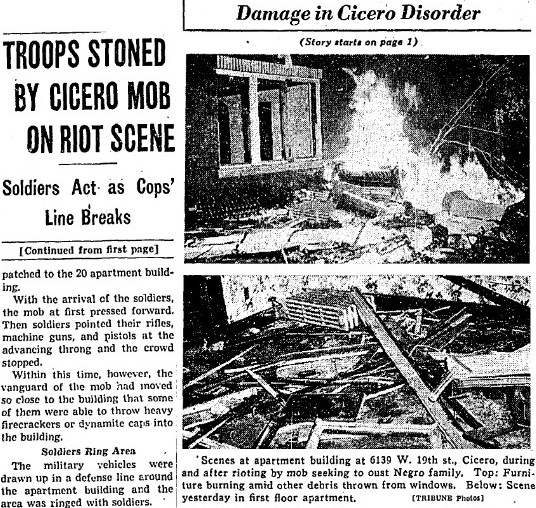
Or, take the example of the role of violence in residential segregation. After violence at a South Shore beach set off moreviolence in Chicago in 1919, residential segregation was enforced not just with restrictive covenants and blockbusting and redlining: actions involved bombings and attacks. Historian Stephen Grant Meyer detailed some of this in his book As Long As They Don’t Move Next Door: Segregation and Racial Conflict in American Neighborhoods, a book I read for a class paper. In places like Cicero, Illinois and Levittown, Pennsylvania, violence accompanied attempts of blacks to move to the suburbs.

CiceroRiot1951ChicagoTribune

Photo by Chicago Tribune, July 13, 1951

Or, take the last in the list as an example. The book that really brought this to my attention as a student was Philip Agee’s Inside the Company: CIA Diary. This led me to read a lot about the Church Committee’s work in 1975-1976 as well as assassinations in the United States and ones in which the United States played a role abroad. In several papers, I worked with the idea of assassinations, discovered databases of political violence in countries around the world that political scientists have collected for decades, and found that the political violence rates in the United States are high.

All together, the United States is awash in violence. It is part of American history, it is regularly promoted, and it is often excused or justified. Thinking about some of the examples I noted above, I found out about these through reading and research because these stories are widely taught, known, or experienced by significant segments of the population. Yet, violence is antithetical to numerous aspects of American society and ideals, including the religious beliefs of many Americans, particularly when harnessed alongside other destructive ideologies such as white supremacy or colonialism.

Leaving the big city for the suburbs – and then pulling up the drawbridge

In yet another article about the possibility of people leaving cities for suburbsthis time in The Washington Post – the narrative ends with this:

ancient architecture black white black and white

Photo by Francesco Ungaro on Pexels.com

Those who study cities say they will remain in the long term and that many jobs will come back. People such as Bailey, who moved away from the Bay Area, are banking on that. He declined to name the town where he moved for fear more people will relocate there, driving up prices.

“I like keeping the local culture and the area is relatively affordable now,” he said. “I’d rather not see the same price inflation that happened in the Bay happen to smaller communities as well.”

On one hand, this could reflect housing market realities in some of the priciest markets in the country. Prices are so high in New York, San Francisco, Seattle, and a few other places that finding reasonably priced housing is something people want to protect. If more people can work remotely, certain places could become more attractive and experience an influx of residents.

On the other hand, is this similar logic to the exclusion in suburbia practiced for decades? This exclusion tended to be along race and class lines; suburbanites wanted to be around those like them and keep others out. When they moved into new subdivisions or what used to be small towns, they later use NIMBY logic to limit opportunities for others. What was an opportunity for them could not become an opportunity for others.

Those with resources and connections will likely have advantages in a race for more attractive or affordable locales. Some will be able to pay more for the privilege of leaving the city. Those moving to the suburbs may simply contribute to ongoing patterns of residential segregation across metropolitan regions, whether they officially live in a city or suburb.

Sports stadiums and white flight

How the Atlanta Braves and Atlanta United went about procuring their stadiums hints at the city’s racial divides:

Accompanying the announcement, the team released a map showing where, precisely, Braves Country was—and, notably, where it wasn’t. That view of the greater Atlanta area was speckled with red dots, each one indicating the home of a 2012 ticket buyer, including season-ticket holders. Only a smattering of red appeared to the east, west and south of Turner Field, while thousands of dots congealed into a ribbon above downtown that expanded into a wide swath in the half-dozen suburban and exurban counties to the north. The new stadium would be closer to the middle of that mass, which happened to embody an older, whiter and more conservative population than the city proper. Those northern suburbs were fast diversifying, yet many in Atlanta—particularly in its black population—felt slighted by the decision, their perspectives colored by decades of racial and political tension between city and sprawl.

Five months later MLS commissioner Don Garber, Falcons owner Arthur Blank and then-mayor Kasim Reed proclaimed in their own press conference that downtown Atlanta would be home to MLS’s 22nd franchise, and the new club, Atlanta United, would take the pitch in 2017, the same year the Braves headed to Cobb. The soccer team would play in the same new $1.6 billion stadium the Falcons would soon call home, but United would be no afterthought. The facility would be designed to accommodate the beautiful game from the start. Pushing back against skepticism and pointing to an influx of young professionals near Atlanta’s urban core, Blank assured MLS’s leaders he could fill the massive venue, even in a market known for lukewarm enthusiasm toward pro sports. Reed boasted that his city’s foreign-born (and, seemingly implied, soccer-loving) population was growing at the second-fastest rate in the U.S. Garber himself insisted these factors combined to make downtown an ideal MLS incubator. The city “embodies what we call a ‘new America,'” he said, “an America that’s blossoming with ethnic diversity.”

Fast-forward five years, and Atlanta United’s ticket-sales map, while not a direct inverse, is considerably more centralized than Braves Country (or even, says United president Darren Eales, a depiction of the Falcons’ fan base). United, meanwhile, aided no doubt by winning the 2018 MLS Cup, has led MLS in attendance in each of its three seasons, averaging 53,003 fans in ’19, among the highest in the world. This echoes the success the Braves found when they chased their audience to the north, the farthest any MLB team had ventured from its city center in 50 years. The Braves’ average home attendance, aided too by on-field success, reached 32,779 fans this season, up 31% from their last year at Turner Field…

Kruse, the Princeton history professor, is blunt in his assessment of such feelings. “These ideas about downtown being a dangerous place are really about the people downtown,” he says. For years he thought that “suburbanites want nothing to do with the city except to see the Braves.” But today? “That last connection has been severed. I see this movement of the stadium as the culmination of white flight.”

Trying to connect with particular fan bases or contributing to decades-long processes of residential segregation and white flight? How about both?

Three additional thoughts:

  1. More could be made here of the public money the Braves received from Cobb County. Plus, they could develop land around the new stadium, now a common tactic to generate more revenue beyond fan attendance. Yes, fan attendance is important but the long-term money may be in investing money in land surrounded by whiter and wealthier residents. Stadium development then just continues the process of limited capital investment in neighborhoods that could really use it and concentrates it in places where wealth is already present.
  2. Baseball is widely regarded as having an older and whiter fan base. Soccer is said to have a more diverse and younger fan base. In addition to the demographics of the Atlanta area, the sports themselves try to appeal to different audiences (even as they might work to reach out to different groups).
  3. It will be interesting to see how many sports teams in the next few decades move to more niche locations while still claiming to be from the big city. Civic identity is often tied to sports teams as most metro areas can only support one team from the major American sports. Can big city politicians still lose when the team from the area decides to move to a suburb (see a recent example in the Las Vegas area) but takes that revenue out of the big city? Can a team that locates in one particular area of the metropolitan region still easily represent the entire region?

Living close to work

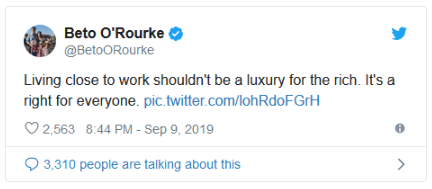
Presidential candidate Beto O’Rourke tweeted earlier this week about the ability of workers to live near their place of work:

https://twitter.com/BetoORourke/status/1171238016289034240

There is a lot to think about here. A little historical context: most workers lived very close to work up until the Industrial Revolution and the urbanization that came with it. The separation of home and work life is a relatively recent phenomenon for humans.

A little data on commute times. The 2017 American Community Survey showed the average commute time was 26.9 minutes. Commuting time can differ quite a bit across metropolitan regions:

McKenzie says the East Stroudsburg, Pa. metro area has among the longest average one-way travel time, clocking in at about 37.9 minutes. The U.S. Census Bureau contacted NPR with new information to include the New York-Newark-Jersey City metro area, which has a travel time of 37 minutes. Travel times for the two metro areas are not statistically different from one another.

Among the shortest average travel times, usually less than 20 minutes, were in Cheyenne, Wyo. and Grand Forks, N.D.

There is an academic term that addresses this issue: spatial mismatch. In this theory, jobs available to lower-income workers are located far from their residences. Imagine a typical well-off suburb: can the workers at the local Target or McDonald’s or gas station or hotel live in that community or nearby? Patterns of residential segregation and exclusionary zoning can mean that cheaper or affordable housing is not available close to certain jobs. This can be a more hidden form of inequality as longer trips to work mean less time for other activities.

This might get trickier for people with more resources and the options of where they want to live. A common American trade-off for the middle-class gets at this: should a homeowner move further out from work to purchase a larger home or live closer to work and job centers (which can include urban downtowns as well as suburban job centers dozens of miles away from urban downtowns)? Is a shorter commute worth having if it comes with paying more money for (possibly smaller) housing?

And perhaps the wealthy can truly live the closest to work if they so choose. Some of them might even locate their business or firm to where they are. Others might have multiple homes, including ones significant distances away where they can get to work by means not available to many such a private jets and helicopters.

So perhaps the issue here is not really living close to work but deeper issues involving mixed-income neighborhoods and moving away from resources (income and wealth) determining where people can life. O’Rourke gets into this a bit more, calling for smarter and denser cities that he says will lead to numerous positive outcomes – which could include shorter commutes.

Connecting residential segregation, highways, mass transit, and congestion

Historian Kevin Kruse suggests the traffic congestion in today’s big cities is connected to segregation:

This intertwined history of infrastructure and racial inequality extended into the 1950s and 1960s with the creation of the Interstate highway system. The federal government shouldered nine-tenths of the cost of the new Interstate highways, but local officials often had a say in selecting the path. As in most American cities in the decades after the Second World War, the new highways in Atlanta — local expressways at first, then Interstates — were steered along routes that bulldozed “blighted” neighborhoods that housed its poorest residents, almost always racial minorities. This was a common practice not just in Southern cities like Jacksonville, Miami, Nashville, New Orleans, Richmond and Tampa, but in countless metropolises across the country, including Chicago, Cincinnati, Denver, Detroit, Indianapolis, Los Angeles, Milwaukee, Pittsburgh, St. Louis, Syracuse and Washington.

While Interstates were regularly used to destroy black neighborhoods, they were also used to keep black and white neighborhoods apart. Today, major roads and highways serve as stark dividing lines between black and white sections in cities like Buffalo, Hartford, Kansas City, Milwaukee, Pittsburgh and St. Louis. In Atlanta, the intent to segregate was crystal clear. Interstate 20, the east-west corridor that connects with I-75 and I-85 in Atlanta’s center, was deliberately plotted along a winding route in the late 1950s to serve, in the words of Mayor Bill Hartsfield, as “the boundary between the white and Negro communities” on the west side of town. Black neighborhoods, he hoped, would be hemmed in on one side of the new expressway, while white neighborhoods on the other side of it would be protected. Racial residential patterns have long since changed, of course, but the awkward path of I-20 remains in place…

[S]uburbanites waged a sustained campaign against the Metropolitan Atlanta Rapid Transit Authority (MARTA) from its inception. Residents of the nearly all-white Cobb County resoundingly rejected the system in a 1965 vote. In 1971, Gwinnett and Clayton Counties, which were then also overwhelmingly white, followed suit, voting down a proposal to join MARTA by nearly 4-1 margins, and keeping MARTA out became the default position of many local politicians. (Emmett Burton, a Cobb County commissioner, won praise for promising to “stock the Chattahoochee with piranha” if that were needed to keep MARTA away.) David Chesnut, the white chairman of MARTA, insisted in 1987 that suburban opposition to mass transit had been “90 percent a racial issue.” Because of that resistance, MARTA became a city-only service that did little to relieve commuter traffic. By the mid-1980s, white racists were joking that MARTA, with its heavily black ridership, stood for “Moving Africans Rapidly Through Atlanta.”…

Earlier this year, Gwinnett County voted MARTA down for a third time. Proponents had hoped that changes in the county’s racial composition, which was becoming less white, might make a difference. But the March initiative still failed by an eight-point margin. Officials discovered that some nonwhite suburbanites shared the isolationist instincts of earlier white suburbanites. One white property manager in her late 50s told a reporter that she voted against mass transit because it was used by poorer residents and immigrants, whom she called “illegals.” “Why should we pay for it?” she asked. “Why subsidize people who can’t manage their money and save up a dime to buy a car?”

Translation: decisions about transportation were both a consequence of a national inclination toward racial and ethnic segregation and an ongoing contributor toward racial and ethnic segregation. In a country that is relatively sprawling and prefers cars, determining who has access to transportation and what kind of transportation is available can be part of who can get ahead.

While the root cause of all of this may be racial issues, it is interesting to consider this as a congestion issue. Would the public be convinced to change transportation infrastructure because they dislike sitting in traffic? The evidence from Atlanta as well as numerous other American cities (such as developing a regional transportation effort in the Chicago region) suggests this is not a strong argument. Wealthier residents are hesitant to ride buses, trains may be tolerable, but driving is still preferred even when so many hours per year are devoted to it. Suburban Americans like cars and they like the ability to exclude and I would argue the second is the master priority when push comes to shove.

Best sociological finding I heard at ASA 2019

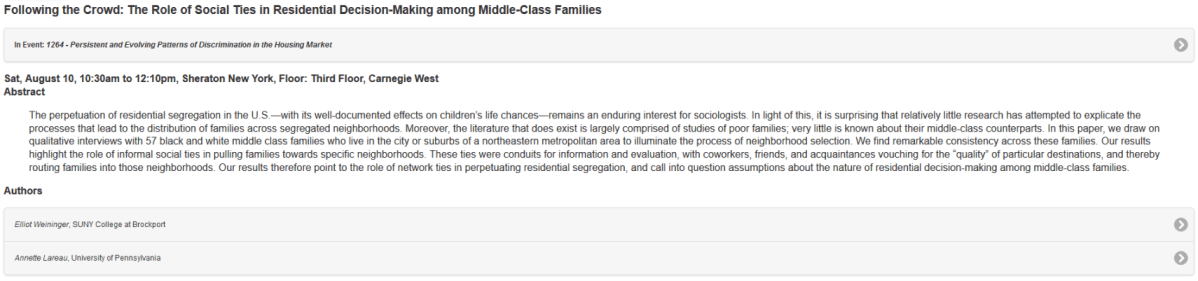
Not surprisingly, the most interesting sociological finding I heard at the annual ASA meetings this past weekend involved research into suburban life. More specifically, Weininger and Lareau looked at how middle-class parents choose where to live:

ASAsession19

As they explained in their presentation, we might imagine these relatively educated and well-off families would look at all sorts of data regarding neighborhoods, compare their relative merits, and then choose one. Instead, they found these families would rely on limited vouching for particular locations from ties in their social networks – sometimes fairly weak ties – and then make decisions based on that. This could even occasionally lead to mistakes.

I look forward to hearing more about how this all works and what this leads to. There is interesting material to consider here including:

-What if there are conflicting network recommendations (either different preferred locations or different opinions on the same location)?

-How does the process change when the respondents do or do not have much local knowledge of the communities they are considering?

-Does this effect hold for middle-class residents of different racial and ethnic groups?

-Can networks help people move into more hetereogeneous locations or do they primarily help reinforce homogeneity?

Processes, events, and decisions add up to significant consequences from Chicago’s 1919 riots

With the 100 year anniversary of the 1919 violence and riots in Chicago approaching, the Chicago Tribune considers some of the long-lasting consequences of a violence-filled summer:

The riots ended after seven days, brought about by the intervention of the Illinois militia — which critics said came too late. The riots changed Chicago in ways it continues to grapple with. Days after the riot, the City Council, for example, proposed formalized segregation on the South Side that remains in place informally today…

Consequently, the trauma of the white assault on the black community left another lasting legacy: the black street gang. “To be sure, the 1919 riot contributed directly to Black gang formation in Chicago as Black males united to confront hostile White gangs who were terrorizing the Black community,” author James C. Howell wrote in his book “The History of Street Gangs in the United States: Their Origins and Transformations.”…

The end of the riots brought swift condemnation, expert groups to examine the cause and criminal charges — though primarily against alleged black rioters — but no real consensus on what to do. On the latter point, in the days after the riot, Cook County State’s Attorney Maclay Hoyne initially charged only black citizens with rioting, leading to a walkout by members of the grand jury hearing the cases…

“In the aftermath, you call it an interracial consensus that the best way to prevent something like this from happening again was to keep the races separate. That was the lesson that was mislearned from the riot,” he said.

This is a reminder that a long legacy of residential segregation, inequality, and racism in the city of Chicago does not just happen: it is the result of specific social processes (some under the control of Chicago leaders and residents and others not), particular events, and reactions to those processes and events. Similarly, it is not easy to simply “turn the page” from past events or reverse the consequences; the same processes, events, and decisions have to be countered with different options.

And if this latter statement is true, Chicago and many other American places have a long way to go regarding countering these legacies. Remembering the past processes, events, and decisions is very important. As the Tribune article notes, how many Chicagoans think the 1919 riots are an important part of the city’s legacy? But, then more work needs to be done. And at this point, it is hard to say that Chicago has done much to reverse these patterns started in the early 1900s.