How homeowners and investors see home purchases differently

What is buying a home about? It could depend who you are:
Photo by Thirdman on Pexels.com

Ordinary buyers and investors have different priorities when sizing up a house purchase. An owner-occupier will focus on whether they can afford the monthly mortgage payment, rather than obsessing over cap rates. They might be willing to overpay if the house is in a good location and is the right long-term fit for them or their family.

It can be frustrating for institutional investors when house hunters bid prices up to irrational levels in tight markets, as is happening today. But sky-high valuations have a silver lining for landlords. Oddly, family homes have turned out to be a great hedge against higher interest rates, as the lock-in effect of ultralow in-place mortgages has protected valuations. And now is a great time for landlords to prune their portfolios and sell properties at near-record prices. 

As the existing housing stock is so unaffordable, investors need to find other ways to grow their portfolios. Large players such as American Homes 4 Rent are building houses themselves, or buying newly constructed units directly from builders. This should be helpful for the undersupplied U.S. housing market.  

There is also a small pool of properties that can be picked up at prices that make sense to investors. According to real-estate investor Amherst, around $12 billion of two-to-four-bedroom homes are currently listed for sale at a 5.75% cap rate. These properties are cheaper because they need work. But it might be more lucrative to patch them up than to build new ones, given it currently costs $200 a square foot on average to build a house compared to $20 to $30 a square foot to renovate.

In the end, both sets of owners want to gain financially from their purpose. Investors want a return on their investment as do homeowners as they tend to expect the value of their property to increase in their time as owners.

But how they get to that return seems to differ. The homeowner will often live in the property in the meantime. As mentioned above, the financial return is not the only factor involved. For the big investor (the primary focus in the article as opposed to smaller investors), a property might be more of a data point among many other properties.

In both situations, it is worth asking how this emphasis on financial investment changes (1) the experiences of those living there and (2) communities. Owning a single-family home has long been part of the American Dream but the move to treating it more like a financial commodity does change matters.
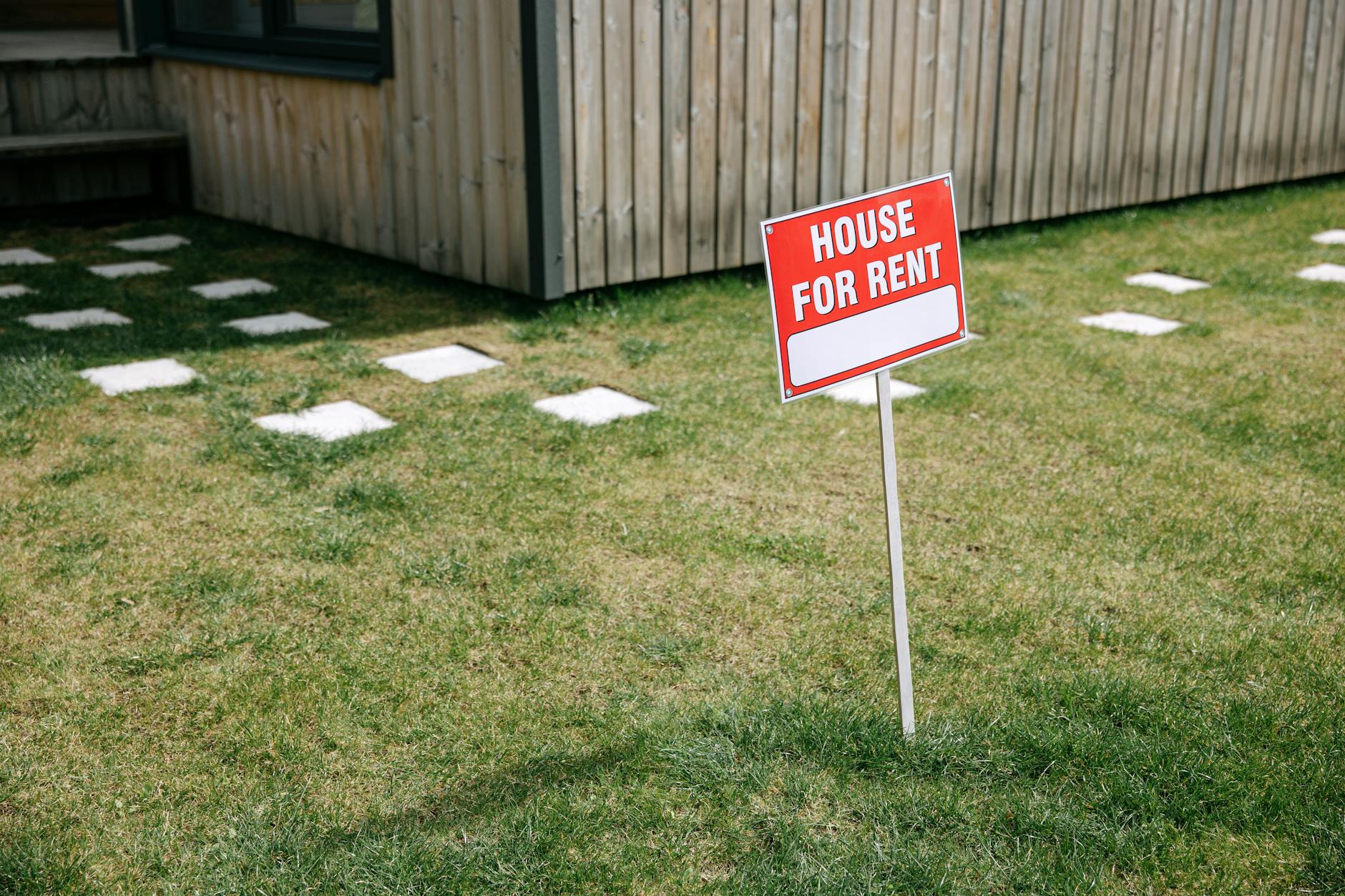
“Small-time landlords still dominate the single-family-rental landscape” and have new tools

One reporter argues the small landlords of today operate differently:

Photo by Ivan Samkov on Pexels.com

Institutional investors — those with more than 1,000 homes in their portfolios — own about 426,000 of the 14.2 million rental homes today, John Burns Research and Consulting found. Most of those properties are in sunny Southern places like Atlanta or Raleigh. Small-time landlords still dominate the single-family-rental landscape, but these aren’t your mom and pop’s “mom-and-pops.” For one, the industry is vastly more transparent than it was in the early 2000s. If you want to see what comparable homes in your neighborhood are renting for, you can scroll through Zillow or visit the website of one of the institutional investors, such as Tricon Residential, Pretium, or Invitation Homes, all of which publicly list their properties and their asking rents. If even that sounds like too much work, companies including Buildium and Roofstock, known mostly for servicing the largest investors in the space, stand at the ready to offer property management and pricing advice — for a fee, of course…

Data on small landlords’ behavior is notoriously scarce, but the latest John Burns figures show that in cities with little to no institutional presence, the smaller landlords are the ones cranking up the pressure. Chattanooga, Tennessee, for instance, has practically zero homes owned by institutional landlords but one of the country’s highest rates of rent growth for single-family homes, with the typical asking rent for new leases up 10% in April from a year prior. Institutional investors own less than 1% of single-family rentals in Grand Rapids, Michigan, but asking rents there were up 8% year over year. In a similar vein, corporate owners may face the most scrutiny over evictions, but mom-and-pop rental owners are more likely to illegally evict their tenants, advocates for both landlords and tenants told Business Insider as part of a wide-ranging investigation into so-called “lockouts.”

Mom-and-pop landlords may not be required to detail their operations in quarterly calls with stock analysts, but most experts I spoke with agreed that even those who own just a handful of properties are getting more with the times…

There will always be some landlords who seek nothing more than a tenant who pays rent on time, doesn’t leave, and doesn’t pick up the phone to complain when something breaks down. For this subset, the onslaught of proptech companies and landlord software may seem like unnecessary money sucks. But others will recognize the need to compete with the more professionalized newcomers — the landlords, both large and small, who fix things on time, let you pay online, and, yes, raise rents accordingly.

If this argument is correct, then it sounds like the information now available to potential landlords and property investors – including for a fee – puts the potential resident at a disadvantage regarding price. Are there tools and information now available on the Internet and social media that help potential renters level the playing field? The potential democratization of information in this sphere may not have benefited everyone in the same way.

I also wonder at the role of expectations about returns on investment among smaller landlords. How much profit should they get? Are they providing a community good or are they hoping to cash out big and/or finance a particular lifestyle? As Americans as a whole expect more money from their houses, how have small-time landlords responded to this?

Costs rising for owning and maintaining a home

A new report suggests owning a home has become more expensive in recent years:

Photo by Monstera Production on Pexels.com

US homeowners are now paying an average of $18,118 a year on property taxes, homeowners’ insurance, maintenance, energy and various other expenses linked to owning a home, according to a new Bankrate study.

That’s nearly the cost to buy a used car and represents a 26% increase from four years ago when it cost $14,428 annually to own and maintain a home…

The per-month cost of owning and maintaining a home has gone from $1,202 a month in 2020 to $1,510 now, Bankrate found…

Of course, the silver lining for homeowners is the fact that home values have gone up significantly since 2020.

Those gains have padded the net worth of millions of Americans. Median inflation-adjusted net worth swelled by 37% between 2019 to 2022, according to the Federal Reserve.

These two trends above might be hard to reconcile: having a home costs more but the value of that home keeps going up. So a homeowner can feel crunched at the moment as they can anticipate a strong return on investment. Which one will they feel more – what feels like a loss in expenses or anticipated value down the road?

Waiting for the realtor to advertise that they get the buyer the best price

I recently received a glossy mailing from a real estate agent describing their recent efforts on behalf of a property owner. A few excerpts from the advertisement:

Photo by Kindel Media on Pexels.com

***Multiple Offers in 24 hours***

My strategic marketing plan generated over 40 groups of potential buyers, igniting considerable excitement from the moment the property hit the market. By Saturday, we had received multiple offers, ultimately securing a contract that surpassed my client’s wildest expectations!

This sounds good for a homeowner looking to sell. They had multiple offers to consider. They got more money that they might have. This agent helped them move to the next stage with more money.

I do not recall getting an advertisement for a realtor that goes the other direction: I found the home buyer a great deal. I negotiated the price down. I helped point out features of the property that led to price reductions. I got the buyer a great deal.

There certainly is a market for getting sellers the most money they can. Americans value their homes for the money they can provide upon sale. They want to see a big jump in the value compared to the price at which they purchased the home.

Buyers also want good financial deals. If you wanted had a tight budget or wanted to buy investment properties, wouldn’t buyers rather have someone who keeps the price lower? I assume there are realtors who do this well and want to find clients.

My interpretation of what Americans mean when they say “renting is throwing away money”

I recently read through some social media discussion of this particular phrase: “renting is throwing away money.” As someone who studies suburbs and housing, what do people mean in the United States with this phrase? Here are a few dimensions of this and some historical and social context:

Photo by Kindel Media on Pexels.com
  1. In more recent decades, Americans have shifted to viewing homeownership more as a vehicle for investment and making money. Houses are not just places to live; people expect them to appreciate in value and provide profits over the years. (And in some places, homes have quintupled in value over several decades.) Renters do not get to share in this built equity while the landlord could cash out both in monthly payments and a sale down the road. If homeownership is primarily about buying a property to see it appreciate, then renters are missing out on this opportunity.
  2. However, homeownership in the United States is not just about making money. Homeownership signals something involving status, social class, and a commitment to a community. Homeowners have made it. Their ability to purchase a home is a signal of their industriousness and commitment to a community. They may raise a family there. Yes, they can sell the home down the road but they have bought into a particular place and put their money into a particular community. This is less about a personal return on investment and more of a marker of the homeowner and their ties to their neighbors and neighborhood.
  3. In contrast, renters are often treated differently than homeowners. They can be viewed as more transient and less interested in building up the local community. They may be assumed to be lower-income or less desirable residents for the community. Rentable units are a threat to community and single-family home property owners. (I have found this particularly true in wealthier suburban settings where opposition to apartments is often framed in terms of who might live there. More expensive apartments do not attract the same opposition even if residents still might be opposed to density, the height of the building, traffic, etc.)

Summing up: in an era with a hyperfocus on investment, homeownership can be viewed as a better long-term return on investment than renting. Additionally, Americans often view homeownership as more virtuous and more desirable for community life than renting. Put these together and there are long-standing concerns regarding renting and apartments.

From subprime mortgage issues to superprime mortgage issues

The most recent financial uncertainty includes mortgages in a superprime era:

Photo by Expect Best on Pexels.com

This is quite the turnaround. After 2008, banking the rich was often touted as a far better model. Even the biggest banks began aiming more of their consumer lending and wealth management at relatively better-off customers, and they scaled back on serving subprime customers. Wealthy customers seldom default, they bring lots of cash and commercial banking business and pay big fees for investments and advice, the thinking went.

But when interest rates shot up last year, it exposed weaknesses in the strategy. It isn’t that the rich are defaulting on loans in droves. But the most flush depositors with excess cash last year started taking their cash and seeking out higher yields in online banks, money funds or Treasurys. On top of that, startups and other private businesses started burning more cash, leading to deposit outflows…

A major way that the better-off do borrow from banks is to buy homes, and often in the form of what are known as jumbo mortgages. Jumbos are for loan amounts over $726,200 in most places, and over $1,089,300 in high-cost cities such as New York or San Francisco. Jumbo mortgages bring wealthy customers with lots of cash. They also are typically more difficult to sell to the market, in part because they aren’t guaranteed by government-sponsored enterprises such as Fannie Mae or Freddie Mac. So banks often sit on them. But the value of these mortgages, many of which are fixed at low rates for the foreseeable future, have dropped as interest rates have risen.

To be sure, not all banks that focus on wealthier individual clients are under intense pressure. Shares of Morgan Stanley and Goldman Sachs, are down less than half as much this month as the nearly 30% decline for the KBW Nasdaq Bank index. But those banks are more diversified and focus more on the steadier, fee-generating parts of the wealth business, such as stock trading and asset management, than on mortgages or deposits.

I interpret this to mean that there is less money – or lower rates of return – to be made on big mortgages. Wealthy people will want to buy real estate, particularly because it is often assumed that the value of real estate will be good long-term, but the money does not generate the amount of money banks want.

If mortgages are too “boring” or do not generate enough money, could we be headed to an era where banks do not want to do mortgages? Money for mortgages could come from elsewhere.

The importance of statistics on college campuses

Within a longer look at the fate of the humanities, one Harvard student suggests statistics dominates campus conversations:

Photo by Markus Spiske on Pexels.com

I asked Haimo whether there seemed to be a dominant vernacular at Harvard. (When I was a student there, people talked a lot about things being “reified.”) Haimo told me that there was: the language of statistics. One of the leading courses at Harvard now is introductory statistics, enrolling some seven hundred students a semester, up from ninety in 2005. “Even if I’m in the humanities, and giving my impression of something, somebody might point out to me, ‘Well, who was your sample? How are you gathering your data?’ ” he said. “I mean, statistics is everywhere. It’s part of any good critical analysis of things.”

It struck me that I knew at once what Haimo meant: on social media, and in the press that sends data visualizations skittering across it, statistics is now everywhere, our language for exchanging knowledge. Today, a quantitative idea of rigor underlies even a lot of arguments about the humanities’ special value. Last school year, Spencer Glassman, a history major, argued in a column for the student paper that Harvard’s humanities “need to be more rigorous,” because they set no standards comparable to the “tangible things that any student who completes Stat 110 or Physics 16 must know.” He told me, “One could easily walk away with an A or A-minus and not have learned anything. All the STEM concentrators have this attitude that humanities are a joke.”…

Haimo and I turned back toward Harvard Square. “I think the problem for the humanities is you can feel like you’re not really going anywhere, and that’s very scary,” he said. “You write one essay better than the other from one semester to the next. That’s not the same as, you know, being able to solve this economics problem, or code this thing, or do policy analysis.” This has always been true, but students now recognized less of the long-term value of writing better or thinking more deeply than they previously had. Last summer, Haimo worked at the HistoryMakers, an organization building an archive of African American oral history. He said, “When I was applying, I kept thinking, What qualifies me for this job? Sure, I can research, I can write things.” He leaned forward to check for passing traffic. “But those skills are very difficult to demonstrate, and it’s frankly not what the world at large seems in demand of.”

I suspect this level of authority is not just true on a college campus: numbers have a particular power in the world today. They convey proof. Patterns and trends. There can often be little space to ask where the numbers came from or what they mean.

Is this the only way to understand the world? No. We need to consider all sorts of data to understand and explain what is going on. Stories and narratives do not just exist to flesh out quantitative patterns; they can convey deep truths and raise important questions.

But what if we only care today about what is most efficient and most able to directly translate into money? If college students and others prioritize jobs over everything else, does this advantage numbers and their connections to STEM and certain occupations that are the only ways or perceived certain ways to wealth and a return on investment? From later in the article:

In a quantitative society for which optimization—getting the most output from your input—has become a self-evident good, universities prize actions that shift numbers, and pre-professionalism lends itself to traceable change.

If American society prizes money and a certain kind of success above all else, are these patterns that surprising?

When the values of homes quintuple over 5 decades by just being there

I recently saw a house near me that was for sale. Checking the online property history, I found that the home is now worth roughly 5 times more than what it sold for in the early 1980s. By just being there for the last four decades, the home has quintupled in value.

Photo by Nataliya Vaitkevich on Pexels.com

This is not a phenomena restricted to our suburban area. Recently following an Internet rabbit trail, I was looking up property values in Levittowns on the East Coast. I remember seeing that their values had at least tripled or quadrupled over a similar span. What were once cheap and simple suburban homes became homes with values significantly above the median value for owner-occupied homes.

Homeowners would likely say that the values have increased because of the maintenance and upgrades in the homes and properties. There has been change; the homes near us have been updated and added to over the last fifty years while the Levittown houses have been transformed in numerous ways over the decades.

But, those positive changes do not add up to such an increase in value. Much of the increase in value has come from just being there. Being in the right location. The owners who lived in such homes benefited financially from a positive return on investment and could roll that new found wealth into other homes, investments, or opportunities.

The long-term consequences for those benefiting from buying a home during a recession

Thinking more about yesterday’s post on cooling home values in certain housing markets, how many people benefit from the lower prices? The typical emphasis in such economic times is to note the difficulty of buying a home when interest rates are higher and there is economic uncertainty.

Photo by RODNAE Productions on Pexels.com

But, lower prices means some might be able to buy when they could not otherwise. The hottest markets in good economic times have high prices and lots of competition. Even as borrowing money is harder in a recession, prices can be lower and the competition might not be as stiff.

Some people are still buying and selling homes during economic downturns. This leads to a long-term question: are those who buy during a recession more or less likely to hold tightly to the idea of a home as an investment? Is buying at the height of the market – famously, such as right before the housing bubble burst in the late 2000s – tied to a deeper focus on property values and a strong return on investment? Or, because a home purchased during a recession might emphasize scarcity and economic uncertainty, might this lead to more concerns about property values?

Measuring the value of a housing investment in “2022’s best real-estate markets”

WalletHub recently looked at the best real-estate markets. Here is how they described their rankings:

Photo by David McBee on Pexels.com

Whether you’re joining the real-estate business or just looking for a place to call home, it’s important to get a handle on the housing markets you’re considering before investing in a property. This year, the housing market is skewed much more toward sellers, with mortgage rates having nearly doubled in the past year and home values having risen nearly 21% on average.

If you aim for long-term growth, equity and profit with your housing purchase, you’ll need to look beyond tangible factors like square footage and style. Those factors certainly drive up property values. From an investor’s standpoint, though, they hold less significance than historical market trends and the economic health of residents.

To determine the best local real-estate markets in the U.S., WalletHub compared 300 cities of varying sizes across 17 key indicators of housing-market attractiveness and economic strength. Our data set ranges from median home-price appreciation to job growth.

This is very different than Money’s best places to live or other rankings that consider communities. This is about rising property values and return on investment. This is about making money by purchasing property. This is about demand and sales.

What would be interesting to consider is where this consideration of return on investment, a growing concern among American homeowners, overlaps with quality of life or desirable communities. Homeowners often have options about which communities or neighborhoods to select, whether they are looking within a metropolitan region where there might be dozens or more options or if the COVID-19 work from home options now mean people do not necessarily have to live near work. Would a return on investment beat out good schools or proximity to work or affordability?