This was the sight I saw a few days ago while driving away from my house: two Canadian geese sitting on my roof. It is not a surprise to see geese in the area. They fly overhead. They walk in the field in the park around the corner. They sit on the pond behind us and walk up into our yard. They occasionally try to cross local roads and tie up traffic.
But I have never seen geese on top of a house. Why would they want to go up there? There hopefully is a not good food up there. If they need a better view, they can fly. Is it safer from predators? Is it somewhere different?
I do not usually look up at my roofline while in front my house. Maybe I should. Perhaps there is more wildlife up there. How about the coyotes that have moved into suburban spaces? The hawk that sometimes sits in the big tree in our backyard? The many squirrels running? Or maybe the one-time appearance of the geese will keep others away.
The more that I think about it, the more that I come to believe that this invention is responsible for the suburbs as we know it. This unassuming little piece of metal, it’s called a gang nail plate or a truss plate, and its job is to affix pieces of wood together at their joints.
What’s really unique about it though is that it can securely connect wood members positioned at almost any angle. With the aid of these plates houses made of standard 2×4 studs can have open floor plans, cathedral ceilings, and complicated roof shapes all constructed with ease. You might recognize all those three traits as the common features of modern suburban homes, especially the so-called McMansions. Yeah, these things make McMansions possible.
The argument of this video is that this is made possible by the gang nail plate. Without it, the roof is more expensive and not as strong. The big spaces that Americans expect in their single-family homes are more difficult to construct.
This reminds me of the importance of other construction techniques that enabled suburban housing. Balloon framing. The systems developed in mass suburbs, such as Levittown, to build homes in stages and with a set number of floor plans.
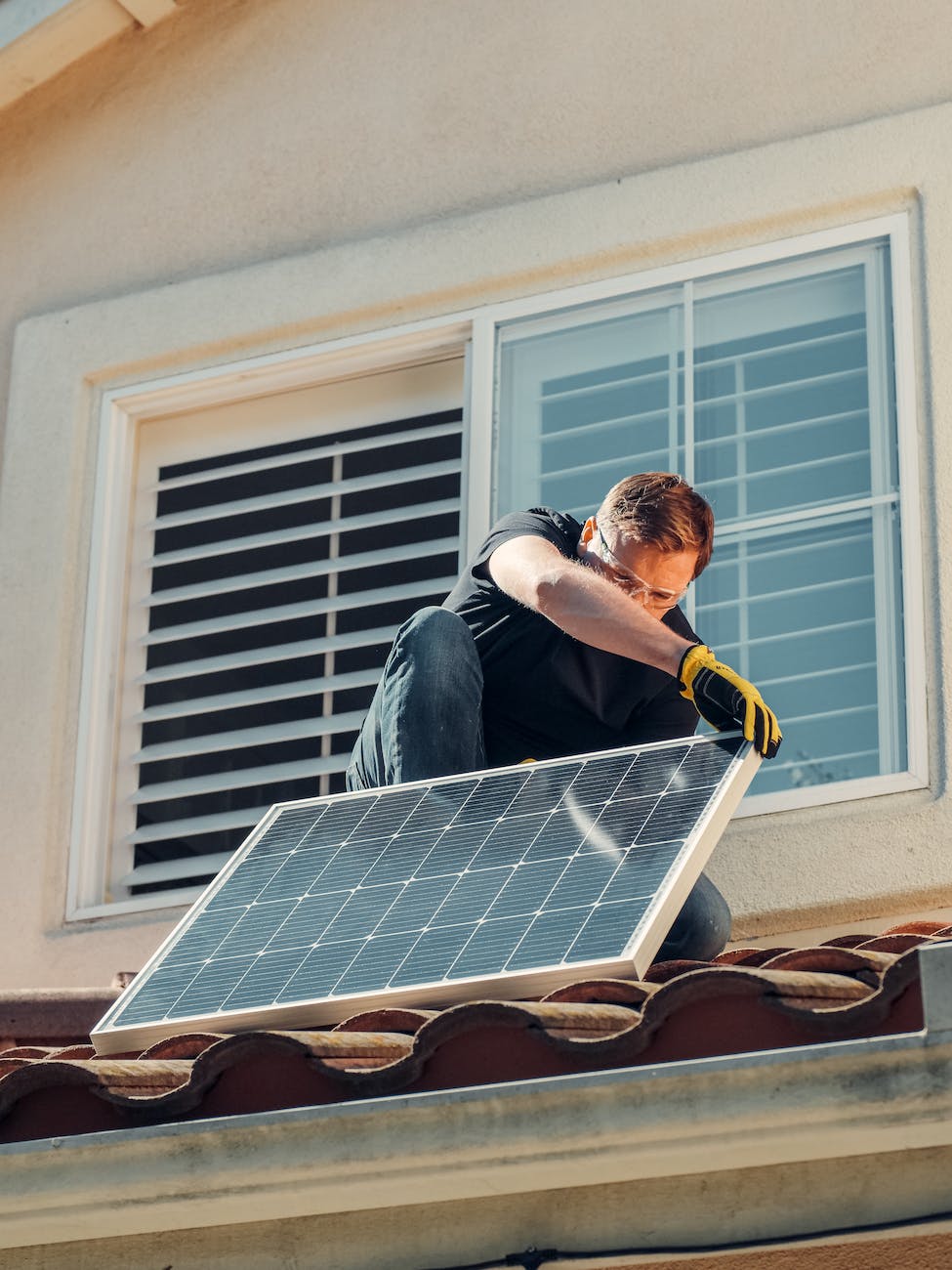
In an attempt to stay true to its motto — “A Unique Village in a Natural Setting” — Kildeer is one of the few Illinois municipalities that bans roof-mounted solar panels from residential buildings.
The reason? Village leaders think they’re ugly…
Residents may install only the generally pricier version of solar energy collection: integrated solar roofs, which are made of solar shingles that blend into a home’s appearance…
Restrictions on solar-power equipment to certain materials and designs is not unusual for the village, said Chief Village Officer Michael Talbett. The municipality already restricts building materials based on quality and aesthetic concerns, he said. For instance, the village does not permit vinyl siding on its homes…
Golf, a small Cook County community just north of Morton Grove, has a moratorium in place on solar development while it finds “the best fit” for its community, village administrator Michelle Shapiro said.
It sounds like property values are the primary concern here. If certain materials are used on a house in a neighborhood or community with more expensive houses, some fear a threat to values and neighborhood continuity. Americans like to talk about the rights of individual property owners but also are very willing at times to regulate property owners to counter perceived threats and interactions with neighbors (think HOAs, local regulations, etc.)
Do solar panels on the roof mar a house or do they indicate a certain class status? Or, as the article indicates, there are higher-end solar panel options that would satisfy those with aesthetic concerns.
Hagen sees a persistent “undertow of people wanting contrast, a dark roof with light siding”—the prevailing fashion. I suspect we can blame anxiety over property values; call it Zillow syndrome. With inflated home prices composing larger shares of owners’ net worth, who wants to take a chance? This is the sort of thinking that has supported water-sucking green lawns in places like Arizona, not to mention racist exclusionary covenants across the country.
The roofing industry itself encourages it. The website of Apple Roofing, which has offices from Florida to South Dakota, credited dark shades with “significantly improving curb appeal.” (Sometime after I spoke with an executive there, this reference was removed.) Its blog argues that the choice between dark and light shingles “should really be about your color preference and curb-appeal over cooling costs … You can rest easy knowing proper ventilation and insulation will ensure the color has no effect on heating costs!” For roofers and manufacturers, such reassurances represent the path of least resistance—or, less graciously, pandering to consumers. And, because light shingles generally cost more to produce (the rock granules embedded in the asphalt base need an extra kiln-fired coating), dark shingles let companies charge higher margins or offer customers lower prices.
But, this prevailing fashion comes with downsides:
All this despite the fact that light shingles tend to last longer than dark ones; they stretch, contract, and crack less in the heat. Factor in energy costs and they’re a bargain: A study by Lawrence Berkeley National Laboratory found that white roofs cost considerably less over their lifetime than both black and sustainability-flaunting grassy “green roofs,” which have other environmental benefits but cost more to install and, contrary to popular belief, don’t do much to counter global warming. Researchers at Australia’s University of New South Wales, another hotbed of cool-roof research, determined that such roofs reduced indoor temperatures by up to 7 degrees Fahrenheit.
This can save lives as well as pocketbooks: Researchers found that living on the top floor under a black roof was “a major risk factor in mortality” in Chicago’s July 1995 heat wave. Cooler roofs and whiter walls may explain why fewer people die in heat waves in Greece and North Africa than in France, Russia, and other countries to the north; all that whitewash isn’t just for scenic effect.
Where are the home roofing influencers who can tilt roofing fashion in a different direction? I say this partly in jest, but the piece goes on to briefly discuss the limited involvement of governments in regulating cool roofs for residences.
The fashion for roofs will probably change at some point; home styles come and go based on a variety of factors. If it can be tilted in a direction that helps limit energy bills, limits indoor overheating, and generally is positive for the environment, this could be helpful.
The trick here might be to link cooling roofing to property values. Homeowners are very interested in increasing their property values. Having the correct style helps but style is not everything. Do cooler roofing options provide a better return on investment in the long-run? Wouldn’t not replacing a roof as often be a good thing? When do green options for homes become a very important factor in deciding property values?
In thinking of houses in light of both recent tornado activity in the Chicago area and reading the book The World Without Us, I was reminded of the importance of the roof for a building. Here is how author Alan Weisman puts it when discussing an abandoned home:
The resin in your cost-conscious choice of a woodchip roof, a waterproof goo of formaldehyde and phenol polymer, was also applied along the board’s exposed edges, but it fails anyway because moisture enters around the nails. Soon they’re rusting, and their grip begins to loosen. That presently leads not only to interior leaks, but to structural mayhem. Besides underlying the roofing, the wooden sheathing secures trusses to each other. The trusses – premanufactured braces held together with metal connection plates – are there to keep the roof from splaying. But when the sheathing goes, structural integrity goes with it.
As gravity increases tension on the trusses, the 1/4-inch pins securing their now-rusting connector plates pull free from the wet wood, which now sports a fuzzy coating of greenish mold. Beneath the mold, threadlike filaments called hyphae are secreting enzymes that break cellulose and lingin down into fungi food. The same thing is happening to the floors inside. When the heat went off, pipes burst if you lived where it freezes, and rain is blowing in where windows have cracked from bird collisions and the stress of sagging walls. Even where the glass is still intact, rain and snow mysteriously, inexorably work their way under sills. As the wood continues to rot, trusses start to collapse against each other. Eventually the walls lean to one side, and finally the roof falls in. That bard roof with the 18-by-18-inch hole was likely gone inside of 10 years. Your house’s lasts maybe 50 years; 100, tops. (19)
The roof helps connect all of the walls and hold the house together and it also serves to keep the elements out from above. Once a hole begins and air, sun, rain, snow, and creatures can get in through the roof, it is just a matter of time before it all starts falling apart. Without a functioning roof, a house may not last long.
Granted, the scenario above discusses when homes are abandoned, an unlikely outcome in many communities. At the same time, this provides a reminder of the need to stay vigilant about roofs. For many homeowners, this is not an easy task: it might be hard to view all of the roof from the ground or from inside the house, accessing the roof might be difficult, and not everyone regularly looks at the underside of the roof depending on the layout of the home and the access.
So when people complain about the build quality of homes or McMansions, I wonder how much they consider the roof. If a mass produced McMansion truly is inferior in quality, would the roof go first or the siding or the walls or the foundation or something else? All could be problematic for the longevity of a home but the roof in particular presents important problems.
In a move that’s a first for the GTA, Canada’s largest suburb and its sixth largest city will soon charge home owners and businesses for storm water costs based on how much of their property is covered. If you have a very small house that causes little run-off water, you will pay nothing. But if your home is in the highest of five size categories, it will cost $170 in 2016 for your share of the city’s storm-water management costs. It’s an approach that Toronto is also looking at ahead of its 2016 budget process, according to a city spokesperson…
Councillor George Carlson, council’s resident environmentalist, has championed the innovative approach since it was first examined in 2011. He recognizes the impact of climate change, but said development trends are also at the root of the problem. “You can’t use pipes the size of Dixie straws when we need massive concrete culverts,” he said after the meeting. “There were streets in Mississauga that looked like Venice in July of 2013 (when a major storm event wreaked havoc across the GTA).”
“But look at all the asphalt and parking lots and McMansions in this city. All of that covered land is sending more and more run-off water into pipes that were probably already too small. I can see the king and queen needing to live in a castle, but does every third person have to?”…
Charges to businesses will be based on a formula that measures the total covered amount of space, but they will be able to save up to 50 per cent of their fee by putting in measures such as catchment basins and permeable material to prevent storm run-off.
It will be interesting to see how this works out. The Councillor quoted above said he thinks this could have an impact on building sizes down the road. Communities with lots of sprawling development often have water problems and solutions range from permeable pavement to green roofs to taxes like these. But, many of these solutions are after the fact which can get quite costly (just see the massive Deep Tunnel project in the Chicago area).
If the real estate pressure is there to build McMansions, I wonder if there are ways around such a fee. (To be honest, $170 a year doesn’t sound like much for the types who buy McMansions.) What if people built underground to get extra space and to minimize the roof size (a la the luxury underground facilities in London)? Presumably there are height restrictions in the community that would limit building up.
McMansions are often known for their multiple gables. These add more volume and angles to the roofline. They are typically not necessary so are considered gauche for simply trying to impress.
Yo Dawg, or Sup Dawg, is an image macro series based on portrait shots of American hip hop artist Alvin Nathaniel Joiner, better known by his stage name Xzibit, and humorous captions that are composed around the recursive phrasal template “Yo Dawg, I herd you like (noun X), so I put an (noun X) in your (noun Y) so you can (verb Z) while you (verb Z).” Since rising to popularity in early 2007, the series has been considered one of the most well-known and longest lasting examples of recursive humor on the Internet…
While Xzibit initially began his career in the entertainment industry as a rapper from Los Angeles, his mainstream breakthrough came almost a decade later as the host of the MTV show Pimp My Ride, which ran for six seasons from 2004 to 2007. In the show, Xzibit gained a reputation for adding luxurious amenities and equipments like fish tanks, clothes dryers and fireplaces into the participant’s car, presumably without consent.
So if Xzibit is known for a show featuring consumption, the connection to McMansions makes some sense.
Where it gets tricky for a McMansion is that green roofs tend to lend themselves to shallower gradients, not to 20deg-30deg pitches. We’ll assume for now that a McMansion roof structure [typically prefabricated timber trusses] has enough load capacity to bear a fully soaked green roof.
Here’s how it could potentially be done;
1. Remove the existing cladding – whether it be concrete tiles or metal decking. Metal decking could remain if the load isn’t too much. Replace with marine ply board;
2. Add the requisite layers of waterproofing, drainage cell, insulation and geotextile;
3. Add the perimeter angles to hold the soil/planting [sounds like it could be a tricky detail, but it is possible];
4. Add the soil profile and planting. For this one there are various methods available – I didn’t have any luck sourcing Australian examples/products so the US it is. There are proprietary soil stabilisation products available for steeper slopes with in-situ planting, or there is planting in plastic trays or even mats which come ready-established.
I agree with the final assessment of the post: I’ve not seen this proposal before. How much might it cost to retrofit the roof of an existing large home? It seems like the easiest way to make this happen would be to change buildings codes to require greener roofs and then the cost simply becomes part of the new home.
With more interest in greener dwellings (tiny houses, net zero energy homes, passive homes, etc.) plus the negative connotations of owning a McMansion or larger homes, I suspect more of these homes will be constructed with green features. However, I continue to wonder: will a large home with some green features, like a green roof, be considered green enough?





 Legally Sociable