Another danger of at-grade RR crossings: bike crashes

One at-grade railroad crossing in Knoxville, Tennessee illustrates the danger such crossings can present to bicyclists:

As many riders know from painful experience, crossing rails embedded in the street is a treacherous undertaking on a bike. There are at least 100,000 at-grade rail crossings in the U.S., not counting city trams and streetcars (which are also notorious for taking down cyclists). But it’s tough to gather data on how many crashes they cause because so few are communicated to the authorities. “The work I looked at, we saw people getting hauled off on ambulances and other things, but very, very few police crash reports,” says Cherry. “There’s a lot of rail infrastructure throughout Tennessee, and I can only imagine how many unreported crashes are occurring statewide or even nationwide.”

That’s part of what motivated Cherry and company to conduct what they call the nation’s first “empirical analysis of rail-grade crossings and single-bicycle crashes.” To them, the problem wasn’t with the cyclists. It was with the roadway design and the fact nobody knows, scientifically speaking, the best way to bike over railroad tracks….

Most experienced riders know the ideal way to do it: As the folks at Bicycling say, cross at a 90-degree angle. That’s the “gold standard” many infrastructure designers strive for. But in cases when the crossing has gaps running in different directions, it might be best to pedal through at 45 degrees. Of course, all this is more complicated when metal tracks are wet, a situation that can turn even a savvy cyclist into a hollering missile directed fast into the pavement…

After pondering a 90-degree crossing that would cost $200,000, partly due to the route being near a river and needing retaining walls, the city and the railroad company settled on a cheaper, roughly 60-degree “jughandle” detour on the side of the street where people were tumbling into traffic. “The total cost was $5,000 for all of that, which is unbelievable, really,” Cherry says. “This has been years in the making, with probably hundreds of crashes there, and it took $5,000 worth of in-house crew time and materials.” (The city later made the path on the other side, located on a greenway, angled to about 60 degrees.)

In addition to bicycles, at-grade crossings are notoriously dangerous for cars and pedestrians. All would do well to pay extra attention when crossing these, even if they are familiar or rarely involve trains. For example, there are several crossings I can think of within a ten mile radius that involve either extra bumpiness, steep approaches, or multiple train lines crossed at once.

While the solution above for bicyclists seems pretty simple, the long-term goal of reducing the number of such crossings is an expensive proposition. It is costly to build bridges and underpasses since in addition to the typical costs of building a bridge or underpass, a solution requires using more land (I recall a proposal to build an overpass in downtown Wheaton that would have obliterated a good portion of the downtown just to provide the necessary ramps) and it can be expensive to construct something while still allowing traffic through (even if roads are closed, trains have a much harder time finding alternative routes).
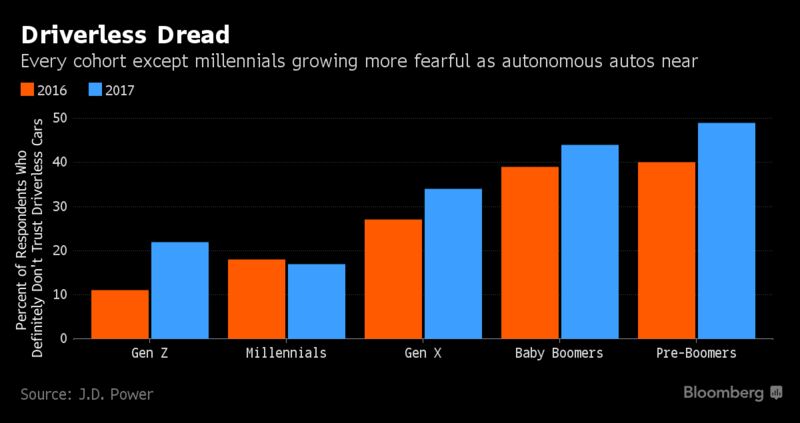
Americans fearful of driverless cars

Recent surveys suggest a majority of Americans don’t want to hand over their steering wheels yet:

Autonomous autos are advancing so rapidly that companies like Uber Technologies Inc. and Alphabet Inc.’s Waymo are beginning to offer robot rides to everyday consumers. But it turns out the traveling public may not be ready. A recent survey by the American Automobile Association found that more than three-quarters of Americans are afraid to ride in a self-driving car. And it’s not just Baby Boomers growing increasingly fearful of giving up the wheel to a computer, a J.D. Power study shows — it’s almost every generation.

Consumers will only become comfortable with driverless cars after they ride in them, Mary Barra, the chief executive officer of General Motors Co., said this week. The largest U.S. automaker is testing 180 self-driving Chevrolet Bolts and ultimately plans to put them in ride-hailing fleets, though it won’t say when…

Dangerous as it may be to operate cars themselves, many drivers are anxious about autonomous technology because they associate it with the fragility of electronic devices. Laptops crash and calls drop with nagging regularity. The consequence of a computerized car crash is much greater.

Americans tend to like technology: we like progress and new and exciting options. Is the fear related to safety or also connected to how Americans view driving (despite all the hours spent commuting and stuck in traffic, Americans like the freedom it offers)?

I’m guessing this fear will drop within a few years as stories of mishaps become normal (and even the occasional mishap would be safer in the long run compared to the tens of thousands of Americans killed each year in vehicles) and the technology improves. Could we also imagine a scenario where governments impose self-driving vehicles because of their improved safety?

Ride the bus for a safer transit experience

A recent study of bus travel in Montreal suggests that it is a much safer experience compared to driving:

By perusing police reports from 2001 to 2010, they found motorists on these routes had more than three times the injury rate of bus passengers. Buses were also safer for people sharing the road. Cars were responsible for 95 percent of pedestrian and 96 percent of cyclist injuries on these arteries, they write in a presentation for this month’s meeting of the Transportation Research Board.

During the same time period in Montreal, nobody was killed while riding the bus, though 668 people were injured. (It’s unknown if that number includes bus operators, who are powerful magnets for abuse.) Meanwhile, auto occupants suffered 19 deaths and 10,892 injuries. Cars were linked to 42 pedestrian and three cyclist deaths, while buses were linked to four and zero, respectively…

In the United States car occupants have a fatality rate 23 times greater than bus passengers, while it’s respectively 11 and 10 times higher in Australia and Europe. They suggest getting more people on public transit could make a large impact on public health.

In terms of public health, the safety argument is compelling: without having to go all the way to self-driving vehicles for all, buses could be an important tool in reducing deaths. Yet, I’ve discussed before that I don’t think many middle- to upper-class Americans would choose to travel by bus in denser areas if they can afford to drive. I don’t know if the safety argument could overcome either (1) the stereotypes of riding the bus and (2) the inconvenience of the bus schedule as opposed to driving a car.

Perhaps what we need is for a city or two to experiment with a public campaign to boost bus membership with a safety campaign. Would residents find it compelling?

Reducing trespassing on railroad tracks

Experts from several areas are working to limit the number of people on railroad tracks:

Trespassing numbers have remained fairly steady over the years and now account for about 72 percent of all railroad-related deaths, with 761 fatalities in 2015, including 296 suicides.

Safety experts are now focused on finding ways to cut trespassing through education, intervention and barriers such as fencing at popular trespassing spots. But advocates concede it won’t be easy — there are 140,000 miles of railroad track in the United States, and it is impossible to contain it all.

“Trespassing has been more of a stubborn problem for us,” said Bonnie Murphy, president and CEO of Operation Lifesaver, a national train safety organization, who spoke along with other safety experts at the biennial DuPage Railroad Safety Council conference last week. “There’s a disturbing, ongoing trend of people walking along the tracks.”

This is an important safety issue. But, it raises a larger question: while the lines are technically private property, how do you realistically keep people off of them when they crisscross all parts of America at ground level? Railroads rejected the idea long ago that fences should be built along the thousands of miles of lines. There is no mention in this article of enforcing trespassing but I assume this would require a significant amount of resources. Cameras at important locations? Warning signs at regular intervals along the lines? Trains using a more effective warning signal of their arrival (think of a targeted rumbling option from a longer distance)? More effort at moving rail traffic away from major population centers (such as going around major metropolitan regions when possible)?

Railroads can be incredible at moving freight and people long distances. However, they don’t interact well with pedestrians.

Exploring why Americans think their children are at such risk

Virginia Postrel summarizes a recent study looking at how Americans perceive the safety of children:

The researchers suspected that overestimating risk reflects moral convictions about proper parenting. To separate the two instincts, they created a series of surveys asking participants to rate the danger to children left alone in five specific circumstances: a 2 1/2 -year-old at home for 20 minutes eating a snack and watching “Frozen,” for instance, or a 6-year-old in a park about a mile from her house for 25 minutes. The reasons for the parent’s absence were varied randomly. It could be unintentional, for work, to volunteer for charity, to relax or to meet an illicit lover.

Because the child’s situation was exactly the same in all the intentional cases, the risks should also be identical. (Asked what the dangers might be, participants listed the same ones in all circumstances, with a stranger harming the child the most common, followed by an accident.) The unintentional case might be slightly more dangerous, because parents wouldn’t have a chance to make provisions for their absence such as giving the child a phone and emergency instructions or parking the car in the shade.

But survey respondents didn’t see things this way at all. “A mother’s unintentional absence was seen as safer for the child than a mother’s intentional absence for any reason, and a mother’s work-related absence was seen as more dangerous than an unintentional absence, but less dangerous than if the mother left to pursue an illicit sexual affair,” they write. The same was true for fathers, except that respondents rated leaving for work as posing no greater danger than leaving unintentionally. Moral disapproval informed beliefs about risks…

“People don’t only think that leaving children alone is dangerous and therefore immoral,” the researchers write. “They also think it is immoral and therefore dangerous. That is, people overestimate the actual danger to children who are left alone by their parents, in order to better support or justify their moral condemnation of parents who do so.”

This reminds me of the trolley problem. While it doesn’t deal with risk, it hints at how morality is involved in assessing situations. Good parenting today includes avoiding intentional absences (and even these can be ranked). Leaving a child for unintentional reasons is not so bad. Both are of equal risk – just as saving five lives in the trolley problem regardless of how it is accomplished – but not viewed the same.

Generally, we have difficulty these days estimating risk. Are we more in danger from a possible terrorist attack (limited risk) or getting into a car (one of the riskiest daily behaviors)? We don’t always assess situations rationally nor do we have all the information at our fingertips. I don’t know that the answer is to suggest we should be more rational all the time: this is difficult to do and may not even be desirable. In this particular case, it might be more prudent to explore where these ideas of morality come from and then work to alter those. Alas, this is also likely a lengthy task.


Embedding traffic lights in sidewalks to help pedestrians

Incessant smartphone use is leading to urban adaptations:

That is why officials in the city of Augsburg became concerned when they noticed a new phenomenon: Pedestrians were so busy looking at their smartphones that they were ignoring traffic lights.

The city has attempted to solve that problem by installing new traffic lights embedded in the pavement — so that pedestrians constantly looking down at their phones won’t miss them.

“It creates a whole new level of attention,” city spokeswoman Stephanie Lermen was quoted as saying. Lermen thinks the money is wisely spent: A recent survey conducted in several European cities, including Berlin, found that almost 20 percent of pedestrians were distracted by their smartphones. Younger people are most likely to risk their safety for a quick look at their Facebook profiles or WhatsApp messages, the survey found…

But city officials say their work is justified: The idea to install such traffic lights came after a 15-year-old girl was killed by a tram. According to police reports, she was distracted by her smartphone as she crossed the tracks.

The direction of change is with the smartphone users: their safety matters and urban planners and officials must adjust.

I assume the future self-driving cars will be able to communicate with smartphones (or whatever devices we are all sporting at that point) to protect cars from the pedestrians. At that point, the cars will be far safer than the zombie or distracted or unpredictable activity of any pedestrian.

Removing ineffective “Children at Play” signs in Naperville

Naperville is removing “Children at Play” signs that have stood along roads for decades:

City crews are preparing this month to take down all 400 of the signs featuring a black silhouette of a child about to dart into traffic, said Jennifer Louden, deputy director of Naperville’s transportation, engineering and development department. Where appropriate, they will be replaced with signs that read “Neighborhood Speed Limit 25.”

“A lot of the ‘Children at Play’ signs were so prominent back in the ’80s,” Louden said. “They’re in almost any neighborhood in Naperville.”

But transportation standards have changed, she said, citing reports that the signs could give parents and children a false sense of security, don’t provide a safe driving speed and are unenforceable…

Zegeer said he recommends towns install new speed limit signs that are accompanied by speed bumps, strategic street painting or a number of other traffic calming measures.

I’m guessing there will be some negative reactions to this move as the signs seem to make sense: drivers will see a sign that kids might be playing nearby and they will slow down. Yet, that is not what the research finds. Drivers don’t respond much to such signs. Road signs in general might not be terribly effective as there is a lot for drivers to take in. As noted above, design and “traffic calming measures” can be much more effective in slowing drivers. You can’t exactly blow past a speed bump the same way you can ignore a road sign.

Thinking more broadly, this hints at one of the common downsides of suburban neighborhoods. On one hand, they are often viewed as preferable for children: bigger spaces, more green space, no noxious land uses nearby. On the other hand, the spatial design of suburbs regularly emphasize driving over the safety of pedestrians. Those bigger yards contain houses that emphasize the garage and driveway and feed unto wide streets where drivers try to operate as efficiently as possible (meaning they want to go as fast as they can).

The furor over traffic fatalities – in the early 1900s

With talk about the first Google self-driving car crash, one writer reminds us of earlier discussions about cars and accidents:

There’s some precedent for all this, of course. It’s not as though the car as we know it today was thwarted by human deaths. The first recorded traffic fatality in the United States occurred in 1899, in New York City, when a man stepping off a trolley was struck by a taxi.

The three decades that followed were chaotic and deadly. Scholars and justices debated whether the automobile was, perhaps, inherently evil. By the 1920s, cars were causing so many deaths that people in cities like New York and Detroit began throwing parades in an attempt to underscore the need for traffic safety. Tow trucks would haul smashed, totaled vehicles along the course of the parade. From The Detroit News:

“Some wrecks featured mannequin drivers dressed as Satan and bloody corpses as passengers. Children crippled from accidents rode in the back of open cars waving to other children watching from sidewalks. Washington, D.C., and New York City held parades including 10,000 children dressed as ghosts, representing each a death that year. They were followed by grieving young mothers who wore white or gold stars to indicate they’d lost a child.”

Eventually, traffic laws and other safety features—stop lights, brightly painted lanes, speed limits—were standardized. And car-safety technology improved, too. Vehicles got shatterproof windshields, turn signals, parking brakes, and eventually seat belts and airbags. In 1970, about 60,000 people died each year on American roads. By 2013, the number of annual traffic fatalities had been cut almost in half.

I am usually amazed when I look back at historical and sociological work about the major changes in society due to and in response to the car. Even with all the safety implications – tens of thousands of deaths each year – Americans went all in for the car, changing our streets, residential patterns, leisure activities, homes, and numerous other areas.

There are also some similarities with the advent of railroad technology in the mid-1800s where it took some time to develop reliable safety devices. In Forging Industrial Policy, sociologist Frank Dobbin describes the multitude of safety issues in Britain where railroads were allowed a lot of latitude until too many people were dying.

Rumbler emergency siren to shake your vehicle

Milwaukee police are trying out a new kind of siren:

It’s a siren you don’t just see, and hear, you actually feel it. It’s called the Rumbler and it’s expanding on a police force near you. It’s a siren that emits a low frequency sound that vibrates your car. It goes through the material of the vehicle, the frame, and seats. The subwoofer is located inside the grill of the car. Milwaukee K-9 Police Officer, Jeff Lepianka says the department has been adding the sirens over the last few years to battle distracted driving.

Lepianka says, “Drivers will have their ear buds in, be on their cell phone. This siren will break through this and get the people to pull over so I can get to where we need to go.”…

“With the Rumbler going people 10 to 15 car lengths are already getting to the side.”

Those precious minutes saved, could save lives.

In the name of safety and combating distracted driving, perhaps this is the wave of the future. This possible technology prompts two thoughts:

  1. This reminds me of the use of high-frequency sound devices used to chase away teenagers. Since adults lose the ability to hear such frequencies as they age, it can be particularly effective in targeting loitering youngsters.
  2. When we eventually all have self-driving cars, it would be easy to automatically pull all vehicles aside to allow emergency vehicles through. This could certainly help decrease response times but it would certainly be odd – at least the first time or two – to be automatically sidelined.

The article suggests pulling over is often delayed because of distracted driving but I wonder if this is also the case even when the drivers aren’t engaged in other activities. Have driving norms changed? At what distance are drivers supposed to pull over? I’ve noticed that fewer emergency sirens use their sirens and it is not always easy to see flashing lights.

Trading the large yard and dining room for interior play spaces

Home buyers with young kids are looking for houses with certain kinds of spaces:

The biggest requirements for families with children, according to the National Association of Realtors, is what you’d expect: 62% of those with kids 18 and under say the quality of the neighborhood is important, while 50% are looking for a good school district and 49% want the home to be convenient to their jobs. Fewer said that lot size or proximity to parks and recreational facilities were a factor in choosing a home. The statistics come from the group’s 2015 Profile of Home Buyers and Sellers report.

Yet once those top-level needs are met, families start to make more detail-level compromises. And being able to visualize a place for the kids to corral their stuff and play has become a priority, according to Blackwelder and others…

But in the Kansas City area, too, an indoor play area is a priority, Hines said, since parents want a separate space to keep toys from flooding the kitchen and family areas. “The volume of toys we have is much higher [than in generations past],” she observed…

Retailers are also suggesting the dual-use room as a trend. On the website for Land of Nod, a Chicago-based retailer of children’s furniture and products, there are tips on how to create a formal dining room and playroom in one.

How Americans choose and use their homes is often influenced by larger social forces. Based on this article, here are some of the larger forces at work:

  1. A move away from formality. Americans have often been said to be casual and informal people and this removes one of the more formal rooms of the house (along with the living room).
  2. An ongoing interest in private space. Play for children here is confined more to settings that are easier to control and within quick sight and sound of parents.
  3. The need for increased safety for children also contributes as kids are not only in private spaces but are also still within the home where others cannot reach them.
  4. A greater emphasis on the needs of children as opposed to other members of the family. Perhaps every child should now have a dedicated play room and parents should have no spaces off-limits to kids. (Think of the formal parlor of past decades where children were banned or very infrequent guests.)

Will the dining room completely disappear in the trend toward great rooms and open living spaces? Probably not, particularly if there are some easy solutions to split the use of the space between more formal dining and play areas. Yet, if fewer people have formal gatherings, perhaps the dining room will become a luxury item in homes with the extra space or for those who desire such segmentation.