When many people in the United States prepare a turkey today, do they get the turkey ready to cook alone or with other people? How about when carving the turkey?
How many people gather around the turkey preparing it to go into the oven or onto the grill or into a fryer? Or is this more commonly a solo activity?
It might be different for the carving. Does this take place at the table or off in the kitchen? Does just one person get to wield the tools to carve the turkey?
Gathering for the meal is more communal. Thanksgiving is pitched as a family holiday. Does that familial interaction extend to the food preparation? Is it different for the turkey compared to other food items on the Thanksgiving table?
The ring of the doorbell when you’re not expecting anyone is, at the least, odd. Above all in big cities, where distances between homes can be long and the act of going to see someone implies a certain amount of preparation to traverse the town. In far-flung neighborhoods, the chance that someone was merely in the area is low and the sound of someone at the door is more commonly tied to the arrival of a delivery person or a letter carrier. Unexpected visits are getting less common, be they from friends, family members or neighbors who show up unannounced with the aim of having a little chat.
Such encounters happen often in small urban centers and rural areas where neighbors don’t just share walls, but also, in a certain way, their free time. A lack of new residents can lead to deeper personal relationships with one’s existing neighbors that aren’t limited to a simple “hello” and “goodbye,” as they are in larger-sized cities. In contrast, social relationships that develop in the neighborhoods of major metropolises, particularly those groupings of persons who are tied together by nothing more than the simple fact that they share space, are in danger of extinction. Such are the claims of some neighborhood associations that are bearing witness to a massive exodus of local populations, supplanted by temporary neighbors, inhabitants of tourist apartments in which they rent rooms or the entire apartment and spend a short amount of time in the city. Rent increases that have taken place in recent years, added to the impossibility of saving up enough to buy one’s own home, are transforming the urban social balance.
As the article suggests, this is a massive shift from much of human history where people lived in smaller communities and tended to have closer ties with people around them. Today, we are more used to choice in selecting our relationships. Still, we encounter people we do not know regularly, whether that is looking at them from our moving vehicle or in a store or at a public event.
What if the future looks like a Black Mirror episode where people do not have to interact with anyone they do not want to? Or could technology provide us information about people as we pass near them?
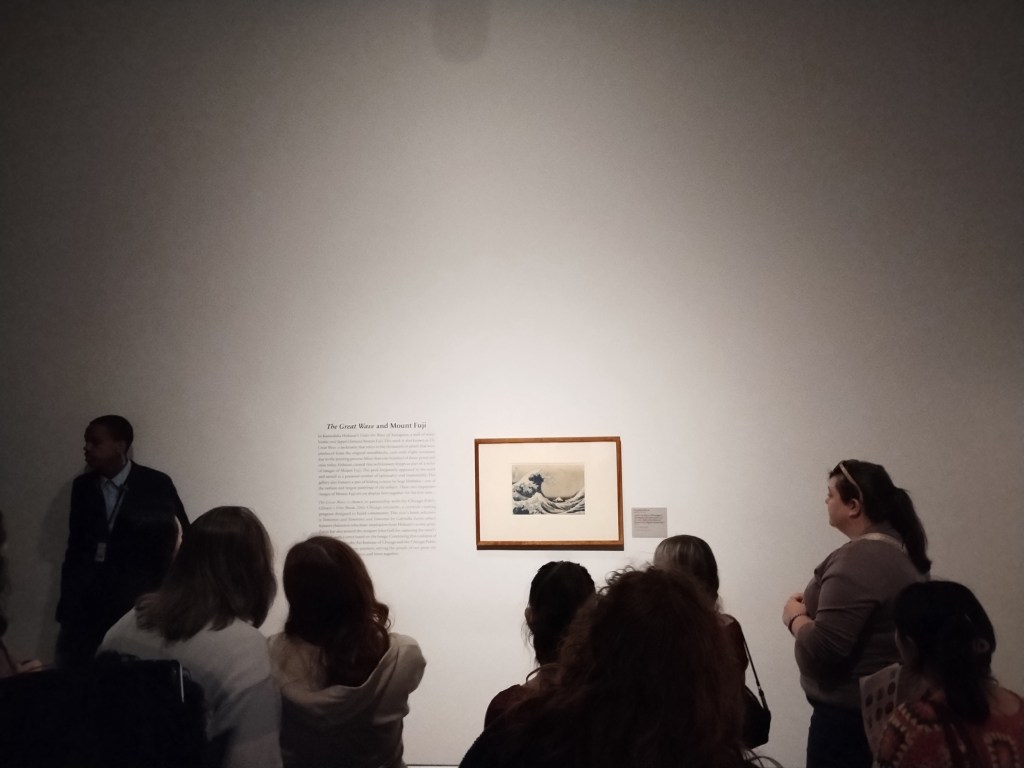
But it was also notable the setting in which the print is displayed. The Ando Gallery is unique; hear the audio tour experience here. The room has darker lighting and there is a high ceiling. The print is on a long wall to the back left from the entrance.
Because the print it smaller and the gallery has space, here is what the scene looks like:
On the day I was there, the print had a small crowd around it as people took in the work and the text on the wall. I was reminded of the gallery of The Louvre with the Mona Lisa where a large crowd presses to see what is a smaller painting. In both places, the work and its status attracts crowds.
This is a different experience compared to other common settings. First, large paintings – like A Sunday on La Grande Jatte at the Art Institute – can attract crowds. However, the size of the painting means many people can still see the whole thing even when there are numerous people around. Second, numerous works in art museums have few or no people looking at them. Even on busy days, one can find quiet rooms where there are no crowds and an observer can take it all in on their own.
Even as we might interact with art as individuals regularly, whether in museums or in books or elsewhere, this also serves as a reminder that we often do it in interaction with others. The small crowd around The Great Wave were quiet, even reverent, as each person or group took it in. But they could not ignore that many others were also right there having their own experience.
If you’ve been feeling depleted and disconnected from a world of diminished meaningful in-person interactions, “Join or Die” explores one reason why, as laid out by social scientist Robert Putnam. Collectively, we’re less involved in organized gatherings. There are all kinds of reasons for that, but it’s a fundamental shift that’s affected our quality of life, because the social bonds that result when you join a club or organization are not just a matter of “warm, cuddly feelings,” Putnam says in the film. “In area after area of our community life, our communities don’t work as well when we’re not connected.” And that, he says, has far-reaching effects not only on us as individuals, but on democracy itself…
Putnam’s thesis is that communal activities build social ties, which have value beyond the immediate satisfaction of just doing things together. It creates a sense of mutual obligation.
I was thinking about some of these ideas as I was reading an article in the Chicago Reader about dog owners letting their pets run off-leash in city parks. Technically it’s not allowed and the practice can be controversial, but the story focused on an aspect I hadn’t considered: “While proximity and green space may have motivated people to start utilizing unofficial areas, the community that forms within is what keeps them coming back.”
This is more or less Putnam’s theory come to life. According to the story, because of the “community-oriented and unregulated nature of the unofficial dog parks, their patrons feel that they look out for each other’s dogs more than people do when at an official (dog-friendly area). The sentiment that ‘we all look out for one another’ was repeated more times than I could count, whether in the context of cleaning up after dogs, calling dogs that run outside the gates and/or begin to wander off and explore new scents, or maintaining space for other park patrons.”…
Putnam says TV is one of the reasons we’re fractured. He calls it “lethal for social connectedness — basically we’re now watching ‘Friends’ instead of having friends.” But I think it goes even deeper. The kind of stories we see on TV reinforce many of the factors he’s citing. Instead of stories rooted in the idea that life is a group project, we’re fed the message that fixing or changing anything is, as Putnam put it, “the business of somebody else” — and on screen that’s usually the police or superheroes, rather than regular people working together to solve problems.
Another way to think about it is that there are collective and individual benefits to joining a club: it can help one’s well-being and improve social connections. At the same time, the social relationships and social networks formed can help tighten bonds and communities.
In contrast, other common activities may not do the same things. Online or social media activity can bring people together – but it can also lead to atomization and relationships that work differently when not regularly conducted in-person. Television tends to be a more solo activity or occurs with a small group, even as mass media has the potential to bring people together to some degree (common experiences, etc.).
I am curious to hear more about the actual in-person component of joining a club and how much this matters for building social capital. As Randall Collins explains in Interaction Ritual Chains, unique things happen when humans are in physical proximity.
The idea of Starbucks as a third place became part of its corporate mythology. Starbucks aimed to create a welcoming environment for coffee drinkers and employees with comfortable seating, jazz music and the aroma of freshly-brewed coffee. Employees who brewed and served Starbucks coffee, whom Starbucks called baristas, handwrote customers’ names on their drink orders…
Mobile app and drive-thru orders make up more than 70% of Starbucks’ sales at its approximately 9,500 company-operated stores in the United States. In some stores, customers complained online that Starbucks pulled out comfortable chairs and replaced them with hard wooden stools. Starbucks has also built pickup-only stores without seating. Machines that print customers’ names have replaced baristas’ handwriting on cups.
“Third place is a broader definition,” current Starbucks CEO Laxman Narasimhan said last year. The “classic definition of third place — it’s a box where I go to meet someone — it’s frankly not relevant anymore in this context.”…
Starbucks’ changes to its sit-down business model came in response to several trends — demand from customers for ordering coffee from their cars in drive-thru lanes or on their smartphones. The shift from a business serving hot coffee to one in which cold coffees, teas and lemonades make up more than half of sales. The Covid-19 pandemic, which forced cafes to shut indoor seating.
Starbucks shifted to meet Wall Street’s demands, too. Starbucks found it could reduce labor costs and increase order volume by running a mostly drive-thru and take-away coffee business. Starbucks also found difficulties with being America’s third place and did not want to become the public space and bathroom for everyone, including people coming into stores who were homeless or struggling with mental health challenges on city streets. Starbucks has closed some stores and restricted bathroom access over safety concerns.
The shifts make sense: more consumers want quick service and coffee to go, the company and shareholders want to make more money, and serving the public can be difficult.
But this is a different approach to coffee, food, and places more generally. Getting coffee to consumers as cheaply and quickly as possible and when and where they desire it treats place differently. Arguably, you might not even need a location any longer. Can we get Starbucks via drones or by drivers within ten minutes of an order? Why bother going to a location at all? Why not have a huge centralized Starbucks that sends out drinks at light speed in all directions?
The purpose of third places is less about consumption and more about social interaction and conversation. Yes, third places like cafes and pubs have food. But the food helps people talk and relax. All humans need to eat – and they also need social connections. Having a refresher in the car while driving – often a solo experience – is a different experience than sitting with friends for half an hour near other people.
Erin is one of millions, from teachers to therapists to managers to hairdressers, whose work relies on relationship. By some accounts, the U.S. is moving from a “thinking economy” to a “feeling economy,” as many deploy their emotional antennae to bear witness and reflect back what they understand so that clients, patients, and students feel seen. I’ve come to call this work “connective labor,” and the connections it forges matter. It can be profoundly meaningful for the people involved, and it has demonstrable effects: We know that doctor–patient relationships, for instance, are more effective than a daily aspirin to ward off heart attacks.
But this work is increasingly being subjected to new systems that try to render it more efficient, measurable, and reproducible. At best, firms implement these systems assuming that such interventions will not get in the way of workers and clients connecting. At worst, they ignore or dismiss those connections altogether. Even these complex interpersonal jobs are facing efforts to gather information and assessment data and to introduce technology. Moneyball has come for connective labor…
Connective labor is increasingly being subjected to new systems that try to make it more predictable, measurable, efficient—and reproducible. If we continue to prioritize efficiency over relationship, we degrade jobs that have the potential to forge profound meaning between people and, along the way, make them more susceptible to automation and A.I., creating a new kind of haves and have-nots: those divided by access to other people’s attention.
To quantify relationships could be difficult in itself. It requires attaching measurements to human connections. Some of these features are easier to capture than others. In today’s world, if a conversation or interaction or relationship happens without “proof,” is it real? This proof could come in many forms. A social media post. A digital picture taken. Activity recorded by a smart watch. An activity log written by hand or captured by a computer.
Then to scale relationships is another matter. A one to one connection multiplied dozens of time throughout a day or hundreds or thousands of times across a longer span presents other difficulties. How many relationships can one have? How much time should each interaction take? Are there regular metrics to meet? What if the relationship or interaction goes a less predictable direction, particularly when it might require more time and care?
Given what we can measure and track now and the scale of society today, the urge to measure relationships will likely continue. Whether people and employees push back more strongly against the quest to quantify and be efficient remains to be seen.
This story highlights an interesting gap in who knows their neighbors. Yet, this statistic is brought up so you can make sure you are not paying their utility bills. First, the statistic:
However, chatting to your neighbors is not as common as it used to be. A Pew Center study shows that fewer young Americans are familiar with their neighbors. Among adults under age 30, about a quarter (23%) claim to not know any of their neighbors, compared with 4% of those aged 65 and up.
Why might it be useful to know your neighbors?
That’s what happened to Brooke Patterson. She took to TikTok to explain how she realized that she had apparently been paying for her entire apartment building’s utility bills — for two years.
The gap cited above could be the result of multiple factors. People 65 and up might have lived in places longer. They had different social norms regarding neighborly interaction. They might not rely on technology as much in order to interact with people.
Is the primary goal to knowing your neighbors to save money? Or others might suggest your neighbors could help you look out for your property. Other primary goals for knowing your neighbors could include acting neighborly – looking out for each other, offering aid when helpful – and building community. That could come with cost savings down the road or even positive money if the character of the neighborhood helps boost property values. This might be another difference over time: what people hope to gain through social interaction.
Our bathrooms, bedrooms, kitchens, and dining rooms are places of great physical intimacy, and we often measure our closeness with others by the rooms we are willing to share with them. Close proximity also means vulnerability, and trust is an essential component of inhabiting common spaces and microbial environments. But our preferences are malleable. Both individualism and cooperation are learned traits; like muscles, the more we use them the stronger they become. Some of us just uncritically accept the private apartment or single-family home for ourselves because it is what our societies consider “normal.”
As noted above, imagining different housing possibilities is difficult because Americans are used to these options and what tends to be idealized. These options have been promoted for decades and backed with government funds and policies, ideologies, and preferences. To promote other options – like cohousing – requires a concerted and prolonged effort. Even calling such options “utopian” suggests it is unusual and perhaps unattainable.
This reminds me of the 2010 book In the Neighborhoodwhere Peter Lovenheim tries to get to know his neighbors, with the mark of success being able to stay overnight. It is one thing to say hi to a neighbor, it is another to regularly welcome them into your home.
Smith Mount, chair of the city council in Huntington, West Virginia, was determined to see her community launch the state’s initial outdoor drinking zone — an idea made possible only after the legislature changed the state’s alcohol law earlier this year…
Huntington leaders saw the district as a way to encourage economic growth by drawing more people to the heart of the city: The hope is that by allowing people to grab a drink and linger, they’ll spend more time and money downtown. Steps away from the banks of the Ohio River, the zone’s few square blocks include local restaurants, bars and shops…
In recent years, several states have relaxed alcohol consumption laws to allow communities to create their own limited drinking zones. They aim to revitalize downtown cores hollowed out by the changing nature of retail and the post-pandemic loss of office workers…
Aside from bringing foot traffic to shops and restaurants, officials say the success of the new districts reveals the need to update antiquated liquor laws that long banned public consumption in most places to try to reduce public intoxication and drunken driving. While some critics have raised concerns about the new districts’ potential to promote drinking, crime or littering, organizers across the country say they have largely been adopted without incident.
This has happened in a number of places in the last decade or so. The importance of business shows up here as alcohol is assumed to be a means by which people will buy and consume more. Alcohol by itself can help boost business as it can be profitable to sell and can then generate more local revenue through taxes. Alcohol plus walking and visiting other nearby locations offers additional benefits.
A side effect of this might be a larger social scene. If people are willing to be downtown and linger, there are more opportunities to interact with each other. While alcohol could lead to negative interactions, it could also lead to people willing to enjoy more time around others. The United States does not have a strong legacy of third places or public squares; could alcohol help turn downtowns into regular social scenes?
That’s why a group of researchers from Chile, Italy, Israel, Russia, Slovenia, and Spain recently collaborated to understand the mathematics behind “six degrees of separation.” They discovered that a natural human social challenge– weighing the costs versus benefits of social ties– may point toward the root of “the magic number six.”
Take a moment to think about why social networking is so coveted– in both work and recreation. Oftentimes, individuals hope to gain something, whether that be status or prominence, by identifying strategic social connections.
In these cases, people aren’t just hoping to accumulate a massive number of connections. Instead, they’re looking to find more meaningful “right” connections– which will essentially place them in a middle-network position and allow them to funnel more information flowing through their network…
At the heart of this game is the goal of social centrality, and once this battle reaches a sort-of equilibrium, all people involved have secured a position in the network that balances their drive for status against their budget for friendships.
“When we did the math, we discovered an amazing result: this process always ends with social paths centered around the number six. This is quite surprising,” explained Professor Baruch Barzel, one of the study’s lead authors.
I wonder what people might think if they saw this explanation of social relationships: it is a tradeoff between a central position in a network and how much they can spend on relationships. In some ways, we hear this in discussions of social networking where the goal is to create a lot of connections and a good flow of information and resources to you. On the other hand, viewing relationships as commodities or as transactional seems disrespectful and cruel.
Do we know that number six has always been the value or has this changed over time given social changes, settlement patterns, and other factors that differentiate life in different periods and contexts?








 Legally Sociable