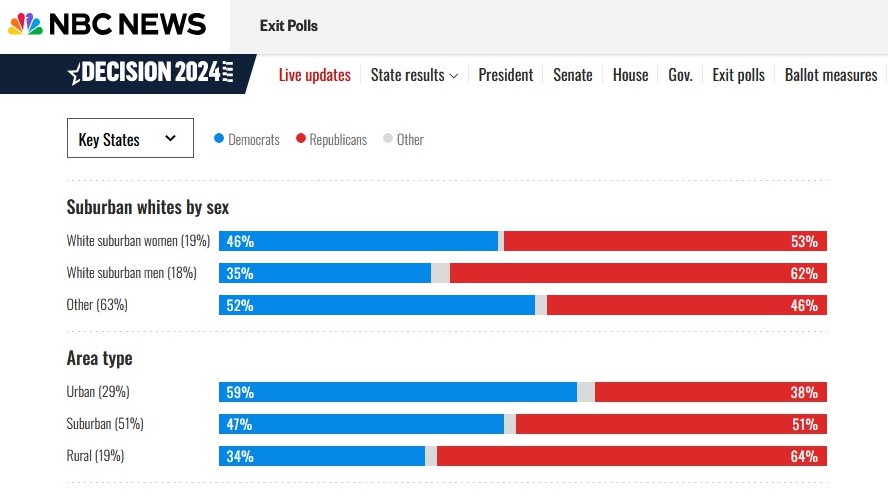
Based on these results, it looks like the Democratic candidate won large percentages in urban areas, the Republican candidate won a majority in rural areas, and suburban voters went slightly for the winning candidate.
If this pattern roughly held across the United States, it would be similar to patterns from previous presidential election cycles. If a candidate wants to win, they need to appeal to enough suburban voters.
What appealed to suburbanites specifically in 2024? If economic conditions was a top concern of voters, is this what drove suburban voters? The top table above suggests white suburbanites in these 10 states voted for the winning candidate. Were they driven by economic concerns or other issues?
And as attention turns to the next election cycle, how will parties and candidates seek to appeal to suburbanites? In addition to those thinking of presidential office, how will House districts involving suburbs speak to suburban residents?
Over the past decade and a half, however, the dynamic has dramatically shifted. In 2008, the top fifth of earners favored Democrats by just a few percentage points; by 2020, they were the group most likely to vote for Democrats and did so by a nearly 15-point margin. (Democrats won the poorest fifth of voters by a similarly large margin.) Democrats now represent 24 of the 25 highest-income congressional districts and 43 of the top 50 counties by economic output. A similarly stark shift has occurred if you look at college education rather than income. Perhaps most dramatic of all has been the change among wealthy white people. Among white voters, in every presidential election from 1948 until 2012, the richest 5 percent were the group most likely to vote Republican, according to analysis by the political scientist Thomas Wood. In 2016 and 2020, this dynamic reversed itself: The top 5 percent became the group most likely to vote Democratic…
That realignment leaves both parties in a strange place heading into November. Voters consistently say that the economy is the most important issue of the 2024 election. And yet the affluent overwhelmingly support Kamala Harris, whose administration favored bold redistribution and big government spending, while a critical mass of working-class voters favor Donald Trump, whose economic agenda consisted largely of cutting taxes for the rich and trying to kill the Affordable Care Act.
This is not the only political shift in recent years but an interesting one nonetheless. Are these political shifts enduring? Such a shift disrupts short-term activity but there could also be long-term consequences. With the resources and connections elites have, does a shift like this lead to other consequential changes?
While the article focuses on whether these voters are voting in their material best interests, another part is intriguing: how then does this fit with the American obsession on the middle-class and the political rhetoric and activity that goes along with this? Does the composition of who comprises the electorate for a political party than affect how much the party talks about the middle-class or pursues policy aimed to help that group?
And since I think about the suburbs a lot, how does this affect how the two parties view suburbs in the United States? Traditionally viewed as middle-class places with powerful local control, does this shift with new political bases at play?
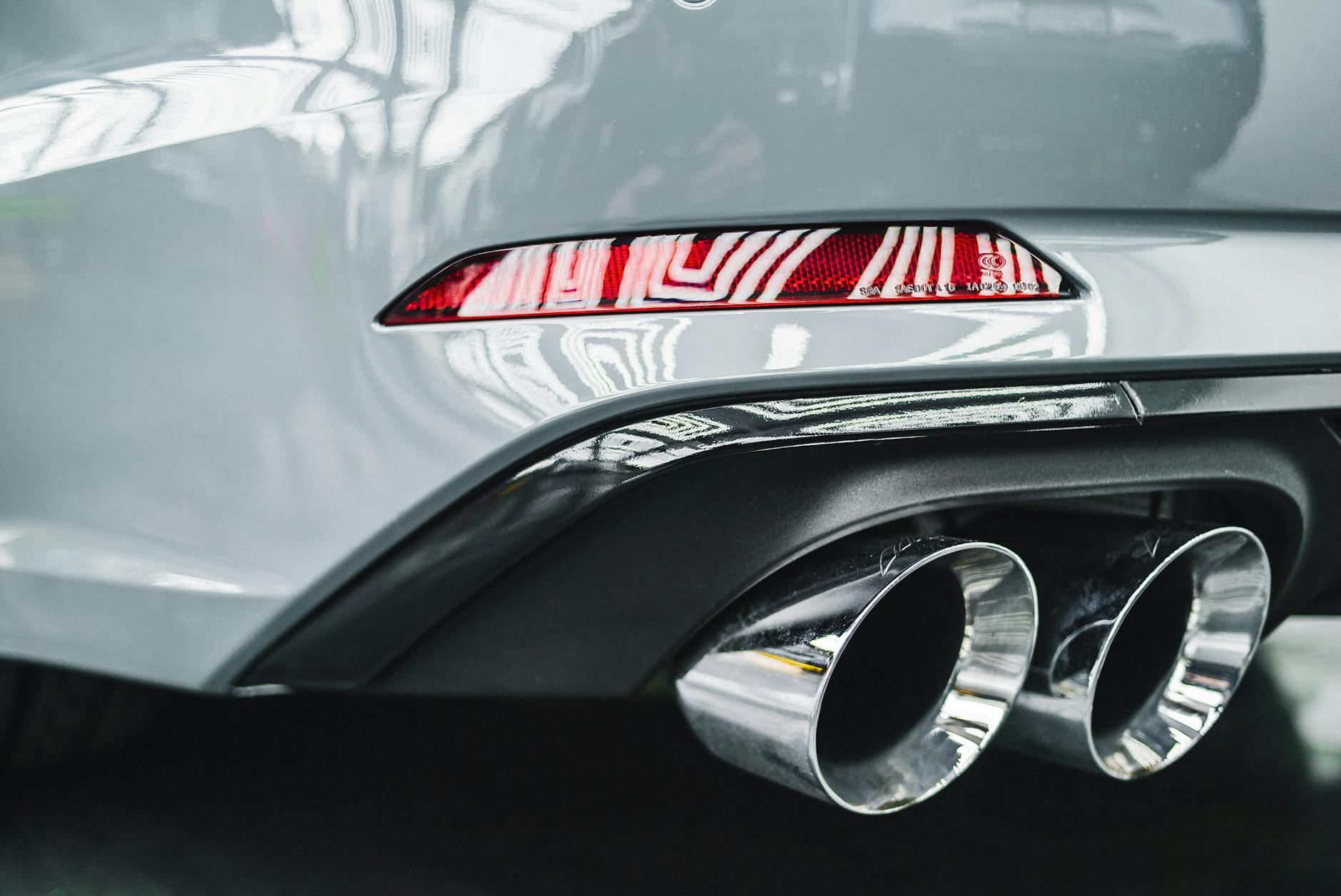
Noisy mufflers were among the top complaints at a recent “chat with the chief,” and city council members also have fielded complaints coming from the downtown district and the south end of Naperville near 95th Street.
The noise from engines revving and modified mufflers can get loud enough to be heard blocks away, said Mayor Scott Wehrli, who lives near the city’s downtown district. This summer, for example, motorcycles revving their engines through one of the parking decks created enough noise to disrupt an outdoor summer band concert, he added…
Under state law, it is illegal to have a modified muffler on a vehicle, Naperville Police Chief Jason Arres said. Naperville police have been issuing citations based on that law.
Between Sept. 1 and Oct. 8, police issued 26 citations. Two of them resulted in guilty pleas on Wednesday and about $300 in fines for each citation, officials said…
Arres, who noted complaints about noisy cars is not unique to Naperville, is hopeful word will travel fast that loud cars aren’t welcome in town.
Two questions quickly came to mind when I read this:
Will loud cars and vehicles now avoid Naperville? It is a big community with lots of locations for locals and visitors to travel to.
What if nearby suburbs do not enforce this state law? Say Naperville continues to enforce this law and issue citations and some of the drivers do indeed stay away; will these drivers simply visit nearby suburbs? Will they get their vehicles fixed or modified? While Naperville is indeed big, nearby suburbs could many of the same kinds of places to drive to.
This is not just limited to loud cars; what about enforcing having proper license plates or tinted windows that are too dark or other vehicle issues that are not moving violations? If a number of communities do not enforce this, will it make that much of a difference?
It will take some time to see if the issue is addressed to the satisfaction of Naperville leaders and residents. And will the problem shift to neighboring suburbs?
Suburbanites, who make up about half of the U.S. electorate and are as racially diverse as the nation at large, are a key prize. Biden beat Trump in suburban counties by about six percentage points in the 2020 presidential election.
Before Biden dropped out, Trump was leading him 43% to 40% among suburbanites in Reuters/Ipsos polls conducted in June and July, reflecting the Democrat’s struggle to energize supporters.
Harris began closing the gap when she launched her campaign in July and led Trump 47% to 41% among suburban voters in polling across September and October. That represents a nine-point swing in the Democrat’s favor, according to the analysis of six Reuters/Ipsos polls that included responses from over 6,000 registered voters…
Winning the middle – whether nationally or in the election’s key states – won’t necessarily crown the victor. Democrat Hillary Clinton, who got nearly 3 million votes more than Trump nationwide in the 2016 election and beat him in suburban counties by about 1 percentage point, still lost the election when Trump flipped six states that had voted Democratic in 2012.
Suburban voters are a sizable block of voters as this is where a majority of Americans live. Do all suburbanites vote the same? No, suburbia is increasingly complex with people in suburbia have different experiences and backgrounds.
Related to the previous point, do suburbanites see themselves as a voting bloc? If I were to take the Chicago metropolitan area as an example, voters across the region might not see themselves as similar to others in the region’s suburbs.
Will the presidential candidates appeal more directly to suburban life in the last few months? If the economy is the biggest issue for voters (as the article suggests), is talking about the middle-class direct enough? Trump in 2020 spoke directly about suburbs; will both candidates do this in 2024?
Illinois Department of Transportation leaders unveiled a new diverging diamond design they predict will expedite travel for drivers on the interstate and local roads…
“The modern design is a proven solution to improve safety and traffic flow in a busy area like where we are today,” IDOT Secretary Omer Osman said…
The interchange dovetails with Rock Run Collection, a major Will County development that will include housing, retail, restaurants, offices, and the relocated Hollywood Casino Joliet…
A diverging diamond has a smaller footprint than conventional cloverleafs and is cheaper to build.
Innovation to keep all the vehicles moving smoothly between interstate and a local major road.
What other major roadway changes could help speed up traffic and increase safety? Adding lanes does not necessarily speed up traffic. The Chicago region has plenty of left-turn on green signal only lanes that help reduce certain crashes. Protected bike lanes are only found in a few denser places.
Is the answer in better vehicle technology? Vehicles that talk to each other and/or driverless cars? Smaller or lighter vehicles?
Another possible solution is to reduce the amount of driving. This could be hard in sprawling suburban areas, like where these diamond interchanges are located. Introducing more mass transit options in the region is possible but it is costly, is harder to implement in the suburbs, and it might not find favor among residents.
The drivers at this busy interchange may come to appreciate their new diamond among the asphalt. Others may want to wait for more innovation that improves travel through suburbia.
Just as there was nothing natural about the processes that prompted suburban decline, there was nothing natural about the vast funds poured into these communities to make redevelopment happen. County and state governments led the way through planning, policies, and public investments meant to entice private investment. As Silver Spring and Wheaton vividly revealed, their efforts were layered and robust: enterprise zones, urban and art districts, eminent domain, tax breaks, parcel assemblage, parking regulations, new transit investments and infrastructure. Public agencies created new market pressures that directed and enabled profitable private development. They served as the promotional arm of private corporations, advertising new suburban downtowns as safe for middle-class consumers and residents. They were critical actors in creating displacement pressures and were, as many activists argued, responsible for their redress.
But for the millions of dollars in tax breaks, incentives and assistance that developers were given, what was asked in return for those who lost their homes, businesses and sense of community? What was gained for those who had lived with broken sidewalks and run-down playgrounds for decades? Were they the beneficiaries of this progress – or was the development, as many suspected, for someone else?
As visions for new suburban downtowns emerged, long-standing communities could scarcely see themselves in the sketches of shiny new plazas and pedestrian streets. As in downtown Silver Spring, these images projected futures that allowed for the comfortable return of the white middle classes, catering to their tastes and preferences for what an authentic and safe urban experience looked and felt like. They did not honor marginalized groups’ deep histories, struggles or valued places. If suburban boosters dared to look back at all, their visions sugarcoated the past in ways that did not trouble their present plans.
Even diversity became a selling point. In Wheaton, multicultural festivals crowded the downtown plaza and colorful art displays featured faces from across the world. Yet many wondered whether its fragile diversity was simply a transition to a future in which they no longer existed.
This is gentrification — and it is suburban. While the language of retrofitting or renaissance may be much more genteel, their processes are no less brutal nor disruptive. They affect the lives and livelihoods of countless neighborhoods and threaten the sense of place that people of color and new immigrants have fought to establish and protect, sometimes with, but largely in the absence of, white neighbors and public support.
This sounds similar to what studies of urban gentrification find: the promises of new development and growth can have negative consequences for residents already there.
I wonder if resisting gentrification in the suburbs might be harder for two reasons:
Growth is good in the United States. This is true across numerous American communities but might even be more baked into the idea of suburbia. Suburbs are meant to grow. To resist growth is to resist a higher status. (An exception might be that communities that are already well-off and exclusive can resist growth.)
The city of Woodbury in recent years has made native landscaping and pollinator gardens more intentional in some of the city’s 500 stormwater basins. The homeowners associations that rule many of Woodbury’s residential developments, dictating everything from front door colors to permitted landscaping, have become more lenient. The just-built Westwind New Home Community has in its recorded covenant a stipulation that allows homeowners to use native plantings and shrubs.
The Legislature weighed in last year with a new law saying cities cannot ban pollinator gardens or native plantings in front yards, opening a path for those who want to create a bee-friendly spot. The conflict got widespread attention after the city of Falcon Heights sued a man who planted vegetables in his front yard…
When visitors ask her for advice, Boyle sends them to Metro Blooms, a Minneapolis nonprofit that helps communities create healthier landscapes. There’s some cost to a project like Boyle’s, but the larger barrier was the social stigma…
Hong has pitched an idea to developers to allow homeowners to choose their landscaping, much the same way they might choose the home’s paint color or countertops, and to give them the option of planting native grasses and pollinator gardens. If someone just bought a new house that came with sod and in-ground irrigation, “it’s asking a lot of the homeowner to rip that all out and do something different,” Hong said…
The counterargument is that most builders choose sod for new houses because of state and federal rules about stormwater and erosion control, said Nick Erickson, the senior director of housing policy for Housing First Minnesota, the state trade association for builders.
From the story, it sounds like at least these sets of actors have gotten involved: a municipal government, homeowner’s associations, the state legislature, non-profits, and some residents. On the other hand, developers and builders may privilege grass lawns because of state and federal guidelines. Additionally, the story hints at more informal interactions as residents talk offline and online about lawns and draw upon long-established patterns about lawns and yards.
All of this suggests to me that moving away from lawns is not an easy task. Americans, particularly in the suburbs, tend to like lawns and what they represent. To present viable alternatives takes work. Many homes already exist. What might motivate people to take out a lawn and replace it with something else? What incentives are available? In this particular situation, a danger to wildlife is motivating some people to act. Elsewhere, it might be drought or limited water supplies.
If people want to envision a United States with substantially fewer grass lawns in thirty years, this article hints that multiple actors will need to work. Each could have a part to play in incentivizing other options. And as noted above, having new homes that do not start with a lawn is a potentially powerful change that could take some time to pursue.
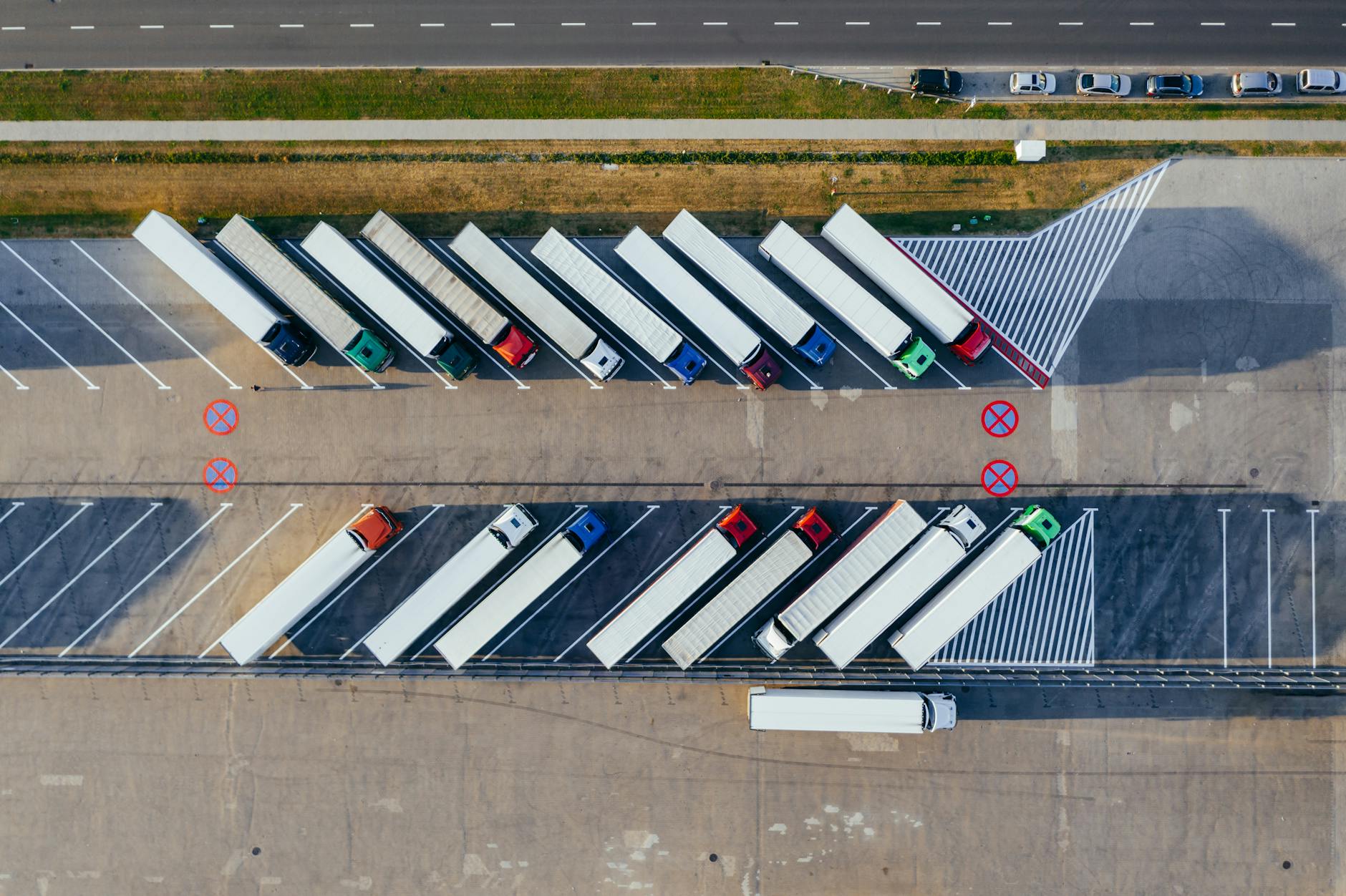
Outpost, an Austin, Texas-based company, is transforming 30 acres at 70 Airport Road into a location where 1,000 semi trucks can park in a safe, secure setting, said Trent Cameron, the company’s co-founder and CEO…
When it opens Oct. 1, the number of parking spaces will exceed the 900 available at the Iowa 80 Truckstop in Walcott, Iowa, which bills itself as the world’s largest truck stop, in part because of the restaurants, stores, truck dealership, movie theater, repair shop and other service businesses spread out over its 220 acres, according to its website.
As Cameron noted, there’s a need for more truck parking. A report done by the American Trucking Association found there is one parking space for every 11 trucks on the road and many drivers spend nearly an hour every day trying to find a place where they can stop, resulting in about 12% lost pay annually.
Beyond that, truck drivers waste a lot of fuel searching for parking and often are forced to park in unsafe and unauthorized locations, the association report said.
Suburbs are not often home to truck stops as these tend to be located further outside of big cities. Developers may see land as more profitable for other uses. Companies may want cheaper land and more of it. As noted later in the article, suburban residents often do not like lots of trucks on local streets and as neighbors.
Additionally, Chicago is an important trucking and transportation hub, serving both the large metropolitan area and a lot of traffic passing through to other places. Many trucks make their way into and out of the region with many warehouses, retail facilities, and communities.
Will large suburban truck stops become more and more common? Will this push residents and communities to make certain choices about land and locations?
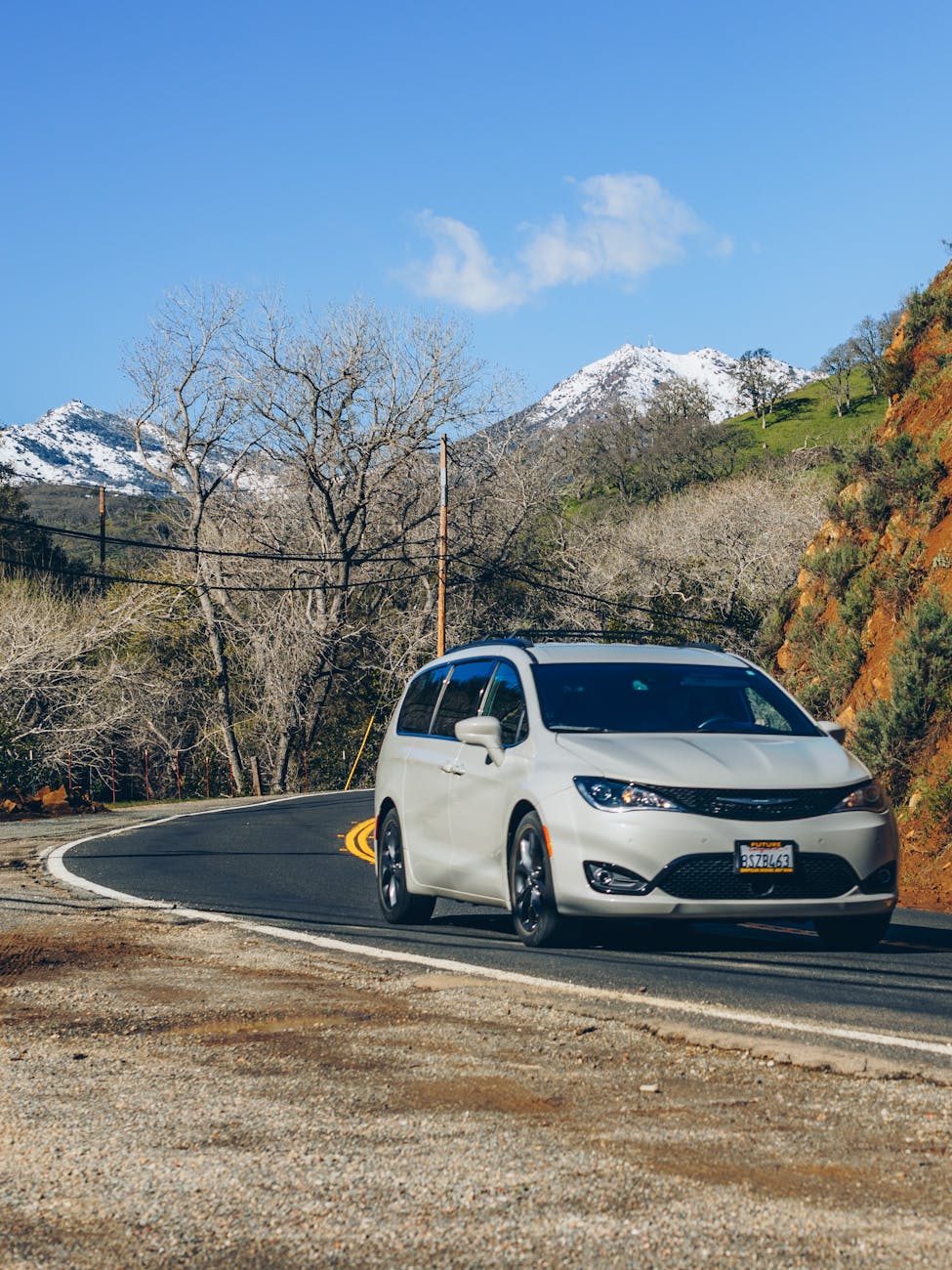
Even so, minivan sales have been falling steadily since their peak in 2000, when about 1.3 million were sold in the United States. As of last year, that figure is down by about 80 percent.
What caused this decline? The same article suggests this:
However it evolves, the minivan will still be trammeled by its fundamental purpose. It is useful because it offers benefits for families, and it is uncool because family life is thought to be imprisoning. That logic cannot be overcome by mere design. In the end, the minivan dilemma has more to do with how Americans think than what we drive. Families, or at least vehicles expressly designed for them, turned out to be lamentable. We’d prefer to daydream about fording Yukon streams instead.
I am interested in some of the bigger connections that might be made around this same time (early 2000s). So family life in the suburbs – embodied by the minivan – became uncool? The 2000 Census was the first time 50% of Americans lived in suburbia. By this point, several generations of Americans had experienced or grew up in suburban settings. Is a choice of vehicles really pushing back against family life in the suburbs (even as plenty of Americans continue in these settings)?
Or another way to take the argument above is that individualism wins out over any symbols of family life. The iPhone and SUV somehow broadcast a consistent message of a cool or unique individual – regardless of how many people own the same model – while the minivan is saddled with family life. Did the long-term American yearning to be an individual doom the minivan (despite its peak in 2000)?
A third consideration: is this just a branding question? If so, other products have been revived so why not the minivan? Imagine a famous celebrity endorses the minivan and drives one around. Or a new brand emerges. Or problems arise with SUVs and the minivan is dependable. Or families become cool again. There may be limited interest in trying to revive the minivan but this could provide someone a marketing challenge.
And they didn’t help you get from one neighborhood to another or back home from a night out to the suburbs…
Many businesses rely on suburbanites coming downtown for the weekend to eat or watch an artistic offering as the fall season kicks off.
Chicago is a big city so there are plenty of trips taking place solely within the city. Additionally, many big cities and people within are used to the idea that people from the suburbs travel into the city.
But these two short passages highlight a back and forth between both city and suburb. There are some traveling from city to suburbs, perhaps even for a night out (some suburbs are cool?). Others are traveling into the city to take advantage of particular opportunities offered in the city (or for work).
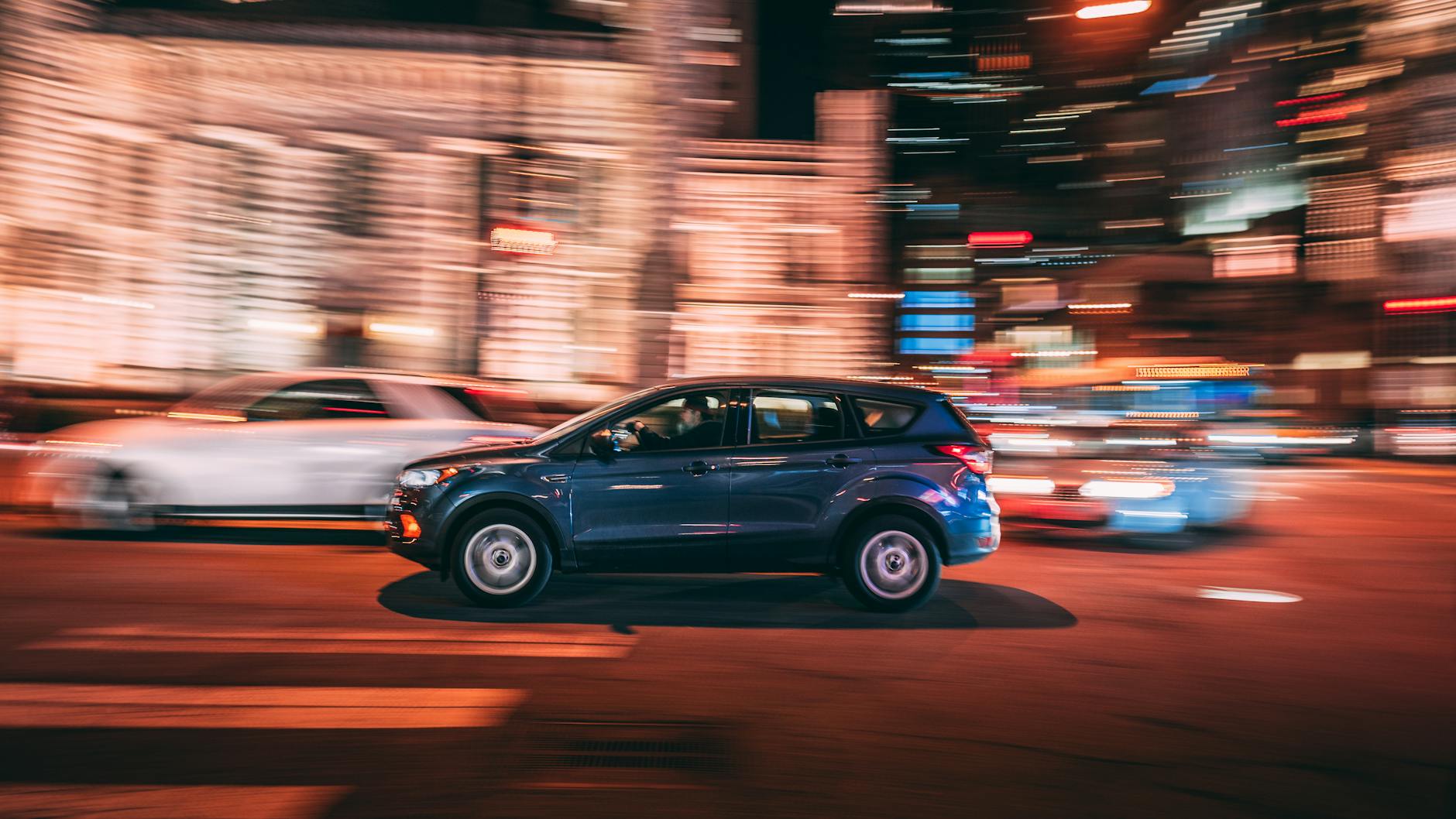
These newer patterns complicate efforts to address traffic. The predictable rush hours into the city in the morning and out of the city in the afternoon and evening have morphed into more traffic headed in all directions at more times. Traffic can be present around the clock, even without special events or celebrations.





 Legally Sociable