Why the study of social media and the study of suburbs goes together

Two days ago, I presented a talk titled “Screens, Social Media, and Spirituality: Technology and Religiosity Among Emerging Adults.” In this particular talk, I drew upon my work work with co-authors analyzing social media. While this is one of my research areas of interest, I am also a scholar of suburbs. How do these two areas go together?

To start, the sociological study of the Internet and social media has connections to the study of communities and places. Barry Wellman is a good example of a scholar who studied communities and then the Internet. Both social spheres have logics that connect people: communities tend to rely on geographic proximity while Internet and social media networks rely more on choosing connections and common interests. (There are other lenses sociologists could use to join the two topics: materiality – think smartphones and single-family homes; narratives about science and progress; consumption.)

Both social media and suburban areas rely on narratives of choice made by users or residents while both ave deeper forces pushing people toward those choices. In social media, people do not pick platforms at random nor are the platform’s development and popularity random. What people users connect to is not random; existing social ties matter as do factors like fame, influence, and power. Similarly, Americans may often argue they made it to the suburbs through their own efforts but decades of government policy as well as cultural ideology has privileged the suburban way of life.

One might argue that social media is relatively placeless. Users can communicate with any connected friend or follower from any place and at any time. Compared to social interaction bounded by proximity, technology offers unprecedented access without a need for a tie to a place (outside of a need for some sort of Internet connection). But, this placelessness is also a critique regularly leveled at American suburbs where the regularly repeating of features can make it appear all to be similar. See an example of this argument. (I tend to disagree as suburban communities can have very different characters, just as different social media platforms and interactions can feel different even if they all all fall into the same broad categories of social life.)

Finally, the profound implications for communities and broader society by both phenomena – particularly mass suburbanization after World War II and social media after the founding of Facebook plus the quick popularity of smartphones – are hard to ignore. It isn’t just that more Americans moved to suburbs; this had ripple effects on many places (including every major city), industries (think cars, fast food, big box stores, etc.), and government policy. It isn’t just that people now spend some time on social media; the shift to different kinds of relationships means we have to think afresh about how community works.
Perhaps the only way to turn scholarly attention to the suburbs is to focus on their politics

A long piece comparing the disparate fates of Parma and Shaker Heights outside of Cleveland, Ohio suggests it is politics that makes it worth examining suburbs:

We don’t spend much time thinking about the suburbs. That’s sort of the point — they’re purposely and pleasantly boring, a cul-de-sac monolith of culture. But the suburbs also form the worldviews of 175 million Americans. Whom you live next to, where your parents went to school, what store opens down the street — all these small things shape the politics of Americans before they even know what politics are.

In the past few years, the suburbs have also shown themselves to be the heart of the shifting politics of the nation. According to exit polls, Hillary Clinton lost the suburbs to Donald Trump in 2016, continuing a slump for Democrats — Obama lost the suburban vote in 2012 after nabbing it in 2008. But in the 2018 midterm elections, Democrats took back the House on the strength of their showing in suburban districts.

Lots of theories for the changing political proclivities of suburban Americans have been floated, and white Americans are front and center. (White people are the majority in 90 percent of America’s suburban counties.) Class has something to do with it. Over the past few years, college-educated white people have been increasingly more apt to vote for Democrats, while those without a college education skew Republican.

But what do we mean when we talk about “class” and politics?

Indeed, there is a growing body of research from political scientists and others as well as plenty of media interest (example I am quoted in here) on political changes in suburbia. The general pattern is this: Democrats tend to win in communities closer to the city, Republicans tend to win in the exurbs, and the two parties are now dueling over middle suburbs. While these are broad patterns, there can be communities within metropolitan areas that do not exactly fit the mold (as this article notes).

At the same time, I find it odd that this may be the only reason scholars and commentators may pay attention to the suburbs. If the majority of Americans live there (175 million residents, according to the number above), isn’t this enough reason to focus on them? Or, is everything today about counting votes and political races, to the exclusion of the other important factors in suburban life?

This analysis of two Cleveland suburbs also has the pieces for a more accurate and ultimately interesting look at these two communities. In discussions of social class along with race and community history, the article hints at how two suburbs can come to such unique outcomes in a particular election cycle. Think inertia plus community decisions and outside pressure. But, since the goal is to illustrate the issues Democrats face in the suburbs, we are not allowed to consider these suburbs in their own right. Instead, they serve as fleeting communities that are not worth considering more deeply except for their votes.

What I want to know: do TV shows push viewers to buy certain kinds of houses?

After publishing two papers in the last few years on TV depictions of suburbs and their houses (see here and here), it leaves me with one big question: do shows like these directly influence what homes people purchase?

Americans watch a lot of television – still an average of about four hours a day for adults – and they see a lot of dwellings. While there is a mix of housing units shown, scholars point out that television since the 1950s does place a lot of emphasis on single-family homes. This includes fictional shows set in single-family homes in the suburbs (think Bewitched or Desperate Housewives), rural areas (think Lassie), and cities (think Happy Days and King of Queens). More recently, viewers can see homes on HGTV and other networks that emphasize home life (plus the shows on other networks that specifically target homeowners, from This Old House to Trading Spaces). This makes some sense in a country that holds up owning a single-family home, particularly in the suburbs, as an ideal.

But, we know little how about all of this watching about homes translates into choosing homes. My study “From I Love Lucy to Desperate Housewives” did not find much evidence that more popular suburban television shows led to more people living in suburbs (or vice versa). Similarly, outside of some interest from Sopranos’ fans in having a home like Tony, there is little to no evidence that Americans flocked to imitate the home or neighborhood of the Sopranos. While the viewers of HGTV might be relatively wealthy, do they take what they see and directly purchase something like that?

It is relatively easy to make claims about how media products affect thoughts and behavior. However, it is harder to make direct, causal connections. I would guess advertisers around such shows hope such a connection is present. If we could examine this relationship between shows and homes more closely in research studies, it could help us better understand how Americans form, maintain, and change their approaches to homes and communities.

Recognizing and learning from “radical suburbs”

A new book from journalist Amanda Kolson Hurley looks at “radical suburbs” that do not fit the stereotype of sleepy, homogeneous, bedroom communities. From an excerpt:

Clichés and misconceptions still define suburbia in the popular imagination, and it drives me crazy. I live in Montgomery County, Maryland, outside of Washington, D.C. I’m a suburbanite, but my life doesn’t revolve around manicured lawns, status anxiety, or a craving for homogeneity. My suburban experience is riding the bus as people chat around me in Spanish and French Creole. It’s having neighbors who hail from Tibet, Brazil, and Kenya as well as Cincinnati. It’s my son attending a school that reflects the diversity—and stubborn inequality—of America today…

Radical Suburbs is about waves of idealists who established alternative suburbs outside of Eastern U.S. cities, beginning in the 1820s and continuing through the 1960s. These groups had very different backgrounds and motivations, but all of them believed in the power of the local community to shape moral and social values, and in the freedom provided by outskirts land to live and build in new ways.

As opposed to the groups who went far into America’s interior to settle isolated communes, these were, in a paradoxical-sounding phrase, practical utopians. Staying close to the city let them try out new ways of living with a financial lifeline and emergency exit. Now, at a time when—it could reasonably be argued—the future of the country hangs on what suburbs do over the next 20 or 30 years, their history shows that bold social and architectural experimentation is not alien to suburbia. In fact, it’s a suburban tradition…

Over the past 150 years, suburbanites have lived in large communal dwellings and tiny shacks, Modernist apartments and neo-Gothic mansions. They’ve been renters and homeowners, domestic servants and corporate executives. They’ve cultivated both emerald lawns and food crops. They’ve sought escape from social progress, and freedom from convention.

Two quick thoughts:

  1. I would be happy if academics and the public alike, particularly those interested in urban regions and issues, would acknowledge and analyze the variety of suburban communities. This book and multiple other studies make exactly this case: the suburbia that is often criticized may fit some suburbs but certainly not all. As jus ta short list, there are suburbs of working-class residents, suburbs of non-white residents, communities built around different ideals than single-family homes and cars, edge cities, and more. Suburban communities may share some fundamental features yet differ significantly on other parts of social life.
  2. I’ll have to read the book but I would be interested in knowing if there are patterns as to how at least a few suburbs could pursue less conventional ideals while a good number of suburbs simply followed convention. In other words, how did radical suburbs start and how can other communities follow similar paths? If these communities present some models worth emulating, how do established suburbs change course? It is possible for suburbs to change but going against local inertia can require significant decisions.

Chicago area voter turnout around 13-15%

The Daily Herald describes the low turnout in municipal elections in the Chicago area a week ago.

Only 13 percent of the suburb’s registered voters cast ballots in Tuesday’s election, the lowest rate for any election since at least 2006…

With hundreds of races in each county, some drew more voters than others. The Hinsdale High School District 86 tax hike question in DuPage County brought more than 40 percent of the district’s voters to the ballot box, with the looming threat of massive extracurricular cuts if the request didn’t pass. It did.

But scores of other races had less than 5 percent turnout, according to vote totals available on some election websites, mainly because they weren’t contested…

The growth in actual voters is little comfort to political scientists, local politicians and suburban election officials, who worry low voter turnout shows a dangerous level of apathy by the electorate.

While the article tries to bring out the positive news – there are more registered voters compared to the last set of municipal elections and some races had higher turnout races – it is hard to sugarcoat these figures. The Chicago suburb in which I live had low turnout for the first mayoral race in years. These local elections can have a significant impact as local leaders react to external pressures as well as have internal discussions. Not every local official makes significant changes and many local officials may run to make small improvements and preserve the nature of their community. At the same time, many communities have key moments in their past to which they could point to as sending the community down a different route and altering the community’s character.

Again, if Americans claim to like local government and local control in suburban settings, why do they not vote in larger numbers for the officials who will help guide their communities and local governments?

A town of over 53,000 residents can elect a mayor with just over 3,600 votes

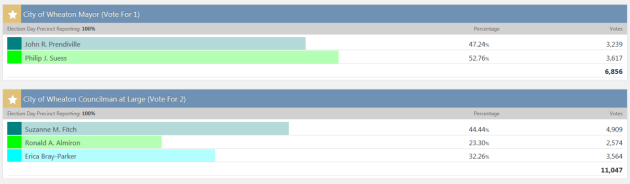
Municipal elections in Illinois took place this past Tuesday. In my suburban community of just over 53,000 residents, here are the results for the two races:

WheatonMunicipalElectionResultsApr19

In races for two important local positions, voter turnout was relatively low. Of the roughly 41,000 adults in the community 18 and older, the mayor was elected by 3,617 voters while his opponent had just over 3,200 votes. In the councilman race, the numbers are a little harder to interpret because voters could select two but the numbers are certainly not much higher. Overall, under 20% of adults voted (hard to know how many are registered) and less than 10% of those adults selected the next mayor.

Perhaps there are a variety of factors at work:

  1. Do residents/voters believe that municipal elections matter? What do local officials do anyways?
  2. Holding municipal elections separately from larger races – state and national races that tend to get more attention – could lessen enthusiasm.
  3. Perhaps the candidates are not that exciting (the two mayoral candidates shared multiple characteristics) or they are unknown to broad swaths of the community.

Low voter turnout is now common and it may not take much to be voted in to local office. But if suburbanites claim to value local government, it is not hard to see the disconnect between choosing local leaders and wanting to maintain local control.


Suggestion that Hudson Yards and other urban megaprojects threaten suburbs

The glitz of the new Hudson Yards in New York pushes one theater critic to argue such spaces threaten suburbs:

A problem faced by suburbs becomes all too clear at Hudson Yards. Affluent Americans are almost all going to live in cities, starving urban centers of affordable housing just as they’ll choke up the traditional suburban resources. No suburb, I kept thinking, can compete with this. And Hudson Yards, or Lincoln Yards, or whatever comes next, are far from done.

Such large developments in significant urban neighborhoods are worth keeping an eye on because of all the change that comes at once plus what is included in the new spaces.

But, I don’t think Hudson Yards or the proposed megaproject on Chicago’s north side or the development around Staples Center in Los Angeles will threaten suburbs in the long run:

  1. These spaces do not have the same combination of factors that Americans like in suburbs starting with the emphasis on single-family homes and family life. Projects like these have elements of what suburbia can offer but primarily offer a different experience: bustling activity, diversity of dining and cultural options, presumably a greater mix of people. Suburbs can indeed compete with this by offering a different lifestyle.
  2. The housing available in these new projects is primarily for wealthy urbanites, likely appealing to young professionals and older adults who like all the activity and the newness. This may indeed continue to help concentrate the affluent in certain urban neighborhoods but there will be plenty of working to middle-class residents who will be priced out and will find suburban housing more affordable.
  3. Surveys continue to suggest that even young Americans desire a suburban life in the long run, particularly when they reach a certain age or have families. From my vantage point, the emphasis on the rush to the big cities is overplayed.

Both sizable and exciting urban megaprojects can find success alongside suburban life. Perhaps they may even draw on different people groups in the long run, segmented by age as well as resources. And perhaps we should continue to keep paying attention to who has difficulty finding a true home in either type of space.

Suburban ministry accepts notorious convicted murderer as resident

Suburbanites do not want to be associated with crime, particularly notorious ones. So a recent action by a Christian ministry in Aurora is notable:

Wayside Cross Ministries of Aurora officials said Monday that by accepting “Ripper Crew” murderer Thomas Kokoraleis as a resident, the organization is doing what God commands everyone to do: Show kindness and mercy to all, even enemies, the ungrateful and the wicked.

“We are mandated by our Lord Jesus Christ to love our neighbors. According to Luke 16, anyone in a genuine need is a neighbor,” Executive Director James Lukose said in a news release that Wayside Cross also posted on its website, waysidecross.org

Kokoraleis, 58, was released from prison Friday after serving half his 70-year sentence. He is not on parole, and is free to live where he wants, as long as he informs police…

Kokoraleis was one of four men suspected of killing as many as 17 women in Chicago and the suburbs in the early 1980s. His younger brother, Andrew, was one of them and was executed in 1999.

The Chicago Tribune wrote an editorial several days ago on Kokoraleis’s release:

A judge chose to sentence him to life in prison. But his conviction was struck down over legal errors, and the case was resolved with the defendant pleading guilty and being sentenced to 70 years. Thanks to the rules in effect back then, which allowed him to cut his time in half through good behavior, Kokoraleis was released Friday at age 58. He is expected to live at a Christian-oriented facility in the Wheaton area…

We won’t relitigate Thomas Kokoraleis’ case or his guilt. But we feel no hesitation in saying that life behind bars should have been the certain sentence for what he did. There is something profoundly exasperating about seeing someone who took part in such wanton slaughter being allowed to walk free among civilized people.

I wonder if this will cause any furor long-term in Aurora and the surrounding area. UPDATE APRIL 2, 2019 – The mayor of Aurora is not happy about this.

“In light of the unspeakable nature of the crimes committed by the Ripper Crew, I would hope that Wayside would reconsider the decision that brought Kokoraleis to Aurora — particularly given the Ministries’ close proximity to parks, churches and day care centers,” Irvin said in a statement Monday evening. “I absolutely disagree with Wayside Cross Ministries’ decision to allow Kokoraleis to reside at their facility in Aurora.”

Presumably, there are plenty of nearby residents with possible competing loyalties in this particular case: they would claim Christian faith and also be at least hesitant about living near such a murderer. There would be few suburban cases at this level that could push suburbanites to consider balancing justice and forgiveness – and both suburban and American history suggest they would almost always settle on the side of justice and keeping the issue as far away from their homes and community as possible.

I hope there will be a follow-up either way, whether Kokoraleis lives quietly or falls into trouble again.

McMansion literary tales: a proposed teardown leads to local dysfunction

The McMansion continues to feature in literary works. A new book from a Washington D.C. area author uses a proposed teardown McMansion to highlight suburban issues:

Coincidence or not, Langsdorf’s success comes after leaving her longtime suburban existence. Following her 2012 divorce, Langsdorf moved to Adams Morgan in the District and devoted herself to writing while teaching yoga on the side. And yet, the book takes her back to that former life: “White Elephant” seems to channel all of the frustrations she felt juggling her identities as a mother and creator in a stifling suburb. The novel follows the residents of the fictional enclave of Willard Park — inspired, in part, by Langsdorf’s hometown of Kensington, Md. — where an interloper’s plans to build a McMansion amid the cozy bungalows leads to angry town halls, scandalous romantic dalliances and shady high jinks.

Like Langsdorf, two of the main characters in her ensemble are mothers grappling with their identities beyond being wives and mothers. Allison Miller, who has lived (mostly) happily in Willard Park for more than a decade, wonders what to do with her photography — more than a hobby, less than a career. Her new next-door neighbor, Kaye Cox, can’t figure out who to be, caught between her role as a fixture in her husband’s behemoth of a house and her own interest in interior decoration. These women and their author are well-acquainted with the eternal dilemma for parents, the pull between caregiving duties and other interests, professional and personal…

Almost every neighborhood in the D.C. region has experienced a version of the changes in “White Elephant.” Even Adams Morgan: The Line hotel, for example, occupies a building that was once a church. Langsdorf laughs about some of the struggles she’s seen in her own building, hastening to add that her fellow co-op residents are all great neighbors.

The residents of Willard Park come to realize that houses matter less than their inhabitants — and that the suburbs aren’t for everyone. Langsdorf understands this, too; in her current existence she feels more herself. “My life is much more vibrant,” she says. “I love being able to walk everywhere, and I do have more time to write.”

That a proposed McMansion could lead to “dalliances” and “high jinks” is intriguing to consider…the angry public meetings are much easier to verify.

While it would not have been possible to discuss McMansions before the 1980s since the term did not exist, it sounds like this new work draws on several common suburban critiques featured in novels, films, television shows, and other cultural products. Suburban residents, particularly women and mothers, feel trapped by suburban expectations and a landscape that does not easily lead to human connection or diverse experiences. They then look for ways to break free of the suburban mold and explore different outlets.

These works tend to emphasize those that feel “the suburbs aren’t for everyone.” At the same time, many Americans live in the suburbs by choice and I assume a good number of suburbanites feel their existence is at least okay. Is it because cultural works need crises to overcome (the hero on their journey must overcome something) or are the suburbs are a unique target because they are so common in the United States (over 50% of residents live there) and so reviled?

Communities, inertia, and change from a sociological point of view

After recently reading Market Cities, People Cities and hearing a talk by one of the authors plus having several conversations with people about how sociologists think about how communities and organizations develop and change, I wanted to outline how cities and suburbs change over time. Here is how I would describe it:

  1. A community or organization is founded. Relatively small in size at the start, it takes on characteristics and activities of its founder(s). These initial traits can have effects down the road but are not necessarily deterministic of where the community will end up. Inertia and founding energy carry the social collective along.
  2. Two major categories of social phenomena can lead to change. One option is outside social forces or pressure. Examples for communities could include broader shifts (such as new residents moving there from elsewhere, changes in government policies or funding, large-scale economic shifts, or changing cultural norms in the broader society) as well as more local changes (such as requests for new development, budget issues, a critical mass of new residents in the community, changes brought by local elections). A second option is internal decisions made to go a different direction (or reaffirm the existing inertia/path). These decisions are often a reaction to outside forces but they can also spring up from internal discussions and thinking. Examples of this could include requests for new developments, budget issues, and a critical mass of new residents.
  3. A period of inertia then follows until another major period of decision/reaction to outside forces takes place.
  4. The community or organization then goes on until it doesn’t.

To sum up: communities tend to follow a particular path of development and community life until something happens externally and/or internally that often allows space to have a discussion about a different vision. This “something happens” could be the result of external forces or internal forces or decisions. Emerson and Smiley rely more on steps toward developing a social movement while my own suburban work suggested “character moments” could lead to new paths. This collection of founding characteristics plus key moments then comprises the unique character of a community or organization that can differentiate it from an organization of community of the same broader kind.