Township argument: don’t disband us because we only take a little of your money

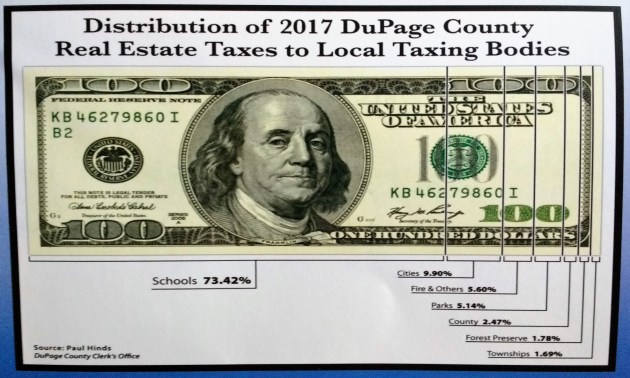
Continuing with local governments making interesting appeals to suburbanites, I received a newsletter from our township earlier this week. Illinois and DuPage County have had discussions about limiting taxing bodies and dissolving townships because of the state’s large number of taxing bodies. In response, the township put this graphic on the first page of the newsletter:

TownshipGraphic

While other parts of the newsletter described what the township does and how residents benefit, this graphic makes one argument: the township does not really ask for much so leave us alone.

In relative terms, this is a good argument: townships ask for the least amount of money. Even the Forest Preserve, a rather large one, asks for more money. On the other hand, given property values in the township, even 1.69% can add up to some decent money over the years. Plus, how does the money for townships compare to what residents get from the other taxing bodies?

On the whole, the quick appeal to property taxes hints at how suburbanites think: they do not want to pay more in taxes and want to be able to see how the money is being spent. I’m guessing relatively few DuPage County residents could detail what the townships do (compared to other taxing bodies) or connect the township activities to their property values.

Rallying cry: support higher property taxes for schools to have higher property values

I saw a yard sign that made this argument about a proposed tax rate increase for a nearby school district: voting yes to the increase means you are protecting your property values.

This is a circular argument fit for the suburbs. Property values are partly dependent on the perceived status of a community. Generally, higher status suburbs have better performing schools. Thus, paying more in taxes means the property values are likely to increase. For the average suburbanite, this means they should expect a bigger payoff in the end when they sell their home. In other words, vote to hand over some money starting now to guarantee a bigger amount of money later.

There are other reasons a school district and its supporters could give in order to support a tax increase. Provide a better education for the children of the district. Support the important work of teachers. Invest in the community’s future.

But, given the difficulty of asking many suburbanites for higher property taxes, perhaps these abstract notions do not work. Many districts work hard to develop support for a referendum way before it comes to a vote. In this case:

The Board’s vote comes after months of community-engagement work. In January 2018, CCSD 89 Superintendent Dr. Emily K. Tammaru convened a Superintendent’s Finance Committee to examine the district’s financial status and priorities. The committee looked at the nearly $3 million in cuts the district has made since 2009, and examined how rising enrollment and increasing costs have affected the district’s budget.

The members of the Finance Committee eventually recommended two options to the Board of Education:

  • Option A: Increase revenues in order to maintain comprehensive, high-quality educational programming. Increasing revenues would allow the district to avoid cuts to programs that directly impact students.
  • Option B: Reduce programs and increase fees. The district would need to make about $1.2 million in cuts during the 2019-20 school year. These cuts could include reductions of: gifted services, band and orchestra, social work services, library staff, and full-day kindergarten. The cuts could also result in larger class sizes. The cuts could be more significant in subsequent years.

The district then hosted three community meetings to share financial data and gather feedback. Community members who attended those meetings said they valued fiscal responsibility, but did not want cuts that would affect programming and potentially property values.

At the community meetings, 84.7 percent of the people in attendance said they supported increasing the tax rate rather than cutting programs to balance the budget. When the district conducted phone surveys this summer of all residents (parents and non parents), 56.9 percent of residents said they would support a 40-cent referendum.

Even with this supposed support (note the drop-off in support in those who attended the meetings versus those who answered the phone survey; plus, who answered their phone?), the bottom line appeal here is money. Some parts of the district will pay more than others – the referendum page uses a $300,000 value as a baseline while Glen Ellyn has a median housing value of just over $400,000 and Lombard has a median value of $240,000 – but the money will come eventually. Pay us now so you can gain later.

If suburbanites value property values above all, perhaps this is the only way to build support for local tax increases.

The suburban dimension to the Kavanaugh hearings

The testimony from Christine Blasey Ford and Brett Kavanaugh all revolved around a suburban high school social scene. Some suburban features of the matter at hand:

-Kavanaugh lived in Bethesda, Maryland. This community just northwest of Washington D.C. is largely white as well as very wealthy and educated. Ford also lived in the Washington D.C. suburbs.

-Kavanaugh described his summers in high school as involving working (having his own lawn mower business, working in construction) and getting together with friends. It sounds like they were able to drive themselves places. They had some measure of independence to engage in teenager activities. Ford described spending many summer days at the country club pool.

-Both Kavanaugh and Ford went to private schools in high school and highly ranked colleges (Yale and the University of North Carolina – Chapel Hill).

-The partying and drinking scene at people’s houses and other settings (like the beach) sounds like descriptions I have heard about parties in wealthier suburbs as well as occasional stories relayed to me from my own suburban setting.

-Kavanaugh described himself as working really hard at school even as he also came from a family with good jobs and resources. He also described participation in a number of high school activities including football.

-Kavanaugh had a decent-sized group of friends who hung out and knew each other fairly well (even if they have not kept up so well over the years since high school).

-A number of the physical settings mentioned in the hearing are common in suburbia. The alleged assault took place at a two-story suburban house in nearby Chevy Chase (also a very white and wealthy suburb) that probably does not stand out much from neighboring houses. Ford described running into Mark Judge at a local supermarket.

-Both Ford and Kavanaugh ended up in successful careers that might be considered befitting of their wealthier suburban origins: Kavanaugh has a law degree and is a judge and Ford has a Ph.D. and is a psychologist.

The descriptions of this suburban life from the allegation and the denial seem like they could come from any number of wealthier American suburbs. These are places where teenagers often have a good measure of independence and some access to vehicles, money, and alcohol (and/or drugs), the teenagers generally end up as successes, and some mischief or misdeeds are allowable for kids from good families (and perhaps even encouraged). On one hand, these are the sorts of places where teenage life can look pretty good. On the other hand, as the hearings imply, wealthier suburban life can go horribly wrong in ways that resources and success can not easily remedy.

How much Americans want nostalgic suburban recreations outside of “memory towns”

To help older Americans with dementia and other ailments, “memory towns” bring them back to their younger days:

On August 13, a brand-new town in Southern California welcomed its first residents. They trickled through the doors of a generic beige warehouse on a light-industrial stretch of Main Street in Chula Vista, a San Diego suburb. Then they emerged in Town Square, a 9,000-square-foot working replica of a 1950s downtown, built and operated by the George G. Glenner Alzheimer’s Family Centers. Unlike the businesses around it hawking restaurant supplies and tires, Town Square trades in an intangible good: memories…

Glenner has partnered with the home-health-care giant Senior Helpers, which employs some 25,000 caregivers around the United States, to build Town Squares around the country. Version 2.0 is under construction near Baltimore, in a former Rite Aid in White Marsh, Maryland. Senior Helpers will own and run that facility, which is expected to open in early 2019. But franchise sales are underway, and Peter Ross, the company’s CEO, is bullish…

The onward march of private or semipublic “nostalgiavilles” (retiree-only communities, such as the The Villages in Florida, are similarly engineered to evoke vanished small-town life) raises the question: Do people respond to these places simply because they remind them of their youth, or does their form matter, too? After all, millions of Boomers grew up in postwar sprawl, but Town Square isn’t designed to mimic that.

Instead, as Tarde noted, it “really replicates [a] kind of urban experience. You’re going to a movie theater, going to a library, a department store. Engaging in these activities that may not be accessible to these individuals any longer. But they are in Town Square, and it’s safe.” In other words, the principle behind Town Square is the dense concentration of different services, as in a city (although adapted for a vulnerable population).

Sounds like a promising idea.

I wonder how much of a market there is for recreating idyllic American suburbs in various forms. This could include therapy settings (though the examples discussed above seem to focus more on urban downtowns) and senior living communities. But, it could also include history museums, parks, entertainment venues, and retail settings that want to add a unique element.

One way this could happen is through history museum. Imagine a facility like Naper Settlement in Naperville, Illinois. The facility seems to be well-funded and it helps a wealthy suburb of over 140,000 residents connect to the community’s earlier decades (mid-1800s to early 1900s) as a small farming community. The outdoor portion includes a number of older buildings either moved to the property or recreated that give visitors a glimpse of what life used to be like. Yet, the facility does not do as much with the postwar suburban boom era that might be the true marker of what Naperville is today. Could it move 1950s ranch homes and strip malls and other markers of postwar life that would give visitors a sense of a growing suburban Naperville?

If critics are right about suburbs, perhaps there is little nostalgia worth celebrating. After all, suburbs have been characterized as patriarchal, cookie-cutter, conformist, a waste of resources, and racist. At the same time, millions of Americans grew up in such settings and cultural products (books, films, TV shows) regularly invoke idyllic postwar suburbia (while other products in the same mediums try to show off the darker sides of the same places). These postwar suburbs also came about in an unprecedented era of American prosperity.

At some point, I expect Levittown might become part of a museum or theme park. Given the amount of people who experienced such settings plus the attention (both positive and negative) given to suburbs, isn’t this an opportunity waiting to happen? At the least, many suburbs across the United States will need to find ways to provide compelling and interactive narratives about their own growth that encompasses the era of highways, subdivisions, and sprawl.

Would more Americans move to cities if they could live in a suburban neighborhood in city limits?

This summer, the New York Times profiled two neighborhoods in a “Suburbs in the City” series. See the profile of Ditmas Park in Brooklyn and Marble Hill in Manhattan. Many American cities have such locations: neighborhoods within the city limits of a major city but with single-family homes, quieter residential streets, and wealthier residents. This is true of both older American cities – Boston, New York, Philadelphia, Chicago – as well as newer cities that are more sprawling – Houston, Phoenix, Las Vegas.

Three quick thoughts regarding such neighborhoods:

1. Americans like suburbs in part because they offer proximity to the big city and its amenities without necessarily having to feel like they live in a big city. I would guess at least a few Americans would consider attractive urban neighborhoods that have the feeling of a suburb. Single-family homes with yards alongside assurances that their kids are safe and will get ahead are huge. The biggest downsides might be issues like a further removed city government and higher taxes.

2. David Rusk discusses how important it is for big cities to capture such locations within city limits. What he calls elastic cities, places that have successfully annexed more land in recent decades (and many cities in the Northeast or Midwest, like Detroit and Chicago, have not), tend to do better on a number of economic and social measures. These neighborhoods allow some city residents who would otherwise move to the suburbs (like many other Americans) to stay in the city.

3. How much should big cities work to enhance these more residential neighborhoods to entice wealthier residents to stay versus deploying resources to neighborhoods who need the resources more? Chicago presents a great example: the city has worked to reassure whiter and wealthier families that residential neighborhoods, particularly on the north and northwest sides are worth staying in (read about one white flight reassurance program). On the other hand, mayor Rahm Emanuel and others have been dogged by claims that the city cares little about poorer neighborhoods.

Reasons why five south Chicago suburbs lead the way in black homeownership rates

A report from Pew Charitable Trusts ranks five suburbs south of Chicago – Olympia Fields, South Holland, Flossmoor, Matteson, and Lynwood – in the top ten nationally for homeownership rates for blacks. Here is how this happened:

“We took a strong approach to diversity back in the 1970s and 1980s,” De Graff said. “We passed the strongest fair housing ordinance in the nation.”…

Flossmoor and South Holland are among towns where policies embrace values of diversity. On Aug. 20, the Flossmoor Village Board adopted a set of “Guiding Principals for Diversity & Inclusion.”…

“The white population of this area shrank dramatically from a majority of 62.6 percent in 1990 to 37.6 percent in 2000,” his report said…

Mayors offered other analysis about the Pew report that sheds light on why several south suburbs lead the nation in black homeownership rates. Burke and De Graff said Olympia Fields and South Holland have few multi-family housing units and that their communities consist mostly of single-family homes.

On one hand, this would seem to signal progress. Many suburbs were closed to blacks and other minorities for decades. Only in the last few decades decades have blacks been able to move into more communities and the population shift has picked up in recent years. On the whole, the suburbs are now more non-white.

On the other hand, the story hints at ongoing difficulties. The homeownership rate for blacks on the whole in the United States is still low: 41%. The suburbs just to the west of these suburbs – categorized in the story as southwest suburbs – have a very low percentage of black residents. Finally, the white population dropped in these suburbs in the 1990s as blacks moved in. White flight continues.

Does this all represent success – access to the suburban American Dream for blacks – or an ongoing story of exclusion as whites flee and limit black homeownership to a relatively small portion of a large metropolitan area?

Suburban schools (“institutions that are supposed to be the best”) and race (“the deeper systematic issues of race in this country”)

The new documentary America To Me looks at race in a well-funded suburban high school in the Chicago area:

“When you look at institutions that are supposed to be the best, and look at where they fail, you get a deeper understanding of where we’re failing as a whole, everywhere,” James said in a telephone interview.

James and three segment directors spent the 2015-16 academic year embedded inside the high school to follow 12 students in what appears to be a challenging, model educational environment for a highly diverse student body…

“What I hope people take away is a much more complete and full understanding of some of the deeper systematic issues of race in this country,” James said, “even in liberal communities like Oak Park. Even in well-funded school systems like Oak Park’s.”…

“Just because you live in suburban America,” James said, “if you’re black or biracial, it doesn’t mean everything’s cool.”

The setup is a good one: the suburbs are supposed to the places where the residents who live there can together share in amenities like nice single-family homes and local institutions, including schools, that help their children get ahead. If you live in the suburbs, many might assume you have a pretty good life.

But, of course, race and ethnicity matters in the suburbs as well. Historically and today, suburbs can work to exclude certain kinds of residents, often along race and class lines. Suburbs can have some of the same residential segregation issues as big cities. This means that students may be near each other in schools but may not necessarily live near each other or share other settings. Suburban poverty is up in recent decades. All together, just because someone lives in the suburbs does not guarantee a good job or a white middle-class lifestyle.

Regardless of where the documentary ends up at the end, perhaps it can help show what the suburbs of today often look like. The image of white, postwar suburban homes may match a few communities but many others are more diverse and face occasional or more persistent issues.

West Chicago in the news for the wrong reasons

Few of the scores of Chicago area suburbs receive national attention. Even more rarely is the spotlight turned on West Chicago, a more working-class, diverse, and railroad-based suburb roughly 30 miles west of the city. The local suburban headlines tell the story:

WestChicagoHeadlineAug1718DailyHerald

And even the DrudgeReport took note (middle column, sixth headline down):

WestChicagoHeadlineAug1718

This is not what any suburb wants. Tales of suburban violence go against everything suburbs supposedly stand for: good places to own a home and raise a family. Such a horrific headline might be easier to accept if it came from the big city but not a suburb.

Additionally, West Chicago has other issues in its past to overcome. Its distance from the city and an interest in attracting firms prompted city leaders in the late 1800s to change the name of the community from Turner to West Chicago. (This gets at the DrudgeReport headline above: West Chicago may be in Chicagoland but it would be a huge stretch to link the suburban violence with criticism of the city of Chicago and mayor Rahm Emanuel’s efforts regarding violence.) A long-time industrial firm ended up creating a Superfund site spread throughout the suburb and hundreds of properties needed remediation from radioactive elements in the late twentieth century (see my published piece “Not All Suburbs Are the Same.”) Tension between white residents and Mexican immigrants occasionally flared with discussions of English-only ordinances and changes to bilingual education options in the local schools.

Put this all together with a negative reputation in DuPage County and the surrounding area as a community that is poorer and less attractive that others and it may be hard to find good news in the media about West Chicago. This has not stopped numerous civic leaders and residents from doing good things in the community. Yet, it can be hard for a suburb to develop a positive wider reputation.

Fighting for suburban votes in the Illinois gubernatorial race

Like many state and national political races, the path to being elected governor of Illinois runs through suburbia:

In 2014, Rauner defeated former Democratic Gov. Pat Quinn with a big assist from DuPage, Kane, Lake, McHenry and Will counties. The Chicago region contributed 62 percent of statewide votes for governor in 2014. Without Chicago, the suburbs generated 44 percent of ballots cast in Illinois…

Reason No. 1 “is the raw number of independent/swing voters in the collar counties,” Morris said…

Another lure for Pritzker and Rauner is that collar county turnout is typically higher compared to elsewhere during nonpresidential election years, analysts say…

A final reason for the suburban surge is bragging rights. With the future of the presidency looming large, both candidates want their coattails to decide the fate of congressional seats in play like the 6th District.

With over 50% of Americans living in suburbs and consistent patterns of urban residents voting for Democrats and rural voters going for Republicans, this is the truly purple part of America. And, we can probably be even more specific about which suburban voters by geography are up for grabs: those living in inner-ring suburbs and closer to the big city lean Democratic and those farther out and on the exurban fringe lean Republican. These patterns are replicated in Illinois: Chicago will deliver big votes for Pritzker, downstate/more rural Illinois will deliver votes for Rauner, and the winner will be decided by suburbanites who often can be swayed.

It would be fascinating to see the suburban microtargeting data of both Illinois candidates. Does Pritzker think there are enough working-class suburbanites? Does Rauner think generally favorable economic conditions in the conditions lifted the boats of enough suburbanites to vote Republican? Who targets which suburban racial and ethnic groups? While the article suggests both candidates are making numerous suburban campaign stops, it might be worth keeping track of which suburbs and which groups receive attention.

Suburban culture and voters summed up by Furbys, soccer moms, and two minivans

Alexandria Ocasio-Cortez made recent comments about who Democratic House members are and who are they are trying to appeal to. Her argument about these leaders being stuck in “90s politics” included this bit:

Their heyday was in the ’90s when kids had, like, Furbys, and soccer moms had, like, two vans. That’s not America anymore!

While a number of suburbanites and right-wing commentators have suggested her comments are off-base and are attacking a suburban way of life, she is both right and wrong:

  1. The American suburbs have changed. They are more non-white and poorer than they were in the 1990s. Ocasio-Cortez’s own life story is a testament to these changes. The suburbs today are much more diverse.
  2. She cites several material markers of suburban culture from the 1990s: Furbys and minivans. These were indeed real and to some degree are not as popular today. However, replace the minivan with the hipper SUV and there is little difference. (Additionally, she could have strengthened her case by adding McMansions to the 1990s mix since they arose as a term in this decade.)
  3. The “soccer moms” claim is the most interesting one to me. On one hand, it was political shorthand from the 1990s to describe a group that both parties wanted to target: women in the suburbs who drove their kids to soccer games and other activities. Those people still exist and, if anything, the number of suburban activities kids normally pursue has probably only increased. On the other hand, rarely do political candidates or prognosticators talk about soccer moms even as the current battleground is the middle suburbs. While Ocasio-Cortez has to think about her own potential constituents, there are still plenty of suburbanites who would be turned off by talk claiming that their time is over. Even if soccer moms is not a valid category (nor is NASCAR dads), suburban voters in their multiple strata are still worth courting.

To sum up, the majority of Americans still live in suburbs. Suburban communities and culture may have changed but the interests of suburbanites still matter in local, state, and national races.