Homer Glen-based home rehabber Pawel Radzik paid $66,000 last year for the modest, three-bedroom ranch-style brick house on 141st Place, and he gave it a major overhaul, saying last week that “80% of it is new — new flooring, new cabinets, new plumbing, new electrical, new kitchen.” He then listed the home in January for $219,000 before cutting his asking price to $205,000 later that month and then to $199,900 in February…
Upon the naming of the pontiff, Radzik immediately pulled the house from the market and told Elite Street at the time that he was looking into “what is the best option for me,” regarding the home, given its newly discovered provenance and heightened prominence.
Now, Radzik and his listing agent, Steve Budzik of iCandyRealty, have teamed up with auction house Paramount, with a June 18 auction date. The house has a reserve price of $250,000, meaning that Radzik has the right to reject any offers below that amount…
What a new owner would do with the home is unclear — perhaps turning it into a shrine to the new pope, or alternately restoring it to how it might have looked when the pontiff was a boy. No one disputes that the house has no real equal, as Prevost is the first American ever to become pope, and the 141st Place house is the only home Prevost ever lived in while growing up.
Three things strike me from this news:
The house looks like a typical postwar suburban house in the Chicago area: modest in size by today’s standards and was in need of overhauling. And the community it is in has changed.
This house is famous because of someone who once lived there. What happens to such suburban houses? There must be many such houses in the American suburbs – even though no other ones can claim to be the home to such a religious leader – given the number of Americans who have lived in suburbs over the decades.
The increase in value is striking. Even before the announcement about the Pope, the home went from a purchase price of $66,000 last year to a sales price around $200,000 this year to a set minimum of $250,000 later this year. That a significant appreciation in housing value. Does this end up as a successful house flipping project?
I will be curious to see what the home sells for as it combines an aging yet rehabbed and more valuable home in the suburbs connected to a famous religious leader.
But at the same time, these are not just local issues. There are patterns across places. What happened with public housing in Chicago may not have been exactly the same as what happened in other major cities but the effects of federal legislation and monies and public perceptions about public housing influenced numerous cities. Suburbs have unique characters but types of suburbs – say edge cities or inner-ring suburbs – can have similar experiences and trajectories. The ways zoning is used to privilege single-family homes and exclude people and undesirable uses is common. National ideologies regarding desirable and undesirable housing influences leaders and residents.
Figuring out how to link these two realms regarding housing – national and state-level policies and meanings and local action and sentiment – is very important to addressing any large-scale housing issues. Abandoning larger-scale efforts because all housing is local is not helpful. Focusing efforts only at the state or national level can ignore complexities within communities and regions.
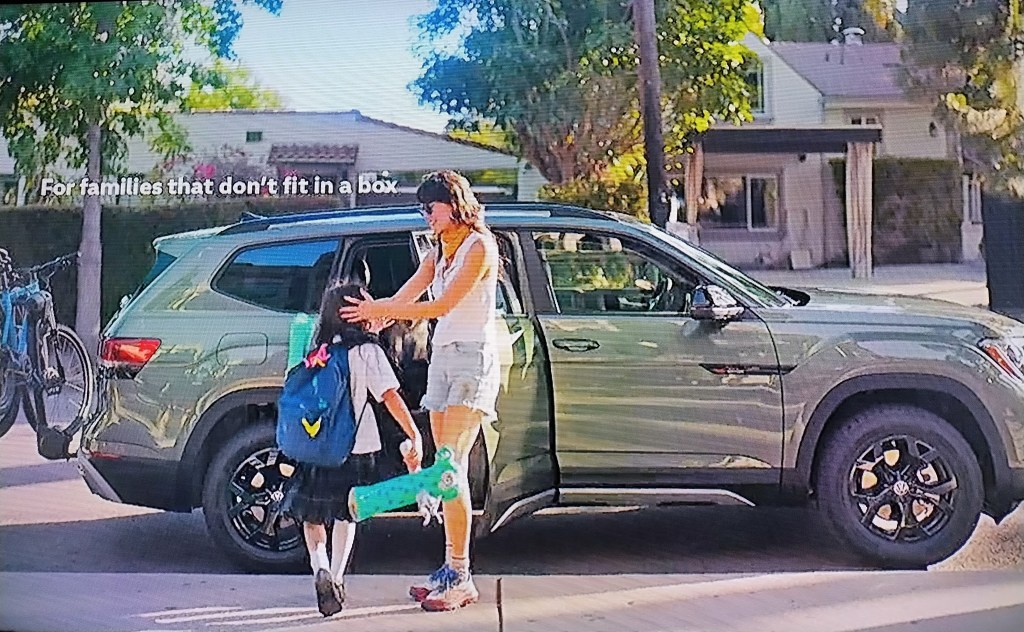
A new Volkswagen TV commercial features the song “Little Boxes” sung by Malvina Reynolds. This song originally critiqued the sprawling mass suburbs of the postwar United States but now is used – and in a remixed version! – to sell an SUV:
Four thoughts related to this advertising campaign:
The song was protesting conformity in sprawl. Does buying a particular SUV counter conformity and sprawl?
The tagline above – “For families that don’t fit in a box” – seems to suggest that people who own this vehicle are doing things outside the box. This vehicle allows you to escape the normal suburban life. Can this happen when almost everyone has an SUV already?
The song said houses were boxes; are SUVs boxes? This particular model might be less boxy than some others but it still looks like a box. Are SUVs cool boxes where as suburban ranches houses were considered by some to be uncool boxes?
If the primary target of this campaign is suburbanites, then a song critiquing suburbia is being used to sell products suburbanites. We have come full circle: do what you can to sell SUVs to suburbanites!
Between 1925 and 1990, the rate of suburbanization differed by Protestant denomination. Some denominations were already more likely to be in the suburbs (their suburban presence predated mass suburbanization), some moved to the suburbs in increasing numbers, and some hardly moved at all. The general pattern among these groups was an increasing percentage of their churches in suburban locations, a process that was underway by the 1930s and 1940s and continued after World War II…
In this study, churches were influenced by settlement patterns in the Chicago region and the presence of numerous churches already existing in suburban communities. In addition, the racial and ethnic identity of some denominations helped dictate their choices for new suburban locations.
This article built on important work by multiple scholars about white flight in the Chicago area. Mark Mulder in Shades of White Flightlooked at how The Christian Reformed Church and The Reformed Church in America churches, both Dutch Reformed denominations, moved to the suburbs. Irving Cutler in The Jews of Chicago examined how Jews moved to suburban communities. Eileen McMahon in What Parish Are You From?analyzed how one Catholic parish responded to changing neighborhood populations, including moving to the suburbs.
As the story is told of American suburbanization, particularly after World War Two, the story should include the role religious institutions and adherents played in supporting white flight. I say more about the ways this played out with evangelicals in Sanctifying Suburbia.
Pope Leo XIV grew up in Dolton, Illinois, a suburb just south of the city of Chicago. Is this a story not just of the first American pope but a pope who grew up in the changing American suburbs? Over the years, what happened in his suburban community that had its first white settlers in the 1830s? First from the Encyclopedia of Chicago:
The mixture of railroads and the Little Calumet River proved to be a good site for industry. Dolton grew as a center for truck farming and manufacturing. It has produced bakery equipment, brass castings, shipping containers, cement, furniture, agricultural equipment, steel tanks, and chemicals. This diverse activity attracted an ethnically varied workforce. In the 1960s the Calumet Expressway (now the Bishop Ford Freeway) improved automobile and truck access to Chicago by two interchanges serving Dolton. In recent years large numbers of African Americans have moved to Dolton. The 2000 census reported a population of 25,614 with 14 percent white, 82 percent black, and 3 percent Hispanic.
According to a table on this page, Dolton was 99.9% white in 1960, 58.1% white in 1990, and 14.3% white in 2000. According to the Census Bureau, Dolton is now 4.9% white.
This is the story of how one small town became trapped in a downward spiral that poverty experts say follows a well-worn pattern of deindustrialization that leads to a disenfranchised economic class. Communities of color inherit a legacy of decline and then lack the resources, both financial and political, needed to turn things around.
The focus is Dolton, but it just as easily could be Riverdale, Harvey, Dixmoor, Posen, Calumet City or other nearby suburbs that once were powered by steel and other industry but over time slowly coalesced into a broad swath of economic distress. In other parts of Illinois, such as North Chicago to the north or Maywood to the west, the details change but the problems are often much the same.
It was no one single thing, but a cascade of events that changed the fortunes of Dolton and its neighbors. The decline of manufacturing led to a loss of job and pay opportunities, which in turn fed a wave of white flight as longtime residents left and were replaced by African-American city dwellers lured by better, yet not too expensive, housing.
But luring new investment to now majority black communities proved a challenge and housing values began to fall, taking down with them the tax revenues needed to keep up public services. Next came widespread foreclosures and an invasion of real estate scavengers who bought houses on the cheap, transforming a community of homeowners with a deep financial stake in their town into one of renters with looser bonds.
All the while, the political fabric vital to turning things around continued to fray. Government stumbled amid patronage and gridlock, rendering even more challenging the task of drawing needed new investment.
His parents had been living in a 1,200-square-foot brick house on East 141st Place in Dolton. They bought it new in 1949, paying a $42 monthly mortgage.
His father Louis Prevost was superintendent of the south suburban schools in District 169. News clippings from 1945 show he served as a Navy lieutenant in the Mediterranean in WWII. He had graduated from the old Central Y.M.C.A. College in 1943 while living in Hyde Park.
The new pope’s mother, Mildred Martinez Prevost, studied library science at DePaul University. Her death notice, in 1990, said she and her husband started the St. Mary’s library in the basement of the old school building and mentions jobs she had in the libraries at Holy Name Cathedral, Von Steuben High School on the North Side and at Mendel from 1969 to 1975.
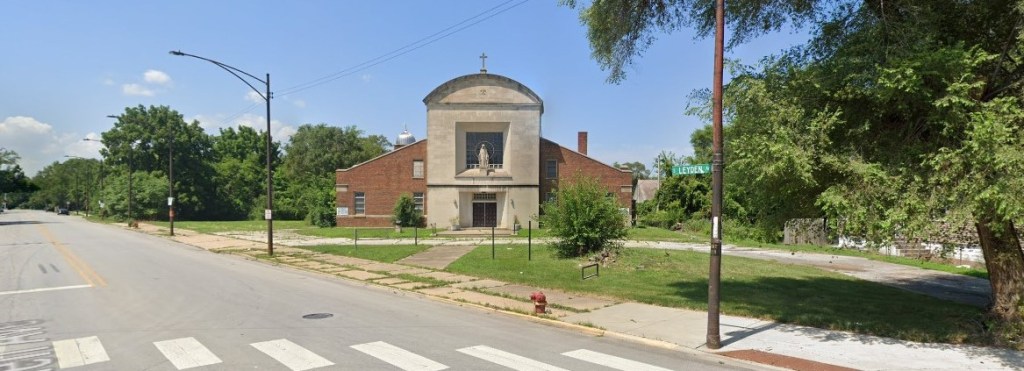
The Prevosts attended a Catholic parish – St. Mary of the Assumption – just inside the southern borders of Chicago and next to the suburbs of Dolton and Riverdale. Here is what the property looked like as of July 2024:
Like St. Mary’s, other Catholic institutions that helped shape the future cardinal are long gone, closed over the past several decades as the Catholic population around where he grew up and elsewhere plummeted. Among those bygone institutions:
• Mendel College Prep High School, where Prevost and his mother worked.
• St. Augustine Seminary High School in Michigan.
• Tolentine College in Olympia Fields, the suburb where he briefly lived.
• Mount Carmel Elementary School in Chicago Heights, where his father was principal.
Several of these communities mentioned – Olympia Fields, Chicago Heights – experienced racial change similar to that of Dolton.
If white Catholic residents indeed left Dolton and other communities on the South Side of Chicago and its southern suburbs and American suburbia became more complex, where did they move to? How did this shape the ministry of Pope Leo XIV?
“As advertised, your on-site, outdoor, retail business use of Property is strictly prohibited and must immediately cease,” the May 16 letter read. Small, at-home businesses are allowed under the village’s House Occupation Code. The catch is they must operate indoors.
Yamamoto has been appealing for about a year, hoping to work with the village to update the zoning code and allow for the farm. He even submitted three separate proposals. The first aimed to tweak the code so that residents can apply for special use permits for agrotourism. The second changed “agrotourism” to “agricultural experiences” and limited what could be sold and the number of people who were allowed on the property. The last proposed a change in the village’s definition of “agricultural activities” — which are already allowed — to include on-site sales…
“The Village’s Zoning Board of Appeals was particularly concerned that under these various proposals, similar outdoor commercial operations could be allowed to occur on every residential single-family property in the Village,” Paul wrote.
But Little Ducky still has support in the community. Several residents showed up to Yamamoto’s first proposal hearing in August 2024, and many more wrote letters. In all, 133 written comments were submitted, with 129 in support and four in opposition. Of those who spoke in person, 16 supported the farm, while three opposed it…
Yamamoto isn’t giving up. He’s already submitted two more applications and has been waiting for a response since February. In the meantime, he and his wife are picking and delivering tulips themselves.
The catch in this case seems to be that indoor businesses are allowed – imagine something involving a home office or a service that can be provided in a home – versus an outdoor operation. That outdoor business could create noise or be unsightly or disrupt the character of a single-family home neighborhood. Residents might be willing to put up with loud power equipment to keep their landscaping looking good (or not) but an outdoor business is a threat.
It will be interesting to see if support from local residents could shift the outcome. Could a one-time variation in the zoning be granted? Or the zoning guidelines changed to allow clearly-defined agricultural uses?
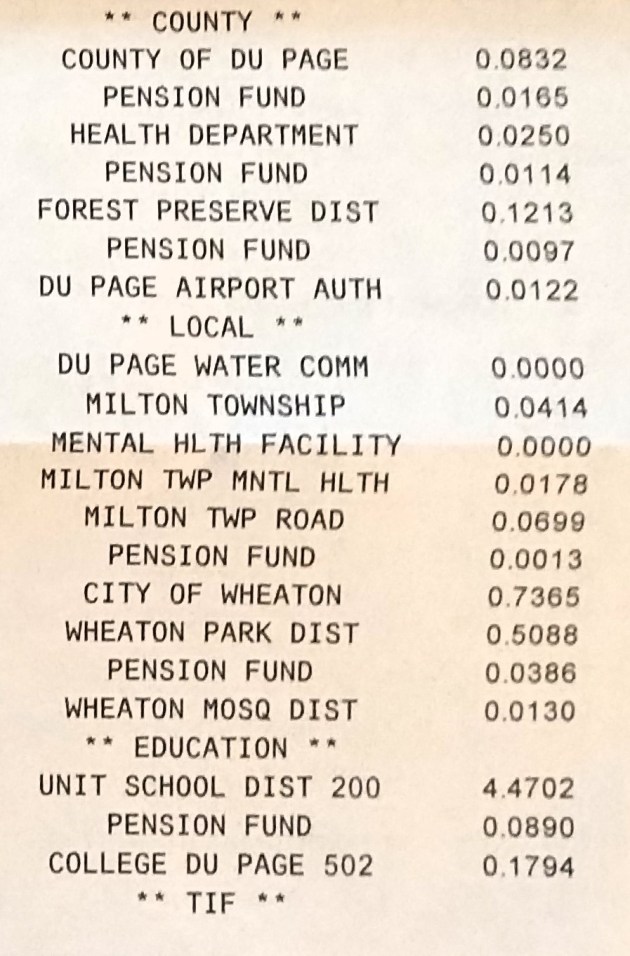
In thinking about recently receiving property tax bills in our county, I wondered what suburbanites would be willing to give up in order to lower their taxes. Here are some thoughts about each of the taxing bodies that receive monies:
-the county: how many people could name exactly what the county provides? Some roads, some medical and social services, some other things. Perhaps some people would rather pay a municipality or a state to do the same things?
-pension funds: I’m guessing taxpayers have little choice here.
-DuPage Airport Authority: how many average residents see the benefits of having a private airport within the county? Perhaps this helps some businesses?
-water commission: getting water is necessary.
-Milton Township with four lines: does the work the township does be carried out by the county or municipalities?
-City of Wheaton: lots of local services, including roads. What would residents want the city to do less of?
-Park District: not everyone participates and facilities and programs can be costly. But is the alternative all private options?
-mosquito district: who likes mosquitos?
-K-12 school district: the tax costs are high but what suburbanites want lower quality schools (which then they often associate with property values)? Or how many people want less money for the next generation?
-Community College district: with the costs of college these days, would people be willing to have a smaller community college or no community college option?
Consider these all together and the tax money goes towards schools, roads, public health, and more. Perhaps the argument could be made that these same services could be provided more efficiently or at better scales. This might save some money but does not necessarily address the long-term issues of rising costs and the need to update and maintain vital infrastructure. And if voters restrict one source of funding – such as limiting property taxes in California – then governments will seek revenues elsewhere.
Is it possible to consider all of these taxes at once rather than considering them one a time through referendums or each body making decisions that are best for them?
Similarly, Dr. Gans challenged conventional wisdom about postwar suburbia in “The Levittowners” (1967). For more than two years, he lived in Levittown, N.J., later renamed Willingboro, and concluded that the residents had strong social, economic and political commitments, and that notions of suburbanites as conformist, anxious, bored, cultureless, insecure social climbers were wrong.
Gans moved into one of Levittowns, located in New Jersey, in its infancy and lived there for several years. The book challenged several critiques of mass produced suburbs including homogeneity, blandness, and that suburbs damaged families and individuals. However, Gans suggested Levittown had its own problems including limited activities and space for teenagers, ongoing conflict, difficulty engaging with pluralism, and unresolved tensions between private home life and community structures.
For example, here is what Gans concluded about what shaped the community in the new suburb:
Perhaps the most significant fact about the origin of a new community is that it is not new at all, but only a new physical site on which people develop conventional institutions with traditional programs. New towns are ultimately old communities on new land, culturally not significantly different from suburban subdivisions and urban neighborhoods inhabited by the same kinds of people, and politically much like other small American towns. (408)
On this point, he thought the Levittowners showed similar characteristics to what De Toqueville found in American civil society.
At the same time, he expressed critiques of the new suburban life. Here are my notes from pages 431-432 about his recommendations: “(1) most important priority for future suburban planning is the population mix (2) suburbia must be made available to all who can and want to come – especially made available to poor and nonwhite families (3) communities should be planned with block homogeneity and community heterogeneity.”
Many others have studied suburban life and communities but this thorough study set a high bar.
I have also heard this critique applied to retail spaces, Disney World, and resorts. They project one image but they are not what they seem. They are real places – you can walk around, you can buy things, etc. – but not real at the same time. They lack authenticity. (This might imply there are places that are authentic, not imitations. They are what they are. This is another matter.)
Are there suburbs that are real places, where the facade is not a facade, that feel like what they actually are? Or suburbs that are honest about the challenges they face alongside the possibilities they might offer? How accurate is the narrative that the American suburbs are inauthentic or is this more prevalent in cultural works?
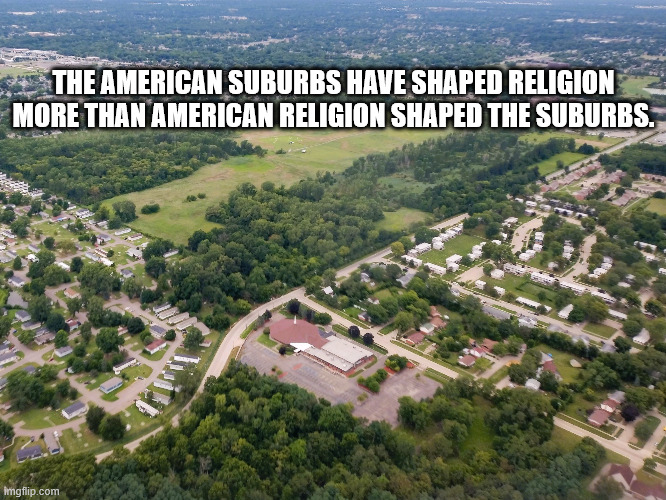
I have been studying and writing about religion in the American suburbs for about ten years now. After recently publishing a book on evangelicals embracing suburbia – Sanctifying Suburbia– and more recently also looking at a variety of religious traditions over time in the Chicago suburbs, I had this thought:
This is a broad statement. But if I were to put the two social forces side by side – suburbanization in the United States and religion (and all that entails) in the United States – I would come down on suburbs affecting religion more than the opposite. Here is a couple of ways to think about:
As religious groups have moved to the suburbs, whether Catholic, Protestant, Muslim, Jewish, or others, they often have to adapt to suburban settings.
How much do religious congregations, organizations, and adherents in suburbia shape community life or social life at the structural level (beyond individuals, small groups, some social networks, more micro level)? Another way to put it: if these religious groups were not present, how different would suburban life be?
I am going to keep thinking about this claim and may write more about it. Even as religion has served to provide meaning and structure for many humans and societies across time and space, suburbia is a powerful place and ideology.






 Legally Sociable