Enjoying late summer warm waters in Lake Michigan

A late summer swim in Lake Michigan can be exciting. It is early September or even later and you test out the water. Dip a toe in. See if it is warm. And sometimes it is. Warm enough to jump in, swim, play. Even if school has started or fall seems to have already begun (even if it is not “officially” started by the calendar) or municipal pools have already closed, the warm waters of the lake prolong summer.

As someone who has visited Lake Michigan throughout my life, these are good moments. Lake Michigan is not always warm enough for swimming, whether testing out the chilly waters at Memorial Day or finding that a change to a north wind overnight has cooled the water temperature too much.

There may be more late summer days like this in the future as the Great Lakes are warming:

Lake Michigan is heating up. The lake’s surface temperature has surpassed the running average dating back to 1995 nearly every day this year, according to National Oceanic and Atmospheric Administration (NOAA) data. And it’s not just one Great Lake. All five are warming. The massive bodies of water, which provide drinking water to more than 30 million people, are among the fastest-warming lakes worldwide, according to the federal government’s Fifth National Climate Assessment.

It’s a trend that doesn’t show any sign of slowing. As heat trapping-greenhouse gasses continue to accumulate in the atmosphere, the Great Lakes region is projected to grow warmer and wetter in the years and decades to come. Over a fifth of the world’s supply of non-frozen freshwater flows through the five connected Great Lakes, forming the Earth’s largest freshwater ecosystem.

Beyond a longer swimming season, might this lead to more Great Lakes tourism? Different conditions (algae, different fish, etc.) for swimmers and other recreational users of the lake? Will the lake remain an attractive place to visit?
Suburban sounds near the start of fall

During the pandemic, some who were at home described the noises they heard from their residences that they may have missed in going to work regularly or being out more.

As summer winds down on the calendar and fall approaches, I noticed some different sounds in the suburbs. I described some of the suburban noises of summer back in 2018. Here are a few of the notable changes heading into a new season:

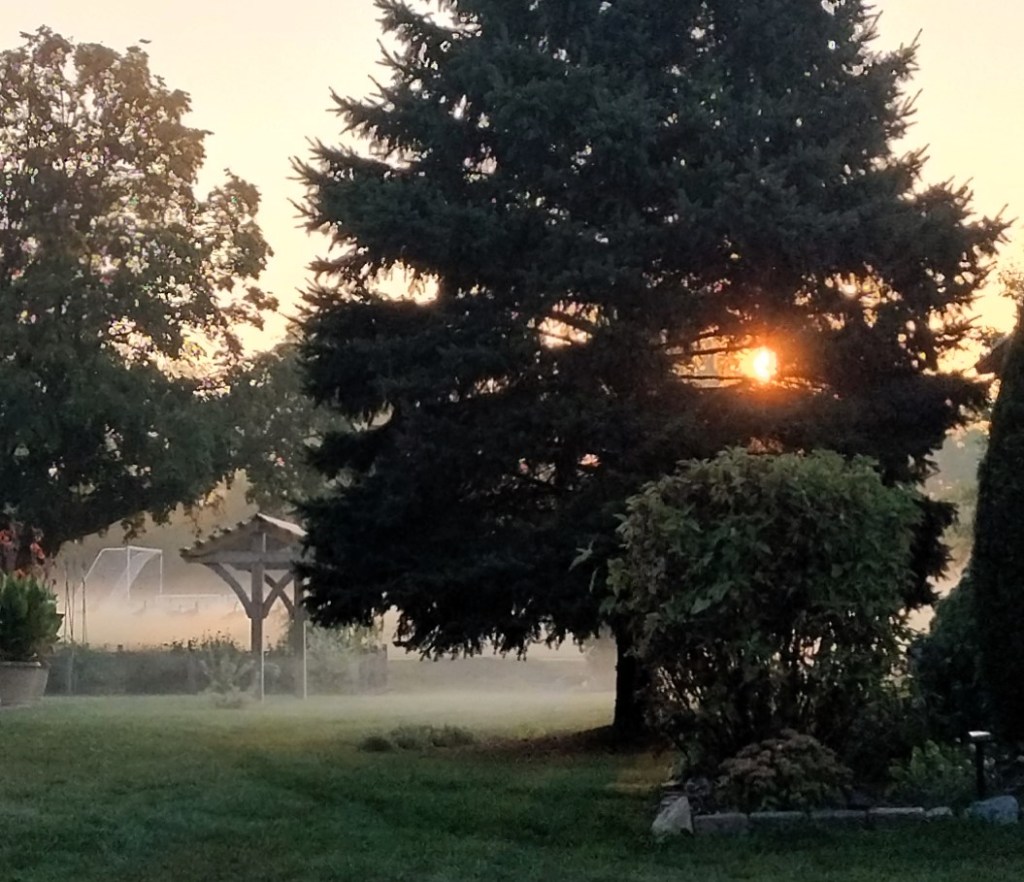
-Geese flying overhead regularly and standing around in fields and near water. The picture above includes geese honking and milling around in the early morning suburban mist on a soccer field set up for the fall season.

-Fewer lawnmowers at work and less yard work noise. It also has not rained much recently. The spring and summer hum of outdoor machines has lessened.

-The occasional sound of marching band practices and performances. We are more than a mile from a high school but we can hear the band at work (cannot hear cheering).

-No cicadas at this point of the year, particularly compared to earlier this summer in our area.

-Less noise from kids in the neighborhood during the day with school in session. Of course, people living near schools likely hear a lot more noise now during the middle of the day compared to the summer.

This is a particular suburban soundscape soon to change with leaves blowing around and crunching underfoot and later snow dampening outdoor noise.

The growth of the South required air conditioning

The South is hot during the summer – especially so this year – and architectural adaptations to deal with the heat have given way to air conditioning:

Photo by Airam Dato-on on Pexels.com

“They would build homes with transoms over the doors and over the windows,” Dr. Diaz explained. “They would build homes with the front door and the back door in complete alignment — you could basically create a wind current through the house.”

Days were structured around the heat, waking at 4 a.m. to work outside, then taking breaks and eating a big meal in the middle of the day…

The ascendance of air-conditioning was a transformative force in the South, facilitating the rise of suburbs and making the region less forbidding for companies that wanted to move in. Now, transoms and rising early have been replaced with drive-throughs and attached garages and cranking up the A.C. — for people with the means and jobs that allow it.

“People are so completely dependent on air-conditioning,” said Craig E. Colten, a professor of geography at Louisiana State University. “You run around on our campus and you see people going between classes in shorts and sweatshirts because the air-conditioning is so ramped up.”

Even as air conditioning makes inside activity more possible, it would be interesting to see how much activity during the hot months takes place inside compared to the rest of the year. If people in colder climes spend more time inside during the cold months, is the same true in the South during the summer?

And do not forget the importance of air conditioning for office work.

The problem of summer (and many other) days: too many fun things to do

As summer winds down and school starts up again, I am reminded of something I experience every summer and throughout much of the year: there are more fun things to do each day than I am able to do. Here is an incomplete list of activities I want more time for each day:

Photo by Tran on Pexels.com

-Reading

-Watching interesting TV shows and movies

-Seeing more of family and friends

-Playing board games

-Enjoying the outdoors

-Playing and listening to music

-Advancing writing/research projects

I do not often feel bad about not being able to do all this. Rather, I am excited to get to the next day(s) and to continue these activities. I cannot keep up with everything I want to do but with steady progress there is much to enjoy.

(As a side note, the conversations in recent years about a glut of content in television and online hint at a bigger glut: life offers a lot of possible experiences. For example, I read regularly but there is not enough time to get to everything I want to read, should read, and need to read to keep up with my field and interests.)

The start to social distancing summer

As the weather warms up, people want to get back to summer activities: going to the beach, taking vacations, outdoor gatherings with family and friends, barbequing, outdoor festivals and performances, and more. How much of this is possible? A few thoughts connected to recent posts:

  1. If consumption is indeed down, this will be disastrous for many communities. Already, local finances are in trouble but without infusions of cash from tourists, many places will struggle.
  2. Americans like to drive; is the summer road trip possible in many parts of the United States?
  3. Certain outdoor activities will be okay in many places. But, this is reliant on either having large spaces where people can spread out or in private spaces with fewer people. Large beaches will be okay, smaller settings (thinking of some of Chicago’s smaller beaches) may be more problematic. Having a cookout in a backyard is fine while having a bunch of people in a confined space for a concert will cause more issues. Walking and biking are made easier with warmer weather.
  1. Does warmer weather increase sociability? This is when physical distancing might be a more appropriate term than social distancing as people seek to be outside more and inevitably interact with more people.
  2. With disparities in COVID-19 cases across locations and groups, will some groups have a more typical summer while others will face heavier restrictions?
  3. A summer without sports is hard to imagine. How will people get around this or seek alternatives?

With Memorial Day almost here, we will see what happens.

Summer break widens achievement gap

Summer break may be welcomed by children but research shows that it contributes greatly to the achievement gap between students of different backgrounds:

Consider, first, the evidence for the summer fade effect. Taken together, a variety of studies indicate that students’ academic skills atrophy during the summer months by an amount equivalent to what they learn in a third of a school year, according to a review by Harris Cooper, a professor of education at Duke University, and several co-authors.

This deterioration, furthermore, varies substantially by income and race, and its impact persists even past childhood. Barbara Heyns, a sociologist at New York University who studied Atlanta schoolchildren in the late 1970s, found that although academic gains during the school year were not substantially correlated with income, summer decline was.

Subsequent studies have replicated the finding. Karl Alexander, Doris Entwisle and Linda Olson of Johns Hopkins University, for example, found that the summer fade can largely explain why the gap in skills between children on either side of the socioeconomic divide widens as students progress through elementary school. Children from all backgrounds learn at similar rates during the school year, but each summer students of high socioeconomic status continue to learn while those of low socioeconomic status fall behind.

The impact is felt even years later. The learning differences that begin in grade school “substantially account” for differences by socioeconomic status in high-school graduation rates and in four-year college attendance, Alexander and his co-authors report.

This article adds some more information:

Many low-income kids actually make great progress in school from August to June, only to see much of it wiped away by an idle summer, he says. “We need to get over ourselves a little bit over our idyllic view of what summer is and what it’s supposed to be,” he adds.

A 2007 study by Johns Hopkins University researchers found that by the time students enter high school, “summer learning loss” accounts for roughly two-thirds of the nation’s achievement gap in reading between poor and middle-class students.

If the evidence is clear, how long until more districts go to reduced summer breaks or year-round school? Overcoming the culture of summer break could be difficult to do. Also, might we have a situation where wealthier districts continue summer break while less well-off districts try to combat this summer achievement decline?

Quick Review: Fall

With classes starting today, I thought I would make the argument that Fall (loosely defined here as late August to late November) is the best season of the year. Here are the reasons:

1. School starts. I’ve always enjoyed school. Now as a professor, it feels good to get back into the classroom and see energetic students again. There is always lots to do. The academic calendar has started anew.

2. The weather improves. I’m not a big fan of really hot summer weather and Chicago has been above normal hot this year. I enjoy the cool edge on the breeze. Today’s weather of about 77 degrees with sunny skies was perfect for the first day of school. And I can’t wait for the chillier days when it feels good to sit inside and read but is still pleasant enough outside to not need a heavy coat.

3. The sports world picks up. After a stretch with only baseball on the air, football, basketball, and hockey start. I enjoy watching both the professional and collegiate level and by October, there is quite a variety of action.

4. Special days. Labor Day is the unofficial end of summer (and summer break), my birthday rolls around, and I enjoy looking forward to Thanksgiving and Christmas.

I know others would disagree with me but I’m planning to enjoy the next few months.

Changing dumpsters into swimming pools

In New York City, officials are hosting a summer program that includes swimming pools made out of dumpsters.

This is the kind of creative thinking that many cities could benefit from. Of course, it only sounds like there are a few of these pools being run by the city and they are each quite small. However, it is a clever reuse of a common object to bring some joy into summer life in the city. And the designer suggests they are cheap to put together.

Summer heat and society

The heat of the summer is often equated with positive things: sun, outdoor activities, the beach, and driving with the windows open or convertible top down.

But the heat can also cause and expose issues in a society. In Russia, there has been record heat and a staggering number of deaths:

On Monday, Moscow health authorities announced that the number of deaths each day in the capital had nearly doubled to 700 as most of central Russia entered the seventh week of a heat wave. The high temperatures, hovering around 100 degrees, have destroyed 30% of the nation’s grain crops and triggered massive peat bog and forest fires that alone have killed more than 50 people and devastated dozens of villages.

Andrei Seltsovsky, chief of Moscow’s health department, said the city’s morgues were filled almost to capacity, with 1,300 of the 1,500 slots taken. He suggested that residents, instead of following Russian Orthodox tradition of holding burials on the third day after death, bury loved ones sooner.

This sort of event is not isolated to Moscow. Something similar happened in Chicago in 1995. Sociologist Eric Klinenberg wrote about the summer in the book Heat Wave: Social Autopsy of a Disaster in Chicago. In an interview, Klinenberg discussed the book. There were some controversy over the “official death count.” Cook County’s chief medical examiner reported 465 deaths related to the heat for the hottest week but the numbers were disputed by Mayor Daley.

Additionally, the death rates differed by race:

The actual death tolls for African Americans and whites were almost identical, but those numbers are misleading. There are far more elderly whites than elderly African Americans in Chicago, and when the Chicago Public Health Department considered the age differences, they found that the black/white mortality ratio was 1.5 to 1. Another surprising fact that emerged is that Latinos, who represent about 25 percent of the city population and are disproportionately poor and sick, accounted for only 2 percent of the heat-related deaths.

So heat can help expose the disadvantaged in society, those who have no or little access to air conditioning, are often alone, and have no one to check in on them. Since that summer in Chicago, the city has opened “cooling centers” (which are available now all over the state of Illinois) to provide a place for those who don’t have other options. Measures like these have cut down on heat-related deaths in Chicago – it remains to be seen what Moscow will do to help with this current and future heat waves.

Ending summer vacation

Time makes an argument for ending the typical American summer vacation from school. Numerous studies indicate that children lose ground during the summer and low-income students lose a lot of ground:

And what starts as a hiccup in a 6-year-old’s education can be a crisis by the time that child reaches high school. A major study by researchers at Johns Hopkins University concluded that while students made similar progress during the school year, regardless of economic status, the better-off kids held steady or continued to advance during the summer — while disadvantaged students fell back. By the end of grammar school, low-income students had fallen nearly three grade levels behind. By ninth grade, roughly two-thirds of the learning gap separating income groups could be blamed on summer learning loss.
The article also mentions the romanticism linked with summer vacation: trips, outdoor activity, freedom. This seems particularly crucial for American teenagerdom when teenagers get a first taste of being away from their parents. Even though I really liked school, I did enjoy summer vacation and all the options that were available to me (which not everyone has).
Would it be too difficult to split the summer vacation into two sections of about a month or a month and a half long? This seems like a reasonable compromise: some time off for everyone, shorter gaps for students to lose knowledge.