The pandemic gives residents to some places, the years afterward take them away

What happened to the places that gained residents during the pandemic? Some are now experiencing less growth:

Photo by Tracey Mahoney on Pexels.com

Flash forward to today, and the big “winners” of the work-from-home reshuffle — metros that drew hordes of footloose workers and disaffected coastal dwellers — have turned into losers. Fewer people are moving to so-called Zoomtowns. Home listings are piling up on the market. Prices are dropping. The anxiety has shifted from buyers trying to elbow their way in to sellers just trying to offload their properties. A new report by the real estate analytics firm Parcl Labs, shared exclusively with Business Insider, shows that home sellers in the lower half of the US, also known as the Sun Belt, are the most desperate in the country…

Housing demand surged early in the pandemic — the country’s homeowning ranks swelled by a whopping 2.2 million people between the first quarter of 2020 and the same point in 2022, an analysis by the Harvard Joint Center for Housing Studies shows. But for all the talk of upheaval, movers more or less stuck to those pre-pandemic flight patterns — just at warp speed. People kept migrating from big-city centers to the suburbs and from the North to the South. Sun Belt states, including Florida, Texas, Arizona, and North Carolina, experienced the largest population gains from domestic migration between mid-2020 and mid-2021, per a Harvard analysis of Census data. The Dallas metro, for example, gained around 63,000 people from other parts of the country that year, a huge jump from just 19,000 the year prior. Phoenix, Tampa, Austin, and Charlotte recorded similar increases. Expensive states with large urban areas, including California, New York, Illinois, and Massachusetts, saw the biggest losses…

The North-to-South movement still holds, but the North is losing fewer people, and the South isn’t gaining like it once was. The most recent numbers, for the yearlong period ending in mid-2024, show net domestic migration to the South was down almost 38% compared to the first year of the pandemic. Domestic migration to the Midwest, on the other hand, is up about 60% in that same period, though it’s still negative in absolute terms. The Northeast’s net loss was down to 192,000 in the latest tally, compared to a loss of 390,000 at the height of the pandemic. With the migration tide receding, sellers in once-hot metros are getting real. In Denver, Charlotte, Jacksonville, and a smattering of other Sun Belt markets, more than half of single-family homes for sale have seen a price cut, Parcl Labs data shows. In the Boston, Philadelphia, and Buffalo metros, the share of listings in that bucket drops to fewer than a third.

That’s just one metric. To gauge sellers’ desperation these days, Parcl Labs created what it calls the Motivated Sellers Index, which combines four factors: the number of price cuts on home listings, the time in between those cuts, the size of the price decreases, and the length of time homes are spending on the market. The higher the score, the greater the homeowners’ urgency to sell. The lower half of the US, with the exception of much of California, is awash in high scores, indicating sellers are ceding negotiating power to buyers. Same goes for much of the West. The Midwest and Northeast, on the other hand, registered some of the lowest scores in the nation: Sellers there are sitting pretty by comparison.

This is something I have wondered about a lot in recent years and even addressed, with Ben Norquist, in a chapter in my book Sanctifying Suburbia: in today’s world of smartphones, the Internet, and easy travel, why do people and organizations stay where they do when they could be located almost anywhere?

Evangelical non-profits described the benefits of being near other evangelical organizations. They thought they could find employees in certain places and could partner with other actors in the community. Some had long histories in their community while others had made a major move to help their budget.

Residents do not just go where there is cheap housing or plenty of jobs. They have ties to places and people. Moving comes with its own costs.

So some more people moved related to the pandemic following similar patterns in previous decades: away from metro areas in the Northeast and Midwest to the South and West. And that appears to be continuing, but at a slower pace and with some indicators that the rapid growth in the South and West is slowing. What does this all mean?

Perhaps the pandemic years were an aberration. Yes, people can work from home but this is not what all companies and organizations want. Bring a bunch of new people to new places and the housing prices go up and the communities change.

Does this mean all that movement would stop completely? Or that places in the Northeast and Midwest would grow? Not necessarily. Long-term patterns are hard to break.

NIMBY has come to sprawling Sun Belt metropolitan areas

Recent research looks at why housing costs have increased so much around numerous Sun Belt cities:

Photo by lil artsy on Pexels.com

Although the Sun Belt continues to build far more housing than the coasts in absolute terms, Glaeser and Gyourko find that the rate of building in most Sun Belt cities has fallen by more than half over the past 25 years, in some cases by much more, even as demand to live in those places has surged. “When it comes to new housing production, the Sun Belt cities today are basically at the point that the big coastal cities were 20 years ago,” Gyourko told me. This explains why home prices in the Sun Belt, though still low compared with those in San Francisco and New York, have risen so sharply since the mid-2010s—a trend that accelerated during the pandemic, as the rise of remote work led to a large migration out of high-cost cities…

The Sun Belt, in short, is subject to the same antidevelopment forces as the coasts; it just took longer to trigger them. Cities in the South and Southwest have portrayed themselves as business-friendly, pro-growth metros. In reality, their land-use laws aren’t so different from those in blue-state cities. According to a 2018 research paper, co-authored by Gyourko, that surveyed 44 major U.S. metro areas, land-use regulations in Miami and Phoenix both ranked in the top 10 most restrictive (just behind Washington, D.C., and L.A. and ahead of Boston), and Dallas and Nashville were in the top 25. Because the survey is based on responses from local governments, it might understate just how bad zoning in the Sun Belt is. “When I first opened up the zoning code for Atlanta, I almost spit out my coffee,” Alex Armlovich, a senior housing-policy analyst at the Niskanen Center, a centrist think tank, told me. “It’s almost identical to L.A. in the 1990s.”

These restrictive rules weren’t a problem back when Sun Belt cities could expand by building new single-family homes at their exurban fringes indefinitely. That kind of development is less likely to be subject to zoning laws; even when it is, obtaining exceptions to those laws is relatively easy because neighbors who might oppose new development don’t exist yet. Recently, however, many Sun Belt cities have begun hitting limits to their outward sprawl, either because they’ve run into natural obstacles (such as the Everglades in Miami and tribal lands near Phoenix) or because they’ve already expanded to the edge of reasonable commute distances (as appears to be the case in Atlanta and Dallas). To keep growing, these cities will have to find ways to increase the density of their existing urban cores and suburbs. That is a much more difficult proposition. “This is exactly what happened in many coastal cities in the 1980s and ’90s,” Armlovich told me. “Once you run out of room to sprawl, suddenly your zoning code starts becoming a real limitation.”

Glaeser and Gyourko go one step further. They hypothesize that as Sun Belt cities have become more affluent and highly educated, their residents have become more willing and able to use existing laws and regulations to block new development. They point to two main pieces of evidence. First, for a given city, the slowdown in new housing development strongly correlates with a rising share of college-educated residents. Second, within cities, the neighborhoods where housing production has slowed the most are lower-density, affluent suburbs populated with relatively well-off, highly educated professionals. In other words, anti-growth NIMBYism might be a perverse but natural consequence of growth: As demand to live in a place increases, it attracts the kind of people who are more likely to oppose new development, and who have the time and resources to do so. “We used to think that people in Miami, Dallas, Phoenix behaved differently than people in Boston and San Francisco,” Gyourko told me. “That clearly isn’t the case.”

This is an interesting American phenomenon: people benefit from moving to new development that they can afford and then later they resist efforts to offer some of the same opportunities to others who might want to live in the same places but happened to get there later. The residents would surely talk about changes more development would bring. Countless examples of arguments about changes in character, more traffic, more noise, how those who live in apartments do not contribute to the community in the same way. These residents found suburbia just as they loved it and they often do not want it to change. I have seen this across my research and unless there is a major movement in the other direction, it seems like it is going to continue.

This puts people today in difficult situations. Can sprawl keep going and going beyond what already exists? How many people have the resources to live in places with higher housing costs? Will new places become the Sun Belt of today? How these questions are answered will affect American metropolitan regions in the decades to come.

Why people move to Phoenix (and similar locations)

The Sun Belt has boomed in population and some cannot seem to figure out why. A historian explores the appeal of Phoenix:

Photo by Yigithan Bal on Pexels.com

“Why would anyone live in Phoenix?” You might ask that question to the many hundreds of thousands of new residents who have made the Arizona metropolis America’s fastest-growing city. Last year, Maricopa County, where Phoenix sits, gained more residents than any other county in the United States—just as it did in 2021, 2019, 2018, and 2017.

At its core, the question makes a mystery of something that isn’t a mystery at all. For many people, living in Phoenix makes perfect sense. Pleasant temperatures most of the year, relatively inexpensive housing, and a steady increase in economic opportunities have drawn people for 80 years, turning the city from a small desert outpost of 65,000 into a sprawling metro area of more than 5 million. Along the way, a series of innovations has made the heat seem like a temporary inconvenience rather than an existential threat for many residents. Perhaps not even a heat wave like this one will change anything…

Outside the summer months, the quality of life in Phoenix is really quite high—a fact that city boosters have promoted stretching back to before World War II. They traded the desiccated “Salt River Valley” for the welcoming “Valley of the Sun.” Efforts to downplay the dangers of Phoenix’s climate go back even further. In 1895, when Phoenix was home to a few thousand people, a local newspaper reported that it had been proved “by figures and facts” that the heat is “all a joke,” because the “sensible temperature” that people experienced was far less severe than what the thermometers recorded. “But it’s a dry heat” has a long history, one in which generations of prospective newcomers have been taught to perceive Phoenix’s climate as more beneficial than oppressive.

Most people surely move to Phoenix not because of the weather, but because of the housing. The Valley of the Sun’s ongoing commitment to new housing development continues to keep housing prices well below those of neighboring California, drawing many emigrants priced out of the Golden State. Subdivisions have popped up in irrigated farm fields seemingly overnight. In 1955, as the home builder John F. Long was constructing Maryvale, then on Phoenix’s western edge, he quickly turned a cantaloupe farm into seven model homes. Five years later, more than 22,000 people lived in the neighborhood; now more than 200,000 do. Even today, the speed of construction can create confusion, as residents puzzle over the location of Heartland Ranch or Copper Falls or other new subdivisions that include most of the 250,000 homes built since 2010…

“Why would anyone live in Phoenix?” serves as nothing more than a defensive mechanism. It makes peculiar the choices that huge numbers of Americans have made, often under economic duress—choices to move to the warm climates of the Sun Belt, to move where housing is affordable, to ignore where energy comes from and the inequalities it creates, and, above all, to downplay the threats of climate change. In that way, Phoenix isn’t the exception. It’s the norm.

Another way to put this: Phoenix and similar places embody the suburban boom in the United States. They offer cheap homes away from more established settlements in the United States. Sure, it involves a lot of driving, hot weather, and uses many resources but it appears to offer a pathway to comfort and convenience.

At some point, such growth may not be possible. For example, water supplies might not hold up. Or, Americans might decide a car-dependent life is no longer as desirable.

Another big factor that might slow growth is rising housing prices. If cheaper housing is indeed driving many people to Phoenix, more expensive housing might send people elsewhere. Phoenix is not the cheapest market people could go to. Right now it is popular and growing but this does not necessarily have to last.

The later costs of sprawl

One writer suggests the sprawl of the Sun Belt leads to significant costs down the road:

Photo by Life Of Pix on Pexels.com

Over time, growth has reduced those advantages. Jobs and people moving to states like Texas and Georgia slowly bid up the price of land and labor. Ample spare capacity for land and transportation infrastructure — think six-lane highways — let sprawl be a growth outlet for decades, but over time congestion and distance from airports and job centers raised the cost of sprawl as well. The 2008 financial crisis arguably busted the sprawl model in the largest Sun Belt metros of Houston, Dallas and Atlanta, where until the onset of the pandemic single-family building permits had lapsed to 35% below the 2006 highs, despite those metros still having reputations for sprawl and fast growth…

What’s needed to maintain past growth momentum and meet the expectations of these new populations is a continued push up the value chain towards local economies based on knowledge work, with higher-paying jobs and college-educated workers. The specific services or investments needed to lure these types of jobs and workers will shift with the political winds — it might be a greater investment in schools and universal pre-K programs today, and transportation infrastructure tomorrow. It’s the same kind of policy arms race these communities have been accustomed to for decades, only with more services replacing low taxes as the policy lever.

For now, the most likely tweaks to the governance model will probably be incremental — stormwater improvements, sidewalk construction and other “complete streets” projects, modest increases to educational funding — simply because the votes aren’t there to raise taxes enough for the kind of revenue needed for bigger changes.

But these tensions aren’t going away. It’s eventually going to require larger investments than current leaders and older voters are willing to make. Ultimately, the choice for these communities is to spend the money needed to stay competitive in the new arms race, or lose out to places that will.

In the United States, growth is good. Communities need to grow to show that they are exciting, thriving places. New residents and businesses signal good things to come.

But, the piece quoted above notes the longer-term possibilities of such growth. What happens after the fast growth slows or ends? Is it sustainable? How do communities switch from fast growth to mature growth or stability? My own research in the Chicago suburbs suggests this is not necessarily an easy switch. When the land starts to or does run out, communities have to make important decisions. Should they grow through increased density and/or allow taller buildings? How much will it cost to maintain all of the existing infrastructure? How much redevelopment or teardowns will take place? Even during the high growth periods, the costs can increase – see battles within sprawl over the costs for new schools and who pays – let alone as the sprawling areas age.

More broadly, what happens to sprawling suburbs decades after the sprawl has ended? We can now look back at numerous postwar suburbs and see what happened. The Levittowns always draw some attention for the ways they changed and are still the same. Many of these suburbs are over a half century old (though others are newer). These communities revolve around single-family homes and driving, among other things, and this might continue for decades. Or, it might not if conditions and ideologies change.

Planning for more Sun Belt passenger train routes

Even though the United States has struggled to build and use passenger rail between major cities, the CEO of Amtrak suggests that shift in where Americans live means there are new opportunities:

Photo by Pixabay on Pexels.com

There’s 100 million more people in the United States today than there were when Amtrak was created in 1971. And if you look about the shift of where people moved to and where they have moved from, there are 20, 25 dense corridors across our nation where Amtrak has little to no service. And that’s where people have moved to. Think about the corridors in Arizona, between Phoenix and Tucson and Flagstaff, and the route between Las Vegas and Southern California. Look at the growth that we’ve experienced in the Carolinas, for example, from Raleigh to Charlotte and Greensboro and Winston-Salem—we started the service there a couple of years ago with two trains a day, and we’re looking to grow that to six trains a day along that route.

A lot of the growth I’m talking about here would occur on corridors we already serve, but we’re only serving them once a day. Another that comes to mind is Nashville to Atlanta, with stops in Chattanooga. Try to fly that. There’s no service there. It’s a major corridor. It’s an integrated economy. I could go on and on, but I believe these areas of opportunity allow us, over the next 20-year period of time, to double our ridership.

The logic sounds similar to what has been proposed for the Midwest and other corridors in the United States: look to provide good quality passenger train service between cities where the distance means that flying is not that convenient. But, the geography in the example above has shifted from the Midwest, Northeast, or California corridors to the growing Sun Belt where there are plenty of highways but not as many other transit options.

Thinking more about these Sun Belt corridors, it seems like the Amtrak service is waiting for a critical mass of potential riders as opposed to thinking ahead of the population growth. Take the Nashville to Atlanta corridor. These areas have been growing for several decades: the city of Nashville boomed first in the 1960s and then has expanded from nearly 450,000 residents in 1970 to over 670,000 residents in 2019 while the Atlanta metropolitan region grew from just under a million residents in 1950 to over 6 million in 2019. Is it too late for Amtrak to get started with a thriving service or do they demand from potential riders to even consider boosting the amount of service? Imagine if Amtrak had planned for all of this five decades ago and connected the Sun Belt with numerous routes; how might this have affected population growth and transportation patterns? Could the United States have had a sprawling postwar era full of railroad passenger lines?

Chicago slowly losing population and a few suburban counties barely gaining people

The population of Chicago has declined slightly in recent years. New figures suggest that the population in four surrounding counties have increased slightly.

Photo by sergio souza on Pexels.com

The study showed the Chicago region as a whole was estimated to have lost 4,279 people between 2010 and 2019, a 0.05% decrease. The region, with a population of nearly 8.5 million, includes Cook and the five collar counties plus Kendall County.

Over the same time period, DuPage County grew by 2,575 people, or 0.28%. Will County grew by 7,207, or 1.06%, and Kane County grew by 9,502 people, or 1.82%.

Kendall County saw the highest rate of increase of any Illinois county, growing by 6.65%, or 7,860 people…

Growth in Kane, DuPage, Kendall and Will is likely tied to people already in the region moving farther into the suburbs, he said, and to better job growth in the Chicago area than elsewhere in the state.

If one was just reading headlines, this sounds like a big contrast: Chicago is losing residents and suburban counties are gaining them.

The actual estimates present a more complicated story about recent years. Chicago has barely lost any residents. The suburban counties have barely gained any residents. The region as a whole is relatively stagnant regarding population. The state of Illinois has lost a lot of residents but not necessarily from the Chicago region.

Even though this is not a story of massive population loss in recent years in the Chicago region, stagnant populations are usually not regarded as positive. For American communities, growth is good. And populations are not stagnant or declining everywhere; people in Illinois and other locations with population issues can see that other parts of the country are booming. In particular, Sunbelt metropolitan areas are growing at rapid rates.

This is not a new position for the Chicago region. For decades, the city and suburbs have considered the effects of a decline in Chicago’s population (and a rebound for a while) and a growing metropolitan region. Yet, other places are growing faster. Chicagoland is not in the same category as some other Rust Belt metropolitan areas but it is not exactly the attractive location that some other places are.

Losing population in other Illinois cities

Chicago gets a lot of attention for losing population but it is not the only Illinois city facing that issue:

RockfordCityWebsiteJune1120

Rockford, Illinois website – https://rockfordil.gov/

Decatur, in central Illinois about 40 miles east of Springfield, has lost 7.1% of its population since the 2010 census, according to the recently released 2019 population estimates. That drop is the third-largest percentage loss in the U.S. among cities with a population of 50,000 or more. Rockford comes in at No. 15 on that list. The northern Illinois city, the fifth-largest in the state with an estimated 145,609 residents, has lost 5% of its population during that nine-year period.

Rockford’s total population loss of 7,676 people over the last decade places it ninth nationwide among large cities, according to the U.S. Census Bureau, with Decatur (-5,385) at No. 15. Four of the five cities that have lost the most people since the last census are in the Midwest. Detroit has lost the most people, about 43,000, since 2010, followed by Baltimore, St. Louis, Cleveland and Toledo, Ohio…

“I think those cities are very susceptible to having populations hurt by the new service economy or the new postindustrial economy, and that’s because they have such a historical reliance, and a current reliance, on manufacturing and heavy-duty industry,” Wilson said. “And for those city economies that have not diversified, they really get hurt, they get pummeled. And what does that mean to get pummeled? People have a very difficult time living there and earning a living wage. They simply can’t make ends meet. And they become primed for thinking about leaving and trying to find something better.”…

“It’s going to create a further divide between the haves and the have-nots in places like Joliet, Aurora, Rockford,” Wilson said. “And people are going to want to leave.”

Three quick thoughts:

1. The population growth of the Sun Belt is a major force in American change in recent decades. Americans obsess over population growth and it is not in the Midwest so status and attention goes elsewhere.

2. This reminds me of Jennifer Egan’s book Look at Me where one of the main characters dreams of restoring Rockford to flourishing and growth. Yet, it is hard to imagine cities like Rockford or Decatur recapturing their past glory or entering a significant revival.

3. The narrative around population loss in Chicago often revolves around problems specific to Chicago. But, this article hints that it is a state-wide issue or a regional issue. If true, this would require a more coordinated effort across communities and groups that sometimes spend more time sniping at each other than working together (for example, feuds Illinois has with Indiana and Wisconsin rather than regional cooperation).


The potential decline of mature, wealthier suburbs

If you are not growing, you are falling behind. Does the principle apply to older suburbs? See the case of several New England suburbs:

This has little to do with the housing market broadly speaking: In cities like New York, San Francisco, and Boston, prices are rising and homes are sold within days of listing. Rather, it’s a sign that suburban neighborhoods straight out of Mad Men are no longer as in-demand as they once were. Around Boston, for example, 51 towns and suburbs started the year with price declines while the city’s prices skyrocketed. Indeed, as Blackwood drives me through this picturesque New England town just an hour from New York, we pass dozens of for-sale and for-rent signs outside home set back from the road. These are homes that, one day, might have been on any family’s dream list, back when suburbs were where everyone wanted to live and there were dozens of companies to work for nearby. Median home values in Fairfield County, where New Canaan is located, are down 21 percent from their peak in 2003, according to Zillow; for the state as a whole median home values are down 18 percent from their 2004 peak. By contrast, home values nationwide are down just 5 percent from their 2005 peak. In urban areas, they are up—often substantially; in Boston, Charlotte, Portland, San Francisco, and Seattle, prices this year have set record highs.

Cities are in vogue again, and that’s starting to be a problem for places that are made up mostly of suburbs. Companies like General Electric that were once headquartered here in the suburbs are decamping for city centers, where they say they can more easily find the talent they need. In 2010, Aetna abandoned a giant campus in Middletown, Connecticut; Pfizer recently tore down 750,000 square feet of unused laboratory space in nearby Groton. At the same time, the baby boomers who flooded the suburbs to raise their children are getting older and no longer need big homes, but their children’s generation doesn’t have the desire—nevermind the savings—to buy up the houses, at least not at the prices boomers are looking for.

The Northeast has long been growing more slowly than other, warmer, parts of the country. Now, parts of the region are starting to see net losses in population. Between 2014 and 2015, Connecticut lost nearly 4,000 residents as Florida, a retirement hub, added 366,000. During that same period, the Northeast and Midwest together lost half a million people to the South and West. “Where the real action is is the Sun Belt,” William Frey, a demographer with the Brookings Institute, told me.

The losses are exacerbated by the fact that the region’s median age is growing. Connecticut, alongside New England neighbors Maine, New Hampshire, and Vermont, is one of only a few states to have a median age over 40, which means half of its population is over child-bearing age, according to Peter Francese, a New Hampshire-based demographer. “Connecticut is a basketcase demographically, as are many of the states in New England,” Francese told me.

Several thoughts:

  1. As the article notes, there is both inter-regional competition for residents and businesses as well as intra-regional competition. It would be interesting to know whether these communities have seriously considered changes to attract new people. Of course, doing so might mean altered demographics or character.
  2. The problems here are partly regional but also common across American suburbs. What do communities do when (1) they run out of new greenfield space and (2) stop growing? This stage of development might require large decisions to be made because of a default of not changing much could lead to additional issues – see #3.
  3. I would also add that these suburbs are also competing with other nearby suburbs in addition to cities. There are plenty of suburbs trying denser housing or more cultural events or affordable housing that might just attract some of those residents who are leaving or city residents who want the suburban life.
  4. It would be fascinating to compare suburbs at this mature stage – limited land to develop, aging populations and an older housing stock, population plateau or decline – that differ on social class. The suburbs profiled here are wealthy and it could take some time before outsiders could truly point to noticeable decline. In contrast, suburbs with fewer resources could more quickly decline. And once the “decline” starts, what can stem the tide or reverse it?

Majority of American jobs in the suburbs

An analysis at New Geography shows the metropolitan locations of American jobs:

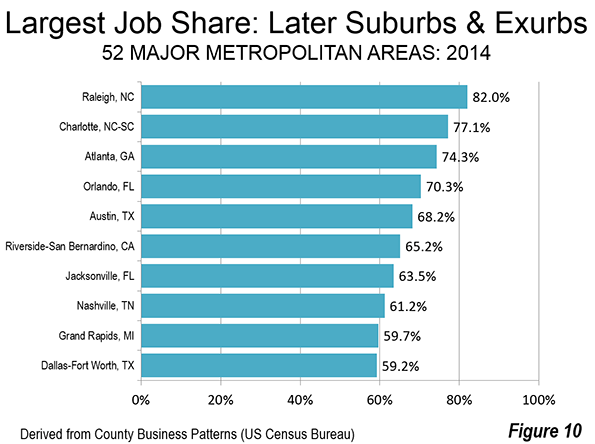
The 2014 data indicates that more than 80 percent of employment in the nation’s major metropolitan areas is in functionally suburban or exurban areas (Figure 3). The earlier suburbs have the largest share of employment, at 44 percent. The later suburbs and exurbs combined have 37.0 percent, while the urban cores have 18.9 percent, including the 9.1 percent in the downtown areas (central business districts, or CBDs).

These numbers reveal dispersion since 2000. Then, the earlier suburbs had even more of the jobs, at 49.4 percent, 5.3 percentage points higher than in 2014. Virtually all of the lost share of jobs in the earlier suburbs was transferred to the later suburbs and exurbs, which combined grew from 31.4 percent in 2000 to 37.0 percent in 2014. The urban cores had 19.4 percent of the jobs (8.8 percent in the CBDs), slightly more than the 18.9 percent in 2014.

While Chicago is one of the cities with a higher percentage of jobs in the city, Sun Belt locations dominate the list of cities with more jobs in outer suburbs:

These figures counter claims or stereotypes that (1) suburbs are primarily bedroom communities where people sleep but work in the city and (2) urban cores are the primary job centers of metropolitan regions. Of course, some suburbs are bedroom suburbs and big city downtowns are still important, particularly for certain industries (think global finance). At the same time, it would be interesting to envision some of these Sun Belt cities with no downtown…how different would Raleigh or Atlanta or Orlando really be?

Deannexation option could lead to smaller Tennessee cities

Efforts by the Tennessee legislature may make it easier for residents and neighborhoods to deannex from large cities:

The growing deannexation debate could ultimately shrink six cities in Tennessee, including Knoxville, Chattanooga, Memphis, Johnson City, Kingsport, and Cornersville.

For more than six decades, communities across Tennessee could simply pass an ordinance to forcibly expand their city limits, whether the people who owned the annexed property liked it or not.  In 2014, the state passed a law requiring residents to vote in favor of joining a city before their property can be annexed…

However, the 1990s and early 2000s were a time of rapid expansion under former mayor Victor Ashe.  Knoxville grew by 26 square miles during his time as mayor, mostly through what was nicknamed “finger annexation” that extended the city limits in the shape of fingers along the interstates…

Deannexation means the city would also lose out on some property taxes.  Rogero said if every annexed neighborhood left the city, it would add up to around $377,000 in annual property taxes.  That figure is actually much smaller than you may expect based on how much property Knoxville annexed in the late 1990s.  Rogero noted only residential property would be eligible for deannexation and much of Knoxville’s annexed property was zoned for commercial use.

Annexation stopped for many Northern cities around the turn of the 20th century as suburbs stopped wanting to join big cities but Sun Belt cities have often had different policies and more land growth over recent decades. Forced annexation would be one of the worst things one could do to many suburbanites who prize property rights and local control. But, it is another thing to allow them to deannex themselves. Would a better solution be to have both parties – those who want to leave as well as the larger community – both approve the annexation or deannexation via vote?

More broadly, there are various efforts for more metropolitan government, particularly to help balance out disparities (housing, education systems, tax bases, etc.) wrought by residential segregation, or to consolidate or limit the growth of local taxing bodies. Thus, it is interesting to hear of an effort to go the direction and let people continue to fragment within regions.