Did certain sitcoms change American society – and how would we know?

Did Norman Lear change American culture through the television shows he created? Here is one headline hinting at this:

From the linked article, here are some of the ways Lear was influential:

Lear had already established himself as a top comedy writer and captured a 1968 Oscar nomination for his screenplay for “Divorce American Style” when he concocted the idea for a new sitcom, based on a popular British show, about a conservative, outspokenly bigoted working-class man and his fractious Queens family. “All in the Family” became an immediate hit, seemingly with viewers of all political persuasions.

Lear’s shows were the first to address the serious political, cultural and social flashpoints of the day – racism, abortion, homosexuality, the Vietnam war — by working pointed new wrinkles into the standard domestic comedy formula. No subject was taboo: Two 1977 episodes of “All in the Family” revolved around the attempted rape of lead character Archie Bunker’s wife Edith.

Their fresh outrageousness turned them into huge ratings successes: For a time, “Family” and “Sanford,” based around a Los Angeles Black family, ranked No. 1 and No. 2 in the country. “All in the Family” itself accounted for no less than six spin-offs. “Family” was also honored with four Emmys in 1971-73 and a 1977 Peabody Award for Lear, “for giving us comedy with a social conscience.” (He received a second Peabody in 2016 for his career achievements.)

Some of Lear’s other creations played with TV conventions. “One Day at a Time” (1975-84) featured a single mother of two young girls as its protagonist, a new concept for a sitcom. Similarly, “Diff’rent Strokes” (1978-86) followed the growing pains of two Black kids adopted by a wealthy white businessman.

Other series developed by Lear were meta before the term ever existed. “Mary Hartman, Mary Hartman” (1976-77) spoofed the contorted drama of daytime soaps; while the show couldn’t land a network slot, it became a beloved off-the-wall entry in syndication. “Hartman” had its own oddball spinoff, “Fernwood 2 Night,” a parody talk show set in a small Ohio town; the show was later retooled as “America 2-Night,” with its setting relocated to Los Angeles…

One of Hollywood’s most outspoken liberals and progressive philanthropists, Lear founded the advocacy group People for the American Way in 1981 to counteract the activities of the conservative Moral Majority.

The emphasis here is on both television and politics. Lear created different kinds of shows that proved popular as they promoted particular ideas. He also was politically active for progressive causes.

How might we know that these TV shows created cultural change? Just a few ways this could be established:

-How influential were these shows to later shows and cultural products? How did television shows look before and after Lear’s work?

-Ratings: how many people watched?

-Critical acclaim: what did critics think? What did his peers within the industry think? How do these shows stand up over time?

But, the question I might want to ask is whether we know how the people who watched these shows – millions of Americans – were or were not changed by these minutes and hours spent in front of the television. Americans take in a lot of television and media over their lifetime. This certainly has an influence in the aggregate. Do we have data and/or evidence that can link these shows to changed attitudes and actions? My sense is that is easier to see broad changes over time but harder to show more directly that specific media products led to particular outcomes at the individual (and sometimes also at the social) level.

These are research methodology questions that could involve lots of cultural products. The headline above might be supportable but it could require putting together multiple pieces of evidence and not having all the data we could have.

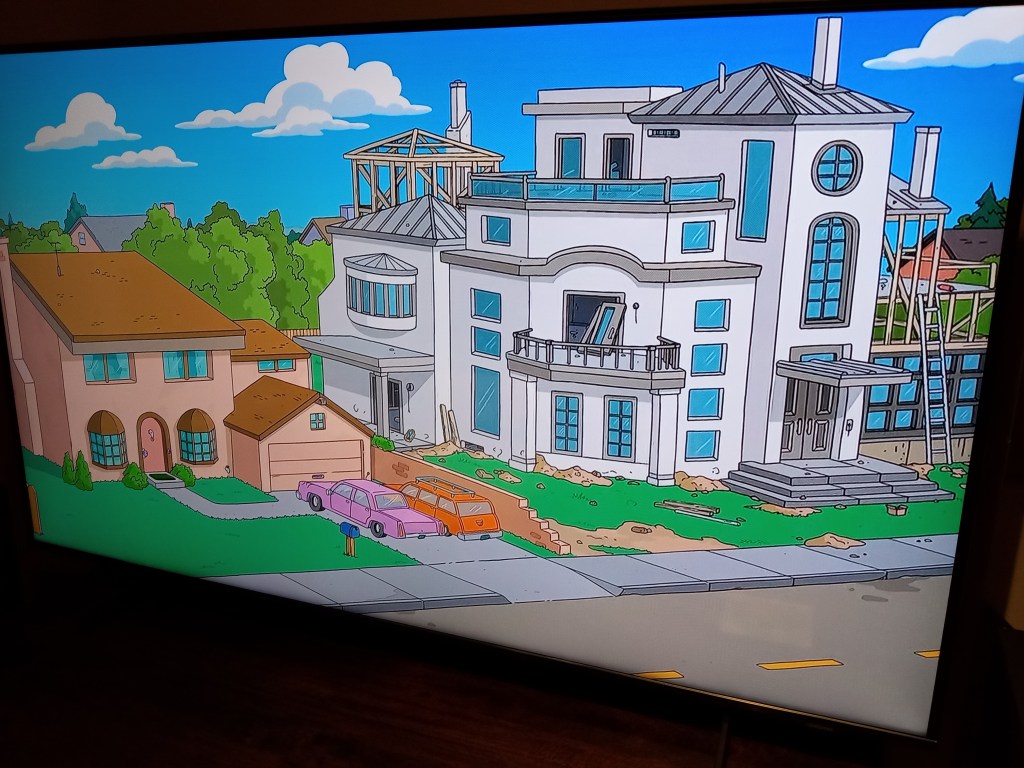
The Simpsons encounter a teardown McMansion

The Simpsons have new neighbors in Season 35 episode 3, “McMansion and Wife.” They get to know each other and enjoy spending time together. But, then the neighbors go from a modest home to a teardown McMansion:

As the new home is under construction, it is called a “reno” and then a “do-over.” Then it turns into a giant home. By my count, the teardown is 3-4 stories, is much bigger in terms of square feet and height as it towers over the Simpsons’ home, and has a mishmash of architectural features. The Simpsons live in a modest suburban home by today’s standards.

This story of a teardown McMansion within an established neighborhood is a common story across the United States. The new home can be considered disruptive by some neighbors even as others might defend the ability of property owners to do what they wish with their home and land and benefit from those changes.

One possible twist this episode briefly explores is the relationship between neighbors in these positions. Can they be friends? Can someone moving into a neighborhood build relationships and soften the blow of tearing down a house and constructing something much bigger on the same spot? Or, do teardowns usually lead to conflict between neighbors?

“Suburban Screams” and the horror of the suburbs

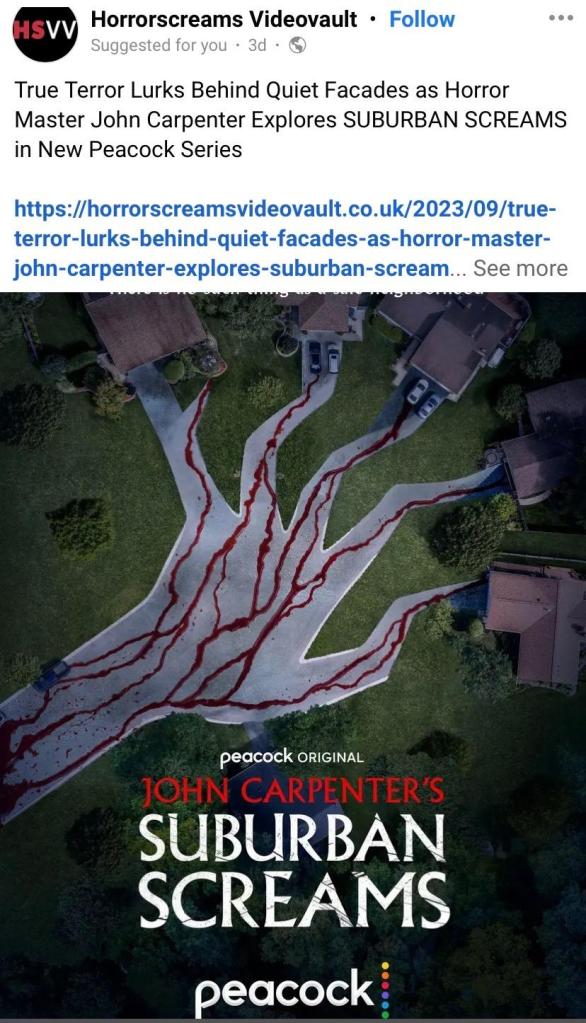
A new television show debuting in a few weeks involves horror in the suburbs:

It is an evocative image: the pleasant suburban cul-de-sac has been replaced by a street and driveways shaped like a hand with blood flowing from the homes.

Here is a description of the show from the Peacock website:

Peacock has shared the official trailer for John Carpenter’s Suburban Screams, a six-episode horror anthology series from the mind of the legendary namesake director, writer, and producer, exploring true tales of terror in suburbia. 

Each episode will delve into the monstrous evil that lurks beneath the surface of friendly suburbia through the lens of one frightful tale. In addition to firsthand accounts, the episodes will include cinematic reenactments, personal archives, and historic town press coverage.

Many cultural products in the last one hundred or so years have endeavored to tell the dark truths of suburbia. Behind the smiling nuclear family or the facade of the new suburban single-family home are less desirable practices and relationships. These stories suggest the suburbs put on a particular face but they are actually something else.

Placing horror in the middle of the suburbs builds on this. Not only might viewers or readers want to learn about the dirtier parts of suburbia; they might want scares and terror.

“Terror” is not typically a term used to describe the suburbs nor is the idea of “monstrous evil.” But that both are “lurking beneath the surface of friendly suburbia” continues an ongoing narrative that the suburbs are not what they seem.

Are the suburbs connected to the popularity of 1950s housewife fashion?

If the style of the 1950s is back, what does this mean about how people see the suburbs?

Photo by Wendy Wei on Pexels.com

A new generation of women is discovering the midcentury look, albeit for wildly varying reasons. Perhaps most divisively, there’s the “trad wife” movement, an online community of traditional women whose retro fashion reflects their religious, conservative and even sometimes far-right values. Then there are women who profess “vintage style, not vintage values,” combining hourglass silhouettes with a progressive worldview. And then there are those women and designers who just happen to appreciate the bygone charm of a swirly skirt…

The contemporary interpretations of 1950s fashion run the gamut from a sprinkle of yesteryear—winged eyeliner, a Grace Kelly headscarf, cat-eye sunglasses—to full-on June Cleaver dress-up. Fans of the look share makeup tutorials and life philosophies on TikTok. On

Pinterest, the somewhat disturbing tag “Stepford wife” includes images of Nicole Kidman in the spooky 2004 remake alongside black-and-white photos of women vacuuming. On Etsy, a gateway to the style, vintage hounds source period pieces, as well as replicas from purveyors like “Hearts and Found” and “Son de Flor.”

The 1950s housewife look isn’t limited to online rabbit roles and vintage shops. It’s also bleeding into high-end runway fashion. Prada has long made ladylike pieces like full skirts, capri pants and fitted sweaters cornerstones of its line, and Dior’s fall 2023 collection played up the house’s heritage of hourglass shapes.

Missing from this discussion is any explicit mention of the suburbs. The suburban lifestyle of the 1950s was a particular one. Even as it suggested middle-class success, it was not home to all nor offered equality. The country was relatively prosperous. The examples of fashion images from the era hint at the suburbs, whether it is Leave it to Beaver or I Love Lucy (two shows part of a study I published on TV shows set in the suburbs) or The Stepford Wives or Barbie (who has a dreamhouse).

Is this fashion trend connected to a feeling of nostalgia about or wrestling with the suburbs? The suburbs are not typically thought of as incubators of high fashion or culture yet, given their important part in American history and as the most common place where Americans live, there may be some connections here. I remember a political poll in 2016 getting at this longing among supports of Donald Trump. There are plenty of American narratives about a golden era of suburbia and also numerous critiques of those narratives.

The suburbs have an ongoing legacy that plays out in all sorts of contemporary issues and conversations. That it should be part of fashion should not be a surprise, even if it may not appear obvious to start.

Can popular TV shows lure new residents to a city?

Fort Worth, Texas is growing. Is this partly because TV viewers can see it on a set of popular shows?

Photo by Bryan Dickerson on Pexels.com

Mattie Parker, the mayor of Fort Worth, Texas, says a focus on crime, homelessness, parks and reliable infrastructure has positioned the city of 950,000 as an attractive alternative to Chicago, San Francisco and New York, which have struggled with perceptions of deteriorating safety in the aftermath of Covid-19.

The 39-year-old Republican, broadly considered to be a moderate in deep-red Texas, says that Fort Worth’s pitch to lure businesses highlights its roots (the city’s slogan is “Where the West Begins”) and small-town vibes, even if its stockyards are now more of a tourist draw than a genuine agricultural enterprise. The nostalgia for cattle ranching and cowboys generated by the hit television series Yellowstone and 1923 — created by Taylor Sheridan, who partly grew up in Fort Worth — are only adding to its allure.

“Fort Worth continues to be an incredibly unique city that is very proud of our Western heritage,” Parker said in an interview at City Hall, where a display case held shovels from groundbreaking ceremonies over the years. “And the timing couldn’t be better because of this fanfare and frenzy over Yellowstone and 1923.”

In Fort Worth, it’s common to see cowboy hats and boots paired with a tailored suit. Unlike nearby Dallas, which mostly feels like any other major metropolis, Fort Worth embraces its sense of place. There’s plenty of live country music, two-step dancing and Tex-Mex cuisine.

This is a long list of reasons for growth. Additionally, Fort Worth is part of the growing Sun Belt.

How much can depictions on a TV show contribute to this growth? Here is how Wikipedia describes the connections to Fort Worth that start with the TV show 1883, the earliest prequel for Yellowstone: “The series follows the post-Civil war generation of the Dutton family as they leave Tennessee, journey to Fort Worth, Texas, and join a wagon train undertaking the arduous journey west to Oregon (the Duttons are never on the actual Oregon Trail itself), before settling in Montana to establish what would eventually become the Yellowstone Ranch.”

I would be very interested in seeing some data regarding the connection between a popular television universe and population growth in a particular city. Are these shows also causing population growth in Montana? It makes sense for a local leader to make the connection to a show people like as it is always helpful to have good press.

Will a new Bewitched TV show be set in a similar looking suburbia?

A new Bewitched show is in the works:

Photo by Burak The Weekender on Pexels.com

The Bewitched update would focus on Tabitha Stevens, the 13-year-old daughter of witch Samantha and human Darrin. She juggles two lives attending middle school while also being secretly enrolled in a magical academy run by her grandmother, Endora — D’Ambrosia describes the premise as “Hannah Montana meets Harry Potter.”

The only mention of the setting of the show involves school settings: a middle school and a magical academy. The original Bewitched, a very popular show in the 1960s, was set in the suburbs of New York City. Samantha stayed at home while Darrin worked in the city. They live in a single-family home. They had a nosy neighbor. They have children.

Will the new Bewitched also include any of suburbia or will it primarily focus on schools? Interestingly, the two comparison TV shows mentioned above also include suburban settings. Hannah Montana was primarily set in Malibu, California while Harry Potter included scenes in and around the Dursley’s house on Privet Drive.

If the new version does include the suburbs, there is an opportunity for the suburbia depicted to look quite different than that of the 1960s. The suburbia often depicted on television then often portrayed nuclear family life in single-family homes on quiet streets. The suburbs today are more complex, diverse, and varied. There is an opportunity here to depict not only updated characters and storylines but also settings.

Audio algorithms and how we watch (and read) TV

More people use subtitles with TV shows because algorithms for audio have changed:

Photo by Nothing Ahead on Pexels.com

Specifically, it has everything to do with LKFS, which stands for “Loudness, K-weighted, relative to full scale” and which, for the sake of simplicity, is a unit for measuring loudness. Traditionally it’s been anchored to the dialogue. For years, going back to the golden age of broadcast television and into the pay-cable era, audio engineers had to deliver sound levels within an industry-standard LKFS, or their work would get kicked back to them. That all changed when streaming companies seized control of the industry, a period of time that rather neatly matches Game of Thrones’ run on HBO. According to Blank, Game of Thrones sounded fantastic for years, and she’s got the Emmys to prove it. Then, in 2018, just prior to the show’s final season, AT&T bought HBO’s parent company and overlaid its own uniform loudness spec, which was flatter and simpler to scale across a large library of content. But it was also, crucially, un-anchored to the dialogue.

“So instead of this algorithm analyzing the loudness of the dialogue coming out of people’s mouths,” Blank explained to me, “it analyzes the whole show as loudness. So if you have a loud music cue, that’s gonna be your loud point. And then, when the dialogue comes, you can’t hear it.” Blank remembers noticing the difference from the moment AT&T took the reins at Time Warner; overnight, she said, HBO’s sound went from best-in-class to worst. During the last season of Game of Thrones, she said, “we had to beg [AT&T] to keep our old spec every single time we delivered an episode.” (Because AT&T spun off HBO’s parent company in 2022, a spokesperson for AT&T said they weren’t able to comment on the matter.)

Netflix still uses a dialogue-anchor spec, she said, which is why shows on Netflix sound (to her) noticeably crisper and clearer: “If you watch a Netflix show now and then immediately you turn on an HBO show, you’re gonna have to raise your volume.” Amazon Prime Video’s spec, meanwhile, “is pretty gnarly.” But what really galls her about Amazon is its new “dialogue boost” function, which viewers can select to “increase the volume of dialogue relative to background music and effects.” In other words, she said, it purports to fix a problem of Amazon’s own creation. Instead, she suggested, “why don’t you just air it the way we mixed it?”

This change in how television audio works contributes to needing subtitles to understand what is being said.

I wonder if the bigger question is whether this significantly changes how people consume and are affected by television. If we are reading more dialogue and descriptions, does this focus our attention on certain aspects of shows and not others? Could this be good for reading overall? Does it limit the ability of viewers to multitask if they need to keep up with the words on the screen? Do subtitles help engage the attention of viewers? Do I understand new things I did notice before in the world with fewer subtitles? Does a story or scene stick with me longer because I was reading the dialogue?

Does this also mean that as Americans have been able to buy bigger and bigger TVs for cheaper prices, they are getting a worse audio experience?

The Brady Bunch house as “the second most photographed home in America”

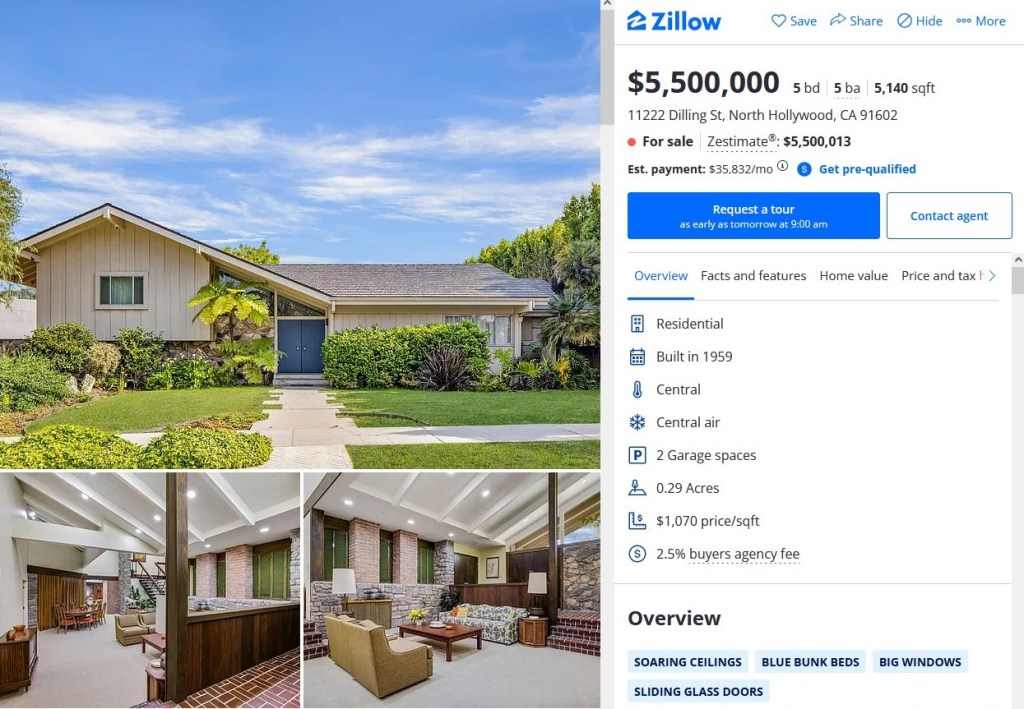
The house featured on the Brady Bunch is up for sale again. Apparently, many people have photographed the home:

The Brady Bunch only lasted five seasons, but its cultural footprint has endured. The ABC comedy — which followed a blended family of eight, their live-in maid and, at certain points, a dog — ran from 1969 through 1974 before inspiring TV movies, a satirical feature remake (and sequel) and countless pilgrimages to 11222 Dilling Street. It has been called the second most-photographed home in America, trailing only the White House, though there is little evidence to back up such claims. 

I am sure someone could try to quantify this. Scan through all of the pictures on the Internet including photo upload sites? Perhaps measure the number of visitors each year to different houses and estimate how many pictures they might take?

A better question to ask might be this particular house is so popular for pictures. It is tied to a popular TV show, it is accessible to the public who can see the home from the street, it is located within the second largest metropolitan area in the United States, and there are a lot of tourists in the area. Still, it is a home built in 1959 that looks rather unremarkable from the outside. This might be a story about (1) the power of TV in American culture and (2) the importance of TV in this particular era of suburbia and Baby Boomers.

I wonder if any other TV shows would be in a top 10 of photographed homes in the United States.

(See earlier posts about the Brady Bunch house: a 2018 post about HGTV owning the home and a 2012 post about comparing the exterior and interior of the homes.)

Encyclopedia Brown’s Idaville sure has a lot of crime

The kid’s book series involving boy detective Encyclopedia Brown includes this description of the town of Idaville, the setting for the stories and home to Leroy Brown and his family:

Photo by kat wilcox on Pexels.com

Idaville was like most seaside towns. It had lovely beaches, three movie theaters, and two delicatessens. It had churches, a synagogue, and four banks

But, read enough of these cases and it all adds up to something: Idaville is not like most seaside towns as it has a lot of crime. Enough crime to fill 29 books with numerous cases in each. Crimes ranging from small violations to larger issues. Lots of different kinds of criminals.

This is not an unusual perspective on crime. Television shows often have a similar message, particularly if they are long-running: crime is happening all of the time. This has the potential to change how viewers understand crime and locations. If you see a particular place associated with criminal activity over and over, how much of an impact does this have?

Some of the other phrases in the intro to the cases provide further clues at how crime is perceived in Idaville and in these cases: “the forces of law and order were in control” and “the town’s war on crime.” Is this the normal experience of small towns or just how we often present mysteries and the work of police?

The bland interiors that pushes viewers to choose gaudy McMansions instead

A review of a renovation TV show suggests it is more fun to see McMansion than bland interiors:

Photo by Rachel Claire on Pexels.com

But like any good home design show, the real main character is not the couple doing the renovations, but the end results. For the two years that I’ve watched this program, I’ve tried to dial down what one might call this aesthetic, which is both specific and generic—like every other high-end Airbnb listing on the market, or an antiseptic boutique hotel that prides itself on design. But it wasn’t until halfway through this season when one of the McGee’s clients hit the nail on the head. “It’s upscale-looking,” a woman says of her newly-renovated basement, which is divided into three clear “zones” meant to delineate what kinds of leisure activities should occur there and why. It’s not quite upscale, but suggestive of it instead, a different kind of new money aesthetic. But if given the choice between Studio McGee’s all-white fantasia and a giant McMansion fit for a Real Housewife of New Jersey, I’d take gold restroom fixtures and Travertine tile any day. At the very least, it’s fun.

What is the look inferior to glitzy McMansions?

What this translates to is large architectural gestures that convey wealth—vaulted ceilings in the kitchen and the living room, a “wine room” with built-in bookshelves that meet the ceiling, and other flourishes that speak to the vast amounts of money this couple must have to maintain their bonus home. It’s not that any of these design choices are anywhere close to hideous, per se—Studio McGee’s signature look is quieter than the Property Brothers, but more sophisticated that Chip and Joanna Gaines’s farmhouse chic. Staged as they are, though, the spaces designed by Studio McGee lack any discernible personality. Children get giant bedrooms with queen-size beds; every kitchen has an enormous island, whether or not the space actually needs it. (While most kitchens could use an island, not every space needs one. Understanding this difference is crucial.)

Is the primary offense that the bland yet wealthy interiors required a lot of money to implement but have no personality? McMansions are often criticized for their blandness; they are big boxes with large rooms that people can fill in many different ways.

It could be that the “fun” of the loud McMansion is that it shows up better on TV and with its particular cast of characters. The show under review is meant to show off a particular aesthetic of its designers while the Real Housewives of New Jersey has a different purpose. The loud McMansion on TV might be fun in the way that McMansion Hell is fun: you make fun of the McMansion and its dwellers. Which home viewers might want to live in might be a different story.