The prime suburban real estate available when restaurants close

Want a prime location in the suburbs? Red Lobster and TGI Fridays might have an answer:

Photo by Armando Oliveira on Pexels.com

Vacant restaurant chains are creating prime real estate for a wide range of companies looking for spots to grow, especially fast-food chains that want to install drive-thru lanes on spots where diners once sat down for dinner.

Chains like Red Lobster and TGI Fridays filed for bankruptcy this year and closed more than 175 restaurants combined. Red Lobster was driven into bankruptcy by mismanagement under a previous owner, global shrimp supplier Thai Union, while TGI Fridays fell under private equity owner TriArtisan Capital Advisors. Denny’s is also closing 150 restaurants…

In the past, these restaurants would often be replaced by a different restaurant chain, with tables to sit at and servers to bring out the food. But now, fast-food and fast-casual chains are taking these spaces and building more drive-thru lanes. Chipotle is building 4,000 new locations, the majority with drive-thru lanes, while Chick-fil-A is building new spots with four-lane drive thrus…

Many of these restaurant locations are also attractive to prospective tenants, as they are freestanding buildings, not located in the back of decaying indoor malls. Indoor malls have struggled in recent years, and mall vacancies reached 6.5% last quarter, according to CBRE. Macy’s, JCPenney, Nordstrom and others have closed hundreds of their stores in malls as online shopping has grown to around 16% of retail sales. Real estate research firm Green Street estimates about 150 enclosed malls have closed since 2008, leaving about 900 today.

Most of the closed restaurants are also located on high-traffic streets with large parking lots or adjacent to a shopping center, making them attractive sites.

I have heard before that certain restaurants and retailers are less into the business of selling things and more into the business of real estate. Think just of the largest fast food chains in the world: how many prime locations do they occupy? If all that land went up for sale at once, how many other businesses would be interested in jumping in?

I have been thinking about locations like these in terms of religious congregations recently. They often occupy important locations within communities, sometimes at busy intersections or in important historic locations. If that location is no longer occupied by a congregation and/or a religious building, it could be a loss in the community (and a possibility for something else).

In the case of these restaurants, it appears there is plenty of demand for the land and plenty of interested parties want to make more money with these properties. Additionally, I would guess most municipalities love that another restaurant will take over. Those new restaurants and businesses can generate even more revenue. The worst possible outcome is that the land remains vacant with limited demand and the property becomes an empty eyesore.

How long before these new restaurants that take over are selling off their own properties? Ten years? Twenty years? At least in this moment, new restaurants want to snatch up these properties but that might not always be the case.

Banks and “extend and pretend” for office properties

With some companies and organizations falling behind on their commercial mortgages, some banks are waiting and looking for ways to get out of the loans:

Photo by Mikhail Nilov on Pexels.com

Some Wall Street banks, worried that landlords of vacant and struggling office buildings won’t be able to pay off their mortgages, have begun offloading their portfolios of commercial real estate loans hoping to cut their losses…

But these steps indicate a grudging acceptance by some lenders that the banking industry’s strategy of “extend and pretend” is running out of steam, and that many property owners — especially owners of office buildings — are going to default on mortgages. That means big losses for lenders are inevitable and bank earnings will suffer.

Banks regularly “extend” the time that struggling property owners have to find rent-paying tenants for their half-empty office buildings, and “pretend” that the extensions will allow landlords to get their finances in order. Lenders also have avoided pushing property owners to renegotiate expiring loans, given today’s much higher interest rates.

But banks are acting in self-interest rather than out of pity for borrowers. Once a bank forecloses on a delinquent borrower, it faces the prospect of a theoretical loss turning into a real loss. A similar thing happens when a bank sells a delinquent loan at a substantial discount to the balance owed. In the bank’s calculus, though, taking a loss now is still better than risking a deeper hit should the situation deteriorate in the future.

Four questions come to mind:

  1. How long will banks wait before aggressively working to drop these loans? It sounds like this is happening a little bit. Is there a possible tipping point? In other words, how much “extend and pretend” is doable?
  2. How much does this behavior toward commercial tenants reflect how the same lenders or other banks treat residential loan holders? If a homeowner is not making their mortgage payments, do they get treated the same? Is the issue more of the size of these loans and not necessarily what kinds of properties are involved?
  3. Given the foreclosure crisis of the late 2000s and the COVID-19 pandemic, is it safe to assume there are plans in place if banks need to move a lot of these loans at once? Who would benefit the most from aid to get out from under a lot of commercial property losses in a short amount of time?
  4. What happens to these vacant properties in the short and long-term? How quickly can they be filled by other uses? How do these vacancies affect the communities in which they are situated?

Turning former shopping spaces into entertainment centers

Imagine a shopping mall less about shopping and more about entertainment. This is what is happening to at least a few vacant big box and department stores:

Photo by Alena Darmel on Pexels.com

Oca’s client, real estate investment firm E8 Properties, has been buying empty Sears stores, dusting them off and converting them into “Elev8 Fun,” a massive indoor family entertainment park created in partnership with Primetime Amusements, a provider of video arcade machine.

The first one, designed by Oca and his team and housed in a 120,000-square-foot former Sears building attached to the Seminole Town Center Mall in Sanford, Florida, opened in January 2022…

To his point, increasingly, more malls are morphing into family entertainment destinations where shopping may not even be what draws shoppers in.

Industry analysts said research shows that adding entertainment experiences shifts more money to mall retailers and not away from them. Through the pandemic and coming out of it, the popularity of pickleball made its way into malls with courts popping up next to skating rinks. Indoor skydiving, Legoland theme parks, virtual golf and microbreweries are other concepts catching on.

Shopping can be its own kind of entertainment. It is not just about buying goods, whether they are necessary for life or not. It is about looking, considering, interacting with people you are with, seeing other people shopping, and participating in particular lifestyles.

But these entertainment centers are offering something else: games, competition, novelty, having fun with others.

Longer-term, does this mean hopping is less entertaining and more efficient when done online? Is shopping more often a private activity since it takes place online? Do people still want to have experiences around or near others, even if the forms of doing so have changed?

An abandoned large development in LA turns into graffiti canvas

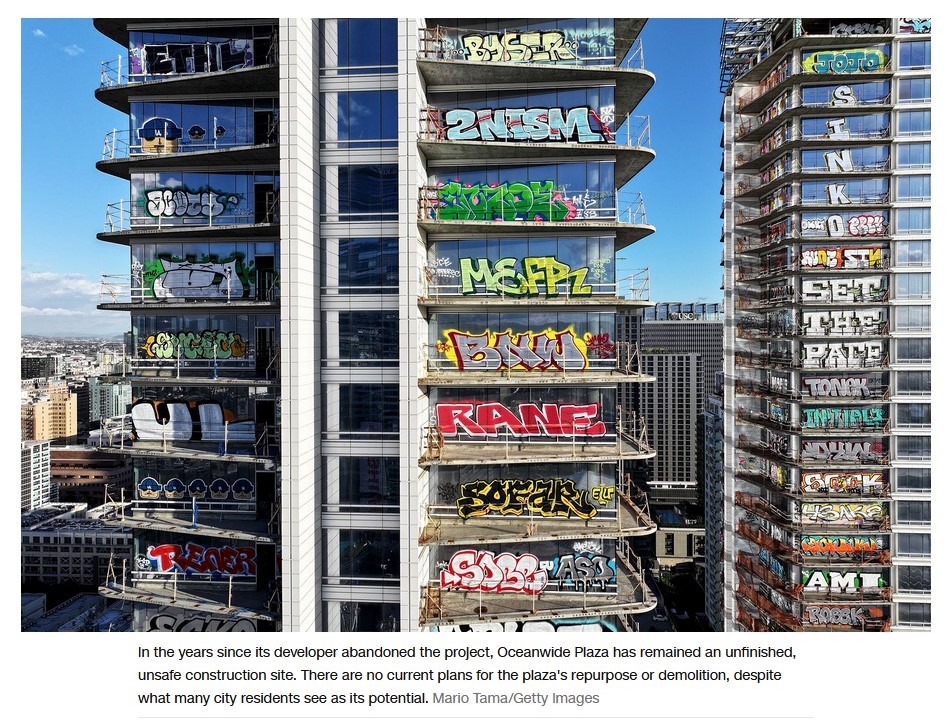
A large development in Los Angeles that has gone unfinished now goes by the name “Graffiti Towers” to nearby residents:

https://www.cnn.com/2024/04/10/style/graffiti-oceanwide-plaza-los-angeles-skyscrapers/index.html

Climbing up abandoned, unfinishedfloors and tightrope walking across balcony ledges, backpacks clanging with cans of alkyd and acrylic, a collective of Los Angeles graffiti artists have transformed their craft beyond urban aesthetics to champion community issues.

Their choice of canvas: Oceanwide Plaza in Downtown LA. Occupying over a full square city block, the plaza was imagined as a vast mixed-use building project, offering city residents over 500 lavish condominiums, a five-star hotel, retail spaces, restaurants and a private 2-acre park.

However, construction on the $1 billion project, which began in 2015, was shelved after the Chinese-backed contractor Oceanwide Holdingsran out of funding in 2019 — and it has lain unfinished ever since…

Transformed in part into an art installation, Oceanwide became an opportunity for the graffiti artists to leave a message to the city below, and a call-out to policy makers who leave buildings to rot…

“People forget that people live here. People own businesses here and they don’t want to have to spend the time and money to clean it up,” said Blair Besten, executive director of the Historic Core of Downtown Los Angeles, an organization which works to improve the quality of life in downtown neighborhoods. The Historic Core prioritizes street sweeping, trash collection — and graffiti removal.

This article showcases the multiple sides of an ongoing public debate about graffiti: is it a response to difficult social and economic conditions? Is it art? Is it criminal behavior that should be punished?

At the same time, how is there such a large abandoned project in Los Angeles? What can a municipality do to finish the development or pursue another use?

Put these two ideas together: are there cities willing to have large-scale platforms for graffiti in or near their downtowns? If graffiti and its place in society is multi-faceted, how might Los Angeles or other large cities incorporate it or work with graffiti artists?

A shopping mall left for walkers, a few stores, and future plans

I recently visited a nearly empty shopping mall in a nearby suburb. The suburb just recently bought more of the property in the hopes of redeveloping the mall into something more productive for the community. On this visit, here is part of what I saw in the mall:

On this winter day, there were at least a few people walking laps around the mall. Others sat in the empty food court. Security walked around.

The directory was about 5-6 years old. At that point, the mall still had a lot of retailers.

In the background of the image, you can see the Sears sign. Almost all of the anchor stores are long gone. Most storefronts are empty. The movie theater is shuttered.

The decline of this mall did not happen immediately. Combine online shopping, lots of shopping options in the Chicago region, and COVID-19 and you get a nearly empty mall. And it will take years to redevelop the property and incorporate the new elements into the community.

Regional banks and commercial real estate loans

As companies reduce their office footprint, what institutions hold many commercial real estate loans?

Photo by Andrea Piacquadio on Pexels.com

US banks hold about $2.7 trillion in commercial real estate loans. The majority of that, about 80%, according to Goldman Sachs economists, is held by smaller, regional banks — the ones that the US government hasn’t classified as “too big to fail.”

Much of that debt is about to mature, and, in a troubled market, regional banks might have problems collecting on those loans. More than $2.2 trillion will come due between now and the end of 2027, according to data firm Trepp.

Fears were exacerbated last week when New York Community Bancorp (NYCB) reported a surprise loss of $252 million last quarter compared to a $172 million profit in the fourth quarter of 2022. The company also reported $552 million in loan losses, a significant increase from $62 million the prior quarter. The increase was driven partly by expected losses on commercial real estate loans, it said.

Because I know little about this, this leads to several questions:

If patterns from earlier crises hold up, does this mean that when regional banks suffer difficulties they will be gobbled up by the larger banks?

What do regional banks have more of these loans – is this more of their specialty or they are more familiar with the local markets?

Who exactly decides which financial institutions are too big to fail and at what point might these regional banks qualify?

If these are the losses of just one regional bank, what might we expect throughout the entire US within the next few years?

Companies want less office space – and better quality space

Office space patterns in the Chicago suburbs suggest two trends at work: companies occupying fewer square feet but wanting to have higher-quality square footage.

Photo by . . on Pexels.com

The moves reflect an overall trend of tenants looking for higher-quality properties with financial stability, said Savills Regional Research Director Anders Klein…

Throughout 2023, trends saw office tenants move from larger spaces in older and more bare-bones Class B and C office properties to smaller spaces in well-maintained Class A buildings with more amenities.

Several thoughts about this:

  1. It would be interesting to see how much less companies pay for office space if this is the trade-off.
  2. Having a nicer location and more amenities on-site might also help companies make the pitch to have employees in the office.
  3. What are the new trends for nice office spaces? We have had a few decades now of gyms, meals, on-site services, etc.
  4. What happens to the less desirable office space? The article suggests some is converted to other uses, like for data centers. other properties might be redeveloped for housing or mixed-use projects.
  5. Could these opposing trends mean office space will look significantly different in the United States in a few decades or will offices still be the offices we know today?

Suburbs buying vacant malls to try to simplify redevelopment process

Two Chicago suburbs are purchasing mostly empty malls with the goal of redeveloping the properties:

Photo by Pixabay on Pexels.com

West Dundee and Bloomingdale officials have similar visions for the mall properties in their towns.

West Dundee sees a mixed-use development with residential, office, retail and entertainment. Bloomingdale’s consultants have drawn up conceptual plans showing residential, commercial and recreational development in place of the mall’s former retail buildings and parking lots.

Typically, villages stay out of the real estate business and leave redevelopment of retail centers to developers. But for West Dundee and Bloomingdale, taking ownership of their malls and clearing some obstacles, such as multiple property owners or restrictive covenants, were deemed essential for future redevelopment.

“Almost uniformly, every developer with whom we spoke stated that the site has too many complications ­— too many owners, too many covenants, too many uncertainties,” Nelson said last year. “The village’s aim is to bring simplicity to the process so reliable developers with established track records will be interested in partnering to reformat the area. Without municipal intervention, that simply won’t happen.”

Two thoughts come to mind:

  1. It is not too surprising that suburban communities want to guide the redevelopment. Suburban residents and suburban community leaders are often picky about what they might want to replace a shopping mall. By purchasing the property, the suburb can choose the developer and the zoning while also setting a vision.
  2. I wonder if this is an instance where a large property owner – the owners of these malls – can afford to sit on these properties for a while to see if there will be a bigger financial return later. I remember reading in the past about parking lots in downtown areas; they are not flashing and they are not the preferred land use but the company who owns that lot can wait until there is significant demand for the property and then make a lot of money on selling the parking lot. Compared to these suburbs, the property owners may be less interested in moving quickly on a redevelopment plan. (This could also apply to recent conversations about suburban office parks and downtown office buildings: even vacant buildings might not need to be sold or redeveloped if an owner can afford to hang on to them.)

US urban office space vacancies related to earlier office building booms

With the vacancy rate for office space in the major US cities almost at 20%, is now safe to conclude too much space was constructed in the first place?

Photo by Scott Webb on Pexels.com

America’s offices are emptier than at any point in at least four decades, reflecting years of overbuilding and shifting work habits that were accelerated by the pandemic.

A staggering 19.6% of office space in major U.S. cities wasn’t leased as of the fourth quarter, according to Moody’s Analytics, up from 18.8% a year earlier. That is slightly above the previous records of 19.3% set in 1986 and 1991 and the highest number since at least 1979, which is as far back as Moody’s data go…

That glut weighs on the office market to this day and helps explain why vacancies are far higher in the U.S. than in Europe or Asia. Many office parks built in the 1980s and earlier struggle to find tenants as companies cut back on space or leave for more modern buildings.

“The bulk of the vacant space are buildings that were built in the 1950s, ’60s, ’70s and ’80s,” said Mary Ann Tighe, chief executive of the New York tri-state region at real-estate brokerage CBRE.

And just as in the early ’90s, it is the overbuilt South that is hit hardest. Today, the three major U.S. cities with the country’s highest office-vacancy rates are Houston, Dallas and Austin, Texas, according to Moody’s. In 1991, Palm Beach and Fort Lauderdale in Florida and San Antonio held those positions.

This sounds like a cyclical market: during financial downturns, fewer companies want office space and vacancies rise. During economic success, more companies expand and make use of the space. When more space is built during the good times, that same space is not necessarily needed later.

Does that mean that COVID-19 was only a partial contributor to office vacancies? Was a reckoning going to come for urban office space even without a global pandemic? Or might office space be back in demand again soon as economic conditions change?

I can see why new office space is desirable to fund and build. Whether it should be built, given the cycles discussed above, is another story. And if office space cannot be easily converted to other uses, how much more is really needed in major cities?

Filling suburban Bed Bath & Beyond locations

When Bed Bath & Beyond closed all of its stores, it left numerous suburban stores vacant. Many of the locations are empty no longer:

Photo by Prateek Katyal on Pexels.com

Burlington, Michaels, Barnes & Noble, Ollie’s Bargain Outlet, Macy’s, HomeGoods and other chains have replaced old Bed Bath & Beyond stores. Indoor pickleball courts, trampoline parks and bowling alleys have also filled up the vacancies…

The majority of Bed Bath & Beyond’s stores are in the suburbs of mid-size and large cities, and are under 50,000 square feet. These are appealing qualities for retailers as some companies favor smaller spaces, instead of mega stores, to save on rent and labor and as shoppers buy more online. Macy’s, for example, is opening its smaller “Market by Macy’s” versions at old Bed Bath & Beyond stores…

Bed Bath & Beyond spaces have been grabbed up swiftly at rents of up to 50% what Bed Bath & Beyond was paying, according to commercial real estate investment firm CBRE. Landlords are taking advantage of the vacancies, with some dividing former Bed Bath spaces into smaller sizes, said Brandon Isner, CBRE’s head of retail research for the Americas.

“There is little to no concern that any of the spaces will go vacant for long,” he said…

It is interesting to hear that some suburban retail real estate is in demand. This would contrast with the negative news about shopping malls or about some big box and strip mall properties. Perhaps it is the particular size of these stores – a medium size that could appeal to a lot of other retailers – or perhaps it is the low price – which cuts the cost of doing business.

I hope there are some large-scale studies going on regarding the transformation of retail spaces in the suburbs. Imagine taking pictures at 5 year intervals in major shopping districts or along major roadways. At the least, it could detail the changes in buildings and what retailers are present. But, it could also catalogue major changes to structures, what kinds of retailers are present, and how popular these sites are. Just as the shopping mall defined life for suburban teenagers for at least a decade, the major shopping centers and strip malls in suburbs defined life for millions over multiple decades. Plenty of people visited Bed Bath & Beyond and many more could visit these structures – with whatever is in them- for years to come.