Walmart operates more than 5,200 stores across the country, and 90% of Americans live within 10 miles of a Walmart or Sam’s Club, the company estimates.
In this story, this figure is cited regarding the rollout of electronic vehicle chargers. The implication is that many potential drivers could then access Walmart’s network.
Part of the Walmart percentage could be the sheer number of stores and it could also be about corporate decisions about where to locate. The company grew from its first store in Rogers, Arkansas to being in many communities across the United States. Do all retailers go for the same sort of locations as Walmart?
It would be interesting to compare to other kinds of business. Take fast food chains that have thousands of locations; would 90% of Americans live within 10 miles of a McDonald’s or a Domino’s? Or what about distances from dollar stores? (Or were once within 10 miles of a Blockbusters?)
Or we could consider other important places. How many Americans live within 10 miles of a park? A school? A police or fire department?
CEO Douglas McMillon announced that Walmart is close to reaching 95% of the U.S. population with three-hour or less delivery, with a 91% increase year-over-year in deliveries under three hours in Q1.
This is remarkable to consider: 95% of over 340 million Americans can be reached by a Walmart delivery within 3 hours. Need something from Walmart? It can get to the vast majority of Americans within 180 minutes.
What is required to make this happen? Numerous locations, including warehouses and stores. Lots of employees and equipment. A strong inventory system. And more.
With this level of delivery possible, how does this change the calculus regarding all of the Walmart stores? Will fewer people visit them in the future because they prefer delivery? Will more of these stores be about deliveries rather than in-person shopping? Could Walmart significantly reduce its store footprint while continuing to extend its reach?
Walmart is excited to announce a comprehensive brand refresh that reflects its evolution as a people-led, tech-powered omnichannel retailer. From its humble beginnings in Bentonville, Arkansas, in 1951, Walmart has grown into a global leader dedicated to helping people save money and live better.
This is the opening paragraph of a press release that has more details. But this first section has a lot of ideas. Walmart is:
people-led
tech-powered
omnichannel
from humble beginnings
global leader
helps people save money
helps people live better
There is a lot here. Probably too much for a slogan or advertising campaign. And how many line up with how the public sees Walmart?
When I think of Walmart throughout most of my life, I think of #6 above. It has pitched as the place for low prices. When they first arrived in the Chicago suburbs, I found that their CDs were much cheaper than the music stores in the area. Compared to other big box stores or grocery stores selling the same or similar items, Walmart often has lower prices.
What does it mean to be “people-led”? As opposed to AI led or driven by numbers? Is “global leader” referring to revenues or practices or name recognition?
The last one might be most interesting. Is the American good life partly dependent on Walmart? If Walmart was not around, would American lives be better or worse? Would this alternate universe just remove Walmart locations or all Walmart is connected to (supply chains, approach to retail, the growth of Bentonville, etc.)? If lots of Americans think Walmart does help them save money and given the role of money and wealth in American life, many might answer “yes” to this.
That all adds up to more than $264 billion spent on groceries at Walmart US locations in 2023, up from $247 billion and $219 billion in the preceding two years.
Not only are top-line sales growing, their percentage of total division revenues is ticking up from about 55% three years ago to roughly 60% last year. And these numbers don’t even include Walmart-owned Sam’s Club.
I remember the first Walmart that opened near us in the Chicago suburbs when I was a kid. It was not a Supercenter and it was not as big as today’s stores. There were some food items there but no fresh groceries. You could buy all sorts of stuff there, from CDs to clothes to auto care items. Buying groceries often required a trip to the major grocery chains in the Chicago area, Jewel and Dominick’s at the time.
The Walmart today is a different experience. One side of the store is devoted to groceries. There are many options available for all sorts of food items. A buyer could go just for groceries and make a choice about whether to add other items to their carts from the other parts of the store.
From these experiences and their revenue streams, it sounds like Walmart is a grocery store first. It is not a conventional grocery store but as the comparative numbers indicate, its grocery sales dwarf other competitors. For younger generations of Americans, they may see Walmart as the prototypical place to get groceries as opposed to supermarkets or neighborhood grocery stores.
The simplest explanation is that collectively our Chicago stores have not been profitable since we opened the first one nearly 17 years ago – these stores lose tens of millions of dollars a year, and their annual losses nearly doubled in just the last five years. The remaining four Chicago stores continue to face the same business difficulties, but we think this decision gives us the best chance to help keep them open and serving the community.
Over the years, we have tried many different strategies to improve the business performance of these locations, including building smaller stores, localizing product assortment and offering services beyond traditional retail. We have invested hundreds of millions of dollars in the city, including $70 million in the last couple years to upgrade our stores and build two new Walmart Health facilities and a Walmart Academy training center.
It was hoped that these investments would help improve our stores’ performance. Unfortunately, these efforts have not materially improved the fundamental business challenges our stores are facing.
Nedra Sims Fears, executive director of the Greater Chatham Initiative, said the closure of the store and health center in Chatham was “deeply disappointing.”…
“All communities in Chicago should have access to essential goods and services,” Lightfoot said in the statement. “That is why I’m incredibly disappointed that Walmart, a strong partner in the past, has announced the closing of several locations throughout the South and West sides of the City. Unceremoniously abandoning these neighborhoods will create barriers to basic needs for thousands of residents.”…
In a statement, Mayor-elect Brandon Johnson said his administration “will be committed to identifying ways to fill the gaps these closures will leave in neighborhoods, and also to finding other ways to ensure families have direct access to groceries in their communities.”
Ald. Sophia King, 4th, and Ald. Jason Ervin, 28th, whose wards include locations slated to close, both called the closures disappointing in statements Tuesday. “The west and south sides need committed partners to reverse decades of disinvestment and discrimination, and I hope Walmart will work hard to invest in the communities in Chicago that desperately need their presence,” Ervin said.
Whole Foods Market opened a new “flagship” branch Downtown, at Eighth and Market near the Trinity Place development, with much fanfare in March 2022. But just 13 months on, the supermarket chain has decided to close the store, which was shuttered at the end of business on Monday.
Residents and leaders expressed disappointment:
News of the store’s closure also sparked dismay online. Residents on Twitter described losing the supermarket as “disappointing,” and “disheartening,” while one warned: “As whole foods goes, so goes the neighborhood.”
The Whole Foods Market fell within the district of San Francisco District 6 Supervisor Matt Dorsey, who posted a thread about its closure on Twitter on Monday.
“I’m incredibly disappointed but sadly unsurprised by the temporary closure of Mid-Market’s Whole Foods,” he wrote. “Our neighborhood waited a long time for this supermarket, but we’re also well aware of problems they’ve experienced with drug-related retail theft, adjacent drug markets, and the many safety issues related to them.”
Residents of all communities need access to food. Certain neighborhoods are invested in less than others. A sizable grocery store can help anchor other business activity. Filling a vacant large commercial space can be difficult.
If a company says it cannot keep a store open – the two companies give different reasons above – what reasons might be acceptable to a community?
I would hope retailers and corporations want to go beyond just making money in a location. At the least, as corporations and politicians often remind us, they provide jobs. But, they can also be much more.
Numerator found that Walmart’s typical shopper in the US is a white woman between 55 and 64 years old, who is married and living in the suburbs of the Southeast. She typically has an undergraduate degree and earns about $80,000 per year.
She visits Walmart at least once per week — about 63 trips per year — and picks up 13 products for a total cost of about $54 per trip. 13.5% of her spending takes place at Walmart, while she spends about 11% at Amazon.
Her primary shopping categories in-store are groceries, including chicken, fruit, snacks and sweets, but she also gets a lot of fast food. Her favorite five brands at Walmart are Turkey Knob, Cheetos, Betty Crocker, Dole, and Tyson.
I am always looking for examples to help illustrate the differences between the three primary measures of central tendency: mean, median, and mode. When an article or report says something is “typical,” what exactly do they mean? Here is my guess at which data above is which measure of central tendency:
-mean: age, education level, visits to Walmart, money spent per trip
-median: income
-mode: race/ethnicity, marital status, place of residence, what is purchased
Some of these are harder to guess or do not fit these three options well. For example, is the $54 per visit a mean or median? Or, the five favorite brands are not a singular mode and they may lead the list of brands but not actually comprise that much of the total percent of purchases.
Additionally, it would be interesting to add measures of variability. How much variation is there in the age and education level of Walmart shoppers? I would guess the company wants to know more about the $54 spent per trip; how many spend more and what could be done to increase the number of people who spend more? Throw in a standard deviation or some other measure of dispersion and the numbers above become much more interesting.
In the end, the report above does not mean that someone visiting a Walmart will find most shoppers fit that profile. The measures of central tendency here tell us something but using multiple measures plus some measures of variability would provide more in terms of revealing who is at Walmart.
Two advertisements, both featuring designer Leanne Ford, recently arrived on the same day in my mailbox. I did not expect that Crate & Barrel and Walmart would both feature the same person:
I wonder about a few things:
What is the overlap of consumers/audience between these two stores? Perhaps there is more overlap than I think.
While each advertisement features the same designer, there are noticeable differences. For Crate & Barrel, Ford is adding to the modernist style. For Walmart, she and her husband are providing tools to tackle home projects. The first is leaning more towards art, the second is leaning toward getting things done. Even how it is presented is clearly different.
Having some familiarity with both retailers, my sense is that both do not often use famous names to sell products. In contrast, a retailer like Target has tried this a number of times. Does this signal a new approach for both retailers? If so, it is interesting that both think Ford will help them appeal to potential customers.
Just thinking out loud about more consonant pairings: Walmart and Ikea? Target and Crate & Barrel?
I cannot help but think about Bourdieu in this context. The idea of home design has grown in recent decades in the United States and the concept and its purveyors – such as HGTV – are broadly available. Yet, how exactly this plays out in different class contexts can vary. Design for middle to upper-class residents means something different than design for lower to middle-class residents.
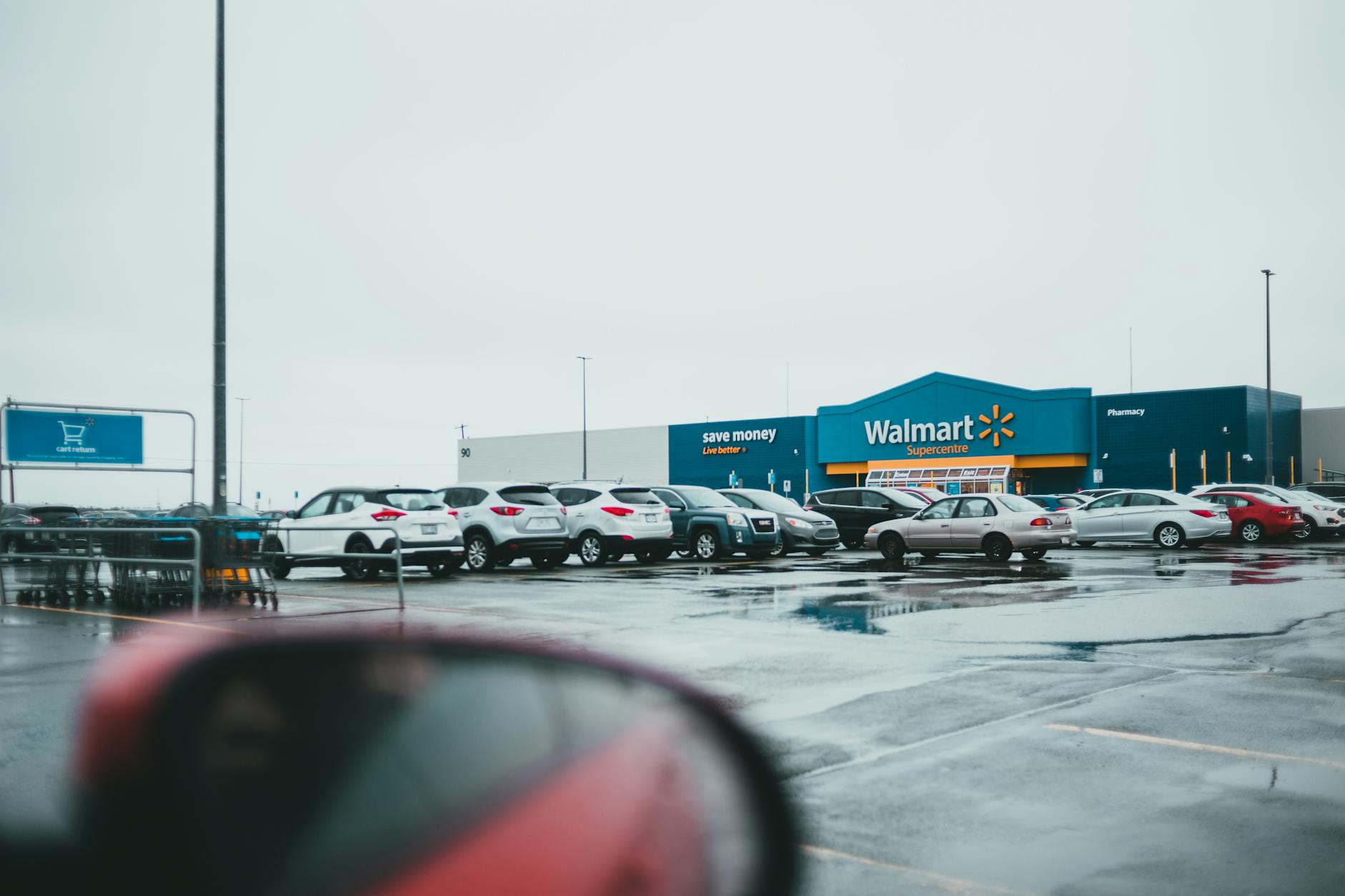
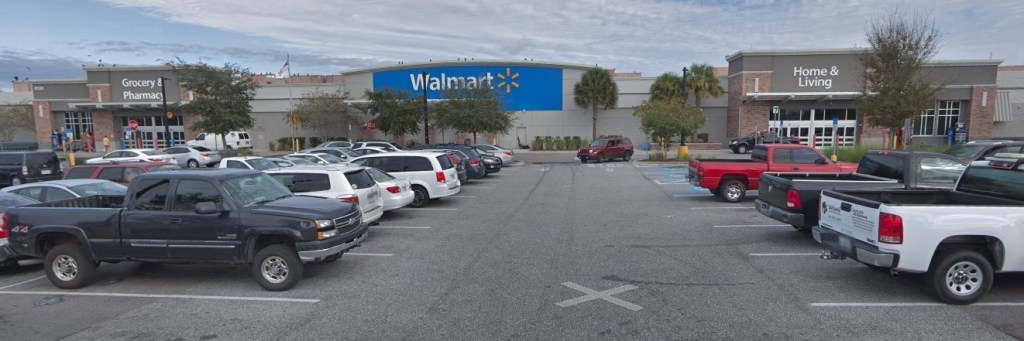
I have driven through many Walmart parking lots and while doing this, I often wonder how a better parking lot experience could help avoid regular issues. Here are some of the big concerns:
There are often a lot of vehicles, people, and carts moving around. It is hard to keep track of all the activity.
Depending on the traffic flow of the location, some of the traffic can be routed right in front of the store as vehicles turn in from a street or adjoining parking lot.
At least a few cars always seem to be lingering right at the front doors or nearby, waiting for people.
Carts are strewn throughout the parking lot; most are in corrals but there are often other ones on medians, in parking spots, and even several parking lots over. (Imagine if the Walmart lot had Costco sized shopping carts!)
A few solutions come to mind:
Everyone needs to be very attentive. Having to pay close attention is not necessarily bad for drivers or pedestrians.
It is better to have the majority of drivers enter the parking lot area from the back rather than from the sides and drive directly in front of the store.
I started thinking about this recently after realizing that I have been in multiple parking garages at Target locations but never at a Walmart. In these locations, there are advantages to having the parking further away from the store and/or having the store on a different level from the traffic flows.
Figuring this out could have multiple benefits including: drivers and pedestrians would feel safer, the parking lot experience could be less fraught and more pleasant, and fewer work hours might need to be devoted to the parking lot.
Perhaps this is just the price Americans are willing to pay for their love of driving and sprawl: complicated parking lots. This is not an issue exclusive to Walmart as many big box stores demonstrate similar patterns. But, since Walmart has so many locations and so many customers, solving issues there could be a big deal.
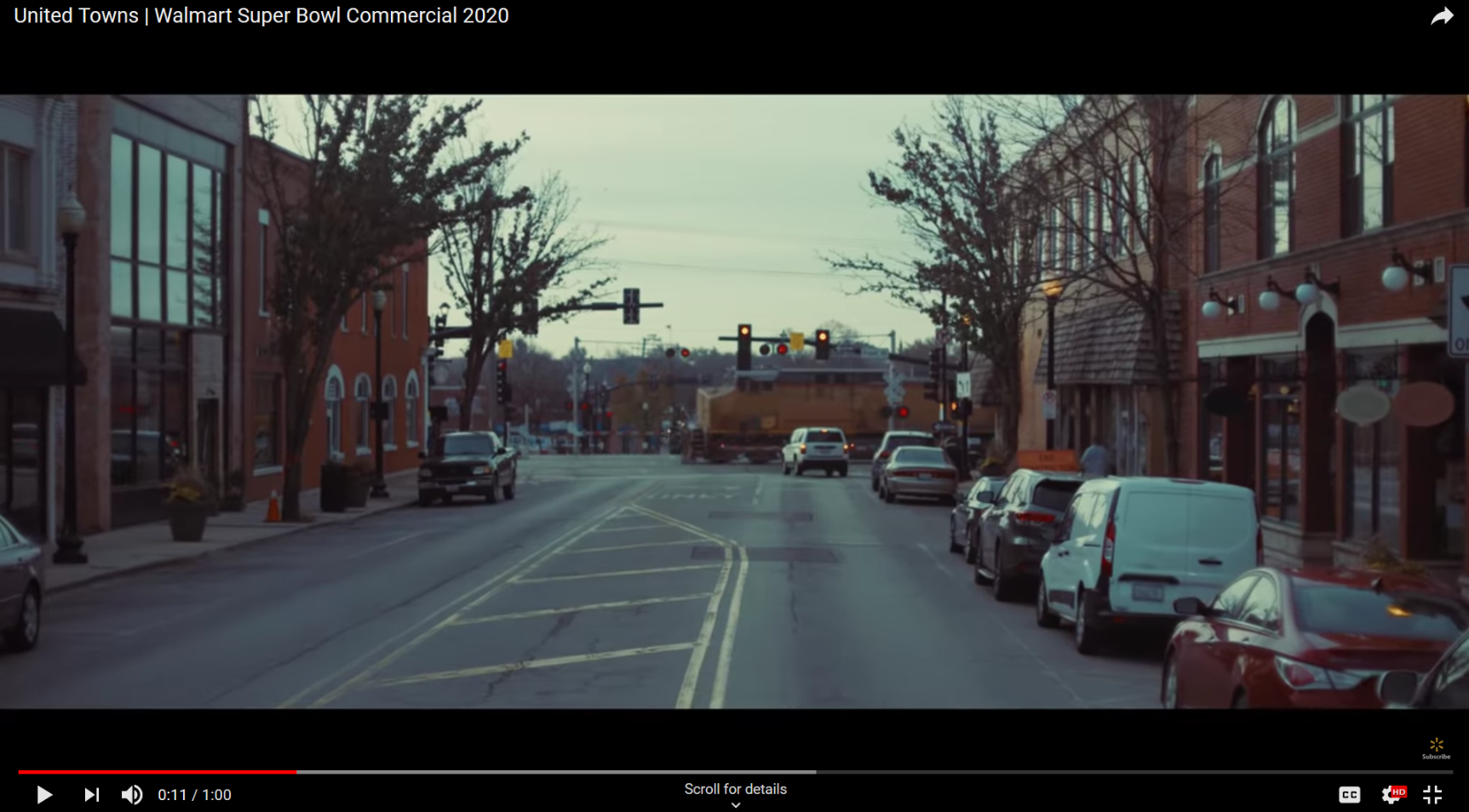
Four things of note from this short appearance of Wheaton in a national ad:
As a number of Wheaton residents noted online, there is no Walmart in Wheaton. This is true but it obscures the larger story. One, how many Wheaton residents shop at Walmart (there are two within several miles of the town’s borders) as opposed to other big box stores (such as the Target in Wheaton or the several within a few miles)? Or, how many Walmart employees live in Wheaton? Two, there may be reasons Wheaton has no Walmart: it might not have wanted one. The busy stretch along Roosevelt Road is carefully controlled by the city – no big box stores. The largest shopping area, Danada, does not have any big box stores (though it now has three sizable grocery stores). Wheaton had one of the first Target stores in the area but it is located right on the edge of town and a proposed Home Depot across the street did not get approval and is now just past Wheaton’s northern border.
The image captures a feature of Wheaton life: the passing of trains through the downtown and the community. Without the train line, there is no Wheaton (at least the one officially founded in the 1850s). The train may be a fact of life in Wheaton and numerous other American communities but it is not necessarily a welcome one since these trains can delay traffic.
The ad on the whole promotes the ideas of small towns and community life. There are lots of shots of houses and older downtown buildings. But, is Walmart both a rural/small town as well as a suburban phenomenon? Without suburban stores – meaning Walmart locations along main roads, within sprawl, and dependent on driving – Walmart is not the company it is today. Like many Americans, Walmart might promote the ideal of small towns but not really live in that world.
Connected to #3, the shot of a cute or quaint suburban downtown is an interesting contrast to the effect of Walmart in the American economy plus the larger changes in which they participated. Wheaton’s downtown is in okay shape but imagine what it could be without big box stores. More broadly, downtowns across the country pursued different options to counter the changes in retail and shopping in the postwar era (starting with shopping malls and strip malls and later extending to big box stores).
I visited both of these locations in recent weeks and was intrigued to see the mix of people at each. I’ll make a quick case for why these locations could provide as good cross-section of America as any other location:
Limited options. For the emergency room on a Saturday night, there are few other medical options available at that time. If anyone has a medical issue, they will end up here. As for Walmart on Sunday evening, there are limited brick and mortar shopping options and the work week is about to start.
People need medical care and grocery/home items. Both locations have people trying to meet basic human needs. Even as online shopping may allow people to avoid other shoppers and online medical consultations are now available, there are inevitably moments where running out to a store or medical professional is necessary. It is hard to imagine either of these facilities disappearing completely (even if the number of retailers is severely reduced).
Connected to #1 and #2 above, people of differences races, ethnicities, and social classes are at both locations. In many other locations, whether due to residential location, the location of jobs, ill will toward others, or access to resources, not all groups are represented. Sociologist Elijah Anderson wrote a book about such rare urban locations.
While these may not be the best locations in which to conduct research, they could offer insights into typical American life.




 Legally Sociable