“[American] Dream Hoarders”

A Brookings Institution scholar examines the upper-middle class and how their choices separate themselves from the middle class:

A great, short book by Richard V. Reeves of the Brookings Institution helps to flesh out why these stories provoke such rage. In Dream Hoarders, released this week, Reeves agrees that the 20 percent are not the one percent: The higher you go up the income or wealth distribution, the bigger the gains made in the past three or four decades. Still, the top quintile of earners—those making more than roughly $112,000 a year—have been big beneficiaries of the country’s growth. To make matters worse, this group of Americans engages in a variety of practices that don’t just help their families, but harm the other 80 percent of Americans…

The book traces the way that the upper-middle class has pulled away from the middle class and the poor on five dimensions: income and wealth, educational attainment, family structure, geography, and health and longevity. The top 20 percent of earners might not have seen the kinds of income gains made by the top one percent and America’s billionaires. Still, their wage and investment increases have proven sizable. They dominate the country’s top colleges, sequester themselves in wealthy neighborhoods with excellent public schools and public services, and enjoy healthy bodies and long lives. “It would be an exaggeration to say that the upper-middle class is full of gluten-avoiding, normal-BMI joggers who are only marginally more likely to smoke a cigarette than to hit their children,” Reeves writes. “But it would be just that—an exaggeration, not a fiction.”

They then pass those advantages onto their children, with parents placing a “glass floor” under their kids. They ensure they grow up in nice zip codes, provide social connections that make a difference when entering the labor force, help with internships, aid with tuition and home-buying, and schmooze with college admissions officers. All the while, they support policies and practices that protect their economic position and prevent poorer kids from climbing the income ladder: legacy admissions, the preferential tax treatment of investment income, 529 college savings plans, exclusionary zoning, occupational licensing, and restrictions on the immigration of white-collar professionals.

As a result, America is becoming a class-based society, more like fin-de-siècle England than most would care to admit, Reeves argues. Higher income kids stay up at the sticky top of the income distribution. Lower income kids stay down at the bottom. The one percent have well and truly trounced the 99 percent, but the 20 percent have done their part to immiserate the 80 percent, as well—an arguably more relevant but less recognized class distinction.

The anxiety of being upper middle class: never quite wealthy enough to have all the goods and experiences of the highest group and always striving to stay above the normal/middle people.

Four quick thoughts:

  1. There is a certain lifestyle to be had here. See, my post a few days ago about a healthy lifestyle may have had some merit…
  2. As described here, many of the efforts appear aimed at avoiding downward mobility. In other words, there is some point in income, education, and lifestyle that cannot be crossed going the wrong way. But, there must be people who have this happen through events like losing a job or a major illness. What happens to them? For the “average” upper middle class person, what really are the odds that they would fall down a rung?
  3. There is a suggestion from the author that Americans shouldn’t and/or can’t just ask the 1% to sacrifice; the top 20% need to sacrifice as well. To put it mildly, this would not go over well. Given their anxieties as well as their tendencies to pull up the bridge after crossing the moat, efforts like affordable housing or school integration or significant increases in taxes will be met with opposition. They would use the rhetoric of the middle class – “we worked hard to get here – anyone could do it” – while pushing hard to protect their own status.
  4. Is the ultimate goal of this group to become truly wealthy? Most of them won’t have that opportunity and must know it. Or, is the goal is to simply not be middle class and have some more advantages than most people? Perhaps it really is about the children: is this the group that more than any other tries to give their kids every advantage as a supposed act of sacrifice?

Second Chicago area diamond interchange opens; how many will follow?

Diverging diamond intersection number two in the Chicago region is opening over the course of a week at I-90 and Elmhurst Road:

Essentially, “northbound and southbound vehicles take turns crossing the intersection,” Garrett explained. “They’ll cross over to the other side, which makes all ramp movements unrestricted. There’s no opposing traffic when turning onto I-90 ramps, which means unopposed left turns and unopposed right turns.”…

On Monday, it will switch to two lanes, and two rebuilt I-90 ramps carrying vehicles to and from the east will reopen. Those ramps will handle about 21,000 vehicles daily.

On Tuesday, two new ramps taking traffic to and from the west will debut, accommodating an estimated 12,000 vehicles a day…

Underneath the diverging diamond is a tangle of utility pipes that carry liquids ranging from jet fuel to O’Hare International Airport to drinking water for suburban communities.

The article notes that only a few motorists had trouble on the opening day.

Looking forward: how many of these can we expect to see in coming years or are these a highway interchange fad? The first diamond interchange in Naperville has had some success – see this earlier post. But, drivers tend to be fussy about changing the roadways, whether with a new interchange or through introducing roundabouts. And, I imagine few residents would be happy to rip out old intersections just to put in a new pattern (think of the costs as well as the lost time to increased congestion). Perhaps we might see a few more of these over the next ten years or so but I don’t think they will become the new normal (which also might decrease people’s comfort with them if they encounter them infrequently).

Smoking as a marker of social class

Recent data shows who in America is smoking and who is not:

Among the nation’s less-educated people — those with a high-school-equivalency diploma — the smoking rate remains more than 40 percent, according to the Centers for Disease Control and Prevention. Today, rural residents are diagnosed with lung cancer at rates 18 to 20 percent above those of city dwellers. By nearly every statistical measure, researchers say, America’s lower class now smokes more and dies more from cigarettes than other Americans.


This widening gap between classes carries huge health implications and is already reshaping the country’s battle over tobacco control. Cigarette companies are focusing their marketing on lower socioeconomic communities to retain their customer base, researchers say. Nonprofit and advocacy groups are retooling their programs for the complex and more difficult work of reaching and treating marginalized groups…

When smoking first gained popularity in the early 20th century, it was a habit of the rich, a token of luxury dusted with Hollywood glamour. Then came the 1964 surgeon general’s report on its deadly effects, and during the next 3½ decades, smoking among the nation’s highest-income families plummeted by 62 percent. But among families of the lowest income, it decreased by just 9 percent.

It is remarkable how little one encounters smoking in wealthier communities compared to less well off places. Would smoking be one of the single best lifestyle indicators of someone who has less education? Imagine a game where you had to guess someone’s education/social class based on observing their normal behavior in public.

Thinking more broadly, perhaps the newest major marker of having more education and a higher social class is good health and the lifestyle associated with it, everything from gym membership to regular jogging to eating patterns to having intense outdoor sports/hobbies. It is not just smoking; these class differences go across a variety of conditions and behaviors.

Americans fearful of driverless cars

Recent surveys suggest a majority of Americans don’t want to hand over their steering wheels yet:

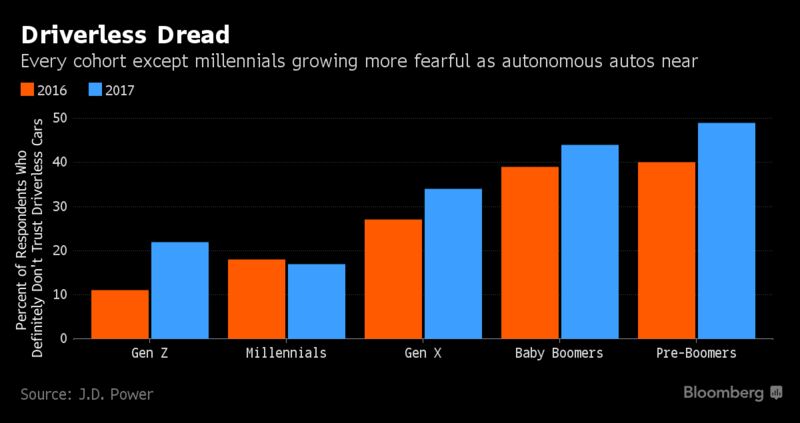
Autonomous autos are advancing so rapidly that companies like Uber Technologies Inc. and Alphabet Inc.’s Waymo are beginning to offer robot rides to everyday consumers. But it turns out the traveling public may not be ready. A recent survey by the American Automobile Association found that more than three-quarters of Americans are afraid to ride in a self-driving car. And it’s not just Baby Boomers growing increasingly fearful of giving up the wheel to a computer, a J.D. Power study shows — it’s almost every generation.

Consumers will only become comfortable with driverless cars after they ride in them, Mary Barra, the chief executive officer of General Motors Co., said this week. The largest U.S. automaker is testing 180 self-driving Chevrolet Bolts and ultimately plans to put them in ride-hailing fleets, though it won’t say when…

Dangerous as it may be to operate cars themselves, many drivers are anxious about autonomous technology because they associate it with the fragility of electronic devices. Laptops crash and calls drop with nagging regularity. The consequence of a computerized car crash is much greater.

Americans tend to like technology: we like progress and new and exciting options. Is the fear related to safety or also connected to how Americans view driving (despite all the hours spent commuting and stuck in traffic, Americans like the freedom it offers)?

I’m guessing this fear will drop within a few years as stories of mishaps become normal (and even the occasional mishap would be safer in the long run compared to the tens of thousands of Americans killed each year in vehicles) and the technology improves. Could we also imagine a scenario where governments impose self-driving vehicles because of their improved safety?

Build a tower in Naperville, possibly tear it down 17 years later

Naperville hasn’t experienced many major failures in recent decades but the Moser Tower along the Riverwalk is in trouble:

The Riverwalk Commission on Wednesday began reviewing an assessment of the structure before formulating a recommendation to the city council about what should be done with the 17-year-old Moser Tower, a 160-foot-tall spire that houses 72 chiming bells and has become an icon on the city’s skyline…

The city could fix the structure and maintain it as is for $3 million; fix it and enclose the base to help prevent future corrosion for $3.75 million; maintain it for a while and then tear it down for $1.6 million; or tear it down immediately for $660,000.

This tower has never received much support. It took longer than expected to complete and this contributed to the current issues as it couldn’t be fully enclosed with the money that was raised.

Additionally, it doesn’t receive much interest from residents today (from the article cited above):

But in a survey of Riverwalk users completed earlier this year, preserving the Moser Tower and Millennium Carillon came in last among four potential projects. When people were asked to choose their top priority, it earned 16 percent of votes.

Projects people preferred include building a park at 430 S. Washington St., just south of the DuPage River near the Burger King, which received 38 percent of votes; extending the Riverwalk south to Hillside Avenue, which got 27 percent of votes; and constructing ADA ramps at the Eagle Street Bridge, which got 19 percent.

All this on (1) the tallest structure along the Riverwalk, a recreation space regularly touted by Naperville leaders as an enduring symbol of the community’s civic-mindedness (started by citizens in the late 1970s), and (2) the largest structure in honor of Harold Moser, Mr. Naperville, who helped develop a significant portion of modern Naperville. Perhaps this will end up being a lesson to Naperville and other suburbs about embarking on unnecessary but nice commemorative projects?

A side note: the tower bears an odd resemblance to a tower from the Lord of the Rings movies.

Most millennials want to buy a home but we keep finding ones who don’t want to

Here is a recent story that both includes survey data that most millennials want to purchase a home yet leads with one who does not want to do this:

Niederkorn, a member of the millennial generation, currently lives with his parents but said he plans to be a renter for life and never buy a home. He craves the ability to pack up and go, he said, and doesn’t want to be saddled with a home loan, property taxes or homeowners associations fees. And though this may put him in the minority — an Apartment List survey of about 24,000 renters nationwide released in May found that 80 percent of millennial renters want to buy a house or condo sometime in the future — it does raise some interesting questions about the American Dream and the place of homeownership within it.

The historical overview of homeownership that follows is helpful but it is a weird premise: the cited data suggests there is a clear pattern but there is this one suburban guy who is going another direction. Do we follow the data or the single story?

On a related note, journalists are fascinated with millennials and what they may or not do, including buying a home. When I see such stories, I wonder if this is masking three different purposes:

  1. This is just another way to suggest there is a trend (journalists are always looking for trends).
  2. Journalists really hope millennials usher in major changes to American society.
  3. Younger journalists often live in big cities and want other millennials to affirm their choices.

Homeownership and suburban living is a hot topic in this area: will millennials follow their parents to the cookie-cutter suburbs and live boring lives? (There is often an evaluation of the suburbs included in the story.) I haven’t seen many articles where the conclusion is that many or most millennials will end up in the suburbs.

The ongoing difficulty of Chicago suburb to suburb commuting

The Daily Herald’s transportation writer details the difficulties of taking mass transit between Chicago suburbs:

My odyssey was prompted by the annual Dump the Pump Day, which encourages people to embrace public transit instead of driving.

Here’s a recap of the two-hour, 36-minute voyage to work:

• 8:20 a.m.: Boarded a Metra BNSF train in Downers Grove that arrived at Union Station.

• 9:23 a.m.: Caught a Blue Line train to Rosemont after a short walk from Union Station and a fight with a Ventra machine.

• 10:13 a.m.: Arrived at Rosemont and transferred to Pace Bus Route 606 at 10:30 a.m.; reached work at 10:56 a.m.

The tedious reverse commute lasted two hours, 57 minutes.

• 2:49 p.m.: Boarded Pace Bus Route 757 in Arlington Heights en route to the Forest Park Transit Center.

• 4 p.m.: Left on Pace Bus Route 301 headed to Oak Brook Center.

• 5:03 p.m.: Departed on Pace Bus Route 322 to Yorktown Center at 5:23 p.m.

• 5:30 p.m.: Took Pace Bus Route 834. Arrived in Downers Grove at 5:46 p.m.

By car, the trip is typically 30 to 40 minutes in the morning and 30 to 60 minutes in the afternoon, depending on traffic.

There are some easy answers as well as some more difficult discussions. The easy reasons to start:

  1. Mass transit in the region was constructed in an earlier era when many more people wanted to commute from suburbs to the city. The suburb to suburb trip is a product of recent decades.
  2. There is not money to do mass transit in the suburbs. This applies both to constructing mass transit (such as rail options) or attracting riders (with buses) who have too many starting points and endpoints.

But, given that so much commuting is now suburb to suburb, why aren’t there some more consistent options? Two deeper reasons:

  1. Infrastructure – not just mass transit but other systems including water – are in trouble. We are decades behind in providing good infrastructure. If it is any consolation, highway systems aren’t in much better shape as they often wait too long to add lanes or new routes (and it is debatable how successful these efforts are anyway.) It is both a funding and planning issue.
  2. Wealthier suburbs and suburbanites don’t really want mass transit. They don’t want to pay for it and they don’t want certain people coming to their community. They can generally afford driving and they like the freedom (and the exclusivity) it provides.

Overall, there is both a lack of will to build and use mass transit in many suburbs.

Reviving the dead shopping mall with residences, hotels

Efforts to resuscitate dead shopping malls include adding living space:

Four years later, after failing to make that work, owner The Krausz Companies is pitching a new plan that would keep existing anchor stores but demolish vacant Kohl’s and Sears stores and significantly shrink the size of the mall. The concept plan, proposed in April, also calls for building 155 town homes and 256 apartments north and east of the existing mall…

Melaniphy said he thinks there also will be more redevelopments that shrink the amount of space devoted to retail and mix it with residential or hotel development.

That’s already happened at the former Randhurst Shopping Center in Mount Prospect. It billed itself as the largest mall in the world when built in 1962 but struggled to keep up as more upscale shopping centers opened nearby. It relaunched as Randhurst Village in 2011, an open-air shopping center with shops, restaurants, a movie theater and hotel.

This sounds a lot like the retrofitting of suburbia suggested by Ellen Dunham-Jones. The key is to have a steady flow of people on the site – people who live there or who are staying at a hotel – rather than relying on people driving to the mall. If all goes well, it might be hard to tell decades from now that these sites were once large shopping malls. (At the same time: (1) these mixed-use developments might stick out in the suburban landscape and (2) the trickiest part of improving these malls might be linking the edges to the surrounding areas. Suburban developments often have fairly impermeable edges.)

A reminder: this does not mean that the traditional shopping mall is dead. There may just be a lot fewer and they will be concentrated in wealthier areas:

“The fancier malls are going to be healthy because there are always folks that want that aspirational lifestyle, but there’s still a lot of money to be made with people who might have more value-oriented customers as their focus,” Trombley said.

While food deserts were all the rage several years ago, we might talk of retail deserts in the future.


Were McMansions ever for everybody?

There is an idea out there that McMansions were everywhere at some point, invading the countryside and were within the financial means of all Americans. A recent Australian headline reminded me of this: “Small, smart, sustainable: Why a ‘McMansion’ isn’t for every Canberra homeowner.” The article goes on to argue that market forces are pushing people toward large houses that they don’t need.

I’ve never seen hard numbers on this – nobody is really measuring McMansion construction – but we can make some guesses based on Census data about the number of new homes of certain square feet. Between 1999 and 2016, the percent of new homes over 3,000 square feet was between 17% and 31%. Not all of these homes are McMansions for a variety of reason: some are too large (over 10,000 square feet or so), some are not architecturally garish or discombobulated. Based on this, maybe 15-20% of all new homes since 1999 were McMansions? That is a sizable amount but not a majority.

Additionally, how many Americans could afford such homes? At the peak of the housing bubble, not everyone could buy a large new home in a nice community. Could everyone in the middle class access such a home at some point over this time period? Maybe. And that doesn’t even account for whether those who could afford McMansions wanted one (maybe 50% of Americans at most would want one?) or had other considerations when purchasing their home that led to another housing option.

McMansions have certainly exerted influence over the last few decades, particularly among the upper-middle class, in certain communities (generally whiter and wealthier communities), and in depictions of newer housing on TV and in movies. But, I don’t think they have been pervasive as sometimes is suggested.

Measuring attitudes by search results rather than surveys?

An author suggests Google search result data gives us better indicators of attitudes toward insecurity, race, and sex than surveys:

I think there’s two. One is depressing and kind of horrifying. The book is called Everybody Lies, and I start the book with racism and how people were saying to surveys that they didn’t care that Barack Obama was black. But at the same time they were making horrible racist searches, and very clearly the data shows that many Americans were not voting for Obama precisely because he was black.

I started the book with that, because that is the ultimate lie. You might be saying that you don’t care that [someone is black or a woman], but that really is driving your behavior. People can say one thing and do something totally different. You see the darkness that is often hidden from polite society. That made me feel kind of worse about the world a little bit. It was a little bit frightening and horrifying.

But, I think the second thing that you see is a widespread insecurity, and that made me feel a little bit better. I think people put on a front, whether it’s to friends or on social media, of having things together and being sure of themselves and confident and polished. But we’re all anxious. We’re all neurotic.

That made me feel less alone, and it also made me more compassionate to people. I now assume that people are going through some sort of struggle, even if you wouldn’t know that from their Facebook posts.

We know surveys have flaws and there are multiple ways – from sampling, to bad questions, to nonresponse, to social desirability bias (the issue at hand here) – they can be skewed.

But, these flaws wouldn’t lead me to these options:

  1. Thinking that search results data provides better information. Who is doing the searching? Are they a representative population? How clear are the patterns? (It is common to see stories based on the data but that provide no numbers. “Illinois” might be the most misspelled word in the state, for example, but by a one search margin and with 486 to 485 searches).
  2. Thinking that surveys are worthless on the whole. They still tell us something, particularly if we know the responses to some questions might be skewed. In the example above, why would Americans tell pollsters they have more progressive racial attitudes that they do? They have indeed internalized something about race.
  3. That attitudes need to be measured as accurately as possible. People’s attitudes often don’t line up with their actions. Perhaps we need more measures of attitudes and behaviors rather than a single good one. The search result data cited above could supplement survey data and voting data to better inform us about how Americans think about race.