Building the ability to disperse billions in rental aid assistance in the US

Congress has allocated billions for rental aid assistance amid COVID-19 but it takes time and infrastructure to distribute it to American renters:

Photo by Pavel Danilyuk on Pexels.com

With millions of Americans out of work due to the pandemic, the eviction moratorium helped keep people in their homes — but it also put a squeeze on landlords. To help, between the December and March COVID relief packages, Congress approved more than $46 billion in rental assistance. Exact amounts renters and landlords can receive depend on their income and where they live, but renters could get enough to cover rent from as far back as March 13, 2020, unpaid utilities and even, in some cases, future rent.

But by the end of May, only $1.5 billion had gone out. And officials are racing against the clock: The federal eviction moratorium ends July 31…

“While we have substantial funds through the American Rescue Plan, we as a nation have never had a national infrastructure to prevent unnecessary evictions,” White House American Rescue Plan Coordinator Gene Sperling said recently during an eviction prevention summit.

While there had been some state and local rental assistance programs, the scale of this program was beyond what they’d handled, a Treasury official said. State and local entities had to build IT systems and hire staff. Some programs did not even open until May or June — but since opening, a Treasury spokesperson said, there has been an exponential increase in renters getting money. Landlords and renters can apply directly for funds through their states, counties and in some cases tribal authorities depending on where they live.

Unprecedented times lead to unprecedented processes? Putting the money into the right hands in a timely manner is no easy task. The steps include:

-approving the monies and making it available

-letting people know that the money is available

-encouraging applications

-processing applications

-disbursing funds

-applying the funds to rent

-overseeing the program during the process and afterward

If it comes together, millions of Americans will be able to stay in their housing and landlords will rent they were waiting for.

Now, to tackle the broader issues of affordable housing in helpful locations…

Agglomeration, working from home, and the character of places

Why do certain industries cluster together in one location? Social scientists have answers:

Photo by Chris F on Pexels.com

Economists believe agglomeration — like the clustering of tech in the Bay Area — has historically been the result of two main forces. The first is what they call “human capital spillovers” — a fancy way of saying that people get smarter and more creative when they’re around other smart and creative people. Think informal conversations, or “serendipitous interactions,” over coffee in the break room or beers at the bar. These interactions, the theory says, are crucial to generating great ideas, and they encourage the incubation and development of brainiac clusters. The other force is the power of “matching” opportunities. When lots of tech firms, workers and investors clustered in Silicon Valley, there were lots more opportunities for productive marriages between them. As a result, companies that wanted to recruit, grow or get acquired often gravitated to places like the Bay Area.

However, remote work could actually improve certain matching possibilities. Companies can hire smart people anywhere in the world when they drop the requirement that they physically be in a central office. Not only that, they can pay them less. Moreover, killing the office can significantly lower costs for companies, which no longer have to pay for expensive real estate.

So, in this theory, the future of work and the economic geography of America really hinges on whether companies can create those “human capital spillovers” through computer screens or in offices in cheaper locations.

This is a phenomenon with a pretty broad reach as cities could be viewed as clusters of firms and organizations. What has been interesting to me in this field in recent years is how places like this come to develop and what it means for the character of the place.

Take Silicon Valley as an example. This is the home of the tech industry and, as the article notes, the big firms have committed to physically being there with large headquarters (including Google, Apple, and Facebook). These headquarters and office parks are themselves interesting and often a post-World War Two phenomena as highways and suburbanization brought many companies out of downtowns to more sprawling campuses. At the same time, the impact of all of this on the communities nearby is also important. What happens when the interests of the big tech company and the community collide (see a recent example of a Facebook mixed-use proposal)? What did these communities used to be like and what are they?

This is bigger than just the idea of employees working from home. This potential shift away from clustering would affect places themselves and how they are experienced. If thousands of workers are no longer in Silicon Valley, what does this do to those communities and the communities in which more workers are now at home? Silicon Valley became something unique with this tech activity but it could be a very different kind of place in several decades if there is new activity and new residents.

The same could be said for many other communities. What is New York City if Wall Street and the finance industry clusters elsewhere or disperses across the globe? What happens to Los Angeles if Hollywood disperses? And so on. The character of places depends in part on these clusters, their size, and their history. If the agglomerations shift, so will the character of communities.

Trying to attract suburban voters by fighting Critical Race Theory

The ongoing struggle for suburban voters now extends to Critical Race Theory:

Photo by RODNAE Productions on Pexels.com

“In suburban areas, the number one cultural issue is critical race theory. The suburbs are on fire with anger,” said Corry Bliss, a Republican strategist who works on congressional races. “We are at the beginning of this issue, not the end.”…

While critical race theory is animating the party’s base, Republican operatives say the issue will have wider appeal than other cultural wedge issues because some parents see it as having a direct impact on their children’s education.

Republicans are zeroing in on winning back the white college-educated, suburban voters that abandoned them during former President Donald Trump’s tenure. A new study from Pew Research Center found that Biden won suburban voters by 11 percentage points in the 2020 election after Trump won them by two points in the 2016 election.

“Parents all over the country have been mobilized because they do not want their children being taught they are automatically racist because of their skin color. I fully expect Democrats’ support for this controversial theory to be at the center of 2022 campaigns,” National Republican Congressional Committee Chairman Tom Emmer said in a statement to McClatchy. “The most compelling electoral issues are those that focus on the issue of fairness, and that’s why critical race theory will be incredibly damaging to every vulnerable Democrat.”

While it remains to be seen how effective this will be, multiple aspects of suburban life and history may fit:

  1. Many suburbs were built on exclusion where whites worked to keep particular racial and ethnic groups out. Even as suburbs overall have become more diverse in recent decades, this has not necessarily occurred in all suburban communities.
  2. Suburbanites are often viewed as individualistic and emphasizing meritocracy. They feel they made it there by their own success and then want to live in their private spaces (usually single-family homes).
  3. While suburbanites in regular social life might want to avoid confrontation with neighbors, the emphasis on local control in suburbs means that national issues can spark conflict at the local level.

As the article asks, will this issue that touches on what suburbs are crowd out other common election issues like the economy or taxes?

Parkway tree diversity in Naperville

The Naperville city logo prominently features a tree. And in replacing parkway trees lost to a tornado last month, the city is working with a number of species:

Photo by Domen Mirtiu010d Dolenec on Pexels.com

Residents are being given the option of choosing the type of tree they’d like planted in their home’s parkway. The only stipulation is the choice needs to be approved from Public Works’ forestry division, and anyone who doesn’t make a selection will be assigned a tree…

The city’s spring list of authorized trees includes the shingle oak, Kentucky coffee tree, Hackberry, hybrid elm, tulip tree, plane-tree, Japanese tree lilac, silver linden, chinquapin oak, crabapple, American linden, red oak, swamp white oak and heritage oak.

There’s also a list of tree species that never will be authorized by the city’s forestry division. Among those are the ailanthus or Tree of Heaven; evergreen conifers such as a pine, spruce or fir; any variety of ash; Hawthorns, unless they’re thornless; Bradford pears; pin oaks; box elders; poplars; willows; cottonwoods; silver maples; and elms, unless they’re disease resistant.

I presume such a list of approved species exists for multiple reasons. Having a variety of species helps prevent issues with diseases or insects that wipe out trees, like elms or ash trees. The shape, size, and foliage of certain trees is better for a parkway setting. Some trees are simply not desirable generally; a few months, I heard a speaker give a short digression on why they hate bradford pear trees.

This is not a choice that should be taken lightly. There is a section in James Howard Kunstler’s TED Talk “The Ghastly Tragedy of the Suburbs” where he discusses the multiple benefits of trees along streets. This includes providing shade and a canopy for the street and sidewalks as well as separating the street and its vehicles from the sidewalks. If done well, trees along a road create an inviting environment. If done poorly, the trees are too few, they die or are scraggly, and the roadway and pathways just look barren.

Chicago as ongoing railroad hub: one quarter of freight trains pass through the region

With Transportation Secretary Pete Buttigieg in Chicago yesterday, the Chicago Tribune provided this context for the need for infrastructure money in the region:

Photo by Pixabay on Pexels.com

His next stop was the CSX Bedford Park Intermodal Yard with Gov. Pritzker, and U.S. Reps. Marie Newman, of La Grange, and Mike Quigley, of Chicago planning to join him.

The event was an opportunity for Buttigieg to talk up how Biden’s infrastructure plan calls for billions in investments to improve freight and passenger rail infrastructure.

The CSX terminal, the nation’s third largest by volume, serves domestic and international intermodal freight. One of every four U.S. freight trains passes through Chicago., according to the U.S. Department of Transportation.

Chicago area residents can catch glimpses of some of these intermodal areas, often on the side of major highways, and they certainly know about the frieght trains that can block their roadways. But, how many know that 25% of national freight traffic passes through the region?

Even as motor vehicles and airplanes came to dominate landscapes – and Chicago has plenty of traffic and one of the busiest airports – the railroad continues to provide food, consumer goods, and transportation. Chicago’s status as a leading global city partly depends on it. The economy of the United States partly depends on it.

The railroad was one very important reason for Chicago’s rise. With its location on the southwest corner of Lake Michigan, Chicago quickly became a railroad hub for connecting the Northeast to a growing Midwest as well as Western expansion and all of its abundance.

The railroad can be an inconvenience. News of railroad traffic increasing in the region can induce concerns from residents and community leaders. But, the railroad traffic in the region at large helps the region as a whole.

More Americans looking for vacation homes in Europe

Those with means and resources can purchase real estate around the globe. This is essential for development in many locations, including major cities as well as vacation destinations in Europe:

Photo by Pixabay on Pexels.com

From Lisbon to the Greek islands, the Americans are back, ready to take advantage of the buyer’s market in many of Europe’s leading resort areas. There are bargains to be had at the entry and mid-levels, with prices buoyant at the top end…

Knight Frank last week released its Global Residential Cities Index for the first quarter of 2021, giving a view of price changes from the year-earlier period, when lockdowns began to take hold world-wide. It shows double-digit increases clustered in the Nordic countries and Eastern Europe, while prime European second-home destinations that had been inching toward the top in previous years—including Lisbon and Malaga on Spain’s Costa del Sol—are seeing declines…

Americans typically play a niche role in Southern Europe’s luxury second-home markets, which tend to be dominated by sun-hungry Northern Europeans. But they have traditionally made themselves more conspicuous at the very top of those markets.

This is different than Americans looking for relatively inexpensive places to retire; this is about finding real estate to invest in and profit from in the long term in desirable locations. This is an opportunity to make money in locations where prices have decreased, in contrast to numerous markets in and around big cities where prices have increased for years. Homes are places to enjoy and to invest in, as sociologist Brian McCabe argues. Being wealthy and staying wealthy can depend, in part, on buying real estate when it is available and then profiting later.

All of this is an opportunity that most Americans do not have or could not even dream about. A second home in a foreign country? The ability to travel there regularly? Being able to sell this property later and/or pass down profits to heirs? Just as those featured on HGTV’s International House Hunters are a select group, those who can take advantage of a European buyer’s market are limited.

An ongoing American antagonism toward big cities

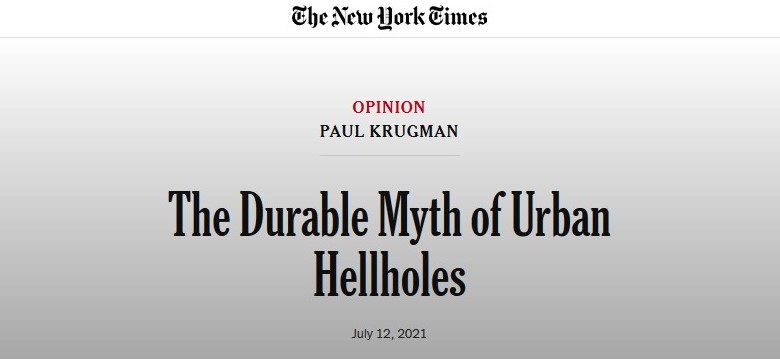
As noted in a recent opinion in the New York Times, the divide between cities and other kinds of communities in the United States has a long history.

From the beginning, Americans have differed on whether to uphold as ideal the urban life or the rural life. Should the model be New York, Boston, or Philadelphia or the plot of land in the country? These differences became more pronounced as urbanization picked up in the 1800s. With the majority of Americans now in the suburbs, the issue still is ongoing as many Americans say they prefer small towns (the suburbs?) while enjoying proximity to urban centers (jobs, cultural opportunities, transportation, etc.).

This is not just a geographic distinction or a set of preferences that some people have compared to others. These choices and systems that push people one way or another (with a lot of social actors and forces involved in encouraging uburbanization) also include a moral dimensions or a set of values and meanings. These are not just spaces; Americans have processes of meaning-making in all of these contexts.

With that in mind, there are several ways one could think about this ongoing contrast:

  1. A binary between city and country. This encourages each side to praise the traits of their option and denounce the other. Very black and white, one is better and one is worse.
  2. The suburbs are an attempted solution to this ongoing binary: some of the country, some of the city (or, as critics of the suburbs might say, none of either).
  3. Connected to different political battles. In the early days, this was part of the issues between Jefferson and Hamilton. Today, this is an issue between Republicans and Democrats. This is also about local/state/regional politics where urban interests go against those of other locations.
  4. A superfluous debate for a long time as we should think about regions with cities as anchors for wide territories where economic, social, and political activity is all intertwined. Think of Boston in the Northeast.
  5. A reaction to the rapid urbanization of the last two centuries that has upset much of human history where most people lived in small communities. Perhaps we are still figuring out how everything works with megacities where so much – population, economic activity, political power, globalized activity – is so concentrated.

In short, this divide is probably not going away soon. Hopefully, the conversation is more productive than denigrating other kinds of communities but rather seeking ways of working together since many of the issues Americans care about would benefit from cooperation across geographies.

Call [area code]-AWESOME for your needs

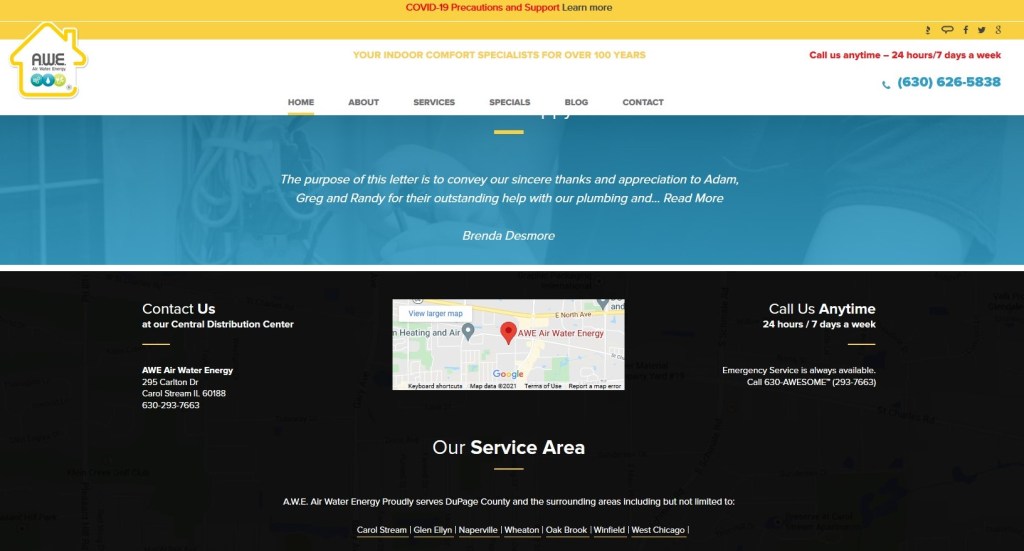
Certain numbers stick out in advertising. The Empire carpet jingle, 1-877-CARS-FOR-KIDS, and one local company I saw recently:

The phone number 630-293-7663 – or 630-AWESOME – works in two ways. First, it fits with the company name A.W.E. which stands for Air, Water, and Energy. Second, what company would not want to be known as awesome? Whether fitting the definition for inspiring awe or remarkable, this number will get remembered. All it needs now is a jingle that sticks in your head…

If you too want to make cool words out of phone numbers, here is a phone number to word generator.

The foresight of old railway viaducts

In regions like Chicagoland where there are numerous railroad lines and at-grade railroad crossings, old viaducts exhibit a measure of foresight that benefits today’s residents:

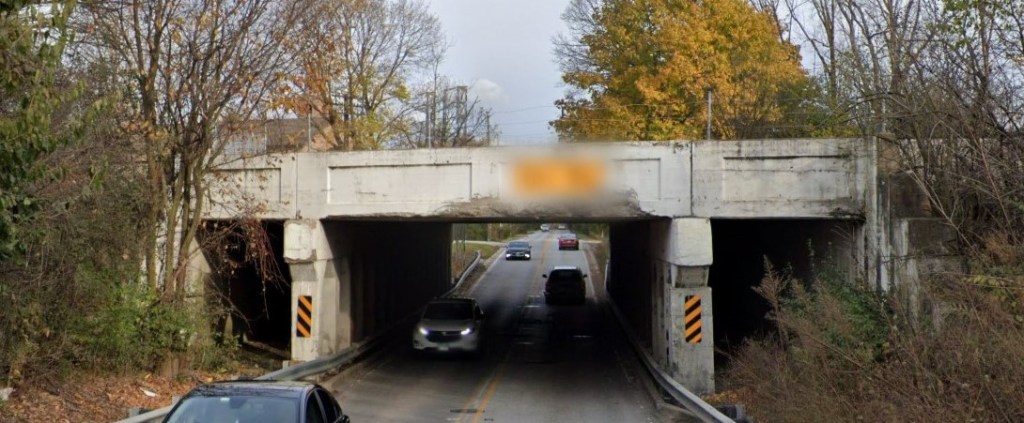
Google Street View image of Vollmer Road viaduct

That factory still operates as Chicago Heights Steel, and the cobblestone portion of Main Street is mostly a driveway leading to it. But just past the factory is a secret passageway of sorts, an ancient viaduct just wide enough to allow one vehicle to pass under the old Elgin, Joliet & Eastern railroad tracks…

There are areas, though, where there are no ways around it, and if you get stopped, you just have to abide. I’ve lived in those areas, but I don’t anymore. The main train line by me is above grade and it’s great. The old Illinois Central tracks, which include what’s now known as the Metra Electric District commuter line, traverse the area atop a big berm as unobstructed motorists cruise underneath through a series of viaducts from Sauk Trail all the way into the heart of Chicago.

According to Metra, the grade separation was a direct result of Chicago hosting the 1893 World’s Columbian Exhibition — city leaders didn’t want messy train deaths to tarnish the event’s image. In the years after those initial express trains from downtown to Jackson Park for the World’s Fair, commuter trains made their way to the suburbs, with Flossmoor getting service in 1900 and Matteson by 1912. The raised platforms, tracks and viaducts followed with the entire line being above grade by the 1920s…

Viaducts are harder to come by these days than they were in the golden age of railroads, and I only know of a few that have been constructed in my lifetime. Despite the hassles that can come along with them, motorists, and likely train engineers too, are happy we have the ones that are here.

Even as railroad lines help put many suburban communities on the map and still provide access to big cities, many local residents just see them as a hassle for the traffic and noise they create. With the automobile dominating suburban travel, trains are nuisance when they block vehicle flow.

I am familiar with numerous railroad viaducts in suburban communities in addition to the ones mentioned above in the south suburbs of Chicago. They were ahead of their time as they allowed access under the railroad tracks, sometimes even before cars were around. Local leaders and officials they foresaw the problems that might arise between ground-level traffic and trains and therefore separated the two flows to let each move on their own. This helps avoid safety issues that still plague communities today.

At the same time, not all of these viaducts have been treated well. As the article notes elsewhere, they can have drainage issues. Their original size is often an issue as today’s vehicles and/or traffic flow is larger, meaning that old viaducts need to be expanded. Letting one car through at a time is better than nothing but many communities would benefit from two lanes each way being able to go under the tracks. Foresight in infrastructure is helpful but it needs consistent attention to keep up with repairs and expanded suburban populations.

American conflict playing out through local school boards

One of the reasons many Americans like suburbs is the local government and local control over land, local organizations, and how local taxes are used. National debates are now playing out in one such local form of government: school boards.

Photo by Pixabay on Pexels.com

Local school boards around the country are increasingly becoming cauldrons of anger and political division, boiling with disputes over such issues as COVID-19 mask rules, the treatment of transgender students and how to teach the history of racism and slavery in America.

Meetings that were once orderly, even boring, have turned ugly. School board elections that were once uncontested have drawn slates of candidates galvanized by one issue or another…

School boards are typically composed of former educators and parents whose job, at least until recently, mostly consisted of ironing out budgets, discussing the lunch menu or hiring superintendents.

But online meetings during the pandemic made it easier for parents to tune in. And the crisis gave new gravity to school board decisions. Parents worried their children were falling behind because of remote learning or clashed over how serious the health risks were.

This preference for local input and control is not just limited to suburbs: from the beginning, Americans have generally liked the idea of decentralized power. In the realm of education, there is input from the federal government, state government, and local bodies and districts. Local citizens retain some ability to provide their opinion on local education and to serve on local governments that control budgets and other aspects of local education.

Because of this system, people can work through different channels to address issues they are concerned about. Perhaps they can pressure the national Department of Education. They might seek to influence state boards. They can run for local boards and show up at meetings to voice their opinions. All could be useful in terms of promoting particular educational paths or policies. At the same time, I would guess there is an immediate satisfaction at showing up at local meetings, seeing real people in your community that shape schools, and advocating for change. These are not distant bureaucrats grinding out policy decisions; these are local elected residents who meet at regular times.

In the current moment, decisions made by local school boards help to differentiate different communities from each other. One district might be open to teaching something where another says no. Money may be allocated one way in a particular community while it is not a budget line in another. Board members may claim to represent one part of a community and not others. Local schools are not just about education; they symbolize local priorities and concerns. They help address or reinforce racial, ethnic, class, and gender boundaries in and across communities. Schools are both a part of the status of a community and contribute to that status.

In this article, it sounds like many of the school board battles are proxy fights over national issues. Whether this serves individual communities and their residents well remains to be seen.