Defining a McMansion, Trait #2: Relative size

When I tell people that I have published about McMansions, the same question almost always arises: “What exactly is a McMansion?” My paper defining the McMansion answers this but in a series of posts here, I want to update the definition based on what I have seen in the last five years.

While McMansions are certainly larger than normal, in certain circumstances they can appear even larger than their square footage: when constructed next to smaller homes (often teardowns, sometimes infill properties) or when squeezed onto small lots (so that the homes seem to be bursting off the property). While I know the second case does happen quite a bit, most of the McMansion coverage of this trait in recent years focuses on teardown properties. Some patterns I’ve observed:

  1. The typical case involves someone from outside the neighborhood purchasing an older home (often a postwar house), demolishing it, and constructing a significantly larger home and/or a home that has a different architectural style than nearby homes. This one picture is a great illustration. Note that the new home does not necessarily have to be over 3,000 square feet or even include the worst McMansion architecture; it just has to be different from the existing homes.
  2. Media coverage of teardown McMansions is overwhelmingly negative. This is likely the issue only comes up neighbors upset over the construction of a teardown McMansion start looking for ways to stop the construction or limit future construction. On the flip side, it is hard to know how many teardown McMansions are constructed without much furor.
  3. It is hard to know exactly what motivates neighbors to complain so vociferously about teardown McMansions. Americans seem to want the ability to buy new homes in good neighborhoods (balancing modern features with valuable locations) but don’t like what it happens to them. The complaints often fall into two camps. First, those who live directly adjacent to a teardown may have a range of new issues to confront: people able to see in their windows, a hulking property next door, losing sunlight, the older home now looking dated or different. Second, the larger issue is often couched in terms of the character of the neighborhood. People feel that when they move to a particular place, that street or neighborhood should stay similar – after all, they liked its features enough that they moved there. A teardown McMansion threatens that.
  4. The fights between neighbors can be quite contentious, a rarity in many suburban communities where middle-class decorum suggests conflict avoidance is best. Lawuits occur (example and example), and some neighbors may even pool their resources to buy a nearby home and save it from being torn down. But, if the foundation of American life is owning a home, perhaps it is not surprising that such conflict arises when owners perceive their home to be under threat. See my six steps for responding to a nearby teardown McMansion.
  5. These conflicts often involve local officials. Numerous communities across the United States have guidelines for teardowns (see the example of Austin several years ago and Los Angeles more recently). Outside of historic preservation districts, these guidelines typically limit the size of the new home (through guidelines like a Floor Area Ratio) and/or provide guidance on particular architectural features.
  6. The teardown debates tend to put local officials in a strange position. Whose rights should they defend? Property owners? If so, do they want to allow long-time residents to have a voice in shaping their own neighborhoods or do they want individual owners to be able to sell their property at a good profit? Can they openly support builders and developers? I suspect most communities want to – growth, particularly high-end houses, is an important marker of vitality – but you don’t want to always run roughshod over your constituents. Teardowns are most common in neighborhoods and communities that are already well off – see recent evidence from the Chicago region – and this tends to pit already well-off community members versus well-off outsiders.

Teardown McMansions are a subset of McMansions as a whole, often constructed in desirable neighborhoods and sometimes raising the ire of neighbors and concerned citizens. Balancing the rights of neighbors and property owners will likely continue to be a sticky issue for many local governments.
Defining a McMansion, Trait #1: Size

When I tell people that I have published about McMansions, the same question almost always arises: “What exactly is a McMansion?” My paper defining the McMansion answers this but in a series of posts here, I want to update the definition based on what I have seen in the last five years.

We’ll start with Trait #1: McMansions are big houses. As noted in the initial research paper, how big is up for update. I think it typically means bigger than normal though not large enough to be considered a home for truly wealthy people. In other words, it is a bigger than average house that more typical Americans (middle to upper middle class to upper class) might live in.

Interestingly, the average size of American homes has been on the rise in recent years even with a recovering housing market and increased scrutiny of larger homes. For new homes constructed in 2015 (see page 9 of the PDF file), the median size is 2,467 square feet and the average is 2,687 square feet. Both are records. There was a slight decline in new home size in 2009-2011 but since then, homes have been increasing in size.

Another way to look at this data is to examine what percent of new homes are over 3,000 square feet. Despite all the calls that McMansions are dead (or worse, making a comeback: see 2011, 2012, 2013, 2013, and 2014 posts on this), there are still new large homes in America. According to the same Census PDF with 2015 data (see page 1), we are at record percentages for the percent of new homes constructed that are 3,000-3,999 square feet (20%) and 4,000 square feet and larger (11%). So, while housing starts are still down overall compared to the early 2000s (currently less than half of some of those years), the homes that are being constructed tend to be larger. That growing tiny house movement (note my skepticism) is also not reflected in this data: with the data going back to 1999, we are at a low with only 8% of new homes having less than 1,400 square feet.

Perhaps the actual square footage of the McMansion is of less interest than the perception that it is large. (This gets into Trait #3 but is worth mentioning here.) It can be difficult from the street to estimate exactly the size of homes. However, it does seem easier to note that a ranch home has to be really large to be a McMansion while a two-story home with particular features in the front can appear larger.

One of the biggest ongoing criticisms of homes this large is that they are simply not necessary. What does one do with all that space? Doesn’t such space promote less family interaction? Doesn’t such a large home require more resources in construction as well as in maintenance? All three of these critiques could be true and yet it seems there are a good number of Americans who like having larger houses. It may be the old American adage of getting the most bang for your buck. It may be that they have a lot of stuff: having lots of stuff and having a big house go together. It may be that we like having additional rooms for specialized uses (man and woman caves, here we come). They may not use much of the house regularly but it could be comforting to have that space when you “need” it.

To conclude, McMansions are large homes though not as big as mansions. Yet, not all big homes acquire the moniker “McMansion.” The next traits highlight particular features of larger-than-average homes that increase the likelihood that they will be considered McMansions.

Four steps for city dwellers to improve winter

The Danish concept of hygge may have the four part secret for surviving winters in dense settings:

Hygge principle: Warmth. Unlike some American cities, where snow seems like a shocker year after year, Scandinavian cities acknowledge and build for their cold climate, with higher energy standards for walls and doors, vestibules that prevent drafts, coat racks for winter gear, and public plazas that block wind and capitalize on southern sun. Then there’s the ritual of the sauna…

Hygge principle: Light and color. With far fewer hours of sunlight, wintertime contentment relies on literal or metaphorical brightness—hence the typical Danish scenes of candle-bedecked dinner tables and windows laced with twinkle lights, or Copenhagen’s streets with their famous Crayola-colored buildings…

Hygge principle: Access to nature. While hygge’s overarching style seems to be an indoorsy, “cocoa by the fire” feel, Pia Edberg, author of The Cozy Life: Rediscover the Joy of the Simple Things Through the Danish Concept of Hygge, points out that experiencing nature is elemental to hygge. “As the old saying goes: ‘There’s no such thing as bad weather, only bad clothes.’”…

Hygge principle: Gathering places. Perhaps the most important antidote to winter’s isolation is hygge’s emphasis on communal gathering and social connection. In Copenhagen, privately owned third places—restaurants, bars, cafes, bookstores—are as central to the wintery social life as public squares are in the summertime.

The American way of rugged individualism may lead to many long cold winter nights…

Really, though, these adaptations to climate are interesting to consider. Every so often, you will find people making arguments that places like the Sunbelt in the United States are attractive because of their warmer weather. But, how much is this a factor versus other possible factors? Or, how is it that many countries along the equator and in tropical zones are outside of the first world? Would New York be the leading global city in the world if it had a climate like Miami or Cairo? In this case of Denmark, is it more about a different kind of society – the Scandinavian way of life that seems to make it to the top of a number of rankings for best places to live – rather than an approach to winter?

At the same time, it wouldn’t hurt to have more fun during the winter months. The weather and lack of sun from Thanksgiving to New Year’s doesn’t seem to prompt the same kind of despondency prompted by January and February.

Chicago sets new record for tourism

The city of Chicago may have problems but the number of tourists continues to increase:

An estimated 54.1 million visitors came to the city in 2016, up 2.9 percent from the previous year’s record-setting count. The increase marks a step towards reaching Mayor Rahm Emanuel’s goal of annually attracting 55 million out-of-towners to Chicago by 2020…

Leisure proved to be the primary attraction behind Chicago’s rising tourism numbers. About four in five visitors last year (nearly 41 million) came to Chicago for fun, city officials say…

The long-running Blues Festival, the NFL Draft and the Chicago Cubs World Series victory parade were three major events last year that helped boost tourism numbers, Kelly said…

City officials also cite business visitation, which grew by 2.1 percent from the previous year, as another factor. Some 31 major conventions and meetings were hosted citywide throughout last year, drawing nearly one million attendees; 35 business meetings are slated for 2017.

I’d love to see how these numbers were calculated. Just take the suggestion that the Cubs World Series parade and rally are part of these totals; how big were those crowds? Early estimates were high but there was little commentary later about more solid figures. Were suburbanites who came in for the day counted as tourists? If the 5 million figure holds, then this one event on its own pushed the city from a lower number than the previous year to a record number.

What if churches considered geographic disparities and their local context?

An interview in the latest print issue of Christianity Today could provide insights for a lot of religious congregations: here is part of the lesson regarding geographic inequalities.

For me, geography is never passive. Why does a new freeway cut through a certain neighborhood? Who lives near that freeway, and why? Those are not just decisions of urban planners or politicians. There are a million little decisions that go into that process—public and private.

It’s impossible to live in a place, or move to a new one, without getting tangled up in the history of its particular structures—who they benefit and who they exclude. That’s a hard reality, because most of us didn’t pave the streets we live on. Yet someone designed those places, and that design will either encourage the flourishing of society or lead to patterns of exclusion…

So many churches, frankly, just don’t know their communities at all. Two or three days a week, a whole bunch of cars come in and then go somewhere else—and that’s the only relationship a church might have with its surrounding neighborhood. That’s more of a suburban reality, but it’s increasingly true of cities as well. The first step, for churches, is just asking, Who’s here? Who are the immediate neighbors that we serve? What populations are underserved? If churches begin to have that conversation more often, then they can look to their congregations and say, “Are we representing the people in this community, and why or why not?”…

The next step is asking, “How can our congregation use its resources—whether that’s a building, a program, or a professional with certain skills—for the sake of others?” Church buildings, for example, are notorious for inefficient usage. They’re filled up a couple times each week, but otherwise the heat is off and they’re just vacant. What a gift it would be for churches to think of their physical structures as resources not just for themselves but also for their surrounding communities. Especially in dense, gentrifying urban areas, where space is really at a premium.

Some related thoughts, many based on findings from the sociology of religion:

  1. A lot of religious congregations seem more interested in internal homophily – being with like people during church activities – rather than turning their attention to their actual neighbors.
  2. Many congregations do little in terms of local outreach – see Congregations in America and the ongoing data of the National Congregations Study. It is not as if they are doing misinformed outreach; little is being done in the first place so getting churches to care about their local community may be harder than it looks.
  3. I agree that urban design can certainly contribute to flourishing or exclusion but it is not necessarily a guarantee of either. Take the highway example given here (and famously illustrated by the Dan Ryan Expressway on the South Side of Chicago): it reinforced existing boundaries.
  4. Why can’t religious groups construct and maintain “cosmopolitan canopies” rather than leaving it to private commercial interests or the efforts of local governments?
  5. I assume there are some differences today in how different religious traditions and denominations approach the local community. This was certainly true in the past where Catholic churches did not disappear when the parishioners moved to the suburbs but rather transitioned to the newest waves of immigrants. Today, who takes their local context into account more and what could they teach others?

Teaching “design thinking” through urban planning

It is popular to teach problem solving skills in schools and at least one group thinks this can be done through urban planning examples:

At a recent teaching conference in Richmond, Virginia, a session on “design thinking” in education drew a capacity crowd. Two middle-school teachers demonstrated how they had used the concept to plan and execute an urban-design project in which students were asked to develop a hypothetical city or town given factors such as population, geography, the environment, and financial resources…

First, he emphasized, design thinking starts with empathy. When designing anything meant to be used by another person—whether that’s a lesson, curriculum, classroom layout, or an imaginary city—the designer must understand what that person (an “end-user,” in design lingo) needs. In the case of the urban-design project, for example, the students can’t just design a pretty building; they must think about the needs of the people who will live there, as well as the available resources, the budget, and the impact that building will have on the surrounding landscape. “The design-thinking philosophy requires the designer to put his or her ego to the side and seek to meet the unmet needs, both rational and emotional, of the user,” Stevenson explained.

Once the student designers have gathered all their research together, they must organize and make sense of it all. Again, in the case of the urban-planning project, after the students have gathered interviews and research about the needs of their city’s future residents, students must figure out what to do with all that information. If, for example, the future residents’ top priorities include affordability and opulence, the student designer is going to have to find a way to integrate the residents’ conflicting needs.

Finally, design thinking requires designers to generate ideas—lots of ideas—and prototype them. In order for this part of the process to work, students and teachers must be comfortable with failure. For many students, particularly those who want to look smart, this phase can be frustrating. “People tend to come up with an idea early on, and know that this idea is it, the perfect idea, and get emotionally invested in that one thing. Then, when their perfect idea fails, they fall apart,” Stevenson said. Design thinking forces students to keep their minds open, to try out lots of ideas early in the process before they let their egos or emotions get too invested in just one.

If one of the purposes of an education is to create better citizens, using urban planning as an example would be a great exercise. My experience with college students suggests that when they arrive at that level of education, they have limited knowledge of how communities came to be or work. Urban planning cannot address all of these issues – I don’t believe, for example, that simply designing a place with New Urbanist techniques guarantees particular outcomes – but it can get students thinking about how environments are shaped by communities as well as shape communities. In other words, communities and physical environments don’t just happen: the interactions between humans and their environment (whether in older or more recent contexts) is a complex and iterative process.

Referendums to annex suburbs to Naperville filed in court

An annexation effort in several suburbs is official: papers were recently filed in court.

Petitions to put the annexation question before voters in Lisle, Warrenville, Woodridge and Naperville were filed Tuesday in DuPage County’s 18th Judicial Court and Will County’s 16th Judicial Court.

The referendum in each town would ask a basic yes or no question. In Woodridge, for example, it would ask voters “Shall the Village of Woodridge be annexed into the City of Naperville?”…

Officials in all four municipalities said the chances of actually merging the towns are remote and any such effort would be enormously complicated, adversely affect other taxing bodies such as park and library districts, and raise countless other issues…

Brummel, Chirico and Lisle Mayor Joe Broda said officials in their cities are studying the petitions and looking for potential flaws that would allow them to file an objection and try to scuttle efforts to put the question on the ballot. Brummel said the towns have until early next week to file such objections, although there’s some confusion as to the actual deadline.

This continues to be an interesting case. As I suggested before, the best reason I could see for this happening is for some ideologue to push the point that conservatives should put their money where their mouth is in wanting less government.

The middle class finding it difficult to find city housing – what to do?

Some urban neighborhoods are hot but this can lead to housing prices that limit how many middle class residents can move in:

The casualties in this war are mostly the middle class. In 2016, rents continued their years-long rise, incomes stratified further, and the average price to buy a home in major US cities rose. The strain pushed the middle class out of cities like Boston, San Francisco, Los Angeles, New York, Austin—the so-called “hot cities.” Some families move to the suburbs. Others flee for less expensive cities. But across the US, the trend holds: cities are increasingly home to high-rollers who can pay the high rents or down payments and lower income people who qualify for subsidized housing.

Macroeconomists say this a good problem to have. These cities are growing. People want to live in them. Stagnating economies in the Rust Belt might envy this kind of trouble. From the perspective of the overall wealth of cities, the middle class being pushed out doesn’t matter. But it matters on the human level, the neighborhood level. In Fort Hill, it means that a teacher at the local elementary school cannot afford to live in the neighborhood where she works. The effects on inequality, mobility, and the demographic composition of cities are very real, their causes multifold, and the solutions difficult…

“It’s very hard to get people to understand that the affordable housing crisis is not for the very poor,” says lawyer Mechele Dickerson of the University of Texas, an expert in housing and the middle class. It’s for people with good jobs who are not poor enough to qualify for subsidized housing, nor rich enough to pay the rising housing prices. “A family that makes $100,000 can’t afford to buy a house in most US cities,” Dickerson says…

The incoming administration has given experts no reason to expect it will prioritize fixing the affordability crises for the middle class. “In terms of the federal government, I see no hope,” Dickerson says. But as with immigration reform and climate change, housing affordability is something that states and cities can tackle on their own. In 2017, this trend toward decentralized power will continue—that is, if cities make retaining middle class residents a priority. That means relaxing the zoning laws to permit more housing stock to enter the market. This is the single most helpful thing the city of San Francisco could do, for example, to counter the tech money forcing prices on the limited housing stock up, says Shulman.

Four quick thoughts:

  1. This article seems to suggest that the government should do something to help middle class residents live in cities and the Trump administration may not help much. So, we do still in America subscribe to the idea that the federal government should subsidize middle class housing (whether in suburbs or cities)?
  2. I’m a little skeptical that the real problem is middle class housing rather than housing for poorer residents. Either this is a very broad definition of the middle class – which is entirely possible since most Americans consider themselves to be middle class – or cities really don’t care about poor and working class residents. I know cities want to keep middle-class residents but about people with less education and job prospects with less pay?
  3. This is an area that could really use some innovation. Big government doesn’t seem to have all the answers (what is the long-term effect of HUD?) nor does the free market (which tends to lead to residential segregation by race/ethnicity and class). What could really work well here is for a number of cities to try new ideas and see what might work.
  4. As the article notes, one of the biggest barriers is existing residents who don’t want to be near “affordable housing.” I’m not sure how you can get around this though there have been some indications that well-designed affordable housing limits some of the stigma. How do you get Americans (urban or suburban) to get past the mentality of pulling up the drawbridge after they move into their desirable neighborhood?

Can you plan suburban growth around an Amazon distribution center?

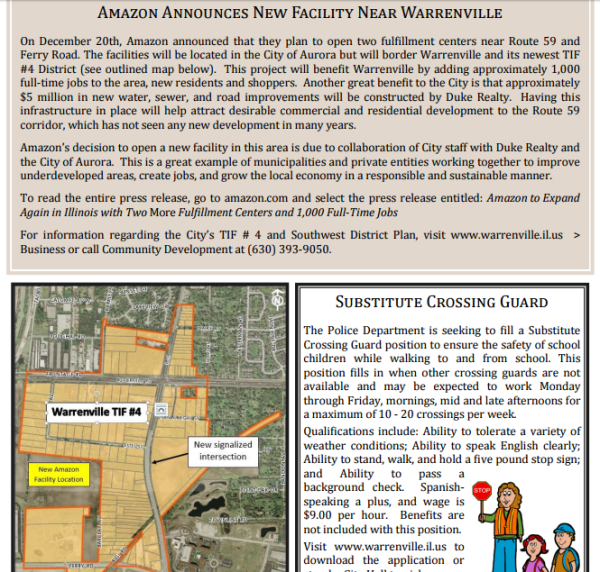
Thanks to state tax breaks, Amazon will soon begin construction on a new distribution center in northeast Aurora. The new facility is said to bring 1,000+ jobs. The latest newsletter from the City of Warrenville discusses the new facility. The facility is located near the border with Warrenville and the city thinks this will be a good for Warrenville:

warrenvilletifamazon

Can an Amazon facility be an economic boon for a suburb, particularly in a portion of the community that is underdeveloped? At the least, the 1,000+ workers will have to live somewhere. Could there be certain facilities that pop up to serve the workers – fast food places? Gas stations? Dry cleaners? Tattoo parlors (wait, Warrenville has enough of those)? Adding students to the school system?

I’m sure the city is either working on estimates of this and it would be worth sharing with the public. Connecting the dots between a warehouse/distribution facility and other community amenities is not obvious and what is Warrenville willing to do to capitalize on this opportunity?

Some in Warrenville, Lisle want to annex to Naperville

This would be a rarity: at least a few residents of two suburbs are interested in being annexed by the large suburb next door.

Apparently spurred by the recent emphasis on government consolidation in DuPage County, residents in Lisle and Warrenville are circulating petitions to place referendum questions on the April 4 ballot to measure support for proposals to annex their communities to Naperville. A similar petition has been rumored to be circulating in Woodridge.

Officials in all four towns said Friday they don’t know what’s behind the effort and stress that the complexities and likely resistance to such consolidations make them extremely unlikely…

“I would oppose that proposal 100 percent,” Broda said. “Each town has unique characteristics that make them special. Longtime Lisle residents wouldn’t even want to think about it. We want to keep the uniqueness of our communities.”…

Naperville is a fine community, he said, “but we have a strong identity of who we are and we have no desire to be part of Naperville.”

The general idea is intriguing if you want to put some conservative ideals into practice. Illinois, in particular, has many local taxing bodies – over 6,000 – and reducing the number of these could streamline operations and possibly lower taxes.

But, why would these particular suburbs want to be part of Naperville? What would they gain? The only thing I could really think of is prestige: for a few decades, Naperville has impressed both with its growth and its amenities. However, that growth has slowed (and won’t significantly increase unless Naperville makes some big decisions about allowing denser developments) and to some the amenities might be outweighed by the downsides of being large (think more traffic, lots of outsiders, etc.). Leaders of nearby suburbs are very aware of Naperville’s growth and, like in this article, are quick to note that they do not aspire to be Naperville and their communities have their own strengths.

Generally, I can’t imagine many existing suburban communities would want to merge with another suburb. The only two scenarios I could imagine: one suburb goes broke and/or one suburb is so small and their infrastructure costs so high that annexation makes sense to spread the cost.

Just to note: the time to become part of Naperville was decades ago. Warrenville finally incorporated in the 1967 after several failed votes in order to help protect itself from Naperville’s expansion. Naperville and Lisle also had conversations in the postwar decades about where each wanted to expand.