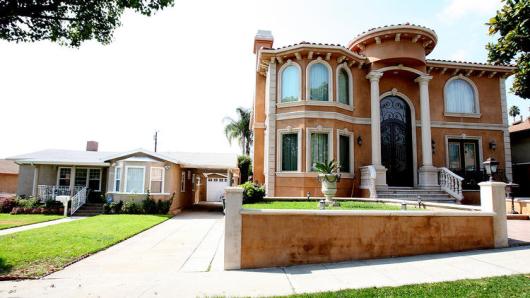
Photo illustrates two of the concerns about teardown McMansions

A news story about possible changes to Burbank’s guidelines for single-family homes includes a great depiction of a teardown McMansion:

burbankteardownmcmansion2013


The image illustrates two common issues neighbors have with such new homes. First, the new home is significantly larger. Not just a little larger; a lot larger. Next to a postwar ranch home now sits a two story property that extends almost to the side property lines and partly due to its higher base now looms over the older, smaller home. Second, we don’t even have to go so far as to claim the architecture of the new home is garish; rather, it is significantly different from the next door ranch home. The small ranch home common to many suburban communities may not be much to look at (though they do have their own enthusiasts) but at least such homes are on blocks of other such homes. Once teardowns begin, the architectural continuity is lost and a hodge podge of homes emerges. A new owner of a teardown could attempt to do a lot to smooth over hard feelings among neighbors but the task is probably more difficult when such a disparity in size and architecture exists.

At the same time, pictures of teardowns can be taken in such a way that either highlight or downplay the differences between adjacent homes. However, I don’t think the picture above can be explained away by angles or camera lenses.


Once a home is labeled a McMansion, can it be redeemed?

McMansionHell recently examined a home in Flower Mound, Texas. A real estate insider asks what the listing agent is now supposed to do:

I post this not to be mean, because obviously this home has people who love it and it is someone’s home, no matter how much of a “mound” it is. There are some very pretty parts. I post it because I truly want your opinion: what would you do with a listing like this to make it more appealing?

A good question for either a real estate agent or a homeowner. With McMansion almost never serving as a positive term, I assume having a home labeled a McMansion is not going to (1) help with the selling price or (2) entice buyers. Even when such homes were really popular, I don’t think too many people would label the homes McMansions to help their cause.

Crazy idea: could you shame people and damage their lives by outing McMansion owners and agents who sell such homes? If you don’t like suburbs – and there are plenty of people who can’t stand them, including a number in academia – this could be an individual level strategy to discourage people from living there. Or perhaps some wealthy McMansion critic could buy up such homes and redevelop the property (presumably with structures they liked better or they could provide a memorial garden).

A better interpretation of crime statistics for Chicago suburbs

The Daily Herald looks at recent crime figures in Chicago area suburbs. How should we interpret such numbers?

Violent crimes increased last year in half of 80 suburbs, says a new report by the FBI we’ve been analyzing.

Property crimes increased in more than 40 percent of the suburbs.

The Uniform Crime Reporting Program’s 2015 report shows Rosemont had a 94 percent increase in violent crimes, from 18 in 2014 to 35 in 2015. Most are assaults, but the category also includes rape, homicide and robbery. The village had a 29 percent increase in property crimes, which include arson, burglary and vehicle theft.

Other more populous suburbs had larger numbers of violent crimes in 2015, including 650 in Aurora, 261 in Elgin and 128 in Naperville.

Violent crimes remained largely flat in Palatine, with 36; Des Plaines, with 50; and Arlington Heights, with 42; while some communities saw crimes decrease across the board. Buffalo Grove saw an 80 percent decrease in violent crimes, to 2, and an 18 percent decrease in property crimes, to 234, while Prospect Heights saw a 33 percent decrease in violent crimes, to 14, and a 29 percent decrease in property crimes, to 112.

What I would take away:

  1. Looking across communities, there was not much change as half of the suburbs did not experience a rise in violent crimes and property crimes increased in less than half of the suburbs.
  2. It is interesting to note larger jumps in crime in certain communities. However, these should be interpreted in light of #1 and it would be more helpful to look at crime rates in these larger suburbs rather than just relying on occurrences.
  3. The last paragraph notes some major changes in other suburbs. But, some of these suburbs are smaller and a large decrease (80% in Buffalo Groves means a drop from 10 to 2) or increase could be more a function of not many crimes overall rather than indicate a larger trend.
  4. There is little indication of crime figures or rates over time which would help put the 2015 figure in better perspective.

All together, the headline “40 suburbs see spike in violent crimes in 2015” is not the most accurate. It may catch the attention of readers but neither the headline or article sufficiently discuss the statistics.

Successful: reversing highway lanes to evacuate people ahead of a hurricane

As Hurricane Matthew approached, officials used all the lanes of highways:

Across swaths of Florida, South Carolina, Georgia, and North Carolina, half the highway lanes have reversed. Traffic engineers call this “contraflow,” the volte-face of normal traffic. Now, on both sides of these roads, vehicles only run one way—away from Hurricane Matthew…

To select the exit routes months or even years before hurricane season, transportation planners turn to flood maps and atmospheric modeling. They predict hazards: wind, storm surge, freshwater flooding. They rely on traffic counts and experience to predict if and when residents will decide to finally leave their homes, and how…

The planners build computer simulations of their predictions, and tinker with the variables—down to specific intersections’ traffic signals—to speed up the process. With a few days notice, some regions choose to evacuate in waves, asking those living at low elevations to depart hours or even days before inland residents.

Rural regions often direct their residents toward one major highway, physically blocking off smaller roads. This undoubtedly results in jams, but some officials would rather have their populations—with their attendant gas, medical, and food needs—bunched together than spread throughout the hinterlands. Metropolitan areas are more likely to shut down an entire stretch of interstate, forcing cars onto side roads until they converge on bumper-to-bumper congestion miles from a flood zone.

It makes sense to use all available lanes going away from the hurricane, especially toward the end when few people would want to go the other direction. I would still be intrigued to see how many police such an effort requires and how drivers navigate on and off ramps going the opposite direction than normal. Even with all the lanes open one way, I imagine the traffic is not moving too fast.

If I remember correctly, reversing the lanes of highways was also on the table during the Cold War to quickly evacuate a major city. You can read a current-day guide to preparing for a nuclear blast here – there is no mention of highways. However, it does suggest more scenarios when people might be asked to evacuate:

Evacuations are more common than many people realize. Fires and floods cause evacuations most frequently across the U.S. and almost every year, people along coastlines evacuate as hurricanes approach. In addition, hundreds of times a year, transportation and industrial accidents release harmful substances, forcing many people to leave their homes.

While people may not think about evacuations much, I don’t think the highway lane reversals are common at all.

Sociology and totalitarian regimes

The discipline of sociology in Russia/the Soviet Union has faced problems over the decades:

Totalitarian regimes have a conflicted relationship with sociology. On the one hand, they have no elections or free media from which to learn about the public mood, so they need sociologists even more than democratic governments do. On the other hand, their fear of information is directly proportional to their need for it. They fear that sociologists, if allowed to work freely, will obtain knowledge about the vulnerabilities of the regime. An ideal totalitarian regime would find a way to obtain sociological data without the sociologists.

This push-pull relationship with sociology kept playing out throughout the Soviet period. For decades, sociology was effectively a banned discipline. Even Karl Marx, in official Soviet scholarship, was stripped of his sociological credentials, retaining the title only of “founder of scientific communism, teacher and leader of the international proletariat.” But starting in the 1950s, a little bit of sociology was allowed, under the auspices of philosophy — Marxist philosophy, of course…

The Levada Center retained its reputation as the most reliable source on Russian public opinion. Even federal ministries occasionally commissioned surveys from it. Sometimes the results of those differed little or not at all from those produced by the Kremlin-controlled pollsters.

But the Levada sociologists could not be controlled by the Kremlin, and that sealed their fate. In the end, the Kremlin’s fear of information became stronger than the desire to know, just as Mr. Gudkov knew it would.

This piece focus on one issue sociologists face within totalitarian regimes: dictators tend to want to control what information is available while sociologists generally want to make information available. Knowledge is power and those who try to subvert the official information stream are punished.

There is also at least one other issue regarding such information: what purpose should it serve? Do sociologists living in these conditions support or endorse the totalitarian actions? If so, are there justifiable reasons for doing so? Generally, sociology has thrived in places with more democratic governments and the discipline of sociology in the United States has shied away from ideas of fascism and totalitarianism, partly on the conservative end of the spectrum. (I’m sure there is work about this; the 1960s was an interesting point for sociology as prior to this, the discipline had some prominent conservative theorists.)

This could lead to an interesting question: is the practice of sociology generally limited to liberal democracies? In other words, it may only be possible under certain societal conditions and may not have emerged as it did without the changes to the nation-state and the start of the Scientific Revolution and the Enlightenment in Europe.

What can a political sociology class do? Perhaps change a highway name

Many highways and roads in the United States have local honorary names and one political sociology class wants to change who a nearby road honors:

University of Mary Washington students are all familiar with Jefferson Davis Highway, the road that leads to campus, Mary Washington Hospital and even Carl’s. Students walk over it to get to Giant, Eagle Landing and Home Team Grill but many students do not know the origin of its name. Students in the Political Sociology Class want to change that…

“The ultimate goal of our class project is to get the City Council of Fredericksburg’s approval to rename the Jefferson Davis Highway in the Fredericksburg area,” Greene said. “We are doing this project to show the public that we care about what our community represents, Jefferson Davis was a Confederate leader who owned approximately 100 slaves, why should we honor a leader who stood for inequality and the superiority of one race over another?”

Jefferson Davis was the owner of at least 113 slaves in his lifetime and was the president of the Confederate States of America from 1861 to 1865, and an embodiment of the values of the planter class. The United Daughters of the Confederacy decided to honor his memory by naming the highway after him…

For students who wish to get involved, Greene suggests showing support by “attending City Council meetings with our class, spreading the word amongst the campus and Fredericksburg community to help promote our mission by word of mouth and our Facebook page, and signing a petition that we plan to create in the near future. The more support we have from UMW, the more likely we are to make a change.”

I bet an analysis of all the honorary names in the United States would turn up a lot of figures who could be controversial. Take Chicago as an example: this helpful website helps makes sense of all of the honorary streets in the city. Given that roads and highways are built with taxpayer money, it makes some sense to have honorary figures who can appeal to everyone.

I like this class idea as a tangible goal for a political sociology course. Undergraduate students often ask how they can make an actual difference and this seems like an attainable goal. Along the way, the students will get opportunities to interact with local officials, the public, and other students and learn how to make such appeals.

Housing prices drive punk music to the suburbs

Punk music is associated with gritty urban life – until that urban life becomes too expensive:

Shows like that are increasingly common in Santa Rosa, and it has a lot to do with the prohibitive cost-of-living in nearby San Francisco. “I had every intention of moving down to the city,” said Ian O’Connor, 23, who organized the gig. “But when the time came, it was too expensive.” Instead, in the last three years, he has booked dozens of all-ages gigs in Santa Rosa, mostly at unofficial venues: detached garages, living rooms, lobbies of sympathetic businesses. The scene thrives on the participation of people like him, area natives in their early 20s who, not so many years ago, would’ve likely moved an hour south to Oakland or San Francisco…

One hallmark of punk’s inception in the Bay Area and throughout the Pacific north-west was the notion of cities as places of possibility, so hollowed out by eroding tax bases and selective civic neglect that they seemed “deserted and forgotten”, as music journalist Jon Savage wrote of his 1978 trip to report on San Francisco punk bands such as Crime and the Dead Kennedys. “It was there to be remapped.”

But with the same cities stricken by intensifying affordability crises – premiums on space that make somewhere to live, let alone rehearse and perform, available to a dwindling few – they don’t beckon young punks like they used to. And though reports of music scenes’ deaths tend to overstate, news of shuttering venues (see eulogies for The Smell, The Know, and LoBot) deters some of the intrepid transplants needed for invigoration. Dissipating metropolitan allure, however, helps account for the strength of scenes in outlying towns…

According to Samantha Gladu – bassist in the feminist, wrestling-themed hardcore band Macho Boys and chief advisor to state senator Chip Shields – recent revelations about what a state investigation found to be cripplingly over-burdensome nightclub regulations have done little to calm the Portland punk scene’s nerves: “Rising rents and recent reporting on the city government’s apparent selective regulation for venues leave punks with the impression that not only can they not afford Portland, they aren’t part of some officials’ vision for Portland.”

Given that more urban features – including denser housing, more non-white and less wealthy residents, and urban issues – have moved to the suburbs, it isn’t too surprising that artistic ventures could move there as well. Yet, I imagine this is not easy for many artists or others who dislike the suburbs and celebrate cities. Can places that are still criticized for conformity, whiteness, and materialism nourish new artistic ventures? Can suburban communities tolerate people who go against convention or who seek space to spread out and explore? If given the resources, I imagine that most bands would want to be in the big city where there is more energy, similar artists, and venues.

However, this represents an opportunity for suburbs to pursue a more creative vision. Many suburbs hold and promote festivals and fairs committed to the arts, both as a way to generate revenue as well as a way to signal openness and engagement. It is something different to have permanent venues devoted to some ventures; could a middle to upper-class suburb give its blessing to a punk music music site? Or a collaborative of experimental artists? In other words, if cities and/or certain neighborhoods are too expensive, numerous suburbs could join the competition to attract musicians and artists and possibly transform their own communities.

Haunted McMansions vs. creepy unfinished construction sites

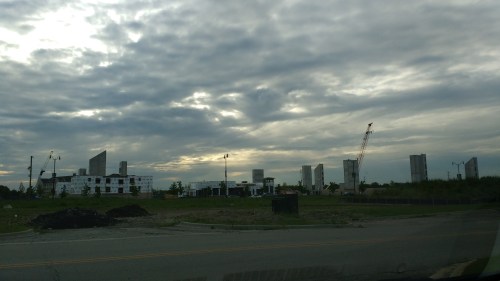
I posted Wednesday about a claim that McMansions appear haunted because of their poor architecture but I think unfinished construction present their own horrors. See this suburban example:

img_20160520_183358037

This is an early evening image of a new residential construction project not too far from our house. All that is standing at this point are elevator shafts. Imagine being trapped in such a project late at night with shadows and wind. There are piles of debris and materials all around. The only escape may be to climb up…shafts that go nowhere. It could be an outdoors, David Bowie from Labyrinth sort of scene. All within sight of a wealthy suburban community with nice homes and lively commercial areas. Yet, it is difficult to imagine how someone might end up in such a situation where they are wandering around such a site.

In contrast, McMansions and other homes may be easier to consider haunted because we associate warm, fuzzy feelings with single-family homes and creepy or evil beings and happenings seem to be such opposites. From the beginnings of the American suburban single-family home, this space was to be a domestic refuge from the outside world or any other intrusions.

But, an empty construction site or unfinished project presents different problems. Is there anyone around? Was the project abandoned for a good reason or some unknown or unspoken reason? Are these ruins or a work in progress? In the end, does the unknown – the construction site – or the familiar – the single-family home, however weirdly designed or old it is – present a more problematic situation?

Online experiment looks at “who driverless cars should kill”

Experiments don’t have to take place in a laboratory: the MIT Media Lab put together the “Moral Machine” to look into how people think driverless cars should operate.

That’s the premise behind “Moral Machine,” a creation of Scalable Corporation for MIT Media Lab. People who participate are asked 13 questions, all with just two options. In every scenario, a self-driving car with sudden brake failure has to make a choice: continue ahead, running into whatever is in front, or swerve out of the way, hitting whatever is in the other lane. These are all variations on philosophy’s “Trolley Problem,” first formulated in the late 1960s and named a little bit later. The question: “is it more just to pull a lever, sending a trolley down a different track to kill one person, or to leave the trolley on its course, where it will kill five?” is an inherently moral problem, and slight variations can change greatly how people choose to answer.

For the “Moral Machine,” there are lots of binary options: swerve vs. stay the course; pedestrians crossing legally vs. pedestrians jaywalking; humans vs. animals; and crash into pedestrians vs. crash in a way that kills the car’s occupants.

There is also, curiously, room for variation in the kinds of pedestrians the runaway car could hit. People in the scenario are male or female, children, adult, or elderly. They are athletic, nondescript, or large. They are executives, homeless, criminals, or nondescript. One question asked me to choose between saving a pregnant woman in a car, or saving “a boy, a female doctor, two female athletes, and a female executive.” I chose to swerve the car into the barricade, dooming the pregnant woman but saving the five other lives…

Trolley problems, like those offered by the Moral Machine, are eminently anticipated. At the end of the Moral Machine problem set, it informs test-takers that their answers were part of a data collection effort by scientists at the MIT Media Lab, for research into “autonomous machine ethics and society.” (There is a link people can click to opt-out of submitting their data to the survey).

It will be interesting to see what happens with these results. How does the experiment get around the sampling issue of who chooses to participate in such a study? Should the public get a voice in deciding how driverless cars are programmed to operate, particularly when it comes to life and death decisions? Are life and death decisions ultimately reducible to either/or choices?

At the same time, I like how this takes advantage of the Internet. This experiment could be conducted in a laboratory: subjects would be presented with a range of situations and asked to respond. But, the N possible in a lab is much lower than what is available online. Additionally, if this study is at the beginning of work regarding driverless cars, perhaps a big N with a less representative sample is more desirable just to get some idea of what people are thinking.

Updating the last few years of (private sector) history of Chicago’s public housing

By now, a number of scholars have effectively explained the problematic history of Chicago’s public housing. But, as this new piece from Curbed Chicago suggests, the most recent years have involved a lot of change. Here are some interesting tidbits from this recent history-in-the-making:

Holsten’s answer is emphatically yes. He specializes in mixed-income and affordable housing, and has developed $500 million worth of it since 1975. But building a mixed-income building is one thing. Forming an actual community across racial and class lines is another. “Our job as developers is much more than financing buildings and property management,” he says. “It’s trying to build community. That’s the hardest part.”…

One sticking point is the issue of density. Chicagoans feel burned by their past experience with high-rises. And the city has a tradition of homeownership that’s different from other very large American cities. Chicago’s famed “bungalow belt” of brickworker cottages built in the early 20th century offered waves of immigrants affordable single-family homes, and preservationists have formed a nonprofit to protect them.So the CHA’s residents would prefer a house and a porch of their own, but that desire often runs counter to the need to accommodate the thousands who have been displaced…

Between 2008 and 2012, the CHA issued about 14,000 fewer vouchers than HUD funded, building up a surplus of $432 million and earning a rebuke from HUD Secretary Julian Castro. (The CHA says its reserves have since been cut and will be spent down by the end of 2017.) A Chicago Sun-Times and Better Government Association investigation found that four out of 10 voucher units have been cited for building code violations in the last five years.

I am skeptical that the private sector alone can solve these housing issues. The free market tends to lead to exclusion and profit-seeking. It doesn’t provide many solutions to correcting existing inequalities, which in the United States tend to connect race, social class, and housing. See an earlier post for a number of the bad outcomes that can result from a free market approach to housing.

On the other hand, the Chicago Housing Authority has done little good. And Americans from the beginning have been ambivalent about involving government in housing. There is little chance that the government will do much more to provide housing – even as the need for affordable housing is great in many cities – because it is a difficult issue in which to find much support.

Perhaps there is a third approach: the US government props up the mortgage industry! Probably not a good long-term solution but this is what we have and it is a system that privileges homeownership.