Seeing McMansions as perfect haunted houses

Pile on the McMansion hell: one writer argues McMansions capture all the essential features of haunted houses.

The term McMansion is itself still relatively recent, coined only in 1992 according to the Oxford English Dictionary. But the landscape of America has long been populated by these off-kilter, jumbled houses, homes whose shape defied all balance and order. At least since the 19th century, we’ve had to deal with ostentatious monstrosities, built without symmetry or class, gargantuan hallmarks of the nouveau riche. We didn’t call them McMansions back then; we called them haunted.

The archetypal American haunted house has always been one whose construction was aesthetically unbalanced. Take one of the most famous American haunted houses, Nathaniel Hawthorne’s house of the seven gables. Defined by its “seven acutely peaked gables, facing towards various points of the compass, and a huge, clustered chimney in the midst,” the house is the ill-gotten gains of Colonel Pyncheon, who accuses his neighbor Matthew Maule of witchcraft in order to acquire his land. There is no order or symmetry to the house; indeed, it’s not even clear where the front of the house is, since it lacks any kind of façade or welcoming front door. The titular, odd-numbered gables poke out in different directions, overwhelming the house with secondary masses and voids. A McMansion 150 years before the term was invented, Hawthorne’s creation set the template for a house that exemplifies wealth without class, ostentation without order…

What is this connection between odd constructions and ghosts? Perhaps it’s because these strange buildings defy common sense and time-honed principles, creating in us a sense of unease that’s hard to name. The principles of architecture—the ones so readily abused by McMansions—didn’t appear overnight; they emerged from centuries of use and tradition. They reflect how we move through houses and how we are most comfortable in them. They maximize the kinds of spaces where we feel most at home, organized around layouts that facilitate ease of use and movement…

In the absence of a good vocabulary to describe that sense of unease, we often fall back on the language of hauntings. A house that’s settled uneasily in its foundation, so that doors swing closed by themselves, and whose layout may trigger a feeling that something isn’t it right—how easy it is to call it haunted, to blame that sense of unquiet on a ghost. The lexicon of the paranormal, after all, is far more ubiquitous and widespread than that of architectural principles, and the language of ghosts is often far easier to call upon than that of primary and secondary masses.

McMansions do regularly feature in horror films. But, this argument is a stretch and I suspect this is another McMansion pile on: “I already don’t like the homes so why not link them to something many people don’t like?” By this argument, any building that is not balanced or orderly is haunted. There are plenty of structures that would fit this description, including many older homes and much of postmodern architecture. On the other hand, do prototypical haunted houses share common traits? Probably, particularly as they are depicted in mass media (whether books, films, or television). In other words, haunted houses may be largely cultural constructions and if enough people paint McMansions as haunted, perhaps it will become real.

Additionally, this argument suggests the supernatural potential of haunted houses is nothing more than bad architecture. How many people would accept this argument, whether they are ghost hunters or people who believe in spiritual beings?

Push continues to add Middle Eastern race/ethnicity to Census

This project has been in the works for at least a few years and now the White House is joining the effort to add a Middle Eastern race/ethnicity to government forms:

Under current law, people from the Middle East are considered white, the legacy of century-old court rulings in which Syrian Americans argued that they should not be considered Asian — because that designation would deny them citizenship under the 1882 Chinese Exclusion Act. But scholars and community leaders say more and more people with their roots in the Middle East find themselves caught between white, black and Asian classifications that don’t fully reflect their identities…

On Friday, the White House Office of Management and Budget advanced the proposal with a notice in the Federal Register, seeking comments on whether to add Middle Eastern and North African as a separate racial or ethnic category, which groups would be included, and what it should be called.

Under the proposal, the new Middle East and North African designation — or MENA, as it’s called by population scholars — is broader in concept than Arab (an ethnicity) or Muslim (a religion). It would include anyone from a region of the world stretching from Morocco to Iran, and including Syrian and Coptic Christians, Israeli Jews and other religious minorities.

But the Census Bureau, which has been quietly studying the issue for two years, also has gotten caught up in debates about some groups — such as Turkish, Sudanese and Somali Americans — who aren’t included in that category. Those are issues the White House is trying to resolve before adding the box on 2020 census forms.

This is a good reminder of how social science categories can develop: through a lot of effort. There are social changes to account for here: how groups understand themselves changes over time. In this particular context, immigrating to the United States and facing particular challenges and opportunities leads to groups that wouldn’t necessarily group themselves together to now desire such a thing. Does the Middle East as Americans often understand it line up with how the region is understood elsewhere (let alone in that part of the world)? There are politics involved: who gets to define such groups? How is the data used? There are measurement issues: who would count in such a category? What are the boundaries? Is it a racial category or ethnicity? How many racial/ethnic categories are needed to understand the world?

All that said, the category of white – typically based on skin color – is very broad and often not very useful considering the social changes in the United States in the last few decades.

Small house movement spreads in ADUs

One way to encourage smaller homes and affordable housing is to allow Accessory Dwelling Units:

The cottage, which won a top design award last year from the American Institute of Architects, is technically called an “accessory dwelling unit,” or A.D.U. Portland has been ahead of the curve in allowing these smaller housing units, which are illegal in many cities and towns under current zoning rules…

In 2010, during the economic slump, when many building plans were being shelved, Portland presciently began to allow homeowners the right to develop accessory dwelling units on standard 5,000-square-foot residential lots for the first time. The city also eliminated development charges of up to $15,000 for new accessory dwelling units to spur homeowners to build.

More incentives followed: Homeowners could build and even rent out a unit that did not have off-street parking; any design not visible from the street could be built without input from neighbors; and new height limits — raised to 20 feet from 18 feet — encouraged two-story units, like Ms. Wilson’s…

Not surprisingly, the concentration of accessory dwelling units has been in central, higher-income areas close to amenities like transit and shops. “Part of this could be due to the fact that people with large amounts of equity can more easily secure financing,” Mr. Wood said. “The City of Portland and Portland State University will be working on a project to encourage and facilitate A.D.U. development in more diverse neighborhoods.”

It may be helpful to compare the ADUs to other alternatives for affordable, small housing.

  1. Would residents and communities prefer tiny houses on their own lots or in communities of tiny houses? The first could be expensive due to the cost of land, defeating the purpose of the smaller housing which is supposed to be cheaper. The second could be too much of a change for some places. ADUs make use of existing lots and aren’t necessarily grouped together.
  2. Would residents and communities prefer larger apartment buildings? On the plus side, you can build more units up and everyone knows that this is an apartment structure (with its higher densities and other unique features). On the negative side, apartment buildings can alter the character of a neighborhood, may require parking, and people often have stereotypes about who lives in apartments. The ADUs hide the higher densities better than apartments – back behind the main housing unit – but don’t provide as many units.

Given the resistance of many municipalities to denser housing, I imagine ADUs could be attractive as they don’t require the density or size of some alternatives. Additionally they can use existing land and generate income for local residents. Even given all that, I think it would take a lot for many cities to adopt this. There is a large need for affordable housing throughout the United States and many communities don’t seem to be moved to do anything; I’m not sure ADUs are attractive enough to tilt the scales.


Whether driverless cars will benefit suburbs or cities

Some are wondering what kinds of places will benefit most from driverless cars:

Two op-eds published Thursday make the case one way and the other for the driverless car and the American settlement. In Bloomberg View, the economist Tyler Cowen argues that new technology—not just cars, but also virtual reality and the Internet of Things—has advantages that favor the suburbs. In the Wall Street Journal, Uber CEO Travis Kalanick posits that new technology will create “a more livable and less congested” city.

Cohen’s argument is in some ways convincing. He’s right that driverless cars and on-demand delivery could bring perks to the suburbs—a commute spent reading a book, say, or the quick purchase of that one-percent pint—that have traditionally belonged to urbanites. It’s also true that new technologies, like a smart home heating system, are more readily installed in the modern, spacious suburban home than the older urban apartment. (Ask a New Yorker if she’s ever had a garbage disposal.)…

But Kalanick makes a great point in his piece: autonomous transportation is actually the less important component in creating “a city that lives and breathes more easily.” The more important concept is… sharing. Not the bullshit low-paid menial labor that has long characterized the sharing economy, but actual sharing, where two people get in the same car together.

The most radical future is one where self-driving cars are shared, both on a single trip and between trips. A slightly less radical future is one in which individuals are willing to use a car someone else has just used, but prefer to ride alone.

All interesting points. But, I have two larger concerns with either argument:

  1. What if driverless cars allow both suburbs and cities to thrive? In other words, it would allow some to live outside major cities and others to further enjoy city life.
  2. Point #1 is connected to another: transportation technology alone does not dictate choices about where people live and work. It can certainly open up new possibilities. But, the American suburbs in general are not solely the result of the automobile; suburbs were growing before this, partly due to newer technologies like trains and streetcars but also due to solidifying cultural ideas about cities, suburbs, and social life. I could see driverless cars both giving justifications to those who want to live a car-sharing life in the big city while others will make the choice to buy a cheaper yet bigger home further away and let the car handle the longer commute.

It is difficult to make predictions in this case. As the article notes in the final paragraph, regulations and policies could help tilt the scales one way or another. We have seen this before: a variety of policies in the early to mid 1900s helped make suburban living more affordable and palatable to many Americans. The results included white flight, disinvestment in major cities, the creation of new infrastructure such as interstate highways, and the development of the suburban American Dream accessible to many (whites).

How many suburban entertainment centers can one region have?

Schaumburg is looking into creating a new entertainment district out of underused properties:

Schaumburg trustees Tuesday approved a $6.58 million offer to buy the two single-story office buildings just north of the village’s convention center and Renaissance Hotel to help develop a new entertainment district and reconfigure Thoreau Drive.

The 110,000-square-foot Woodfield Green Executive Centre lies on the north side of Thoreau Drive and just across Meacham Road from Zurich North America’s new headquarters…

The long-term plan is to hold the property to sell to one or more developers interested in building more restaurant and other entertainment venues near the southeast corner of Meacham and Algonquin roads.

This sounds like a typical suburban strategy today: take properties that are not doing well or even abandoned (see efforts to utilize closed grocery stores) and start generating revenues through new entertainment use. Stores come and go but theaters and restaurants can come together to create a vibrant distract that will generate property and sales tax revenues for years to come.

This did lead me to a question: within the Chicago metropolitan region, how many entertainment districts can the region support? If many suburbs are trying to pursue these goals, can most of them sustain successful districts? There are already a number of successful or established districts: Evanston, Arlington Heights, Schaumburg and Woodfield, Rosemont, Gurnee Mills, the Oak Brook-Yorktown corridor, Naperville, plenty of other downtowns with lively scenes and regular festivals and events (Geneva, Aurora, Elmhurst, etc.) and countless shopping centers that are transitioning to lifestyle centers. I assume there is a saturation point where these districts start losing people to each other. Of course, this might be mitigated by two factors: (1) continued population growth so that everyone can share from a growing spending pie and (2) specialization among entertainment districts that could help each remain competitive.

Another thought: how often do entertainment districts simply reproduce existing patterns of wealth and the distribution of higher-end commercial properties?

NYT: Yes, don’t trust online polls

Although the purpose here may truly be to discredit Donald Trump, here is another argument in the New York Times against online polls:

“Those do a good job of engaging audiences online, and they do a good job of letting you know how other people who have come to the webpage feel about whatever issue,” said Mollyann Brodie, the executive director for public opinion and survey research at the Kaiser Family Foundation. “But they’re not necessarily good at telling you, in general, what people think, because we don’t know who’s come to that website and who’s taken it.”

Professional pollsters use scientific statistical methods to make sure that their small random samples are demographically appropriate to indicate how larger groups of people think. Online polls do nothing of the sort, and are not random, allowing anyone who finds the poll to vote. They are thus open to manipulation from those who would want to stuff the ballot box. Users on Reddit and 4chan directed masses of people to vote for Mr. Trump in the instant-analysis surveys, according to The Daily Dot. Similar efforts were observed on Twitter and other sites.

Even when there is no intentional manipulation, the results are largely a reflection of who is likely to come to a particular site and who would be motivated enough to participate. Intuitively, it’s no surprise that readers of sites like Breitbart News and the Drudge Report would see Mr. Trump as the winner, just as Mrs. Clinton would be more likely to find support on liberal sites…

“In our business, the key is generalizability,” he said, referring to the ability of a sample group to apply to a wider population. “That’s the core of what we do. Typically, it takes a lot of time, and a lot of effort, and a lot of money to do it.”

One helpful solution may be to have media outlets refuse to use any online polls. On one hand, journalists often remind the public that they don’t mean anything while they consistently offer them on their website or on the evening news broadcast. They may have some marketing purpose – perhaps participants feel more engaged or it can give outlets some indication of how many people are going further than just passively taking it in – but why confuse people.

The Chicago of today influenced by 1920s zoning decisions

A new study suggests the beginning of zoning in Chicago had long-lasting effects:

Walsh and two other urban economists investigated zoning’s long-term effects in Chicago, using 1920s parcel-level data on land use and market values prior to, and immediately after, the adoption of the city’s first comprehensive zoning ordinance in 1923. They compared these early quilts of land use to that of the present day (or, at least, to the most recent complete dataset available, which came from 2005).

Contrary to what many economists may believe, they first found that zoning did not merely ratify existing land uses. Lot by lot, they found significant variation between the activities that predated zoning and those that came after, especially as years went by. For example, some factories and shopping areas that didn’t conform to the 1923 code were allowed to stay in their respective locations, thanks to a “grandfather” clause. But over time, the vast majority of them disappeared. The powerful force of zoning can be seen on a citywide scale, too: Whereas 82 percent of Chicago’s developed blocks had some form of commerce happening in 1922, that share had dropped by about half by 2005, researchers found.

In other words, the way Chicago looks in the 21st century tracks much more closely with the desires of its planners in 1923 than it does with the city that preceded zoning. This fact has had a huge effect on economic patterns, too. For example, the researchers found that exclusive residential zoning had a significant impact on home prices, driving up values in neighborhoods cordoned off for single-family homes. On a citywide level, they used a regression analysis to find that the zoning code of 1923 had bigger role in shaping economic patterns—i.e., where commercial and industrial activity is going on today—than either pre-existing transportation networks or geography, two factors you might think would best explain why there’s a factory by the old railroad tracks, or a shopping district near downtown…

Although the present paper didn’t explicitly analyze how Chicago’s old zoning codes have influenced racial segregation, a companion paper published in Julyby the same researchers found that the laws drawn up in 1923 were discriminatory: Areas with more black residents were zoned for higher-density housing, and “neighborhoods with larger populations of blacks or recent immigrants were zoned disproportionately for manufacturing.” Chicago consistently ranks as among the most segregated cities in the U.S., and its present-day economic divisions track closely with race (as well as with municipally recognized community boundaries). It wouldn’t be surprising to learn that zoning laws (much like housing policy) dating back a century are in some ways responsible. That’s a theory that needs investigation, Walsh says.

Zoning decisions are political ones. The suggestion here is that if the decisions are good ones, they can have positive effects for decades. The converse – particularly when used to limit options for particular groups – is also true.

The last paragraph of the article hints at recent suggestions regarding significant changes to urban zoning. It would be interesting to see what average Americans think of such ideas: would they trade predictability for flexibility? Continue with the example of Chicago: would more flexible zoning allow for the construction of more affordable housing or would it mean that more land would be converted to non-residential uses, limiting housing options? New Urbanists have touted mixed-use zoning for a long time but their vision of this is often limited to particular kinds of businesses or offices as well as nicer housing (even if it includes different price ranges).

What do those post-debate snap polls tell us?

Ed Driscoll comments on the results of some of the post-debate snap polls:

TRUMP WINS MOST IMMEDIATE POLLS: “The newspaper collected screen shots of 19 ‘snap’ polls conducted immediately after the debate, and in 17 of them, most respondents said Trump won the debate, often by a wide margin. It isn’t just Drudge and Breitbart; Trump also got more votes than Clinton in instant polls at Time, Slate, Variety and other liberal outlets. I can’t explain it, other than to say that perhaps it tells us more about how people view Hillary Clinton than about how Donald Trump actually performed.”

Well, certainly one explanation is a repeat of the “Ron Paul Revolution” days of early 2008 – but as with Paul’s quixotic presidential bid, having a large enough group of dedicated zealots to tilt Internet polls does not necessarily translate into sufficient votes at the ballot box where it counts.

It seems safe to say that Trump’s core followers are much more passionate than Hillary’s. We’ll know soon enough if there are a majority of them.

The large issue with these snap polls is that they are unrepresentative. We don’t know who answered them and in what numbers. As suggested here, perhaps Donald Trump has more active followers who take such polls.

At the same time, if there are consistent patterns in non-helpful polls like this, perhaps they can provide insights into concerted online efforts. They may not reveal much about the electorate at large but they could help us understand patterns of partisans. Why is it important to “win” such snap polls? Are there dedicated efforts to win and how are these efforts organized?

Ultimately, does this suggest that snap polls are even worse than being unrepresentative: they are regularly used by particular groups to push a message? Winning in any arena is simply too important to be left to real survey methods…

New Australian homes shrinking in size

Not too long ago, new Australian homes rivaled those of the United States. Times have changed:

The country’s homes — some of the biggest in the world — reached peak size in 2009 at an ­average of 222sq m for newly built houses and apartments combined, according to research under­taken exclusively for The Weekend ­Australian.

But the global financial crisis ­put paid to that. The average new home now stands at 192sq m, making it smaller than in 2001, senior KPMG analyst Simon Kuestenmacher found in an analysis of 15 years of data from the Australian Bureau of Statistics.

“Market pressures, a shift in values to ‘less is more’ and spending on experiences rather than material goods, especially among Gen Y, has put Australia on a trajectory towards smaller homes,” Kuestenmacher noted…

firefox_screenshot_2016-09-25t22-25-53-040z

Such trends regarding home sizes can fluctuate as economic conditions, local regulations, and cultural norms change. Now that the new home size has shrunk in Australia, will this continue for a long time? Hard to tell.

I also like the extra analysis that breaks down home size by location: there is not necessarily a singular trend in a country. While much analysis of home size in the United States relies on the single figure produced by the Census each year, I imagine there are some disparate trends across cities and regions in the U.S.

Claim: US undergoing secularization, just at a slower pace

Two sociologists argue that the United States is not that unusual regarding secularization trends in the industrialized world:

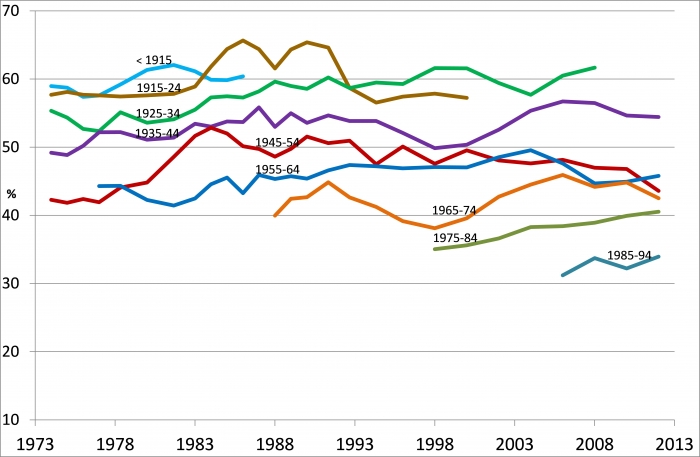
Most research that compares American religion with religion elsewhere emphasizes the high levels of participation in the United States, and treats those high levels as strong evidence that America is exceptional.

If we look at the trends, though, it appears that the US isn’t a counter-example to the idea that modernization causes problems for religion. On the contrary, religious change in the United States is very similar to what we see elsewhere: long-term decline produced mainly by generational replacement.

This process operates slowly, and it can be counteracted in the short term by short-lived revivals, but it is very difficult to reverse…

Figure 2 – Attendance monthly or more often by decade of birth, United States, 1973-2014

Voas Fig 2

Chaves has been making this argument for a few years now.

Two quick thoughts:

  1. As they note at the end, the interesting question then to ask is why the United States has been slower to follow the secularization trend than other nations. This is not a small question and at least several suggestions have already been made by researchers including World Wars in Europe and the rise of the welfare state.
  2. Researchers are in a unique position if they argue any trend is inevitable. Voas and Chaves may be shown correct if religiosity continues to decline in new generations but it could be decades before the conclusive evidence arises. Additionally, societal patterns can change – even if such changes seem improbable at one time. If a researcher is correct in calling out a trend, they can appear prophetic but if they are wrong, their status may be diminished.