Three possible solutions to “American cities and states spend[ing] up to $90 billion in tax breaks and cash grants” to companies

After discussing why American communities spend so much money and effort to attract companies, Derek Thompson proposes four solutions:

First, Congress could pass a national law banning this sort of corporate bribery. Mark Funkhouser, a former mayor of Kansas City, Missouri, envisions the law as the domestic version of the Foreign Corrupt Practices Act, which makes it illegal for Americans to bribe foreign officials.

It’s not entirely clear whether that would pass constitutional muster. The Supreme Court hasn’t ruled decisively on whether the Commerce Clause gives Washington the authority to ban interstate bidding wars. In the 2006 Supreme Court case DaimlerChrysler Corp. v. Cuno, Ohio taxpayers sued the state after it paid the automaker DaimlerChrysler about $280 million in tax exemptions and tax credits. The Sixth Circuit Court sided with the taxpayers, striking down Ohio’s subsidy as a violation of the Commerce Clause. But the Supreme Court avoided a final judgment on the matter by finding unanimously that the plaintiffs did not have standing to bring the suit.

Second, Congress could make corporate subsidies less valuable by threatening to tax state or local incentives as a special kind of income. “Congress should institute a federal tax of 100 percent” on corporate subsidies, Jack Markell, a former governor of Delaware, wrote in The New York Times. “This would not include investments in public infrastructure, work force development or other investments that can attract employers while also providing a significant long-term benefit to taxpayers.” Taxing subsidies would hopefully force cities to change their economic-development strategies, from importing other states’ companies to building their own—through investing in research universities, building more housing, and welcoming immigrants, since foreign-born Americans have the highest rates of entrepreneurship.

Finally, the federal government could actively discourage the culture of corporate subsidies by yelling, screaming, and penny-pinching. As Meagan Day wrote in Jacobin, “The federal government could withhold funds from governors and mayors who threaten to poach jobs from other states, or who won’t disclose their incentive packages.” Washington tends to look on quietly when cash-strapped states break the bank to welcome glitzy tech firms. But an attitude change at the top could trickle down to the local level. Donald Trump, or another president, could have made a national address after the HQ2 announcement slamming Amazon for soliciting taxpayer funds in a silent auction. He could have called a summit to encourage the nation’s mayors and governors to offer the same tax subsidy for HQ2—zero dollars and zero cents. Even a tweet could suffice: “7 BILLION FOR BEZOS?? Trillion-dollar companies in America don’t need our welfare! Bad!”

Interesting options. I have argued before that this practice leads to a race to the bottom between communities. They can even pit suburbs and cities within the same region against each other.I wonder if both businesses and communities would complain. Businesses would want to get the best deal they can. Why shouldn’t they be able to compare different offers? They may go as far as to argue that the tax breaks help them be more profitable which means they can then spread more wealth to workers and investors. Communities might prefer to keep competing because it gives them a chance to entice a business that otherwise might not move there. If tax breaks became less valuable, would certain industries and kinds of firms gather in a limited number of attractive locations? Open competitions for companies gives communities a chance to get their name out there and build a brand. Furthermore, these tax break opportunities allow local officials to show that they are making a concerted effort to bring jobs to an area.

I do not see this practice stopping soon even as we see the fallout of the Amazon race. While it may take time for the federal government to step in, communities could decide to opt out from such competitions. What would happen if in a situation like the Amazon one, the major contenders refuse to pander to the corporation?
Amazon HQ#2 may be headed to a wealthy suburb

Crystal City, Virginia may be the new home of Amazon’s second headquarters site. Here are a few features of the suburban neighborhood located in Arlington:

With the Ronald Regan Washington National Airport two miles to the east, the heart of Washington D.C. five miles to the north, and a few stops on Washington’s Metro linking all three, Crystal City is in the right geographic spot for the Seattle-based company…

Today, the neighborhood, although a part of Arlington, has its own distinct downtown area. The walkable Crystal Drive is dotted with businesses, restaurants and public art, while public/private partnerships are bringing investment in parks and open space

Home prices in Crystal City might be more affordable than they are in Seattle, but that’s not saying much. The median home value in the 22202 area, a zip code Crystal City shares with neighboring Pentagon City, Aurora Highlands and Arlington Ridge, is $625,800, according to Zillow — nearly three times the U.S. median.

Might the lack of single-family homes also be attractive to Amazon?

Crystal City is dominated by one apartment building after another, most of which don’t have ground floor retail or restaurants that would create a sense of community or neighborhood vibrancy. Walk a few blocks away from the shopping mall during any evening of the week and it’s a quiet, almost desolate place. This lack of a community might have been the final piece that Amazon was looking for since it means they can come to town without much opposition.

A few quick thoughts:

  1. On one hand, it is interesting for Amazon to choose a suburban location. A sizable headquarters would be a boon for numerous communities, particularly cities that need a shot in the arm. On the other hand, this is an urban suburban location. The location is technically outside Washington D.C. yet it is a community of high-rises with little distance with the central city in the region.
  2. A location in this region contributes to the rising status of the Washington D.C. region. While other cities and regions may still be larger, this region with its collection of government, military, and business opportunities just keeps growing.
  3. It would be interesting to see how much Amazon would want to contribute to a thriving streetscape in the community. Based on several articles, it sounds like there is limited activity in this community after business hours. Does Amazon want to contribute money to trying to develop a vibrant urban neighborhood (even if it is located in a suburb)?

Who owns large apartment complexes in downtown Wheaton?

The national and international flow of capital in real estate is a well-established phenomena in the biggest cities but it is recognized less in suburbs. Here is an example of this in Wheaton, Illinois:

In the bigger deal, San Francisco-based FPA Multifamily acquired Wheaton Center, a 758-unit property in downtown Wheaton, from Edge Principal Advisors of New York, according to a statement from HFF, the brokerage that arranged the sale.

It’s unclear how much FPA paid—the statement did not include a price and FPA and Edge representatives did not return calls—but the property was expected to fetch about $135 million, according to Real Estate Alert, a trade publication. At that price, the sale would generate a big profit for Edge, which paid $44 million for Wheaton Center in 2014 and invested about $40 million in a major renovation.

The seller of the other property might want to forget about Wheaton altogether. Invesco, an Atlanta-based pension fund adviser, sold Wheaton 121, a 306-unit apartment complex that opened in 2014, for $72 million, according to Connor Group, the Ohio investment firm that bought the property. That’s nearly 25 percent less than the $95.8 million Invesco paid in 2015 for the complex, 121 N. Cross St.

The main culprit: property taxes. Wheaton 121’s taxes rose so much after Invesco bought it that the added expense significantly depressed the property’s value, according to people familiar with the complex. A jump in the property’s assessed value pushed Invesco’s 2018 tax bill up to $2.0 million, a whopping 47 percent increase from 2016, according to DuPage County records.

I suspect most suburbanites know little about who owns major pieces of land in their community, let alone who owns large apartment buildings (which may be more or less common depending on the suburb). Unless the owner makes a big deal of their ownership with signs or presence in the community, daily life just moves on.

But, this infusion of money from far away could have a significant influence on a suburb. Local developers may not be interested in sizable projects or may not be able to access the same amounts of capital. At the same time, a local developer may be more attuned to local conditions. Presumably, all the owners of nicer properties want to be seen as good actors in the suburb but they may have varying levels of involvement and commitment to the exact community.

Fox Valley Mall “near Naperville” Part 2 – development requirements

A store at Fox Valley Mall prefers to say they are “near Naperville” rather than the actual location in Aurora. How did this shopping center end up across the street from Naperville?

The Urban Investment and Development Corporation (UIDC) started purchasing property for a shopping center in 1966. At this point, Naperville was expanding to the south and southwest at a rapid rate but was nowhere near the size it is today. Similarly, Aurora had an established downtown but there was not a whole lot of development in this area. To help guide its growth, Naperville had developed regulations, particularly in residential subdivisions, to help ensure quality development.

In 1972, UIDC annexed the land they had purchased to Naperville. According to local officials in both communities, the developer chose Aurora in part because of fewer development regulations. Fallout from this choice ensued. Aurora and Naperville signed a boundary agreement to help limit such situations where a developer could play the two communities off of each other. The 1975 Naperville mayoral race included discussion of the loss of the mall. Additionally, the construction of the mall and the loss of status and sales tax money to Aurora helped spur Naperville leaders toward improving the community’s downtown. After the mall opened, Naperville was able to capture some status and money through the opening of stores on the east side of Route 59.

In sum, the developer of the Fox Valley Mall chose to locate in Aurora for some advantages in the early 1970s. Given the path of the two communities since then, I wonder if that developer would choose differently today. On one hand, a Naperville address would convey a certain status. On the other hand, locating just across the street might be the perfect solution: the developers could get benefits from Aurora while always claiming to be “near Naperville.”

Fox Valley Mall “near Naperville” Part 1 – status

I recently heard a radio ad for a store located at Fox Valley Mall which was said to be “near Naperville.” The mall is officially located in Aurora so why would a store there claim to be in the next suburb over? One word: status.

In this particular location, Aurora and Naperville are separated by Illinois Route 59. On the east side, containing a number of stores just across the street from the mall, is Naperville. On the west side, including the mall plus additional stores, is Aurora. Aurora is the bigger community – roughly 200,000 people – but Naperville is the wealthier, higher status community. Some of the figures: Naperville has a median household income of over $110,000 and 4.9% of residents are in poverty. In contrast, Aurora has a median household income of almost $64,000 and 14.0% of residents are in poverty. The communities also differ in race and ethnicity: Aurora is significantly less white (over 30%) and more Latino (35% more) and Black (5% more).

So, when a store says they are “near Naperville,” what are they trying to hint at? They want to associate their store and the shopping experience with a wealthier community rather than Aurora. They want people to think of an upscale and safe place, rather than the diversity of incomes and races/ethnicities of Aurora. Ultimately, they want shoppers to come and spend money like they have Naperville resources.

If it is the case that the store wants to associate with Naperville, why is it located in Aurora? The bigger question: why is the mall in Aurora? To be answered tomorrow.

Archetypal American cities and “America has only three cities: New York, San Francisco, and New Orleans. Everywhere else is Cleveland.”

A story about the decline of retail establishments in Manhattan and the consequences for street life ends with this saying from Tennessee Williams:

“America has only three cities,” Tennessee Williams purportedly said. “New York, San Francisco, and New Orleans. Everywhere else is Cleveland.” That may have been true once. But New York’s evolution suggests that the future of cities is an experiment in mass commodification—the Clevelandification of urban America, where the city becomes the very uniform species that Williams abhorred. Paying seven figures to buy a place in Manhattan or San Francisco might have always been dubious. But what’s the point of paying New York prices to live in a neighborhood that’s just biding its time to become “everywhere else”?

These three cities are indeed unique with distinct cultures and geographies. But, I could imagine there would be some howls in response from a number of other big cities. What about Chicago and its distinct Midwest rise in the middle of a commodity empire? What about Los Angeles and its sprawling suburbs and highways between and across mountains and the ocean? What about Miami serving as a Caribbean capital? What about Portland’s unusual climate and approach to social issues? And the list could go on.

Perhaps a more basic question is this: how many archetypal American cities are there? One of the books I have used in urban sociology, The City, Revisited, argues for three main schools of urban theory: New York, Chicago, and Los Angeles. These happen to be the three largest cities in the United States and also have the advantage of having collections of urban scholars present in each. New York is marked by a strong core (Manhattan) and a unique colonial history (Dutch and then English) that helped kickstart a thriving economy and religious and cultural pluralism. Chicago is the American boom city of the 1800s and was home to the influential Chicago School at the University of Chicago in the 1920s and 1930s. Los Angeles is the prototypical twentieth-century American city built around highways and Hollywood with a rise of urban theorists in the late 1900s dubbing themselves the Los Angeles School. If these are the three main cities on which to compare and contrast, a place like Cleveland is more like Chicago (as is much of the Rust Belt), Houston is more like Los Angeles (as is much of the Sunbelt), and San Francisco is more like New York (and some other coastal cities might fit here).

But, these three biggest cities cannot cover all possible kinds of American cities. How many archetypal cities are too many before the categories become less helpful? Should the emphasis be on cultural feel or on how cities develop (New Orleans might simply be a unique outlier in all of this data)? Having these ideal type cities is only helpful so that they help describe and embody broad patterns across groups of cities.

For what ends do sociologists labor?

I recently gave a short presentation in a training seminar regarding introducing first year students to different disciplinary perspectives. For each of the natural sciences, social sciences, arts, and humanities, I described methods and goals. For the goals of the social sciences, I put down “just society” and “social wrongs righted.” One of my colleagues asked me a question about this: “Do the people at the top R1 schools adhere to these goals?” Just having returned from the ASA meetings in Philadelphia and thinking about some of the things I saw there, I said yes.

This is a good question to consider on Labor Day. What are sociologists after when they work? Here are some options:

-just society/social wrong righted: a mindset devoted to improving society, sometimes attributed to an activist approach though American sociology has a deep tradition of this (even if it was shunted into social work and not promoted as much at leading schools)

-knowing more about the social world: this quest for knowledge and a better understanding of whatever phenomena is under study could be at the root of every academic enterprise

-a way to achieve status and power: the field may be limited be compared to others but academic titles and academic merits (published articles, name recognition, grants, school, etc.) still provide a certain status

-the joy of teaching and mentoring students: these expectations likely differ dramatically across institutions (let alone personalities) but there can be both immediate and long-term gratification in making a difference in the life of students

-a satisfying way to occupy one’s mind and fulfill intellectual curiosity

I suppose individual sociologists might be able to pursue unique combinations of these five options within their own experiences and institutional contexts. Yet, on the whole, I’m pretty comfortable asserting sociology and other social sciences want to make the world a better place.

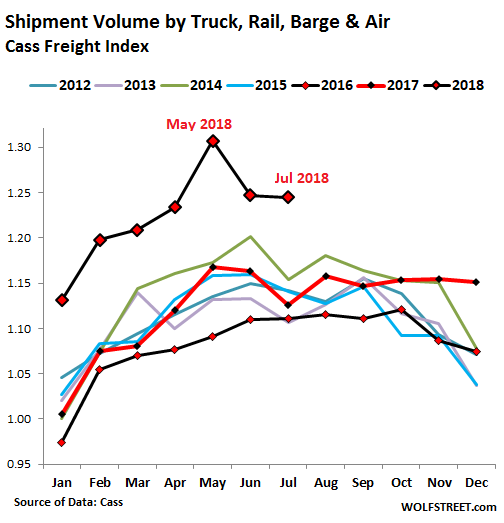
Shipping via truck and railroad in a strong economy

If the economy is going well, the trucking and railroad industries have plenty of work to do:

The dynamics in the transportation sector are “clearly signaling that the US economy, at least for now, is ignoring all of the angst coming out of Washington D.C. about the trade wars,” the report by Cass said.

The Cass Shipments Index does not include shipments of bulk commodities, such as grains or chemicals. But shipments of commodities were strong too, according to the Association of American Railroads. Excluding the carload category of coal, which is facing a structural decline in the US, carloads rose by 6.7% year-over-year, including grain, up 14.7%; petroleum & petroleum products, up 27%; and chemicals, up 4.6%. Of the 20 commodity carload categories, only five showed declines, including nonmetallic minerals, metallic ores, and the biggie, coal.

And intermodal traffic – shipments of containers and trailers via a combination of rail and truck – surged 6.9% in July compared to July last year, the AAR reported.

At the least, this is just a reminder of how goods make their way to stores and eventually buyer’s residences. Those trucks and trains may be a nuisance when you want to get where you want to go but this is how it works in our society.

A few other thoughts:

  1. It is hard to imagine drones could make up for all or even many of the goods shipped by trucks and trains. Or, imagine drones like swarms of locusts.
  2. The shipping industry is another one highly affected by economic swings. Like the construction and housing industries, when times are good, there is a lot of need for goods to be moved around. When a recession hits, all that equipment and all those employees are not needed.
  3. Of course, there is an international component to all of this where goods have to enter or leave countries. That all happens on a consistent even with all the rhetoric regarding trade wars and trade agreements. I remember going past some of the shipping yards in Hong Kong and being amazed at the size of the facilities: cargo containers in huge piles for as far as one could see.

Study suggests more traffic is related to stronger metro economies

What if traffic is not something to avoid but rather a byproduct of a strong economy?

By comparing historic traffic data against several economic markers, the authors found virtually no indication that gridlock stalled commerce. In fact, it looked like the economy had its own HOV lane. Region by region, GDP and jobs grew, even as traffic increased. This does not mean speed bumps should come standard on every new highway. Traffic still sucks, and things that suck should be fixed. What this study does is acknowledge that economically vibrant cities will always have congestion. So transportation planners should instead focus on ways to alleviate the misery rather than eliminate the existence of congestion…

Marshall acknowledges that no statistic can paint a perfect picture of reality, but he says he and his coauthor wrangled their analysis into coherence. Once they accounted for all the hanging chads, the overall trend was pretty clear: Traffic really didn’t do much to the economy. In fact, they found that if anything, places with higher car congestion seemed to have stronger economies. Specifically, per capita GDP and job growth both tracked upward as traffic wait times got worse.

It sounds like the study suggests the better the economy is, the more traffic there will be. I could think of two observations that go with these findings:

  1. The idea of ghost towns, both literal and figurative. If there is a lack of economic activity, the streets and buildings will be pretty empty.
  2. Jane Jacobs argued the most interesting neighborhoods are those with a lot of street and sidewalk activity. This is certainly related to economic activity of businesses, shops, and restaurants as well as the ability of residents and visitors to spend money.

Even if this is true, I would guess this knowledge would do little to help people stuck in gridlock feel better about the situation. They should think “I’m glad I have a good job in a thriving metro area and the traffic is the small penalty to pay for that.”

Perhaps a final piece to this would be to think about what would need to change in urban areas or driving to decouple these factors. Would a significant investment in mass transit counter this connection? More telecommuting and working from home?

The declining value of shopping mall real estate

The declining shopping mall has led to a drop in value for these properties:

“It’s a tough environment. I don’t think anybody really anticipated the decline of the department store to happen as quickly as it did,” said Joe Coradino, chief executive officer of Pennsylvania Real Estate Investment Trust, which owns 21 malls in the Mid-Atlantic region. “The sellers are clearly on their knees.”

The Philadelphia-based REIT has sold 17 bottom-tier malls since 2013. The last deal, completed in September, was a $33.2 million transaction for the Logan Valley Mall in Altoona, Pennsylvania, anchored by Macy’s, JCPenney and Sears stores. If those same properties were on the market today, prices would be substantially lower, Coradino said…

Not long ago, some of the biggest names in private equity, such as KKR & Co. and Barry Sternlicht’s Starwood Capital Group, were laying out substantial sums to snap up retail properties. In 2012 and 2013, Starwood purchased a combined $2.6 billion of malls from Westfield, followed less than a year later by a $1.4 billion deal to buy seven malls from Taubman Centers Inc. From 2012 to 2014, KKR bought four regional malls for about $502 million, Real Capital data show. That demand has all but evaporated as timing a wager on American malls becomes increasingly treacherous…

It’s easy to understand their reluctance to sell now. Prices for malls fell 14 percent in the past 12 months, even as values for other types of commercial properties, such as warehouses and office buildings, rose or held steady, according to Green Street Advisors LLC. At least four properties have been pulled from the market in recent months because the bids were too low, Dobrowski said.

Even with efforts to save some shopping malls, from adding restaurants and entertainment options, housing, and community spaces, a good number will simply not survive. They will not be desirable enough for retail activity nor prime spots for redevelopment. They may sit empty for much longer than communities desire or can bear. I suspect we will see a lot of potential creative solutions to these dead shopping malls as land owners, developers, and communities try to turn them into sites that again contribute to the surrounding area.

Perhaps the most interesting question here is how low prices will get before they interest someone who will buy them. Are we headed for the equivalent of $1 homes for shopping malls? Perhaps they will become subject to blight and renewal programs? Will the price be low enough for neighbors or communities to buy them simply to raze them? Perhaps they will be the dystopian spaces featured in films like Gone Girl?