Trying to convert large empty grocery stores to better uses

The end of a company can have rippling effects: a number of Chicago area communities have been working for years to fill empty Dominick’s stores.

When Dominick’s went out of business in December 2013, it added 72 empty stores to the Chicago area’s retail landscape. The most desirable ones were snatched up by chains like Jewel-Osco, Mariano’s and Whole Foods Market. Last year, Albertsons acquired Safeway, Dominick’s parent company, giving it control of most remaining Dominick’s leases and property in the area.

At least 18 suburbs are still trying to turn the lights back on in the darkened stores. As time drags on, the prolonged vacancies create pockets of blight in once-thriving retail areas, hurting town coffers, hindering other businesses and inconveniencing residents. Some officials blame Albertsons, saying the company is paying rent on dark buildings to block out Jewel-Osco competitors…

Albertsons has been “extending dark store leases” to keep out competition, a tactic that’s “objectionable, but not unusual” in the Chicago area’s extremely competitive grocery industry, said Andrew Witherell, a commercial real estate broker who consulted with Mariano’s on its expansion into 11 former Dominick’s stores…

Other towns have banded together to attract retailers. Last year, nine western suburbs launched a joint effort, “One Call/10 Stores,” to try to fill some 700,000 square feet of former Dominick’s space. Most of those stores, however, remain empty.

In other words, there is little incentive for Albertsons to sell the properties. I would also guess that a number of suburbs have struggled to find tenants who could use all of the building space and possibly be there for a long time. In many places, is there really a need for another grocery store given all the options (and with Walmart operating as the biggest grocery chain in America)?

Perhaps some of these communities need to head in different directions. Break the large store into smaller pieces. Think about retrofitting the whole structure to include a mix of uses and alter the big store and large parking lot dynamic. Maybe demolishing the structure could provide a fresh start and entice someone who doesn’t want to be saddled with an aging large structure. It will be interesting to see how long communities will go before trying something more drastic.

When realtors dislike McMansions

Realtors sell homes. So how do they feel about McMansions? A piece at Realtor.com offers some hints:

We’ve struggled to cover McMansions. For starters, they’re not pleasing to the eye. And, more importantly, we can’t put our finger on exactly what it is about these sad but pricey structures that inspires such a visceral negative reaction…

Q: We’ve grappled with this one for a long time here at realtor.com®. McMansions are like the classic definition of obscenity—”I know when I see it”—but we’ve never come up with a concrete definition for them…

All of the mail from realtors I’ve gotten has been really positive as well. I think that realtors are generally tired of McMansions, especially since they’re so difficult to sell. They find a lot of catharsis in reading McMansionHell.

Does this mean that realtors wouldn’t help sell or buy a McMansion because of their refined architectural sensibilities or because McMansions use of a lot of resources? While McMansions could generate profits for builders, they could also be good for realtors who could make larger commissions.

Based on this, I would enjoy seeing some realtors discuss their approach to McMansions. If I had to guess, I would imagine fewer realtors would be openly critical of such homes because it might limit their business. Perhaps some want to sell such homes while others avoid them like the plague. If they have strong feelings either way, would they openly share these opinions with buyers and/or guide them in certain directions? How many realtors live in homes that could be considered McMansions?

Deadmalls.com

The site has not been updated for a year or so but there is a lot of interesting retail information at Deadmalls.com. You can even purchase your own memorabilia (though I was hoping for something more ghastly)!

Four quick thoughts:

  1. The shopping mall was a marvel of the post-World War II suburban era. Today, there are still thriving malls – even in urban locations as they figured out that they needed to play in this game – but plenty of dead ones (27 listed in Illinois alone). The wonder of having all of those stores in one location that is easy to reach by car.
  2. Have the shopping malls been replaced by anything? Shopping online is not the same visceral experience. Perhaps it is big box stores: occasionally when I wander into a Home Depot or Costco or Walmart, I am astounded by the vast size, the number of products, and the relatively low prices.
  3. There are a lot of efforts to renovate or revitalize shopping malls including turning them into lifestyle centers, adding housing, and incorporating new features like skating rinks. Such efforts will probably succeed in a number of malls..
  4. I’m reminded of the portrayal of a dead mall in the book Gone Girl which portrayed it as a suburban wasteland (along with the McMansions). It would be worthwhile to go back to these dead malls sites in a decade or two to see what has become of them. Urban/suburban ruins? New uses?

Mr. Selfridge got his start in Chicago’s department stores

Henry Gordon Selfridge hit it big in London (and on PBS) but got his start in Chicago’s burgeoning department store scene:

“Within a short time after he entered the employ of the Field store he met the first Marshall Field and made a favorable impression by asking for a job as manager of his department,” the Tribune recalled upon Selfridge’s death in 1947. “He won the job and from then on his rise was rapid.”He proved to have a knack for advertising, then a rare business skill. He was the first to promote holiday sales with the reminder: “Only ___ shopping days until Christmas.” Some credit Selfridge with the department store’s celebrated motto: “The customer is always right.”

In 1890, he became a partner in Marshall Field’s and married Rose Buckingham, a member of a prominent Chicago family. One of Rose’s bridesmaids, Kate Buckingham, donated Buckingham Fountain in Grant Park. An entrepreneur in her own right, Rose bought property on Harper Avenue between 57th and 59th streets, where she built and sold 42 homes. She also was an accomplished horticulturist. The Tribune reported she had a collection of 2,000 orchids…

The girls got a shot at marrying into the nobility because their father transferred the family’s fortunes to England, almost on a whim. In 1904, Harry Selfridge sold his interest in Marshall Field’s for $1.5 million and bought another Chicago department store, a few blocks south on State Street…

Yes, there was a Selfridge’s in Chicago before there was one in London. But not for long. Having bought it in May, he sold it in June — and the new owners renamed it Carson Pirie Scott & Co. Selfridge then went for a visit to London, where he discovered two differences between doing business there and in Chicago.

Chicago contributed much to the development of department stores which helped transform American retailing. Perhaps London makes for a more attractive place to tell the department store story but Chicago would be a pretty interesting setting in itself with department stores around the turn of the century. Why continue the Dick Wolf Chicago Fire/Med/PD/Justice system when you could go back into an even quicker changing era. Additionally, it would be interesting to see someone tie together several strands of American stores: from general stores and department stores to the big box companies and ubiquitous chain pharmacies of today.

A declining number of American gas stations

The number of gas stations in the United States has dropped in recent years:

But gas stations have been in decline for decades. Between 1994 and 2013, the number of retail fueling sites in the U.S. fell from 202,800 to 152,995—a 25 percent decline. In 2015, the number had slipped to about 150,000. (See page 31 of this report from the National Association of Convenience Stores.) And with several powerful megatrends arrayed against them, there are signs that their numbers could shrink significantly in coming years.

Let’s start with gentrification. (And this is the good news.) In many urban areas, gas station owners are finding it simply doesn’t make economic sense to keep selling gasoline—for reasons having nothing to do with demand for their product. As America’s great cities revitalize and attract more wealth, land is becoming exceedingly expensive. In many cities, and especially in New York, a gas station falls far down on the list of the best things to do with a piece of land. Owners realize they can run their businesses at modest profits for years to come or sell out to developers for giant premiums. In Manhattan, where the best use for a gas station is a site for condominium or office development, the number of gas stations fell by a third between 2004 and 2014—to just 39. As the New York Times reports, “Today there is not a single operating gas station left on the city’s East Side from the southern tip of the island to 23rd St.” The conversion of gas stations into apartments and offices is also starting to happen in other land-constrained cities such as Boston; Washington; and especially San Francisco, where at least two-dozen gas stations have made way for other developments over the past six years.

Several other trends are afoot that will lessen the underlying demand for gas stations’ core product. Gasoline, which was pretty much the only transportation fuel for vehicles until very recently, is slowly being displaced by a couple of sources, neither of which relies on gas stations to deliver them. First, there’s natural gas. Cheap and abundant thanks to fracking, compressed natural gas and liquefied natural gas are emerging as options—not so much for consumers and individual cars but for fleets. One of my favorite sites, NGT News, documents how operators of huge delivery fleets such as UPS or giant armadas of garbage trucks such as Waste Management are systematically switching their fleets to run on natural gas–based fuels instead of gasoline…

The other force is electricity, of course. The penetration of electric cars in America’s fleet is still very low. But every month, several thousand new cars hit the roads—Teslas, mostly—that don’t use any gasoline at all and will never, ever, ever stop at gas stations (unless their drivers need to make a pit stop for a Fresca or beef jerky). Sales of all-electric cars are running at about 6,500 month, according to Hybrid Cars. But there are signs of greater electrification. About 6,000 plug-in hybrids, like the one I drive, are sold every month. And there are many, many more to come. Tesla has already taken reservations for more than 370,000 Model 3s.

If this is indeed a declining industry, it will be interesting to see who is able to stay afloat the longest.

Two additional thoughts:

  1. While it is widely accepted that Americans like driving, it is less discussed how many other industries and firms depend on this. Gas stations exist because people regularly need to fill their vehicles and then a set of practices arises around stopping for refreshments and the restroom (they become convenience stores), getting a car wash, being able to take road trips, etc. What happens to drive-thrus if self-driving cars take over? What about big box stores and shopping malls? Less driving means not just fewer cars but a changed way of life.
  2. The paragraph above on gentrification hints at this but all that land formerly occupied by gas stations represents a significant opportunity. Imagine Shell goes out of the American gas station business. Who takes over all that prime real estate? The market might be limited for such land (just how many fast food chains can there be) even though it is often located at busy intersections.

The most common job in 37 states

Moving goods around the country requires a number of drivers:

More than 3 million people drive trucks in the United States. In fact, according to Steve Viscelli, author of “The Big Rig: Trucking and the Decline of the American Dream” and a lecturer in the Department of Sociology, it’s the No. 1 occupation in 37 of 50 states.

Americans don’t generally pay much attention to infrastructure but the trucking industry may be lower than average on the list of infrastructure components. Outside of complaining about large trucks on the road (driving next to them, the noise they generate), it is difficult to remember that so much of what we purchase comes at least part of the way through trucks. And if trucking all moves to self-driving vehicles, perhaps trucking will become even more faceless.

But, perhaps one way we will hear about the future changes in trucking: a significant loss in jobs. Will drivers be able to transition to new jobs better than millions of manufacturing workers or others who have lost jobs because of a changing economy in recent decades?

Profile of a smaller post-World War II builder

The efforts of Levitt & Sons are well known but here is a quick overview of a smaller “merchant builder” from the Boston area:

The Campanelli Brothers of Braintree, Massachusetts, were one of these typical merchant builders. When Michael, Joseph, Nicholas, and Alfred Campanelli created a construction company in the late 1940s, they were young and inexperienced. Their parents, Francesco Campanelli and Lisa Marie Colondono Campanelli, arrived in the U.S. in 1915 from a tiny and ancient mountain village in the Italian Apennines; they settled in an immigrant neighborhood in the small city of Brockton. The boys were used to hard work, quitting school after their father died to help support the family by working at the Quincy shipyards near Weymouth. Joseph also worked on some house construction sites before World War II. The three younger brothers served short stints in the Navy during the war.

After they came home, the brothers used an army surplus truck to move gravel to big construction sites, including Logan Airport. Soon they began pouring concrete footings for new buildings. As their assets increased, they built two new houses in Brockton, one for their mother and one for their sister Ann, whose husband, Salvatore De Marco, now joined the brothers’ team. They branched out to small developments near Braintree, Massachusetts, and Warwick, Rhode Island. Success there led them to develop more ambitious subdivisions in Natick, Framingham, Peabody, and other areas near Boston. In the process, they assembled a sizable group of foremen and loyal subcontractors, many drawn from their old neighborhood and earlier shipbuilding work. Their firm rapidly grew into the leading home building enterprise in the Boston area, and later built extensively in Florida and Illinois as well.

The typical Campanelli house was attractive because, as one buyer explained it, it was “a new kind of house” for “a new time.” It discarded the old-fashioned, larger, more monumental look. It had a low-pitched roof, like contemporary ranch houses in California, but still kept shutters or an occasional bow window for a faintly “colonial” flavor. Campanelli houses usually had two or three bedrooms, a living room, a kitchen large enough to eat in, and a garage. The three-bedroom version was about 1,000 square feet of living space. In the mid-’50s, the firm extended the kitchens to form a “living kitchen” or a kind of a “family room.”

The last brother died just a few years ago and the company the brothers started did a lot of work:

Campanelli Companies built more than 30,000 single-family homes in eight states during the post-war period.

Here is the company – Campanelli – today and how they describe themselves:

Campanelli is a vertically integrated commercial real estate, construction, development and acquisitions company with over six decades of successful experience having developed, built and acquired over 20 million square feet of property. Campanelli has a trustworthy, successful and experienced team that maximizes value, consistently executes on target objectives and provides operational excellence for your company.

I would love to see a study that compares the (1) home styles (2) buyers (3) interactions with local governments and (4) organizational operations of a number of post-World War II builders. Campanelli started small and became a commercial property developer. Though there are differences, it kind of reminds me of the Harold Moser story in Naperville where a former newspaper owner turned lumber store operator started by building a few homes and then ended up constructing a sizable amount of the large city’s homes.

Additionally, are such family business stories like this still possible today or did the combination of unusual housing needs plus innovations in building create a uniquely open market?

Explaining Americans’ decline in geographic mobility

Derek Thompson highlights a decline in movement and summarizes what might be behind it:

Between the 1970s and 2010, the rate of Americans moving between states fell by more than half—from 3.5 percent per year to 1.4 percent. “It’s a puzzle and it’s the one I wish politicians and policy makers were more concerned about,” Betsey Stevenson, a former member of Obama’s Council of Economic Advisers, told The New York Times this week. Fewer Americans moving toward the best jobs and starting fewer companies could lead a less productive economy. On Thursday, the Financial Times reported that productivity “is set to fall in the U.S. for the first time in more than three decades.”…

Every dimension of declining American dynamism is connected. The slowdown in most areas’ business development comes from a shifting tide in American migration. For 100 years, population flowed from poor areas to rich areas. Now the trend has reversed. Land-use policies prevent more middle-class families from living in productive areas, because housing becomes too expensive. Meanwhile, the rich can afford to cluster in a handful of metros where entrepreneurship is a norm, while business dynamism falls in the rest of the country. There used to be too much land to settle. Now there’s not enough land to share.

Two quick related thoughts:

  1. You regularly see people make the argument that people should just pick up and move to where there are more opportunities, meaning jobs and a cheaper cost of living (generally referring to housing and maybe taxes). There is even a single case in Evicted where a person moves from a poor Milwaukee neighborhood to a southern city and seems to be doing well. However, moving is not necessarily easy (see #2).
  2. Why are economists the only ones summarized here? Are sociologists not paying much attention to this? On one hand, I can see how economics would drive decisions about moving. Yet, it is not the only factor. People have social connections wherever they live and it can be difficult to form new social networks. While Americans always have prized mobility, don’t they also celebrate finding your roots and being a presence in your community? (Granted, Americans may be doing neither: moving less and being less engaged in civic life.) This reminds me of some public housing residents who didn’t want to leave pretty bad conditions in high-rise buildings. Or, what about explanations like those in The Big Sort or The Rise of the Creative Class where people choose to live near people like themselves.

Majority of American jobs in the suburbs

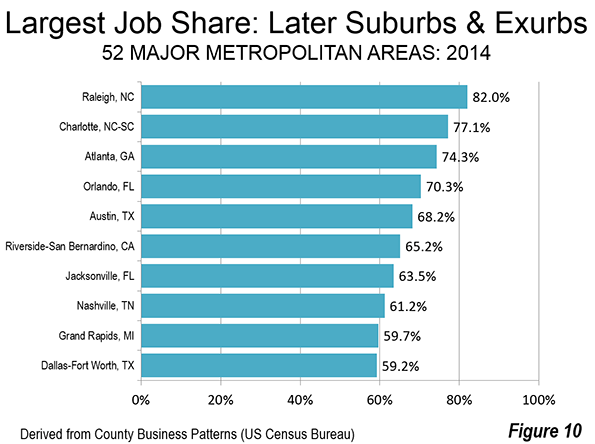
An analysis at New Geography shows the metropolitan locations of American jobs:

The 2014 data indicates that more than 80 percent of employment in the nation’s major metropolitan areas is in functionally suburban or exurban areas (Figure 3). The earlier suburbs have the largest share of employment, at 44 percent. The later suburbs and exurbs combined have 37.0 percent, while the urban cores have 18.9 percent, including the 9.1 percent in the downtown areas (central business districts, or CBDs).

These numbers reveal dispersion since 2000. Then, the earlier suburbs had even more of the jobs, at 49.4 percent, 5.3 percentage points higher than in 2014. Virtually all of the lost share of jobs in the earlier suburbs was transferred to the later suburbs and exurbs, which combined grew from 31.4 percent in 2000 to 37.0 percent in 2014. The urban cores had 19.4 percent of the jobs (8.8 percent in the CBDs), slightly more than the 18.9 percent in 2014.

While Chicago is one of the cities with a higher percentage of jobs in the city, Sun Belt locations dominate the list of cities with more jobs in outer suburbs:

These figures counter claims or stereotypes that (1) suburbs are primarily bedroom communities where people sleep but work in the city and (2) urban cores are the primary job centers of metropolitan regions. Of course, some suburbs are bedroom suburbs and big city downtowns are still important, particularly for certain industries (think global finance). At the same time, it would be interesting to envision some of these Sun Belt cities with no downtown…how different would Raleigh or Atlanta or Orlando really be?

Renaming the Willis Tower and John Hancock buildings

Chicagoans may have to soon adjust to two new names for skyline fixtures:

Sneed hears the Willis Tower, the crown jewel of skyscrapers, is currently the subject of negotiation for naming rights.

Meanwhile, Sneed is told a name change at the John Hancock Center may be imminent…

“Selling naming rights for buildings not occupied by the company that’s named is a new phenomenon and it’s something our ordinances don’t really address,” said Ald. Brian Hopkins (2nd), who has ordered a study by the Commission on Chicago Landmarks Department to determine whether the building qualifies for landmarking status — which restricts building modifications to respect historical integrity.

Even if the names officially change, it will take a significant amount of time for the everyday use of the new titles to change. The buildings are privately owned and yet they have clearly been symbols of Chicago for decades. That the naming rights could change every few years – dependent on the global real estate market – is an odd phenomenon for structures that serve as public markers.

In the long run, perhaps this is why we need non-company names for buildings. Think the Empire State Building or the Gherkin. Firms can move in and out and the name and symbol stays the same. I’m not sure what the Chicago buildings would be named in such a scheme. The Sears/Willis/?? Tower could be the “Stack of Rectangles Tower” and the Hancock could be the “X Support Building.”