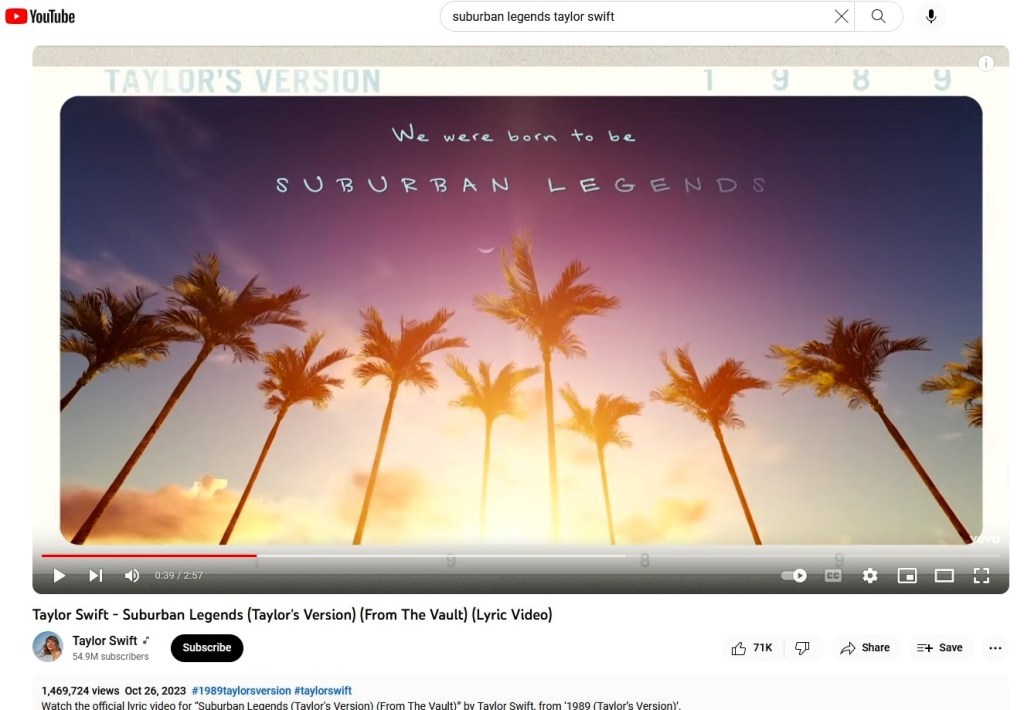
On her latest release, 1989 (Taylor’s Release), Taylor Swift has a new song involving suburban life:
Here are the lyrics from the second time through the chorus:
I didn’t come here to make friends We were born to be suburban legends When you hold me, it holds me together And you kiss me in a way that’s gonna screw me up forever I know that you still remember We were born to be national treasures When you told me we’d get back together And you kissed me in a way that’s gonna screw me up forever
The song describes an ill-fated suburban romance. The main character imagines walking into a high school reunion and surprising former classmates with the person they are with.
What exactly makes the song suburban? This is less clear. A powerful romance that ends in heartbreak and wistfulness could take place in a number of American settings, including suburbs. Is this connected to suburban youth? It is about suburbanites looking back on a more exciting time of life? Does a flashy young romance in a suburb make them suburban legends?
Given that more than 50% of Americans live in suburbs, perhaps there are many people who could identify with these sentiments and certainly plenty of suburbanites who like Taylor Swift.
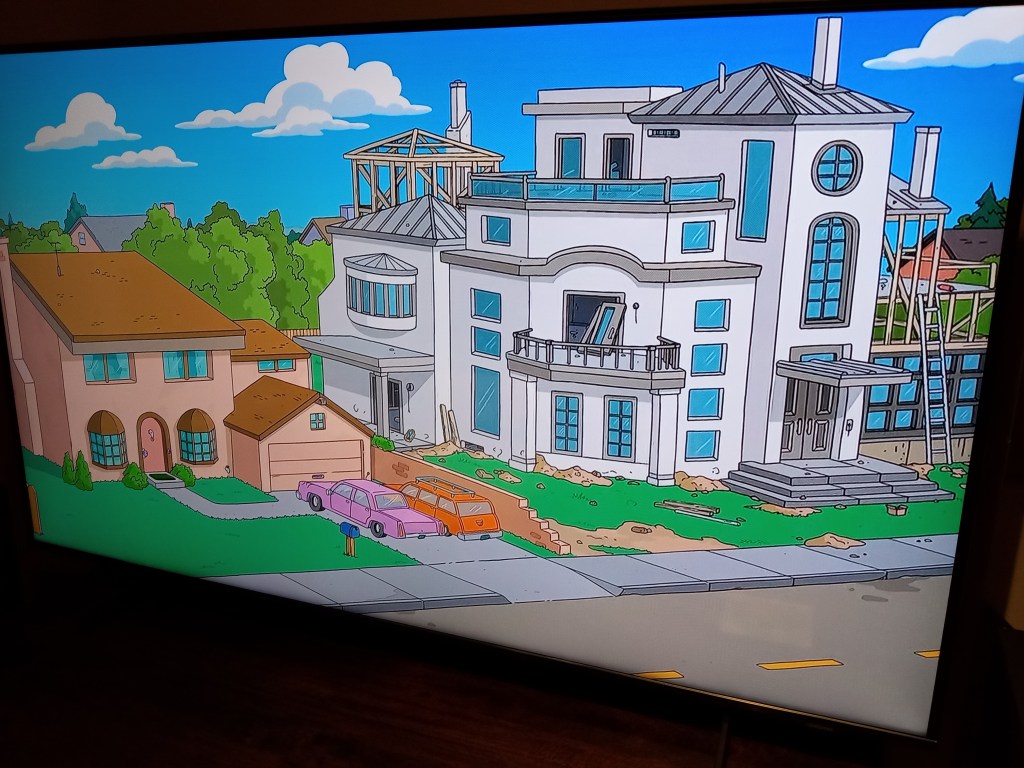
The Simpsons have new neighbors in Season 35 episode 3, “McMansion and Wife.” They get to know each other and enjoy spending time together. But, then the neighbors go from a modest home to a teardown McMansion:
As the new home is under construction, it is called a “reno” and then a “do-over.” Then it turns into a giant home. By my count, the teardown is 3-4 stories, is much bigger in terms of square feet and height as it towers over the Simpsons’ home, and has a mishmash of architectural features. The Simpsons live in a modest suburban home by today’s standards.
This story of a teardown McMansion within an established neighborhood is a common story across the United States. The new home can be considered disruptive by some neighbors even as others might defend the ability of property owners to do what they wish with their home and land and benefit from those changes.
One possible twist this episode briefly explores is the relationship between neighbors in these positions. Can they be friends? Can someone moving into a neighborhood build relationships and soften the blow of tearing down a house and constructing something much bigger on the same spot? Or, do teardowns usually lead to conflict between neighbors?
Spirits are high in Naperville from apparitions including deceased janitor “Yellow Boots” who supposedly lives in North Central College’s Pfeiffer Hall and lovers Charles Hillegas and Jessie Robateene who are said to roam the historic area…
A heartbroken Hillegas horrified the town by digging up Robateene’s grave at Naperville Cemetery in hopes of reviving her with a potion. Franz said he learned about the romance from the deceased couple themselves. With help from a specialized recorder, “they were very talkative and told us the whole story,” he said…
Shoe Factory Road
The scenic route in Hoffman Estates once housed the historical Charles Lindbergh Schoolhouse, purported to be haunted although that could be pegged to teenagers who rendezvoused there. Also adding to the road’s mystique is an unsolved triple murder at a farmhouse where Earl Teets, his wife Elizabeth, and their son Gary were found shot to death in 1979…
Both the Woodstock Opera House and the Genesee Theatre in Waukegan are known for supposed paranormal drama. In Woodstock, it’s “Elvira,” a performer who leapt from the opera’s tower when she didn’t get a part and now is said to sit in the audience. Meanwhile, the Genesee celebrates its spookiness, which includes disembodied barking, with an annual “Ghost Wauk.”
Could such stories help suburbanites recognize the good things in their communities? Supernatural happenings could be destabilizing but they may also serve residents in that they could be reminded that these things typically do not happen.
How might an enterprising suburb or organization capitalize on these supernatural sightings throughout the entire year? October is an obvious time to link these together. However, is there enough interest in the Chicago area to pursue this all year round?
Finally, I wonder how the number of stories told in the Chicago suburbs compares to other suburban areas in the United States. Are there certain metropolitan regions that have more supernatural happenings?
In the early years of the new millennium, internet theorists and tech startups were fixated on the long tail, the idea, popularized by a 2004 Wired article and subsequent book, that on-demand manufacturing and digital distribution would disrupt the winner-take-all logic of monopoly capitalism and allow businesses to profit by making a nigh-infinite variety of products available to any audience, no matter how small. You could sell one book to a million people, but you could also sell them a million different books, especially once you were freed from the storage constraints of a brick-and-mortar store. The problem is that this theory, that “the future of business is selling less of more,” turned out to be, at least in some cases, almost exactly wrong. Faced with the internet’s overwhelming range of choices, people retreat to the familiar, or flock to the latest TikTok trend. In a 2018 study, researchers found that increasing the number of available movies by a mere 1,000 titles decreased the market share occupied by the bottom 1 percent of DVDs—the ones the long-tail effect should benefit most—by more than 20 percent. Faced with even more options, people just gave up entirely. “When instead of 20,000 DVDs you can choose from 50,000 or 100,000 or 1 million,” the study’s co-author, Wharton professor Serguei Netessine, explained, “what happens is demand for all movies goes down.”…
Netflix won’t say how many movies are on the service at any given time, but estimates put it at fewer than 4,000, less than a hundredth of the vast universe it once provided. Where Netflix’s disc-by-mail service promised you could watch anything you wanted, its streaming incarnation merely promises that you’ll always be able to watch something. In the DVD era, Netflix’s queue would not only show you what was available but what wasn’t—if a disc ended up lost or damaged, the title would be grayed out and it would sink to the bottom of the page. But if a title on your list leaves the site, as dozens do every month, it just disappears: off of Netflix, out of mind. I rarely look at my list at all these days, but when I do, I’m vaguely annoyed that it’s full of things I’ve already watched, as if one time through Army of the Dead wasn’t enough. It’s no longer an agenda, something to be meticulously arranged and checked off one item at a time. (The cinephiles have Letterboxd for that now.) It’s just a pile of stuff.
When Hollywood’s legacy conglomerates launched their own streaming services in 2020, they followed Netflix’s initial model: one low price for a mountain of content. For less than $10 a month, you could access every movie Disney ever made, plus all the Marvels and NatGeo specials you could stuff your eyeballs with. Twice that, and HBO Max would serve up a vast trove of Hollywood history, from Batman to Casablanca, not to mention Game of Thrones and Friends. But they followed Netflix’s arc at an accelerated clip. Two and a half years after HBO Max launched, it started pulling down titles by the fistful, and six months later, Disney+ and Hulu followed suit. “This whole idea of warehousing content on Max, on a streaming platform, in retrospect is incomprehensible,” the CFO of HBO’s parent company, Warner Bros. Discovery, recently told investors. “A small percentage of titles really drives the vast majority of viewership and engagement.” Any title outside that small percentage is at risk of being removed, and while a movie or a TV show that went off the air might once have still been available on disc at your local video store, now, not even the people who create the content own their own copies.
The unchecked sluice of streaming can make it seem like you’ll never run out of things to watch, but that doesn’t mean you can watch anything you want to. When the director William Friedkin died last month, many people were unpleasantly surprised to find his cult favorite To Live and Die in L.A. unavailable to stream at any price, even as a digital rental or purchase. The movie is available on Blu-ray, but while Netflix once had a copy in its library of discs, they didn’t in August. (My local library, at least, does.) In the streaming era, we’ve come to accept such artistic lacunae as a way of life, and if To Live and Die in L.A. isn’t available, you can still watch The Exorcist and The French Connection—not to mention Sorcerer and Cruising and Killer Joe. How much William Friedkin does one person need, anyway?
This sounds like the ongoing issue facing the culture industries: how do they know what will be a hit and which products generate the most interest and money? In the world of movies, TV shows, books, music, and similar media, it is hard to know what viewers, readers, and consumers might find worth their time. Thus, these industries produce hundreds and thousands of options each year. A small group will generate a lot of money and help make the rest of the production possible.
Netflix offered a different possibility: the ability to profit from the edges of the catalog. By being the place where movie viewers could find particular options, they could offer a unique product. Other Internet-based companies, such as Amazon, could offer similar opportunities.
But it sounds like Netflix does not think it profits enough from the long tail. The goal is to make a smaller catalog available and focus on finding the big hits. If this is the plan moving forward, the culture industries continue on a long term path: try to crack the code on what becomes a hit and funnel resources to similar products.
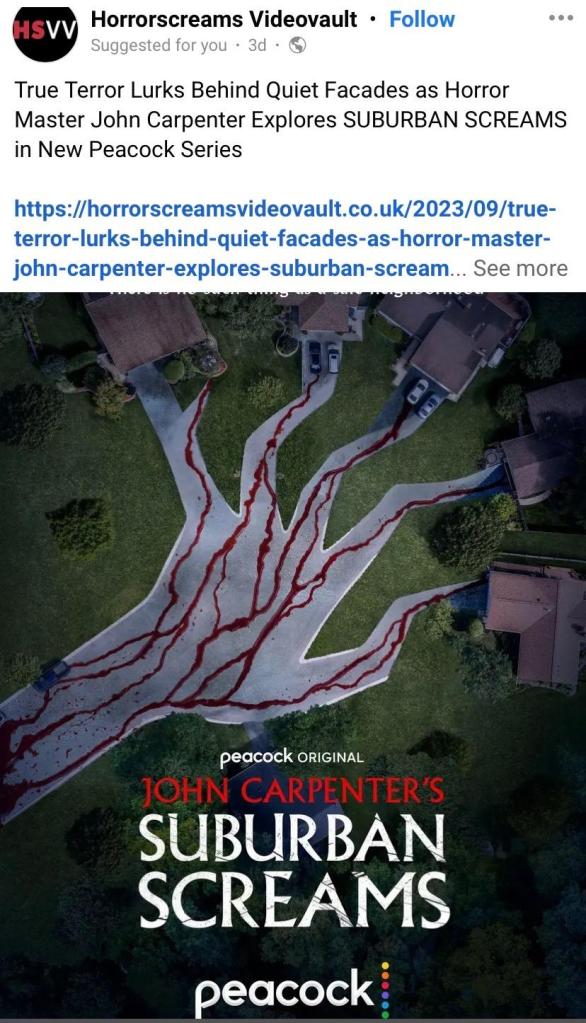
It is an evocative image: the pleasant suburban cul-de-sac has been replaced by a street and driveways shaped like a hand with blood flowing from the homes.
Here is a description of the show from the Peacock website:
Peacock has shared the official trailer for John Carpenter’s Suburban Screams, a six-episode horror anthology series from the mind of the legendary namesake director, writer, and producer, exploring true tales of terror in suburbia.
Each episode will delve into the monstrous evil that lurks beneath the surface of friendly suburbia through the lens of one frightful tale. In addition to firsthand accounts, the episodes will include cinematic reenactments, personal archives, and historic town press coverage.
Many cultural products in the last one hundred or so years have endeavored to tell the dark truths of suburbia. Behind the smiling nuclear family or the facade of the new suburban single-family home are less desirable practices and relationships. These stories suggest the suburbs put on a particular face but they are actually something else.
Placing horror in the middle of the suburbs builds on this. Not only might viewers or readers want to learn about the dirtier parts of suburbia; they might want scares and terror.
“Terror” is not typically a term used to describe the suburbs nor is the idea of “monstrous evil.” But that both are “lurking beneath the surface of friendly suburbia” continues an ongoing narrative that the suburbs are not what they seem.
A new generation of women is discovering the midcentury look, albeit for wildly varying reasons. Perhaps most divisively, there’s the “trad wife” movement, an online community of traditional women whose retro fashion reflects their religious, conservative and even sometimes far-right values. Then there are women who profess “vintage style, not vintage values,” combining hourglass silhouettes with a progressive worldview. And then there are those women and designers who just happen to appreciate the bygone charm of a swirly skirt…
The contemporary interpretations of 1950s fashion run the gamut from a sprinkle of yesteryear—winged eyeliner, a Grace Kelly headscarf, cat-eye sunglasses—to full-on June Cleaver dress-up. Fans of the look share makeup tutorials and life philosophies on TikTok. On
Pinterest, the somewhat disturbing tag “Stepford wife” includes images of Nicole Kidman in the spooky 2004 remake alongside black-and-white photos of women vacuuming. On Etsy, a gateway to the style, vintage hounds source period pieces, as well as replicas from purveyors like “Hearts and Found” and “Son de Flor.”
The 1950s housewife look isn’t limited to online rabbit roles and vintage shops. It’s also bleeding into high-end runway fashion. Prada has long made ladylike pieces like full skirts, capri pants and fitted sweaters cornerstones of its line, and Dior’s fall 2023 collection played up the house’s heritage of hourglass shapes.
Missing from this discussion is any explicit mention of the suburbs. The suburban lifestyle of the 1950s was a particular one. Even as it suggested middle-class success, it was not home to all nor offered equality. The country was relatively prosperous. The examples of fashion images from the era hint at the suburbs, whether it is Leave it to Beaver or I Love Lucy (two shows part of a study I published on TV shows set in the suburbs) or The Stepford Wives or Barbie (who has a dreamhouse).
The suburbs have an ongoing legacy that plays out in all sorts of contemporary issues and conversations. That it should be part of fashion should not be a surprise, even if it may not appear obvious to start.
Mattie Parker, the mayor of Fort Worth, Texas, says a focus on crime, homelessness, parks and reliable infrastructure has positioned the city of 950,000 as an attractive alternative to Chicago, San Francisco and New York, which have struggled with perceptions of deteriorating safety in the aftermath of Covid-19.
The 39-year-old Republican, broadly considered to be a moderate in deep-red Texas, says that Fort Worth’s pitch to lure businesses highlights its roots (the city’s slogan is “Where the West Begins”) and small-town vibes, even if its stockyards are now more of a tourist draw than a genuine agricultural enterprise. The nostalgia for cattle ranching and cowboys generated by the hit television series Yellowstone and 1923 — created by Taylor Sheridan, who partly grew up in Fort Worth — are only adding to its allure.
“Fort Worth continues to be an incredibly unique city that is very proud of our Western heritage,” Parker said in an interview at City Hall, where a display case held shovels from groundbreaking ceremonies over the years. “And the timing couldn’t be better because of this fanfare and frenzy over Yellowstone and 1923.”
In Fort Worth, it’s common to see cowboy hats and boots paired with a tailored suit. Unlike nearby Dallas, which mostly feels like any other major metropolis, Fort Worth embraces its sense of place. There’s plenty of live country music, two-step dancing and Tex-Mex cuisine.
This is a long list of reasons for growth. Additionally, Fort Worth is part of the growing Sun Belt.
I would be very interested in seeing some data regarding the connection between a popular television universe and population growth in a particular city. Are these shows also causing population growth in Montana? It makes sense for a local leader to make the connection to a show people like as it is always helpful to have good press.
The Bewitched update would focus on Tabitha Stevens, the 13-year-old daughter of witch Samantha and human Darrin. She juggles two lives attending middle school while also being secretly enrolled in a magical academy run by her grandmother, Endora — D’Ambrosia describes the premise as “Hannah Montana meets Harry Potter.”
Will the new Bewitched also include any of suburbia or will it primarily focus on schools? Interestingly, the two comparison TV shows mentioned above also include suburban settings. Hannah Montana was primarily set in Malibu, California while Harry Potter included scenes in and around the Dursley’s house on Privet Drive.
If the new version does include the suburbs, there is an opportunity for the suburbia depicted to look quite different than that of the 1960s. The suburbia often depicted on television then often portrayed nuclear family life in single-family homes on quiet streets. The suburbs today are more complex, diverse, and varied. There is an opportunity here to depict not only updated characters and storylines but also settings.
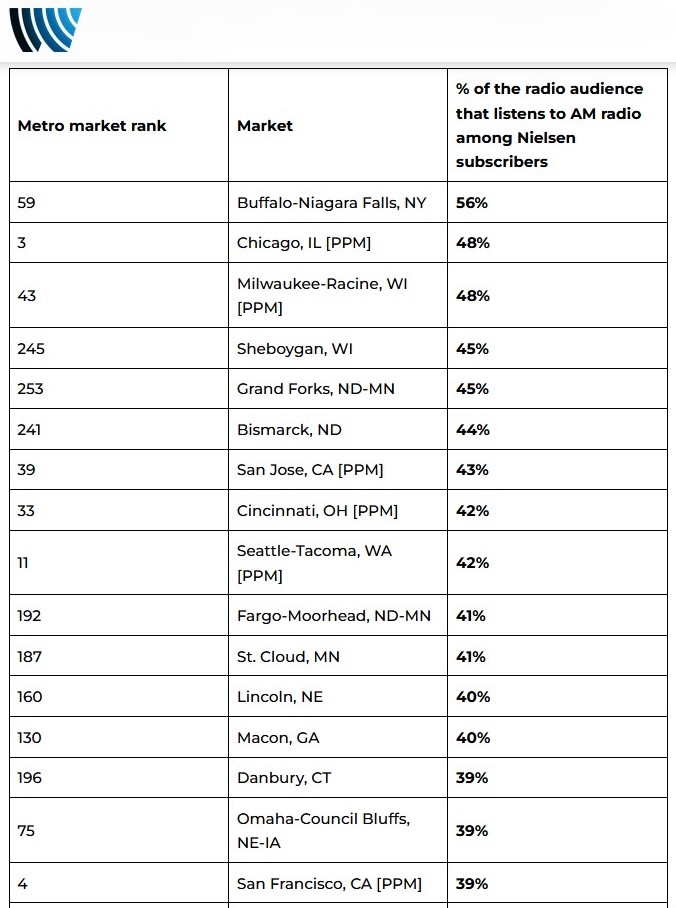
The top six cities on the list are Midwest cities (including Buffalo on the western edge of New York). In this list, the first city in the West is San Jose at #7, the first city in the South is Macon, Georgia at #13, and the first Northeast city is Danbury, Connecticut at #14.
I do not know if these differences are statistically significant but it is interesting to consider why Midwest metropolitan areas might lean toward AM radio. A few possibilities:
-A long history of important AM stations.
-Is the Midwest less dense compared to some other parts of the country or Midwest people do further drives and AM’s longer signal keeps them connected?
-Radio stations on FM or AM in different areas provide different content. Is this linked to more or less interest in music, news, sports, talk, or other content?
-Are there are other lifestyle markers of Midwesterners that are somehow linked to AM radio?
Of the top 20 radio markets in the country, I think only the Washington, D.C. area is not on this list with at least 20% of listeners tuning into AM radio. What are people in DC listening to?
Specifically, it has everything to do with LKFS, which stands for “Loudness, K-weighted, relative to full scale” and which, for the sake of simplicity, is a unit for measuring loudness. Traditionally it’s been anchored to the dialogue. For years, going back to the golden age of broadcast television and into the pay-cable era, audio engineers had to deliver sound levels within an industry-standard LKFS, or their work would get kicked back to them. That all changed when streaming companies seized control of the industry, a period of time that rather neatly matches Game of Thrones’ run on HBO. According to Blank, Game of Thrones sounded fantastic for years, and she’s got the Emmys to prove it. Then, in 2018, just prior to the show’s final season, AT&T bought HBO’s parent company and overlaid its own uniform loudness spec, which was flatter and simpler to scale across a large library of content. But it was also, crucially, un-anchored to the dialogue.
“So instead of this algorithm analyzing the loudness of the dialogue coming out of people’s mouths,” Blank explained to me, “it analyzes the whole show as loudness. So if you have a loud music cue, that’s gonna be your loud point. And then, when the dialogue comes, you can’t hear it.” Blank remembers noticing the difference from the moment AT&T took the reins at Time Warner; overnight, she said, HBO’s sound went from best-in-class to worst. During the last season of Game of Thrones, she said, “we had to beg [AT&T] to keep our old spec every single time we delivered an episode.” (Because AT&T spun off HBO’s parent company in 2022, a spokesperson for AT&T said they weren’t able to comment on the matter.)
Netflix still uses a dialogue-anchor spec, she said, which is why shows on Netflix sound (to her) noticeably crisper and clearer: “If you watch a Netflix show now and then immediately you turn on an HBO show, you’re gonna have to raise your volume.” Amazon Prime Video’s spec, meanwhile, “is pretty gnarly.” But what really galls her about Amazon is its new “dialogue boost” function, which viewers can select to “increase the volume of dialogue relative to background music and effects.” In other words, she said, it purports to fix a problem of Amazon’s own creation. Instead, she suggested, “why don’t you just air it the way we mixed it?”
This change in how television audio works contributes to needing subtitles to understand what is being said.
I wonder if the bigger question is whether this significantly changes how people consume and are affected by television. If we are reading more dialogue and descriptions, does this focus our attention on certain aspects of shows and not others? Could this be good for reading overall? Does it limit the ability of viewers to multitask if they need to keep up with the words on the screen? Do subtitles help engage the attention of viewers? Do I understand new things I did notice before in the world with fewer subtitles? Does a story or scene stick with me longer because I was reading the dialogue?
Does this also mean that as Americans have been able to buy bigger and bigger TVs for cheaper prices, they are getting a worse audio experience?




 Legally Sociable