Will a new Bewitched TV show be set in a similar looking suburbia?

A new Bewitched show is in the works:

Photo by Burak The Weekender on Pexels.com

The Bewitched update would focus on Tabitha Stevens, the 13-year-old daughter of witch Samantha and human Darrin. She juggles two lives attending middle school while also being secretly enrolled in a magical academy run by her grandmother, Endora — D’Ambrosia describes the premise as “Hannah Montana meets Harry Potter.”

The only mention of the setting of the show involves school settings: a middle school and a magical academy. The original Bewitched, a very popular show in the 1960s, was set in the suburbs of New York City. Samantha stayed at home while Darrin worked in the city. They live in a single-family home. They had a nosy neighbor. They have children.

Will the new Bewitched also include any of suburbia or will it primarily focus on schools? Interestingly, the two comparison TV shows mentioned above also include suburban settings. Hannah Montana was primarily set in Malibu, California while Harry Potter included scenes in and around the Dursley’s house on Privet Drive.

If the new version does include the suburbs, there is an opportunity for the suburbia depicted to look quite different than that of the 1960s. The suburbia often depicted on television then often portrayed nuclear family life in single-family homes on quiet streets. The suburbs today are more complex, diverse, and varied. There is an opportunity here to depict not only updated characters and storylines but also settings.

Midwest cities lead the way in % of AM radio listeners

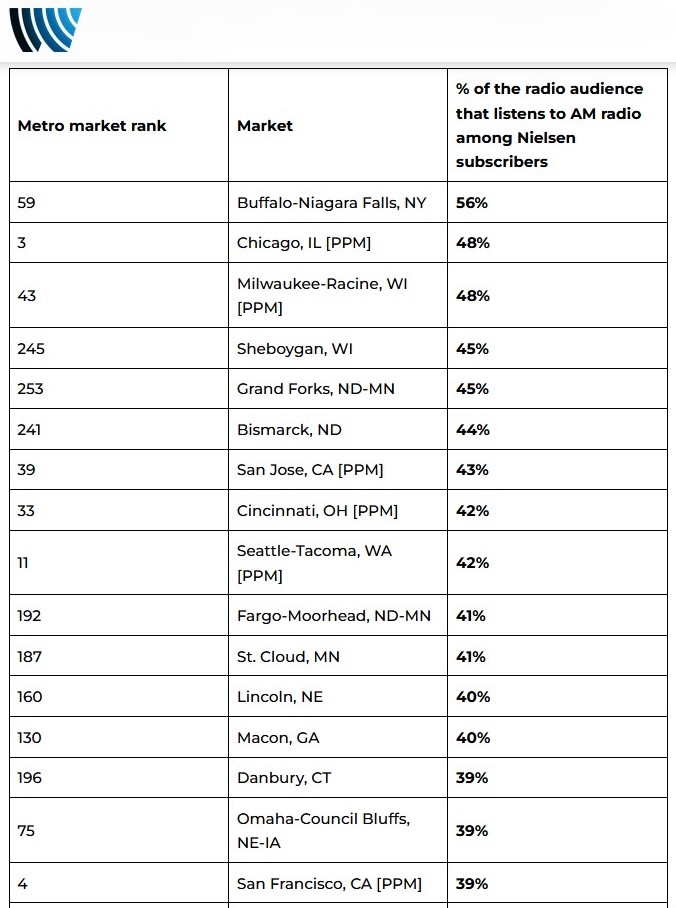
A recent look at “the % of the metro radio audience that listens to AM radio in a month” shows these cities at the top:

The top six cities on the list are Midwest cities (including Buffalo on the western edge of New York). In this list, the first city in the West is San Jose at #7, the first city in the South is Macon, Georgia at #13, and the first Northeast city is Danbury, Connecticut at #14.

I do not know if these differences are statistically significant but it is interesting to consider why Midwest metropolitan areas might lean toward AM radio. A few possibilities:

-A long history of important AM stations.

-Is the Midwest less dense compared to some other parts of the country or Midwest people do further drives and AM’s longer signal keeps them connected?

-Radio stations on FM or AM in different areas provide different content. Is this linked to more or less interest in music, news, sports, talk, or other content?

-Are there are other lifestyle markers of Midwesterners that are somehow linked to AM radio?

Of the top 20 radio markets in the country, I think only the Washington, D.C. area is not on this list with at least 20% of listeners tuning into AM radio. What are people in DC listening to?

Audio algorithms and how we watch (and read) TV

More people use subtitles with TV shows because algorithms for audio have changed:

Photo by Nothing Ahead on Pexels.com

Specifically, it has everything to do with LKFS, which stands for “Loudness, K-weighted, relative to full scale” and which, for the sake of simplicity, is a unit for measuring loudness. Traditionally it’s been anchored to the dialogue. For years, going back to the golden age of broadcast television and into the pay-cable era, audio engineers had to deliver sound levels within an industry-standard LKFS, or their work would get kicked back to them. That all changed when streaming companies seized control of the industry, a period of time that rather neatly matches Game of Thrones’ run on HBO. According to Blank, Game of Thrones sounded fantastic for years, and she’s got the Emmys to prove it. Then, in 2018, just prior to the show’s final season, AT&T bought HBO’s parent company and overlaid its own uniform loudness spec, which was flatter and simpler to scale across a large library of content. But it was also, crucially, un-anchored to the dialogue.

“So instead of this algorithm analyzing the loudness of the dialogue coming out of people’s mouths,” Blank explained to me, “it analyzes the whole show as loudness. So if you have a loud music cue, that’s gonna be your loud point. And then, when the dialogue comes, you can’t hear it.” Blank remembers noticing the difference from the moment AT&T took the reins at Time Warner; overnight, she said, HBO’s sound went from best-in-class to worst. During the last season of Game of Thrones, she said, “we had to beg [AT&T] to keep our old spec every single time we delivered an episode.” (Because AT&T spun off HBO’s parent company in 2022, a spokesperson for AT&T said they weren’t able to comment on the matter.)

Netflix still uses a dialogue-anchor spec, she said, which is why shows on Netflix sound (to her) noticeably crisper and clearer: “If you watch a Netflix show now and then immediately you turn on an HBO show, you’re gonna have to raise your volume.” Amazon Prime Video’s spec, meanwhile, “is pretty gnarly.” But what really galls her about Amazon is its new “dialogue boost” function, which viewers can select to “increase the volume of dialogue relative to background music and effects.” In other words, she said, it purports to fix a problem of Amazon’s own creation. Instead, she suggested, “why don’t you just air it the way we mixed it?”

This change in how television audio works contributes to needing subtitles to understand what is being said.

I wonder if the bigger question is whether this significantly changes how people consume and are affected by television. If we are reading more dialogue and descriptions, does this focus our attention on certain aspects of shows and not others? Could this be good for reading overall? Does it limit the ability of viewers to multitask if they need to keep up with the words on the screen? Do subtitles help engage the attention of viewers? Do I understand new things I did notice before in the world with fewer subtitles? Does a story or scene stick with me longer because I was reading the dialogue?

Does this also mean that as Americans have been able to buy bigger and bigger TVs for cheaper prices, they are getting a worse audio experience?

The McMansion riches of ’80s TV versus the massive dwellings of today’s Succession

TV depictions of what constitutes a house for the wealthy can change over time:

Photo by Pixabay on Pexels.com

And if the “Succession” audience is smaller, the money is, pointedly, bigger. Rewatched in 2023, the idea of luxury in “Dallas” looks quaint, almost dowdy. The aesthetic is Texan country club; the Ewing homestead, the size of a decent suburban McMansion, is a toolshed next to the Manhattan aeries, Hamptons manors and Italian villas that the Roys flitter among.

Some of this is a matter of modern premium-cable budgets vs. the grind of old-school network-TV production, of course. But it also reflects the changed, distorting nature of modern riches. In 1980, American wealth inequality was still near its postwar lows. Since then, the wealth of the top .01 percent has grown at a rate roughly five times as much as that of the population overall. Today, the very rich are very, very, very richer.

The holdings of Waystar Royco — Hollywood studios, cruise lines, newspapers, amusement parks, a king-making right-wing news channel — make Ewing Oil look like a franchise gas station. We know only vaguely how Logan Roy built his empire, but it was enabled partly by the media-consolidation and antitrust deregulation, beginning in the “Dallas”/Reagan era, that allowed his real-life analogues like Rupert Murdoch to make their own piles.

American homes do broadcast messages about a resident’s status and wealth. McMansions are supposed to signal that the owner can afford a big home in a particular style (even if the imitation of traditional styles are odd).

On the other hand, mansions are even bigger, more extravagant, and can be of better build quality. Having multiple such dwellings extends far beyond the McMansion owner in the suburbs.

Another question: do the super wealthy make use of all that square footage and the features or are these part of a real estate investment? The McMansion owner is also hoping to get a return on their investment but the amount of money involved with extra-large properties is at another level.

Courtesy of Architectural Digest, see more about some of Succession’s dwellings here.

The Brady Bunch house as “the second most photographed home in America”

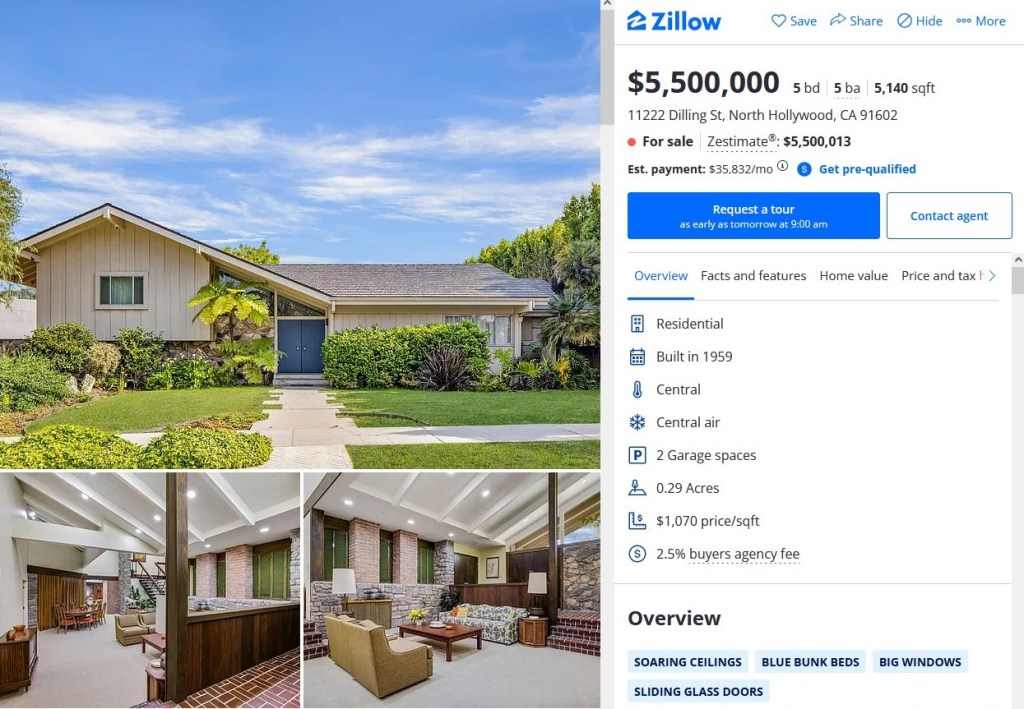
The house featured on the Brady Bunch is up for sale again. Apparently, many people have photographed the home:

The Brady Bunch only lasted five seasons, but its cultural footprint has endured. The ABC comedy — which followed a blended family of eight, their live-in maid and, at certain points, a dog — ran from 1969 through 1974 before inspiring TV movies, a satirical feature remake (and sequel) and countless pilgrimages to 11222 Dilling Street. It has been called the second most-photographed home in America, trailing only the White House, though there is little evidence to back up such claims. 

I am sure someone could try to quantify this. Scan through all of the pictures on the Internet including photo upload sites? Perhaps measure the number of visitors each year to different houses and estimate how many pictures they might take?

A better question to ask might be this particular house is so popular for pictures. It is tied to a popular TV show, it is accessible to the public who can see the home from the street, it is located within the second largest metropolitan area in the United States, and there are a lot of tourists in the area. Still, it is a home built in 1959 that looks rather unremarkable from the outside. This might be a story about (1) the power of TV in American culture and (2) the importance of TV in this particular era of suburbia and Baby Boomers.

I wonder if any other TV shows would be in a top 10 of photographed homes in the United States.

(See earlier posts about the Brady Bunch house: a 2018 post about HGTV owning the home and a 2012 post about comparing the exterior and interior of the homes.)

Is the current era all about more interesting circuses vying for our attention?

A profile of the latest ventures of former footballer Gerard Piqué ends with this:

Photo by sergio souza on Pexels.com

That, perhaps, is the point that all those critics who dismissed the Kings League have missed. It may well be a circus. But Piqué might respond that there is nothing wrong with being a circus. Circuses are popular. They draw a crowd, they hold the gaze, because nobody is ever quite sure what is coming next.

While the circus itself has passed peak popularity in the United States, the argument above appears to have some merit: the average resident of society today is presented with a vast array of circuses. Some are free, some are not. They come through various media forms. They all promise to try to entertain or engross you. Novelty and spectacle are key. The speed at which it all happens is new as is the number of options.

What does this do to the potential viewers? Does it enhance their lives in the long run? Do people want their lives dominated by circuses or would they rather invest in longer-term pursuits, relationships, and community life?

The example above presents a modified form of soccer/football with its own twists. Fans of the regular game plus others interested in a fast-moving and entertaining time can tune in or attend. How long does this last?

Why we play Simcity and not Sim Nimby

A game released earlier this year accounts for the NIMBY behavior of city dwellers:

Photo by Buro Millennial on Pexels.com

Imagine an even-simpler version of the original late-’80s “SimCity” video game: a crude digital map dotted with a handful of pixelated single-family houses. But try to click on the screen — like, say, on the icon of a bulldozer or a factory, or just anything — so you can start laying out commercial blocks and parks and creating your pretend metropolis, which is the objective of most city-building sims, and you’ll be met with a jarring sound effect and a pop-up message: “ERROR. CAN’T BUILD IN NIMBYVILLE.”

Below that is one of many snarky excuses: “Housing is a human right! Just why does it have to be here?”

Such are the Sisyphean pleasures of “Sim Nimby,” a new desktop city-building game where more clicks just lead to more error messages, and nothing ever gets built. The only winners in Nimbyville are the ones programmed to prevail: Not In My Backyard neighbors, or NIMBYs, who block new housing developments at every turn…

So Nass and Weeks hunkered down in a Park Slope bar one evening and hashed out the litany of anti-development NIMBY-isms — more than 50 in total — that the game spits back at prospective builders as a jazzy 8-bit music theme plays. There’s some comic hyperbole at the expense of preservationists (“We can’t tear down that historic brownstone. It’s where Gene Quintano wrote ‘Police Academy 3: Back in Training’”) and some dad-joke-grade gags (“The only thing urban I want to see here is Keith Urban”). Other one-liners — “This is a NICE neighborhood,” “Will someone please think of the property values?” and “Affordable housing? What, you gonna build them an affordable country club too?” — are perhaps less fanciful to housing advocates.

How realistic should city building games be? I have wondered this for years starting with playing Simcity in the late 1980s. How much does the game reflect actual city planing practices and urban outcomes versus presenting a glamorized experience where it is easy to plop in properties, development happens easily, and issues are quickly addressed (as long as the player has enough money and a little bit of sense). Overall, it is pretty easy to build a thriving city.

This version might be too realistic. Players of video games want some level of difficulty or obstacles to overcome but not ever-present problems that make it difficult to do anything. Random disaster? Okay, a player can deal with that. A never-ending chorus of NIMBY concerns? It is too much to handle. The concerns of residents in Simcity are usually addressable; for example, move the residence further from industry, quickly put a park nearby to quiet the criticism, or find another way to improve the quality of life.

I do not know if the player gets some extreme options to address the NIMBY concerns. Have them annex themselves into their own community and build in a neighboring community? Remove all of the residences via eminent domain? Wage a political battle against them? If this is a Simcity where the residents do not want anything new, then growth is not possible and that does not work even in video games.

Asking again: did Kevin McCallister live in a McMansion!?

An overview of movies where Santa is the bad guy included this aside about Home Alone:

Photo by Irina Iriser on Pexels.com

The 1989 film (which is about a boy setting booby traps in his mansion on Christmas Eve to stop a killer Santa) earned a small measure of fame when its creators sued the makers of Home Alone (which is about a boy setting booby traps in his McMansion on Christmas Eve to stop some robbers) for the similarities between the two.

Is the Winnetka, Illinois home a McMansion or a mansion? Several pieces of evidence for the latter:

Atlas Obscura calls it a mansion and says, “Built in the 1920s, the building is comprised of red brick and was built in the colonial Georgian style.” It is hard to call a home as old as this as a McMansion. Additionally, it is built in a classic style, not imitating a classic style.

According to Zillow, the home has 5,398 square feet, 6 bedrooms, and 6 bathrooms. It is worth over $2 million. While the home size is in McMansion territory, that price is not.

-Did director John Hughes have a thing for suburban McMansions? This discussion in reddit.com/r/McMansionHell suggests no.

For more discuss, see my 2019 post.

Bonus information: according to Tripadvisor, seeing this home is the #1 thing to do in Winnetka.

Filming a wealthy home exterior, McMansion interior

A film production designer describes the problem of finding a home for filming:

Photo by Mark McCammon on Pexels.com

We were looking for the Voze mansion and having trouble finding an exterior and interior to match, as most wealthy estate-type people heavily renovate their interiors and look more McMansion inside. The exterior was a house in Pasadena.

I think this is saying that they had a problem finding a home fit for wealthy characters because the homes with the gravitas-invoking exterior did not necessarily have the same kind of interior. Having lots of money can be associated with a particular aesthetic. Describing a portion of the home as having a McMansion look is not usually a good thing. It is a negative term. I imagine a McMansion interior could involve the latest trends, having large spaces, and going for shock and awe rather than refined details.

Through the magic of filming and editing, a different exterior and interior can be put together without too much evidence otherwise. Of course, it is also fun to watch for situations where they do not exactly match.

Play Christmas music all day starting November 1 and ratings go up

The Chicago radio station WLIT starts their 24 hour a day Christmas music today because people and the ratings like it:

Photo by Dzenina Lukac on Pexels.com

WLIT-FM 93.9 will play only Christmas music round-the-clock beginning at 4 p.m. Tuesday.

It is the earliest date in the station’s 22 years of hosting the format that it is making the switch.

Why? Listeners love it…

“The reason stations switch in early November is so they can get a ratings boost for the final few weeks of the survey,” he wrote in an email.

Which comes first: the audience demand for the Christmas music or the supply of Christmas music? Would anyone play Christmas music this early if there was not such a direct payoff?

Such a question could be asked in all sorts of domains, ranging from other Christmas material – do stores put Christmas decorations and displays up right after Halloween to drive demand or is that demand already there? – to products of the culture industries. If such a question could be answered more predictably, there might be more hits – records, films, TV shows, etc. – and fewer flops.

In the meantime, Chicago radio listeners will later today have the option to hear Christmas music all the time. Even in an age of music streamable on demand plus all sorts of other music formats, at least a few will turn to WLIT because predictable Christmas music is available.